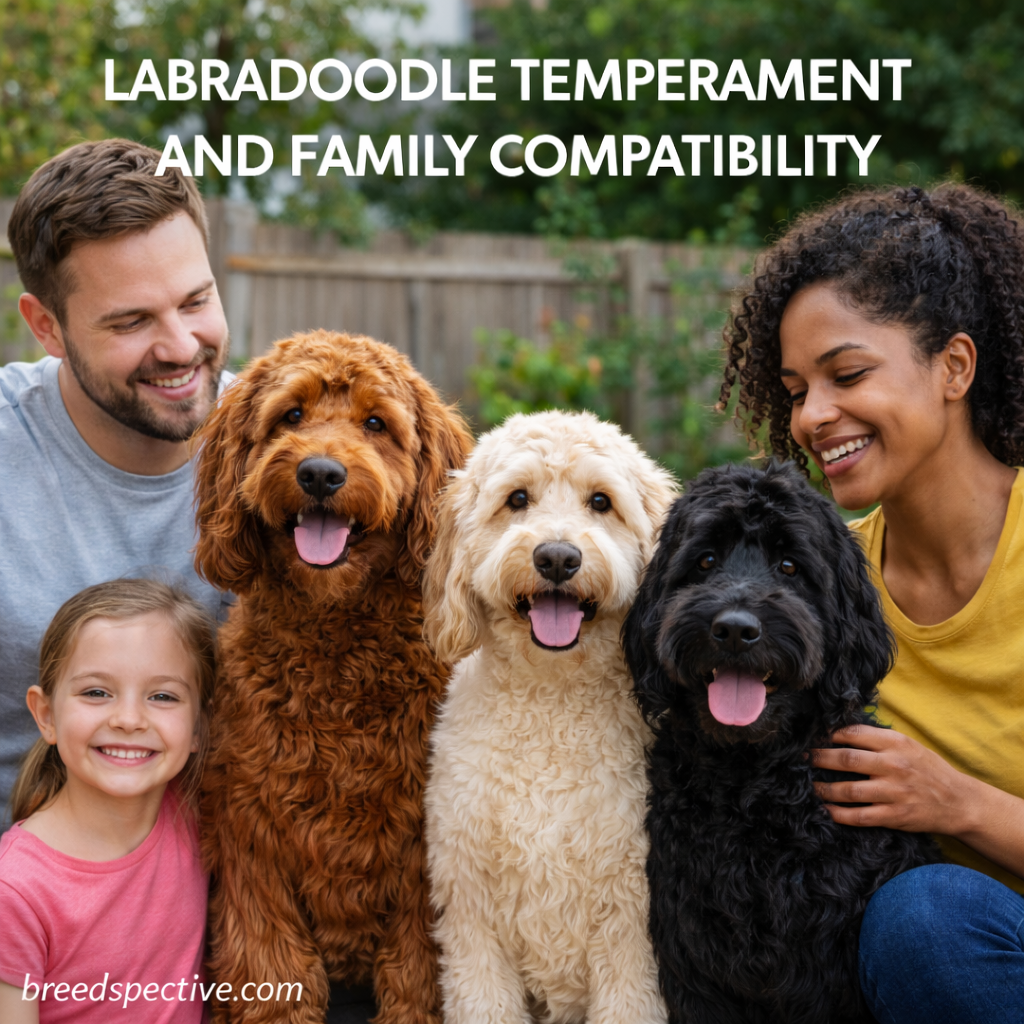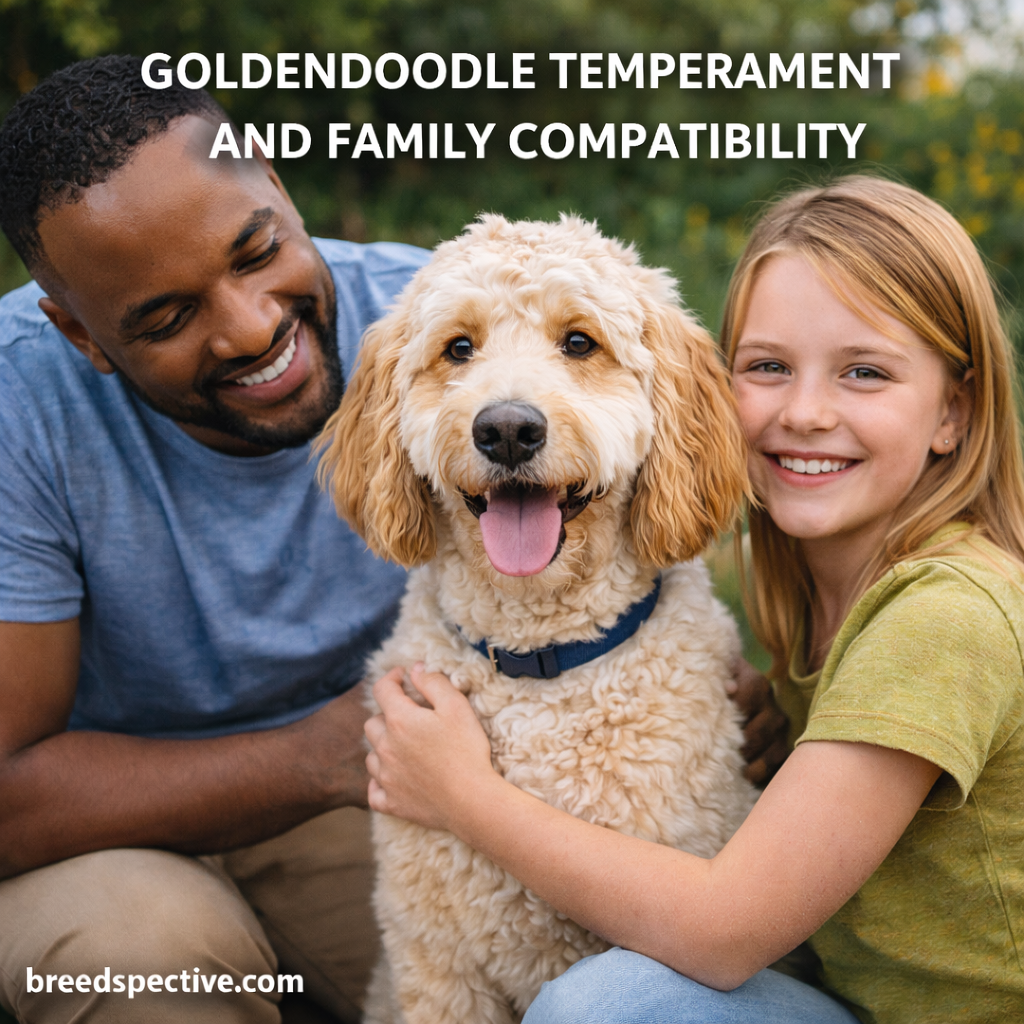
Goldendoodle temperament is typically social, affectionate, intelligent, playful, and strongly people-oriented, but individual dogs can vary considerably. A Goldendoodle combines Golden Retriever and Poodle ancestry, so prospective owners should expect an active companion that needs training, exercise, regular grooming, and substantial interaction rather than assuming every Goldendoodle will be a calm, non-shedding family dog.
Goldendoodles can be excellent companions for active families, including many households with children. Their popularity, however, has also produced a large commercial breeding market, making parent health testing, temperament, coat expectations, and breeder selection especially important.
Goldendoodle at a Glance
| Trait | Typical Goldendoodle |
|---|---|
| Parent breeds | Golden Retriever × Poodle |
| Size | Varies substantially according to Poodle parent and breeding |
| Coat | Straight, wavy or curly |
| Shedding | Variable; low shedding is possible but not guaranteed |
| Exercise needs | Moderate-high |
| Grooming | Moderate-high to very high |
| Trainability | Usually high |
| Good with children? | Often, with training and supervision |
| Good with other dogs? | Often |
| Good with cats? | Often possible with appropriate introductions |
| Alone-time tolerance | Variable; many are strongly people-oriented |
| Best fit | Active household wanting a social, trainable companion |
Because the Goldendoodle is a cross rather than an established standardized breed, there is no single guaranteed Goldendoodle size, coat, personality, or shedding level.
The American Kennel Club does not recognize the Goldendoodle as an AKC breed. Golden Retrievers and Poodles are recognized breeds with written standards and national parent clubs; the Goldendoodle is their cross.
Where Did the Goldendoodle Come From?
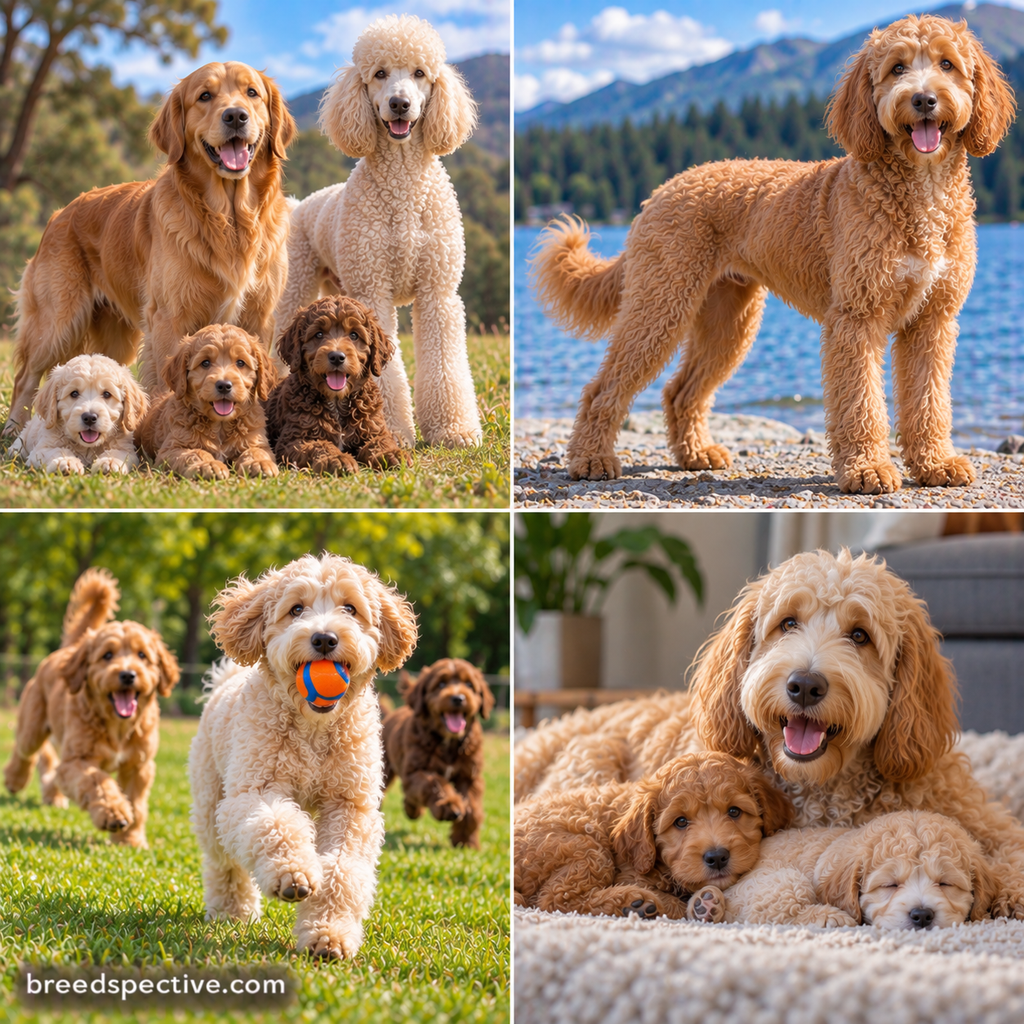
Goldendoodles became increasingly popular during the 1990s, following growing interest in the Labradoodle and the idea of combining Poodle coat characteristics with established companion and sporting breeds.
The two sides of the cross bring substantial working heritage.
Golden Retrievers were developed as sporting dogs capable of retrieving game, including from water. Modern Goldens remain active, social dogs with strong retrieving tendencies. Our guide to Golden Retriever temperament and lifestyle fit covers those characteristics in detail.
Poodles were also developed as water retrievers. Despite their elaborate show coats and reputation as elegant companion dogs, Poodles are athletic, highly intelligent working dogs. The Poodle Club of America’s standard describes the breed as “very active” and intelligent.
That heritage matters because crossing these breeds does not reliably produce a low-energy lap dog.
Our complete guide to Poodle temperament, energy level and lifestyle fit explains the other half of the cross.
Goldendoodle Temperament in Everyday Life
The appeal of the Goldendoodle is easy to understand.
Many combine an enthusiastic interest in people with considerable intelligence and playfulness. They often want to participate in whatever their household is doing rather than quietly occupying themselves for most of the day.
Social and People-Oriented
A well-socialized Goldendoodle may greet visitors enthusiastically, seek physical affection, follow family members through the house, and enjoy outings where it can participate with its people.
That friendliness can have a downside.
An adolescent Goldendoodle that has never learned greeting manners may jump onto visitors, pull toward strangers, or become overexcited whenever something interesting happens.
Start rewarding four paws on the floor during puppyhood.
Intelligent and Trainable
Both parent breeds are highly trainable, so many Goldendoodles learn quickly.
Use that intelligence constructively.
Useful early skills include:
- Recall
- Loose-leash walking
- Leave it and drop it
- Settling on a bed
- Polite greetings
- Cooperative grooming
- Waiting at doors
- Calm behavior around food
- Remaining alone for gradually increasing periods
Training should include calmness as well as tricks and obedience.
A clever dog that receives constant entertainment but never learns to switch off can become exhausting to live with.
Mouthiness and Carrying Objects
Retriever ancestry can appear as an enthusiasm for putting things in the mouth.
Puppies may steal socks, carry toys, retrieve objects repeatedly, or grab household items when excited.
Redirect rather than chase.
Teach “drop it” by trading for something worthwhile and provide appropriate objects the dog is allowed to carry.
Chasing a puppy around the house every time it steals a sock can turn theft into a highly rewarding game.
Jumping and Overexcitement
Friendly does not automatically mean calm.
Young Goldendoodles can be exuberant, particularly larger dogs that inherit substantial athleticism from both parents.
This matters around children and older adults.
Teach greeting manners before the dog reaches adult size. If jumping earns attention throughout puppyhood, the dog has little reason to understand why the same behavior suddenly becomes unacceptable at 50 or 60 pounds.
Are Goldendoodles Good Family Dogs?
They often can be, provided the household actually wants an involved, active dog.
Goldendoodles commonly appeal to families because both parent breeds were developed to cooperate with people. A well-socialized individual can enjoy children’s games, walks, training and general family activity.
For households specifically prioritizing child compatibility, our guide to dog breeds for families with young children covers the broader traits worth evaluating.
Goldendoodles and Children
Adult supervision still matters.
Teach children not to:
- Climb on the dog
- Pull its coat or ears
- Disturb it while sleeping
- Take food or chews
- Corner it
- Chase it when it wants to leave
Larger Goldendoodles can also knock over small children simply through enthusiastic play.
Temperament matters more than the “doodle” label. Ask breeders how they select for stable parent temperaments and how puppies are raised and socialized.
Goldendoodles and Other Pets
Many can live successfully with other dogs and cats, particularly with appropriate introductions.
Do not assume that crossing two retriever breeds removes chasing behavior. Individual dogs can differ substantially.
Introductions should be gradual, and smaller pets should not be left vulnerable simply because a puppy appears friendly.
Can Goldendoodles Be Left Alone?
Goldendoodles are frequently very people-oriented.
That does not mean every individual develops separation anxiety, but independence should be deliberately taught.
From puppyhood, practice:
- Resting away from family members
- Spending short periods behind a gate
- Settling in a safe puppy area
- Occupying themselves with appropriate enrichment
- Remaining calm when someone leaves the room
- Gradually increasing alone time
Do not create a routine in which someone is beside the puppy every minute and then abruptly expect it to tolerate an eight-hour absence.
Destruction caused by ordinary boredom is also different from separation anxiety. A dog that panics, attempts to escape, injures itself, or shows severe distress when alone deserves professional veterinary or behavioral assessment.
Goldendoodle Exercise Needs
Goldendoodles generally need moderate to moderately high daily activity.
For many healthy adults, approximately 60–90 minutes of total daily physical activity is a reasonable planning range rather than a medical prescription. Size, age, health, Poodle variety, individual drive, and family line can all change the amount needed.
Useful activities include:
- Brisk walks
- Fetch
- Swimming where safe
- Hiking
- Scent games
- Training
- Retrieving games
- Food puzzles
- Age-appropriate dog sports
Exercise alone is not enough.
A Goldendoodle that receives an hour of running but no training or mental engagement can still invent unwanted entertainment at home.
Puppies require a different approach. Avoid trying to exhaust a growing puppy with repetitive high-impact exercise. Use shorter play, exploration, training, and age-appropriate walks.
Goldendoodle Coat Types: F1, F1B and F2
Generation labels describe ancestry. They can influence the probability of particular coat characteristics, but they are not guarantees.
| Generation | Typical ancestry | What to expect |
|---|---|---|
| F1 | Golden Retriever × Poodle | Broad coat variation; straight, wavy or curly traits can appear |
| F1B | Usually F1 Goldendoodle × Poodle | Often selected for more Poodle-like coat traits and reduced shedding |
| F2 | Usually F1 Goldendoodle × F1 Goldendoodle | Coat and shedding can vary considerably among puppies |
An F1 is the first-generation cross.
An F1B usually means a Goldendoodle has been bred back to a Poodle, although buyers should ask to see the pedigree instead of relying solely on terminology.
An F2 usually describes two first-generation Goldendoodles bred together.
These labels describe genealogy—not quality.
A well-bred F1 with appropriately tested parents is preferable to an F1B produced from poorly selected dogs with no meaningful health screening.
Do Goldendoodles Shed?
Some shed very little. Others shed noticeably.
The amount and type of shedding depend on which coat characteristics an individual inherits.
A curlier Poodle-like coat may retain more loose hair instead of releasing it throughout the house, but retained hair contributes to tangles and mats if it is not removed through brushing and combing.
“Low shedding” also does not mean “hypoallergenic.”
Our guide to low-shedding dog breeds explains why coat shedding and human allergy reactions are separate issues.
Anyone choosing a Goldendoodle specifically because of serious allergies should not rely on a breeder’s blanket guarantee that a puppy is hypoallergenic.
Goldendoodle Grooming Expectations
This is one of the biggest surprises for first-time doodle owners.
The soft, fluffy coat that makes Goldendoodles visually appealing can be labor-intensive.
Many require thorough brushing and combing several times per week, with professional grooming commonly needed about every 6–8 weeks, depending on coat, clip length and home maintenance.
Pay particular attention to:
- Behind the ears
- Armpits
- Chest
- Legs
- Tail
- Collar and harness areas
- Other high-friction areas
A brush moving across the surface does not necessarily mean the coat is free of tangles close to the skin.
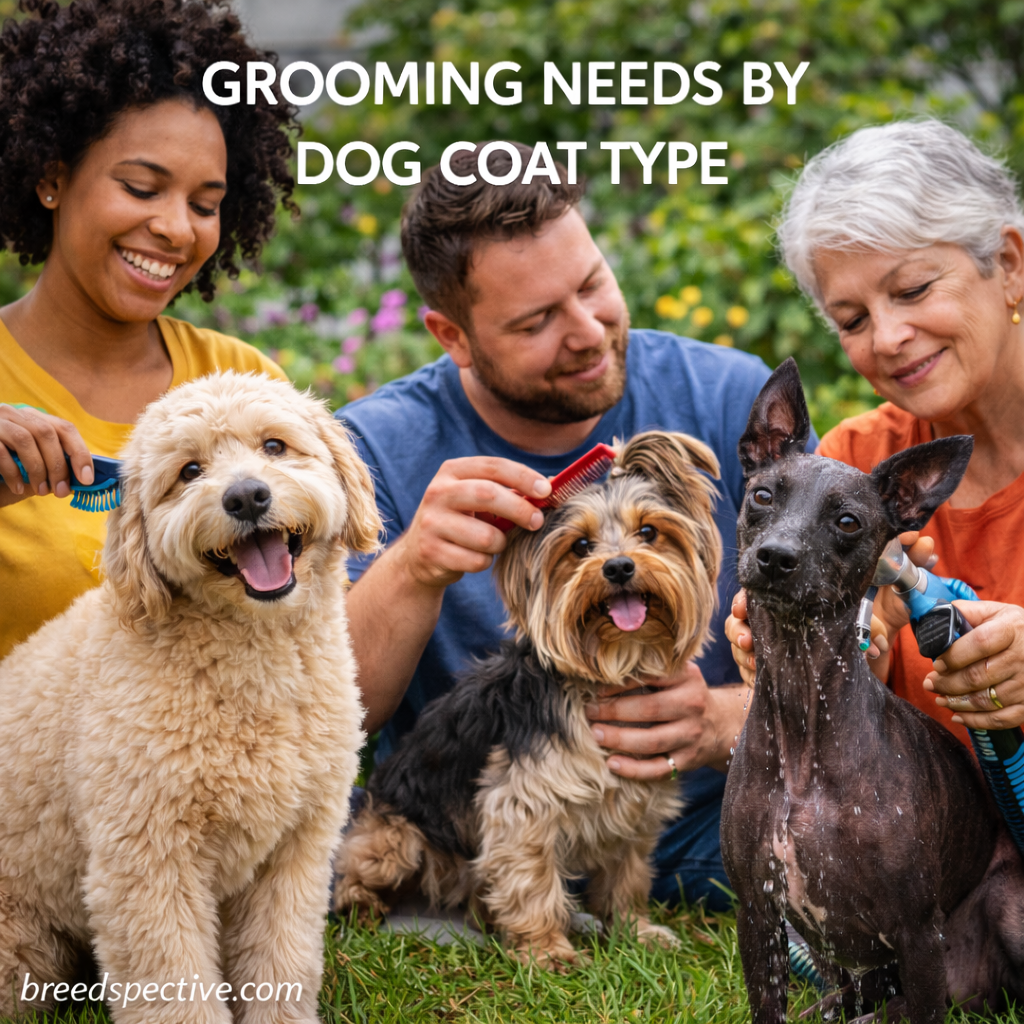
Our guide to grooming requirements by dog coat type explains how different coat structures change maintenance needs.
A shorter clip can make maintenance easier, but it does not turn a curly or dense Goldendoodle into a no-grooming dog.
Health Testing Goldendoodle Breeders Should Provide
A Goldendoodle can inherit health risks from both sides of its ancestry.
Mixed breeding does not make parent health screening optional.
Buyers should expect the Golden Retriever parent to meet Golden Retriever recommendations and the Poodle parent to meet recommendations for its specific Poodle variety.
Golden Retriever Parent
The Golden Retriever Club of America recommends pre-breeding screening for:
- Hips
- Elbows
- Eyes
- Heart
GRCA specifies hip and elbow evaluations, recurring specialist eye examinations, and cardiac examination by a board-certified veterinary cardiologist. The club recommends that results be publicly recorded so buyers can verify them.
GRCA specifically warns that mixed-breed dogs also have hereditary health risks and that failure to screen breeding parents creates unnecessary genetic risk.
Standard Poodle Parent
Many medium and standard Goldendoodles use Standard Poodle ancestry.
The Poodle Club of America’s current health recommendations for Standard Poodles include:
- Hip evaluation through OFA or PennHIP
- Specialist eye examination
- Autoimmune thyroiditis evaluation
- DNA testing for neonatal encephalopathy with seizures, or appropriate clear-by-parentage status
- DNA testing for von Willebrand disease type I, or appropriate clear-by-parentage status
PCA’s broader CHIC recommendations also incorporate breed-relevant health screening such as thyroid, sebaceous adenitis, and cardiac evaluation.
If a breeder uses Miniature or Toy Poodle ancestry, the testing requirements differ. The Poodle Club of America lists variety-specific recommendations, including PRA, specialist eye, patella and, for Miniatures, hip screening.
Verify Results Instead of Accepting “Health Tested”
Ask for each parent’s registered name or identification information and look up the records.
Statements such as these are not sufficient by themselves:
- “Vet checked”
- “DNA tested”
- “Embark clear”
- “Healthy parents”
- “No problems in our lines”
- “Hybrid vigor eliminates genetic disease”
A commercial DNA panel cannot replace hip radiographs, elbow evaluations, specialist cardiac examinations or ophthalmologist examinations when those screenings are recommended.
The Orthopedic Foundation for Animals maintains searchable health records, and GRCA specifically encourages buyers to verify certifications there.
How to Avoid Goldendoodle Puppy Mills and Backyard Breeders
Popularity creates demand, and high demand creates opportunities for poor breeding.
Do not judge a breeder by an attractive website, professionally staged puppy photos, social-media following, or price.
Look for evidence.
Better Breeder Signs
A responsible breeder should be willing to:
- Identify the sire and dam
- Provide verifiable health results
- Explain why the particular parents were paired
- Discuss parent temperament
- Explain likely size and coat without guaranteeing the impossible
- Show how puppies are raised
- Provide veterinary records
- Use a written contract
- Ask detailed questions about your household
- Discuss what happens if you can no longer keep the dog
- Be candid about health and behavioral risks
GRCA emphasizes health screening and disclosure of results to puppy buyers, while the Poodle Club of America’s ethics guidance similarly calls for hereditary testing, proof of testing for buyers, careful screening of homes, health records, and continuing responsibility for dogs produced.
Goldendoodle Breeder Red Flags
Be cautious when a seller:
- Always has puppies immediately available
- Produces many different doodle crosses
- Cannot identify both parents
- Will not provide verifiable health results
- Claims all puppies are hypoallergenic
- Guarantees zero shedding
- Guarantees exact adult size
- Markets unusual colors as the main reason for premium pricing
- Treats a DNA panel as complete health testing
- Claims crossbreeding eliminates inherited disease
- Will ship a puppy with almost no screening of the buyer
- Pressures you to place a deposit immediately
Generation labels and attractive colors are not substitutes for responsible breeding.
Neither is price. An expensive puppy can still come from poorly screened parents.
Who Is a Goldendoodle Best Suited To?
A Goldendoodle can be a strong match for:
- Active families
- Owners who enjoy training
- Households wanting a social companion
- Families with respectful children
- People willing to budget for professional grooming
- Owners who can provide daily exercise and mental stimulation
- Households where the dog will participate in everyday life
Their social nature and trainability are major advantages when matched with the right home.
Who Should Think Twice About a Goldendoodle?
This cross may be frustrating if:
- You want guaranteed zero shedding
- You need a guaranteed allergy-safe dog
- You dislike brushing
- Professional grooming is outside your budget
- You want a low-energy lap dog
- The dog will routinely spend very long days alone
- You do not want to train jumping or excitable greetings
- You expect coat, size and temperament to be perfectly predictable
A yard does not eliminate those requirements.
Before choosing a Goldendoodle because of its popularity or teddy-bear appearance, compare the complete workload with your household using our guide to choosing the right dog breed for your lifestyle.
Verdict: Is a Goldendoodle Right for Your Family?
A Goldendoodle is a strong fit for an active household that wants an affectionate, intelligent, trainable companion and is prepared for substantial coat maintenance, daily exercise, consistent training, and plenty of human interaction. Many can thrive with children and other pets when appropriately bred, socialized and managed.
A Goldendoodle is not the right choice for someone seeking a guaranteed hypoallergenic dog, predictable low-maintenance coat, minimal exercise requirements, or a dog that can routinely spend most of the day alone.
The most important choice happens before bringing the puppy home. F1, F1B and F2 labels can provide information about ancestry and influence coat expectations, but they tell you much less about breeding quality than documented parent health testing, stable temperaments, responsible puppy raising, and breeder transparency.