
Labrador Retriever temperament is typically friendly, outgoing, eager to please, confident, and highly social with people. Labs are famously trainable family companions, but they are also energetic working retrievers whose adolescent intensity, mouthiness, appetite, shedding, and need for daily activity are easy for new owners to underestimate.
The Labrador Retriever Club describes correct temperament as a hallmark of the breed: kindly, outgoing, tractable, eager to please, and non-aggressive toward people or animals. That sociable personality helps explain the Labrador’s enduring popularity, but temperament alone does not make this a low-effort dog.
Labrador Retriever at a Glance
| Trait | Labrador Retriever |
|---|---|
| Size | Males: 22.5–24.5 inches; females: 21.5–23.5 inches |
| Typical weight | Males: 65–80 pounds; females: 55–70 pounds |
| Life expectancy | About 11–13 years |
| Exercise needs | High, especially from adolescence through early adulthood |
| Grooming | Moderate; substantial shedding |
| Trainability | High; generally eager and strongly food-motivated |
| Good with children? | Often excellent with training and supervision |
| Good with other pets? | Often, especially with appropriate socialization |
| Protective tendency | Generally low |
| Best fit | Active household wanting an involved, social dog |
The Labrador Retriever Club’s breed standard describes the Lab as a strongly built, athletic, well-balanced retrieving gun dog capable of working for long periods under difficult conditions while also possessing the stable temperament required of a family companion.
That working background is the part prospective owners should remember when encountering an unusually calm adult Labrador. The relaxed dog you meet at eight years old may have been a dramatically different animal at 18 months.
Labrador Retriever History and Original Purpose
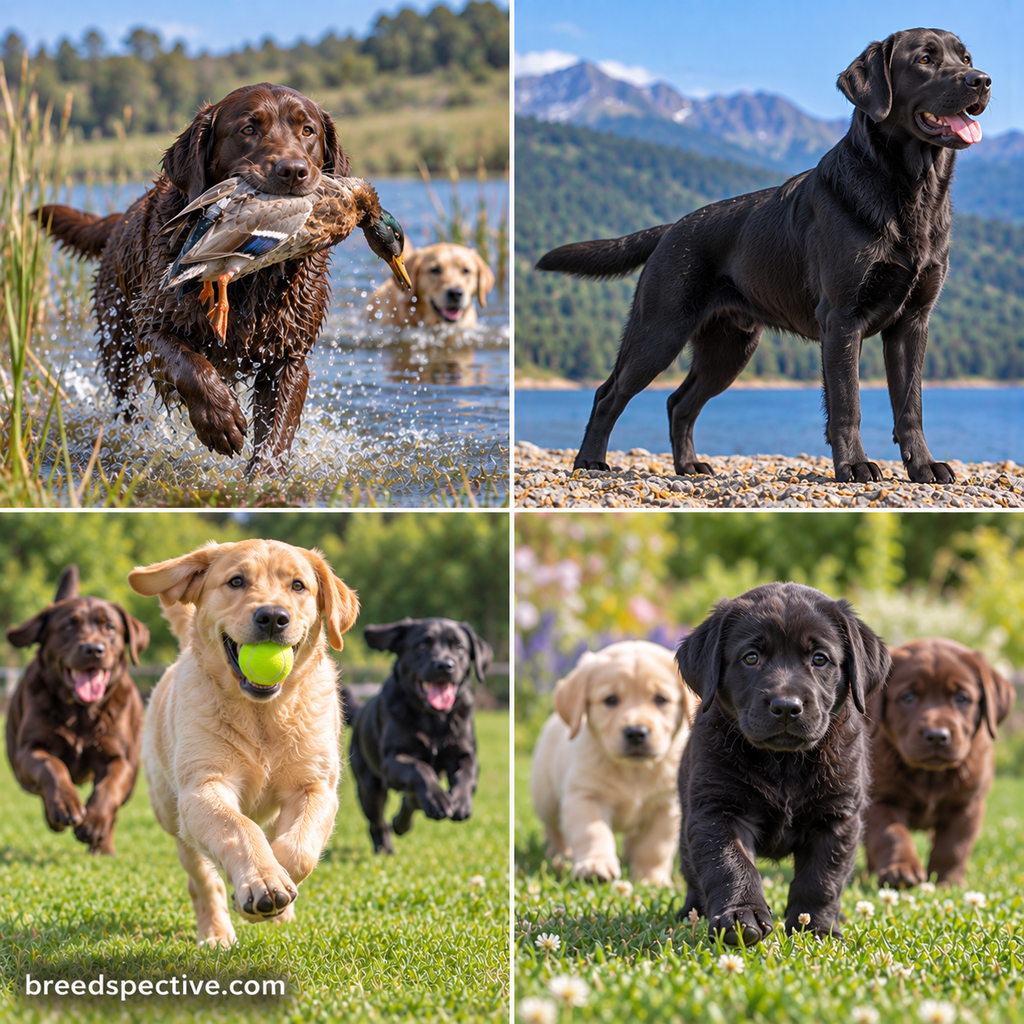
Despite the name, the Labrador Retriever’s immediate ancestors came from Newfoundland, not Labrador.
The breed descends from the St. John’s water dog, also called the St. John’s dog, which developed on the Canadian island of Newfoundland. According to the American Kennel Club, these dogs became known for their ability and enthusiasm in the water. The St. John’s dog is now extinct.
British visitors recognized the dogs’ retrieving ability and imported them to England during the 19th century. There, sporting enthusiasts refined the dogs into the Labrador Retriever.
The job shaped the dog.
A retriever needed to locate fallen game, enter cold water willingly, carry birds without unnecessarily damaging them, return to a handler, and continue working in difficult conditions. That required athleticism, cooperation, persistence, trainability, and a strong inclination to pick things up.
Those traits remain visible in modern Labs.
Why the “Otter Tail” Matters
One of the Labrador’s most recognizable physical features is its thick, rounded otter tail.
The Labrador Retriever Club standard describes it as very thick at the base, gradually tapering toward the tip, and covered by the same short, dense coat that gives it its rounded appearance.
In the water, that substantial tail helps the swimming retriever steer, functioning much like a rudder.
Combined with a dense, weather-resistant coat and powerful build, it reflects a breed designed for water retrieves rather than simply for appearance.
From Working Retriever to America’s Favorite Dog
Few breeds have matched the Labrador’s sustained popularity in the United States.
According to AKC registration statistics, the Labrador Retriever held the No. 1 position for 31 consecutive years, from 1991 through 2021. The French Bulldog moved into first place for the 2022 rankings, ending the Labrador’s record-setting run.
That popularity is understandable. Labs combine an approachable temperament with substantial versatility.
They can be family companions, hunting retrievers, detection dogs, assistance dogs, search-and-rescue dogs, and sporting competitors.
Popularity can also create unrealistic expectations. A Labrador is not born knowing how to walk politely, greet children gently, leave food alone, or distinguish its toys from someone’s shoes.
Labrador Retriever Temperament in Everyday Life
The classic Labrador personality is social and enthusiastic rather than aloof or suspicious.
Friendly and Outgoing
Correct Labrador temperament should be approachable and stable.
The breed standard specifically calls for a kindly, outgoing nature and treats aggression or adult shyness as serious faults.
That makes most Labs better suited to companionship than serious guarding.
A Lab may bark when someone approaches the house, but owners wanting a naturally suspicious protection breed are looking for characteristics that are not central to the Labrador standard.
Strongly People-Oriented
Labs generally enjoy doing things with people.
Walking, swimming, retrieving, training, riding in the car, exploring trails, and simply spending time around the household can all satisfy this social tendency.
This does not mean a Labrador should never be alone.
Teaching puppies to relax independently is healthy. A dog accustomed to constant human attention can struggle when a household schedule eventually changes.
Enthusiastic Rather Than Delicate
The word “gentle” can give prospective owners the wrong picture of a young Labrador.
A well-tempered Lab can be wonderfully friendly while simultaneously being physically exuberant.
Young dogs may jump, barrel through rooms, crash into furniture, carry anything within reach, and greet visitors with their entire body.
For a comparison with a similarly social sporting breed, see our guide to Golden Retriever temperament, energy level, and lifestyle fit.
Labrador Energy Level: The Adolescent Years Matter
The Labrador Retriever is an energetic sporting dog.
A healthy adult commonly needs about 60–90 minutes of meaningful daily exercise, with younger and more driven individuals often benefiting from additional activity and training.
The period many owners underestimate is roughly one to three years of age.
During adolescence and early adulthood, a Lab may already have the size and strength of an adult while still displaying immature impulse control. That combination can produce jumping, leash pulling, stealing objects, counter surfing, destructive chewing, and relentless attempts to initiate play.
Do not expect the dog simply to “grow out of it.”
Maturity helps, but training determines which habits survive into adulthood.
What Good Daily Exercise Looks Like
Useful activities include:
- Brisk walks
- Retrieving games
- Swimming in safe conditions
- Hiking
- Scent searches
- Obedience exercises
- Field work
- Structured play
- Food puzzles and enrichment
Exercise should be combined with training rather than treated as an attempt to physically exhaust the dog.
A highly fit Labrador can become capable of increasingly large amounts of exercise. Teaching the dog to settle is therefore just as valuable as building stamina.
Labrador Mouthiness: Why Everything Goes in the Mouth
Mouthiness is one of the most predictable Labrador behaviors.
This is a retriever. Picking things up is deeply compatible with the work for which the breed was developed.
Puppies may grab:
- Shoes
- Socks
- Towels
- Children’s toys
- Remote controls
- Sticks
- Household objects
- Your hands and clothing during excited play
The answer is not to punish every attempt to carry something.
Provide appropriate retrieving toys and chews, manage access to valuable objects, and teach a reliable drop it and leave it.
Trading is particularly useful. Offer something valuable in exchange for the object instead of turning stolen socks into an exciting chase around the house.
Puppy biting also requires patience. Redirect biting toward appropriate toys, interrupt overly rough interaction, and make sure an overtired puppy receives adequate rest.
Labrador Trainability
Labs are highly trainable because many possess an extremely useful combination: social engagement, willingness to work, and powerful motivation for food or play.
Training should begin immediately.
Useful early skills include:
- Recall
- Loose-leash walking
- Waiting at doors
- Calm greetings
- Drop it
- Leave it
- Settling on a mat
- Handling for grooming and veterinary care
- Staying calm around food
Positive reinforcement allows owners to channel the Labrador’s natural motivation instead of constantly fighting it.
The breed’s cooperative working background is one reason Labs feature prominently in discussions of the easiest dog breeds to train and why.
Trainable does not mean pre-trained, however. A smart, food-motivated Labrador can become exceptionally skilled at stealing food if counter surfing repeatedly pays off.
Food Motivation and Weight Gain
Food motivation can be one of the Labrador’s greatest training advantages and one of its biggest management challenges.
Many Labs behave as though another meal is always justified.
Free-feeding, oversized meals, frequent treats, table scraps, and using large quantities of food during training can make calorie intake climb quickly.
Cornell University College of Veterinary Medicine notes that excessive calories, free-choice feeding, treats, table scraps, inadequate activity, genetics, and medical factors can all contribute to canine obesity. Excess body weight increases stress on joints and can worsen arthritis and overall health.
For a Labrador:
- Measure meals rather than estimating portions
- Count training treats as part of daily intake
- Monitor body condition, not begging behavior
- Weigh the dog periodically
- Adjust food as activity changes
- Discuss unexplained weight gain with a veterinarian
Cornell also emphasizes that diet is central to weight management; exercise helps, but it cannot reliably compensate for chronic overfeeding.
A Lab staring at an empty food bowl is not evidence that it requires another serving.
Are Labrador Retrievers Good With Children?
Labs can make excellent family dogs.
Their sociability, trainability, enthusiasm for play, and generally friendly temperament suit many households with children.
Physical exuberance is the main caveat.
A 65- to 80-pound adolescent can knock over a toddler while attempting to say hello. Puppies can also be mouthy enough to upset children who expect a calm, cuddly dog.
Adults should supervise interactions and teach both sides appropriate behavior.
Children should not climb on dogs, disturb them while eating or sleeping, pull ears or tails, or interfere with a dog that is trying to leave.
For families comparing popular retrievers directly, see Labrador vs. Golden Retriever: which is better for families?.
Our broader guide to the best dog breeds for families with young children covers additional considerations beyond breed reputation.
Labrador Retrievers and Other Pets
The Labrador standard calls for a non-aggressive disposition toward humans and animals.
Many Labs therefore live successfully with other dogs.
Cats can also be compatible, especially with careful introductions, although individual dogs differ. A young Lab’s desire to chase or enthusiastically investigate another animal can be stressful even when there is no aggressive intent.
Calm coexistence should be taught rather than assuming every Labrador automatically knows how to behave around another pet.
Common Labrador Behavior Problems and How to Fix Them
Most common Labrador problems are easier to prevent during puppyhood than correct after the dog reaches full size.
Jumping
Do not reward jumping with attention. Reinforce four paws on the floor and practice controlled greetings before visitors arrive.
Leash Pulling
Begin loose-leash work before the puppy becomes powerful. Reward the position you want and practice around gradually increasing distractions.
Counter Surfing
Keep food inaccessible and prevent successful theft. Reinforce a mat or place behavior during food preparation.
Every sandwich stolen from the counter makes counter surfing more worth trying again.
Destructive Chewing
Provide appropriate chews, rotate toys, supervise young dogs, and use gates or other management when direct supervision is impossible.
Exercise and mental enrichment also reduce boredom-driven destruction.
Stealing and Refusing to Give Things Back
Teach trading rather than chasing.
Repeatedly pursuing a Lab that has stolen something can accidentally create an entertaining game.
Overexcited Greetings
Practice calm greetings with familiar people. A Labrador does not need to greet every stranger or dog encountered in public.
Learning neutrality is valuable even for an exceptionally social breed.
Grooming and Shedding
The Labrador’s coat is short, but it is not low-shedding.
The breed standard calls for a short, straight, dense coat with a soft, weather-resistant undercoat.
Expect hair throughout the year with heavier seasonal shedding.
Regular brushing helps remove loose undercoat before it ends up on furniture, floors, clothing, and car seats.
Routine care also includes:
- Nail trimming
- Dental care
- Ear checks
- Occasional bathing
- Skin and coat monitoring
Labs that swim frequently should have their ears monitored because persistent moisture can contribute to ear problems in susceptible dogs.
Labrador Retriever Health Screening
A responsible breeder should be able to show verifiable health-testing results rather than simply saying the parents are healthy.
The Labrador Retriever Club (LRC) identifies CHIC-related screening that includes hip evaluation, elbow evaluation, an eye examination by a board-certified veterinary ophthalmologist, Exercise-Induced Collapse testing, and D-locus testing. The club also recommends or recognizes additional testing for conditions including centronuclear myopathy, progressive rod-cone degeneration and cardiac disease.
The LRC’s current puppy-buyer guidance provides further details on its recommended testing and encourages buyers to verify results through the OFA database.
What a CHIC Number Actually Means
Do not interpret a CHIC number as a guarantee that every test result was normal.
The Orthopedic Foundation for Animals explains that CHIC certification means the dog completed the breed-specific required screenings and the results were made publicly available. The certification itself does not mean every result is normal.
That distinction matters.
Look at the actual results for the parents rather than stopping when you see “CHIC.”
Hip and Elbow Dysplasia
Hip and elbow screening is particularly relevant in a large, athletic breed.
Cornell University College of Veterinary Medicine notes that canine hip dysplasia can range considerably in severity and that maintaining healthy body weight is an important part of managing joint health.
The LRC requires OFA hip and elbow evaluations within its breeder health-clearance framework.
No screening system can guarantee that a puppy will never develop orthopedic disease, but documented testing gives buyers and breeders considerably more information than appearance or athletic ability alone.
Exercise-Induced Collapse
Exercise-Induced Collapse, or EIC, is an inherited condition relevant to Labradors, particularly because the breed may participate in intense retrieving, hunting, and sporting activities.
The LRC includes a DNA-based EIC test in its CHIC requirements.
Ask breeders for the actual genetic status of both parents and how those results were considered in the breeding.
Field-Bred vs. Show-Bred Labradors
Prospective owners may hear Labradors described informally as “American” or “English” Labs.
These are not separate AKC breeds.
A more useful distinction is often between dogs bred primarily for field performance and dogs bred primarily for conformation, although substantial variation exists within both groups.
Field-focused lines may be lighter, faster, and especially driven to retrieve and work for extended periods. Conformation-focused dogs may have a heavier build and, depending on the individual line, sometimes a different everyday activity profile.
Neither label guarantees temperament or energy level.
Ask what the parents actually do, how they behave in the house, what their activity needs are, and what previous offspring have been like.
For readers comparing another highly trainable sporting breed with a different coat and working history, see Poodle temperament, energy level, and lifestyle fit.
Is a Labrador Good for a First-Time Owner?
A Labrador can be an excellent first dog for a prepared owner.
The breed’s trainability and generally sociable temperament give beginners advantages that they may not have with a highly independent or naturally suspicious breed.
The challenge is surviving the energetic young-dog period without allowing bad habits to become permanent.
A first-time owner needs to be ready for:
- Daily exercise
- Puppy biting and mouthiness
- Loose-leash training
- Excitable greetings
- Food management
- Substantial shedding
- A physically powerful adolescent
- Consistent training for several years
Our guide to the best dog breeds for first-time owners provides a wider comparison of beginner-friendly characteristics.
How Much Does a Labrador Retriever Cost Per Year?
Large active dogs require a realistic budget.
A practical annual planning range for an adult Labrador in the United States is:
| Expense | Practical annual planning range |
|---|---|
| Food and treats | $600–$1,200 |
| Routine veterinary care | $350–$900 |
| Parasite prevention | $200–$500 |
| Toys, chews, and enrichment | $150–$500 |
| Grooming/basic supplies | $100–$350 |
| Training/classes | $0–$700+ |
| Pet insurance | $500–$1,500+ |
| Typical planning total | About $1,900–$5,650+ |
These figures are budgeting estimates, not fixed national prices.
Emergency veterinary treatment, orthopedic surgery, boarding, daycare, professional dog walking, specialized training, and chronic medical care can increase expenses substantially.
Who Is a Labrador Retriever Best Suited To?
A Labrador is a particularly strong match for someone who wants an active, social dog rather than a pet that mostly entertains itself.
Good matches often include owners who:
- Can provide 60–90 minutes of daily activity
- Enjoy walking, hiking, swimming, or outdoor recreation
- Want to train and interact with their dog
- Like retrieving games and active play
- Can tolerate significant shedding
- Want a generally social family companion
- Can manage a strong adolescent dog
- Will control food intake and monitor weight
- Will verify breeder health testing
A large yard is helpful but not essential.
A Labrador living in an apartment with an active owner may receive far more meaningful exercise than one left alone in a suburban backyard.
Who Should Think Twice About a Labrador?
The Labrador’s popularity can make it seem universally suitable. It is not.
Think carefully if:
- You want a genuinely low-energy dog
- Daily exercise is difficult to fit into your schedule
- You dislike dog hair around the home
- Puppy biting and retrieving behavior would frustrate you
- You want an independent dog
- You cannot manage a strong 60- to 80-pound adolescent
- You tend to show affection through unlimited treats
- You want a serious guard dog
- You expect a puppy to become calm without consistent training
The adolescent period deserves particular consideration. A one-year-old Labrador can look fully grown while behaving very much like an impulsive youngster.
Before choosing the breed, compare its actual requirements with your household using our guide to choosing the right dog breed for your lifestyle.
Verdict: Is a Labrador Retriever Right for You?
A Labrador Retriever is right for an active owner or family that wants a friendly, trainable, social dog and is willing to provide daily exercise, structured training, companionship, and weight management. The classic Labrador temperament makes the breed highly adaptable, but its best qualities are easiest to live with when its working-retriever instincts have appropriate outlets.
A Labrador is not right for someone seeking a quiet, low-effort dog that requires little exercise or training. The one-to-three-year adolescent period can bring substantial energy, jumping, pulling, chewing, stealing, and mouthiness, while the breed’s appetite makes portion control a lifelong responsibility.
Choose a Lab because you want the whole package: an outgoing companion with the athleticism and enthusiasm of a working retriever—not simply because Labradors have a reputation for being good family dogs.