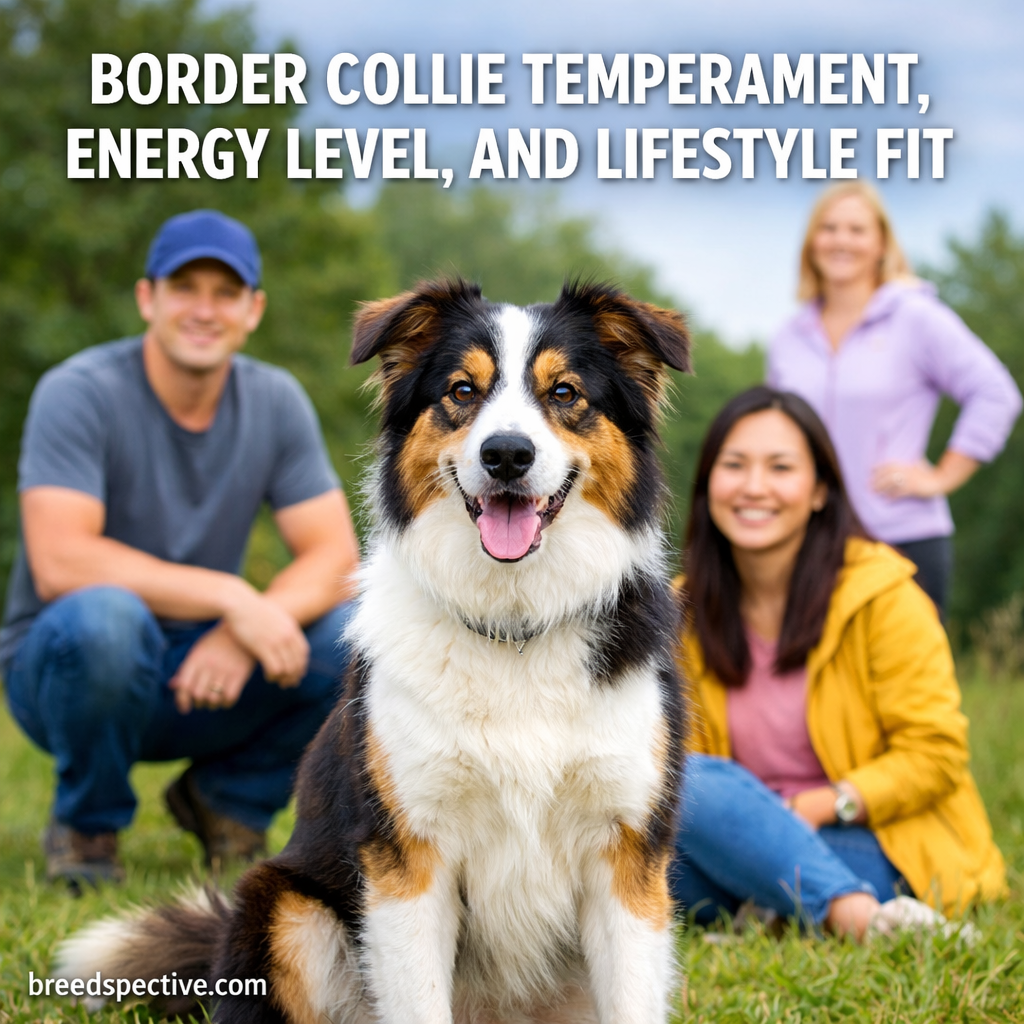

To choose the right dog breed, start with the life you can realistically give a dog: your activity level, available time, living space, budget, experience, and household. Then look for breeds whose adult size, original purpose, energy, trainability, grooming needs, and temperament fit those limits — rather than choosing a dog first and hoping your lifestyle can adapt.
Breed does not predict every individual dog, but it gives you a useful starting point. The American Kennel Club (AKC) currently recognizes more than 200 breeds across seven groups, and many of the differences between them make more sense once you understand the jobs those dogs were originally developed to perform.
Start Here: Your Dog-Breed Decision Framework
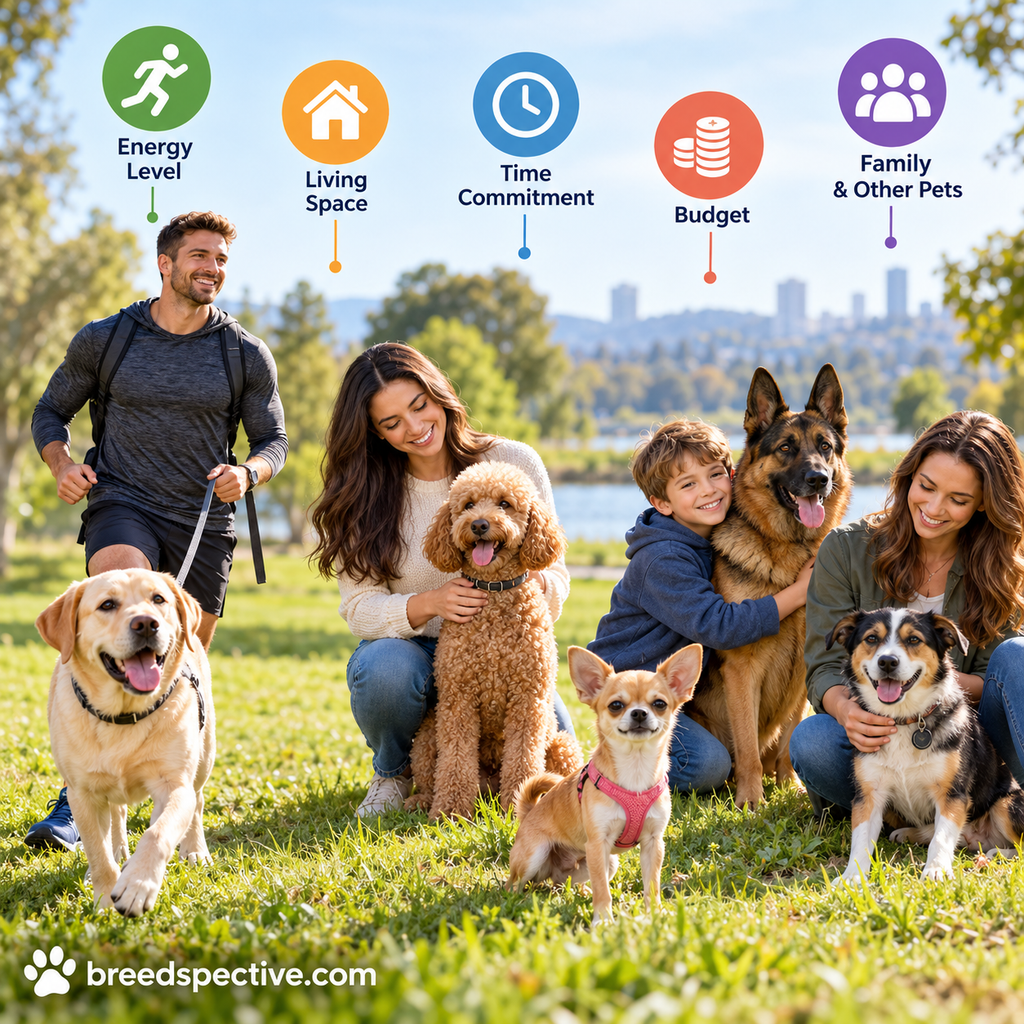
Before researching individual breeds, score your situation in these five areas.
| Factor | Lower-Demand Situation | Higher-Demand Situation |
|---|---|---|
| Activity | Shorter walks, relaxed routine | Running, hiking, training, outdoor activities |
| Time | Busy workdays, limited training time | Flexible schedule, substantial daily interaction |
| Space | Apartment or small home | Larger home with convenient outdoor access |
| Budget | Need predictable, moderate costs | Comfortable with larger food, grooming and care expenses |
| Experience | First dog | Experienced with training and management |
Then add your household:
- Young children?
- Older adults?
- Cats?
- Other dogs?
- Frequent visitors?
- Long periods when nobody is home?
- Rental restrictions?
- Noise-sensitive neighbors?
Those answers should eliminate breeds before appearance enters the discussion.
The American Veterinary Medical Association (AVMA) similarly recommends evaluating your home, work schedule, other pets, exercise access, future living arrangements, veterinary-care budget, and the traits you actually want in a dog before choosing one.
Why a Breed’s Original Job Matters So Much
One of the best shortcuts to understanding a breed is asking:
What was this dog originally bred to do?
The AKC organizes its recognized breeds into seven groups largely according to function and shared characteristics: Sporting, Hound, Working, Terrier, Toy, Non-Sporting, and Herding. The AKC notes that breeds within these groups often retain behavioral tendencies connected to their original jobs.
That history helps explain modern pet behavior.
Sporting dogs
Retrievers, setters, pointers, and spaniels were developed to work with hunters. Many are active, cooperative, and responsive to training.
The Labrador and Golden Retriever fall into this group.
That working background helps explain why both can be excellent companions for active households — but also why neither should be mistaken for a low-exercise dog.
Hounds
Hounds were developed to pursue game through scent or sight, sometimes with considerable independence.
A Beagle following an interesting scent is not malfunctioning. Scent work is central to what the breed was developed to do.
Dachshunds are hounds too. Their small size can disguise the fact that they were developed as determined hunting dogs.
Working dogs
Working breeds historically performed jobs such as guarding, pulling sleds, carting, rescue, and protecting property or livestock.
This group includes breeds as different as the Boxer, Rottweiler, and Siberian Husky.
The label “working dog” should immediately prompt questions about size, strength, exercise, independence, and what happens when the dog’s working tendencies have no appropriate outlet.
Terriers
Terriers were generally developed to pursue and control vermin.
Persistence, alertness, prey interest, and determination were useful working characteristics. They may still appear in modern companion dogs even when there are no rats to chase.
Toy dogs
Toy breeds are small companion dogs, including the Chihuahua.
Their size makes them practical for many homes, but a small body does not remove the need for training, exercise, socialization, or veterinary care.
Herding dogs
Herding breeds were developed to control livestock, often while responding closely to a handler.
Border Collies and German Shepherds are examples.
These dogs can be remarkably trainable, but high intelligence and responsiveness do not automatically make them easy pets. A dog bred to work for hours may need far more activity and mental engagement than the average household expects.
This is why original purpose is often more informative than labels such as “smart,” “loyal,” or “friendly.”
Step 1: Match the Dog’s Energy to Your Real Routine
Do not choose based on your ideal Saturday.
Choose based on your average Tuesday.
If you currently take a 20-minute walk after work, getting a high-drive working breed is unlikely to transform you permanently into someone who spends several hours exercising and training a dog every day.
Your dog needs a routine you can sustain.
Ask yourself:
- How much time can I devote to walks every day?
- Do I genuinely enjoy training?
- Do I want hiking or running to involve my dog?
- What happens when it rains?
- What happens during a busy workweek?
- Who exercises the dog when I am sick or traveling?
- Do I want an active hobby partner or primarily a companion at home?
Our guide to matching a dog’s energy level to your daily routine can help you make that distinction.
If you want a highly active dog
The Border Collie’s temperament and energy profile demonstrates what high mental and physical demands can look like.
A Siberian Husky’s energy level and lifestyle fit presents a different version of high-energy ownership, with northern working-dog characteristics to consider.
For active families wanting a more cooperative sporting breed, the Labrador Retriever’s temperament and lifestyle fit may be easier to align with everyday family life.
If you prefer a quieter routine
Do not assume small automatically means calm, or large automatically means energetic.
Instead, research the breed’s normal adult activity and how well it settles indoors.
For people with limited space and a lower-key routine, our guide to low-energy dog breeds for apartment living provides a more targeted starting point.
Step 2: Choose a Size You Can Physically Manage
Size changes everyday ownership.
A large dog needs more room in the car, a larger crate and bed, larger quantities of food, and equipment sized for a bigger body. More importantly, physical mistakes have greater consequences.
A 10-pound dog pulling on the leash is different from a 100-pound dog doing it.
A large adolescent jumping on a guest, dragging toward another dog, or refusing to enter the car creates a management problem even if the behavior is temporary.
The AVMA specifically recommends considering adult size when choosing a dog and notes that some larger or high-energy dogs can be harder to maintain in apartments or condominiums.
Daily life with a large dog
If you are considering a large breed, picture ordinary situations rather than just walks in the park.
Can you:
- Lift or assist the dog during an emergency?
- Transport it comfortably?
- Fit an appropriately sized crate in your home?
- Control it while leash training?
- Keep food costs within budget?
- Find boarding or pet-sitting arrangements?
- Accommodate a large bed without blocking your living space?
- Manage interactions with children and smaller animals?
A powerful dog also raises the importance of early training.
The Rottweiler’s temperament, energy, and lifestyle requirements are worth reviewing before choosing the breed primarily for appearance or guarding reputation.
The Boxer’s temperament and activity needs show another side of large-dog ownership: energetic, social behavior in a strong body.
Step 3: Evaluate Your Home, Not Just Its Square Footage
A house is not automatically better than an apartment.
The more useful question is what environment you can provide.
An apartment owner who takes a compatible dog outside regularly, trains it, provides enrichment, and meets its exercise needs may offer a better lifestyle than a homeowner who expects a backyard to do all the work.
A yard is useful. It is not a substitute for interaction.
Apartment owners should consider
- Indoor activity level
- Barking or vocal tendencies
- Ease of getting outside for toileting
- Adult size
- Elevator or stair access
- Neighbor proximity
- Rental restrictions
- Access to safe walking areas
The French Bulldog’s temperament, energy level, and lifestyle fit may appeal to people prioritizing compact size and moderate exercise, although health considerations deserve serious research.
The Chihuahua’s temperament and lifestyle fit provides another small-dog option, while showing why tiny dogs still require thoughtful training and socialization.
Houses with yards
A yard expands your options but should not automatically push you toward a high-energy breed.
Border Collies do not exercise themselves simply because grass is available. Huskies do not become low-maintenance because the property is larger.
Structured walks, play, training, exploration, and interaction still matter.
Step 4: Calculate How Much Time You Actually Have
Dog ownership consumes time in small pieces throughout the day.
There is feeding, toileting, walking, training, play, grooming, veterinary appointments, cleanup, and companionship.
Puppies require even more.
The AVMA notes that puppies require additional time for housetraining, socialization, obedience training, feeding, exercise, and supervision. It specifically suggests considering an adult dog, which may already be housetrained and know some basic commands.
For busy owners, that distinction can matter more than breed.
If you work long hours
Ask who handles:
- Morning exercise
- Midday toileting
- Evening exercise
- Training
- Feeding
- Veterinary appointments
- Care during travel
Paying a dog walker, daycare, sitter, or boarding facility may solve some scheduling problems, but those services become part of the ownership budget.
A busy schedule does not necessarily mean you cannot have a dog. It does mean that choosing a demanding puppy or high-drive working breed requires a concrete care plan rather than good intentions.
An adult dog with a known routine and moderate activity requirements may be a much better match.
Step 5: Decide How Much Training You Want to Do
Every dog needs training.
The question is how difficult the consequences become when training is inconsistent — and how much ongoing mental work the breed expects.
A Poodle can be an appealing choice for someone who actively enjoys training. Explore the Poodle’s temperament, energy, and lifestyle requirements if responsiveness is high on your list.
German Shepherds are also highly capable learners, but intelligence comes packaged with size, activity, and working-dog traits. Our German Shepherd temperament and lifestyle profile covers the broader commitment.
First-time owners
If you have never raised or trained a dog, prioritize forgiveness over maximum capability.
A breed that learns rapidly but requires intensive management may be less beginner-friendly than a moderately active, cooperative companion.
Start with our ranking of dog breeds for first-time owners if experience is your biggest concern.
Step 6: Think About Independence and Prey Drive
Trainability is not the same as intelligence.
Some breeds were developed to make decisions without constant direction from people.
The Beagle’s temperament and lifestyle fit is a useful example. A scent hound may find environmental smells extraordinarily rewarding, which changes how an owner approaches recall and walks.
The Dachshund’s temperament and lifestyle fit similarly shows how substantial hunting heritage can exist inside a small dog.
Rhodesian Ridgebacks add size and athleticism to the equation. Prospective owners should understand the common behavioral challenges associated with Rhodesian Ridgebacks before assuming that a short coat means straightforward ownership.
Step 7: Account for Grooming and Shedding
The dog you love looking at may have a coat you dislike maintaining.
Ask yourself how much brushing, bathing, clipping, nail care, and shedding you are willing to handle.
A Poodle’s coat creates different work from a Labrador’s.
A short-coated dog may need less coat maintenance while still shedding. A longer or continuously growing coat can require substantial home grooming or professional appointments.
Do not choose a dog marketed as “low shedding” without investigating what replaces the shedding. Often it is more clipping, brushing, or professional grooming.
Crossbreeds involving Poodles deserve the same scrutiny.
The Labradoodle’s temperament and family compatibility can vary between individuals, including coat characteristics.
The same applies to Goldendoodle temperament and family compatibility and the smaller Cavapoo’s temperament and family compatibility.
A crossbred dog’s adult coat and other traits should not be assumed to fall perfectly between its parent breeds.
Step 8: Build the Real Ownership Budget
The price paid to a breeder or shelter is only the beginning.
The AVMA advises prospective owners to account for food, veterinary care, housing and equipment, mental stimulation, emergency treatment, grooming, boarding, licensing, identification, training, sterilization, and other expenses.
Size affects several of those costs.
A larger dog generally needs larger quantities of food and larger equipment. Professional grooming can make coat type a significant recurring expense. Training classes, walkers, daycare, and boarding can materially change the monthly budget.
Health also matters.
Research the health concerns associated with any breed you are considering and ask a veterinarian about appropriate preventive care.
Before choosing based on what you can afford today, review the hidden costs of owning a dog or cat.
Budget for the dog you will have when something unexpected happens, not only for an uncomplicated month.
Step 9: Match the Dog to Children and Other Pets
“Good family dog” is too vague to make a decision.
A household with teenagers is different from one with a toddler. A quiet home with one older cat is different from a home with three dogs and frequent visitors.
For children, consider:
- Adult dog size
- Excitability
- Play style
- Noise sensitivity
- Training requirements
- How easily the dog can physically overwhelm a child
- The individual dog’s history with children
No breed reputation eliminates the need to supervise interactions between young children and dogs.
For households specifically prioritizing children, use our guide to the best dog breeds for families with young children.
If Labrador and Golden Retriever are your finalists, our Labrador vs. Golden Retriever family comparison looks more closely at the trade-offs.
Existing pets
Do not rely on breed labels alone when introducing another dog or a cat.
Consider the individual dog’s previous experience, prey interest, play style, size, and behavior around other animals.
If adopting, ask the shelter or foster caregiver what has actually been observed.
Step 10: Be Candid About Your Experience
Some dogs leave more room for beginner mistakes than others.
A first-time owner learning leash handling, reinforcement timing, socialization, household management, and canine body language is already learning a lot.
Adding substantial strength, guarding tendencies, very high drive, or extreme exercise requirements increases the difficulty.
That does not make those breeds “bad.” It makes the match more consequential.
If you are considering protection-oriented breeds, our Rottweiler vs. Doberman temperament and lifestyle comparison explains why choosing between them requires more than deciding which appearance you prefer.
Likewise, someone attracted to intense working dogs should compare the German Shepherd and Belgian Malinois before treating them as interchangeable.
Step 11: Think About the Next 10 Years, Not Just This Year
The AVMA emphasizes considering future changes in your living situation when deciding whether a dog fits your life.
That means asking uncomfortable but useful questions.
Could your work schedule change?
Could you move into a rental?
Could children enter the household?
Will older family members live with you?
Can you still meet the dog’s needs if your physical activity decreases?
A breed should fit not only your current circumstances but a reasonable range of circumstances you may encounter later.
For older adults or people deliberately seeking a more manageable companion, our guide to the best dog breeds for seniors focuses on those practical considerations.
Purebred, Crossbreed, or Mixed-Breed Dog?
You do not need a pedigree dog to make an informed choice.
A responsibly bred purebred can provide greater predictability around adult size, coat, and broad breed tendencies. That can be valuable when you have specific requirements.
Crossbreeds can combine characteristics from different breeds, but the outcome is not guaranteed to be a precise 50/50 blend.
Mixed-breed dogs vary even more widely, which makes evaluating the individual particularly useful.
The AVMA notes that both purebred and mixed-breed dogs can be found through shelters and rescue organizations. The ASPCA also encourages adopters to focus on the qualities they need in a companion rather than assuming only a particular breed can provide them.
For a first-time owner, adoption is a legitimate route.
An adult dog in a foster home may come with useful information about housetraining, activity, behavior around people, and how the dog settles in an ordinary home. That information can sometimes make matching easier than predicting the eventual personality of a young puppy.
Puppy or Adult Dog?
Puppies give you the opportunity to shape routines from the beginning, but they require substantial time.
Expect housetraining, socialization, chewing management, supervision, basic training, and frequent interruptions to your normal schedule.
An adult dog may already have established behavior and a more obvious energy level.
That does not guarantee an easy transition. Adult dogs can arrive with training gaps or behavioral needs of their own. The advantage is that you may have more information about the dog you are actually bringing home.
For busy owners, this can make a well-matched adult dog worth considering before defaulting to a puppy.
Breed Finder: Start With Your Situation
Use this section as a shortlist generator, not a guarantee. Every dog remains an individual.
| Your Situation | Breeds or Guides to Start With | Main Trade-Off |
|---|---|---|
| First-time owner | Labrador, Golden Retriever, Poodle | Exercise, grooming or size still matter |
| Active household | Labrador, Boxer, Border Collie | Daily exercise commitment |
| Very active/experienced owner | Border Collie, Husky, German Shepherd | High mental or physical demands |
| Apartment | French Bulldog, Chihuahua, suitable lower-energy breeds | Health, barking and toileting access |
| Families with children | Labrador, Golden Retriever | Young dogs can be energetic and strong |
| Want a small companion | Chihuahua, Dachshund, Cavapoo | Small does not mean training-free |
| Want a large companion | Labrador, Golden Retriever, Boxer | Space, strength and food costs |
| Want high trainability | Poodle, Border Collie, German Shepherd | Intelligent dogs still need ongoing work |
| Want a scent-driven hound | Beagle, Dachshund | Recall and environmental distractions |
| Interested in guardian breeds | Rottweiler, German Shepherd | Training and management matter greatly |
| Interested in Poodle crosses | Labradoodle, Goldendoodle, Cavapoo | Coat and temperament can vary |
| Busy household | Consider a compatible adult dog rather than automatically choosing a puppy | Individual temperament matters most |
| Senior household | Smaller or moderate-energy companion breeds | Consider strength and care needs |
| Open to adoption | Adult mixed-breed or purebred rescue | Evaluate the individual dog’s known behavior |
If two demanding breeds are competing for your attention, direct comparisons can expose differences that broad breed descriptions miss.
For northern breeds, compare the Siberian Husky with the Alaskan Malamute.
For highly active herding dogs, our Border Collie vs. Australian Shepherd comparison focuses specifically on how demanding each can be.
A 10-Minute Dog Breed Shortlisting Exercise
Before reading another breed profile, write down five answers.
1. My realistic activity level is:
Low / Moderate / High / Very high
Do not choose the answer you wish were true.
2. My normal weekday leaves this much dog-focused time:
Consider walks, training, play, feeding, toileting, and grooming rather than counting time when you simply happen to be in the same building.
3. The largest dog I can comfortably manage is:
Toy / Small / Medium / Large / Giant
Think about physical control and transportation, not just available floor space.
4. I am willing to spend this much effort on grooming:
Minimal / Weekly brushing / Frequent brushing / Professional grooming
Be realistic about both time and money.
5. My three non-negotiables are:
Examples:
- Good fit with young children
- Moderate activity
- Manageable in an apartment
- Low grooming commitment
- Suitable for a first-time owner
- Enjoys substantial outdoor activity
- Comfortable size for an older owner
- Highly trainable
- Able to live with another compatible dog
Now eliminate every breed that conflicts with a non-negotiable.
That last step is where good decisions are often made.
If you want a quiet, moderate-energy companion, do not keep a Husky on the list because you love its appearance. If you dislike grooming, do not keep a Poodle because you like its trainability. If you have little time for daily mental stimulation, do not keep a Border Collie because you have heard it is intelligent.
Common Mistakes When Choosing a Dog Breed
Choosing appearance first
Coat color, facial features, size, and popularity tell you very little about whether a dog fits your weekday routine.
Research function and temperament before appearance.
Assuming a yard solves exercise
A fenced yard is convenient, but dogs still need interaction and appropriate activity.
Assuming small means easy
Chihuahuas and Dachshunds demonstrate how much personality, independence, and training need can exist in a small body.
Assuming intelligent means beginner-friendly
A Border Collie can learn remarkably quickly while simultaneously requiring far more stimulation than many first-time owners want to provide.
Underestimating adolescence
A friendly Labrador puppy eventually becomes a strong adolescent dog before reaching mature adulthood. Plan for that stage, not just the puppy you bring home.
Ignoring grooming
The grooming routine you resent will still exist years later.
Ignoring health
Research breed-related health concerns before committing. Discuss your prospective breed with a veterinarian and, when buying from a breeder, investigate appropriate health screening.
Expecting breed to predict everything
Breed provides tendencies.
Individual temperament still matters.
That distinction is particularly valuable when adopting an adult dog whose behavior can already be observed.
How to Research Your Final Three Breeds
Once your lifestyle framework leaves you with two or three candidates, investigate each one using the same questions.
For example, the Golden Retriever’s temperament, energy, and lifestyle profile should be evaluated for the same criteria you would apply to another candidate:
- Adult size
- Daily activity
- Trainability
- Sociability
- Grooming
- Shedding
- Vocal tendencies
- Independence
- Compatibility with children
- Compatibility with other animals
- Health considerations
- Expected recurring expenses
Do not ask, “Is this a good breed?”
Ask:
“Is this a good breed for this household?”
That change in question prevents popularity from becoming a substitute for compatibility.
Verdict: Who Should Choose Which Type of Dog?
A Labrador or Golden Retriever makes the most sense for households that want a social, trainable companion and can accommodate a medium-to-large, active dog.
A Poodle suits owners who prioritize trainability and engagement and are prepared for substantial coat maintenance.
A Border Collie or Siberian Husky is better reserved for someone who actively wants the exercise, stimulation, and management associated with a demanding working dog rather than someone attracted primarily to intelligence or appearance.
A German Shepherd or Rottweiler can suit an owner prepared to manage a large, powerful dog and make training a serious long-term responsibility.
A Chihuahua, Dachshund, or other smaller companion may fit limited space better, but size should never be confused with effortless ownership.
And a well-matched adult rescue dog may be the strongest option for someone who cares more about known temperament and lifestyle compatibility than pedigree. The ASPCA maintains adoption programs and directs prospective adopters toward shelters and rescue organizations, while the AVMA explicitly recognizes shelters and rescues as sources for both purebred and mixed-breed dogs.
The right breed is therefore not the dog you admire most from a distance. It is the dog whose adult energy, size, original purpose, training needs, grooming, costs, and temperament still make sense on an ordinary weekday several years from now.