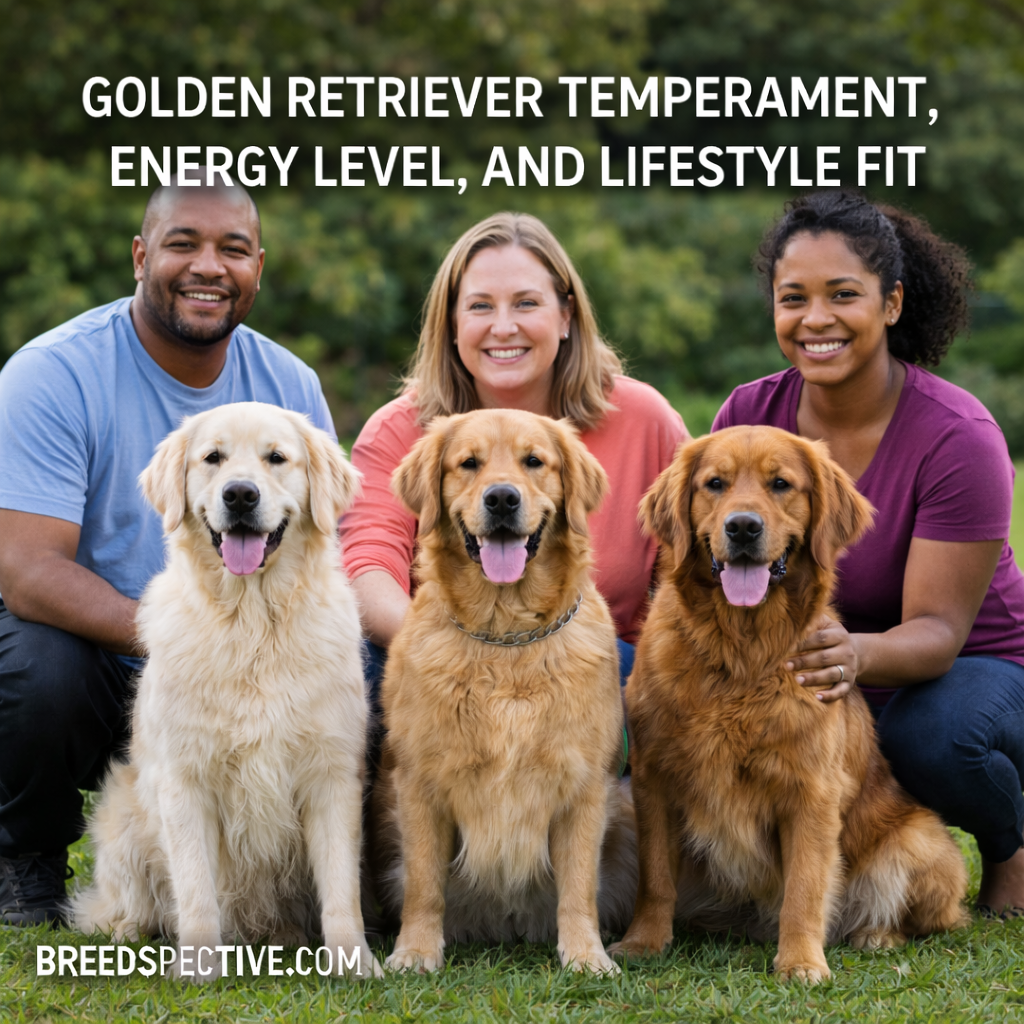
Golden Retriever temperament is typically friendly, confident, eager to please, social, and strongly oriented toward people. Goldens are highly trainable family and working dogs, but their easygoing reputation can hide substantial exercise, grooming, training, and companionship needs—especially during puppyhood and adolescence.
A well-bred Golden should not be timid, hostile, or excessively protective. The AKC breed standard specifically calls for a friendly, reliable, trustworthy temperament, while describing hostility toward people or other dogs and unwarranted timidity or nervousness as contrary to breed character.
Golden Retriever at a Glance
| Trait | Golden Retriever |
|---|---|
| Size | Males: 23–24 inches; females: 21.5–22.5 inches |
| Typical weight | Males: 65–75 pounds; females: 55–65 pounds |
| Life expectancy | About 10–12 years |
| Exercise needs | Moderate to high; daily physical and mental activity |
| Grooming | Moderate to high; regular brushing and substantial shedding |
| Trainability | High; typically eager to work with people |
| Good with children? | Often excellent with training and supervision |
| Good with other pets? | Often, particularly with appropriate socialization |
| Protective tendency | Generally low compared with guarding breeds |
| Best fit | Active, social household wanting an involved family companion |
The official AKC standard describes the Golden as a powerful, active sporting dog with an eager, alert, and self-confident personality. The breed was developed for retrieving, and those working instincts remain relevant to its modern temperament and exercise needs.
Golden Retriever History and Original Purpose

Golden Retrievers were developed as working gundogs in the Scottish Highlands during the 19th century.
Dudley Marjoribanks, later known as Lord Tweedmouth, developed the breed at his Guisachan estate near Inverness, Scotland. Detailed breeding records from the estate helped establish the true history of the Golden Retriever after years of competing origin stories.
The foundation breeding occurred in 1868.
Tweedmouth had acquired a yellow retriever named Nous, the only yellow puppy in a litter of black Wavy-Coated Retrievers. Nous was bred to Belle, a Tweed Water Spaniel. The Tweed Water Spaniel, now extinct, was known as a capable water retriever.
Their 1868 litter produced three yellow puppies named Cowslip, Crocus, and Primrose. These dogs became foundational to the development of the Golden Retriever. Later breeding incorporated additional retriever and sporting-dog bloodlines.
The objective was practical: create an athletic retriever capable of finding and returning shot game over demanding terrain and through water.
That original purpose still explains much about Golden Retriever behavior today. Their tendency to carry objects, enthusiasm for fetch, interest in water, cooperative temperament, and willingness to work alongside people are not accidental characteristics.
Golden Retriever Temperament in Everyday Life
Goldens have a reputation for friendliness, but “friendly” alone does not adequately describe the breed.
A typical Golden combines sociability with enthusiasm, physical energy, intelligence, and a strong desire to interact with people.
Social and People-Oriented
Many Goldens readily interact with family, visitors, and unfamiliar people.
This generally makes them poor choices for someone whose primary goal is obtaining an intimidating guard dog. A Golden may alert to somebody arriving, but indiscriminate suspicion is not a defining characteristic of correct breed temperament.
Their social nature also means they generally do best when included in household life.
A Golden that receives a morning walk and then spends ten hours isolated every day may have a very different quality of life from one receiving exercise, training, interaction, and opportunities to participate in family activities.
Affectionate Without Being Inactive
Adult Goldens can settle comfortably indoors, but that calmness often comes after their needs have been met.
Young Goldens in particular can be exuberant.
Expect running, retrieving, carrying objects, greeting people enthusiastically, and occasional bursts of seemingly endless energy. Many retain a playful, youthful personality well into adulthood; the AKC describes the breed as maintaining its playful approach to life beyond puppyhood.
Anyone considering a retriever should compare this with Labrador Retriever temperament, energy level, and lifestyle fit, since the two breeds share some characteristics but are not interchangeable.
How Much Exercise Does a Golden Retriever Need?
A healthy adult Golden Retriever generally needs about 60–90 minutes of meaningful physical activity each day, with some individuals needing more.
That activity does not need to happen continuously.
A workable schedule could include:
- A brisk 30-minute morning walk
- A 20-minute retrieving or play session
- A second walk later in the day
- Short training or scent-work sessions
- Longer hikes, swimming, or other activities on suitable days
Retrieving is particularly useful because it engages behavior the breed was developed to perform. The AKC notes that swimming and fetching are natural activities for these sporting dogs.
Mental work should accompany physical exercise.
A Golden that walks the same route every day but receives no training, play, or opportunities to problem-solve can still become bored.
Puppies need a different routine. Growing dogs benefit from exploration, free movement, training, and age-appropriate play rather than forced long-distance running or repetitive high-impact exercise.
Training a Golden Retriever
Trainability is one of the Golden Retriever’s strongest characteristics.
The combination of intelligence, sociability, food motivation, retrieving instinct, and willingness to cooperate with people makes the breed suitable for many forms of training.
Goldens work as guide and assistance dogs, search-and-rescue dogs, hunting companions, and competitors in obedience and other dog sports.
Early priorities should include:
- Recall
- Loose-leash walking
- Calm greetings
- Leave it and drop it
- Settling indoors
- Appropriate chewing
- Handling and grooming
- Waiting at doors
- Polite behavior around food
Reward-based training works particularly well.
The biggest training mistake is often not inability but delay. A jumping 20-pound puppy is easy to tolerate. A 70-pound adolescent launching itself at a visitor is considerably less charming.
For comparison with another highly intelligent but differently coated breed, see our guide to Poodle temperament, energy level, and lifestyle fit.
Are Golden Retrievers Good Family Dogs?
Golden Retrievers can be excellent family dogs when their exercise and training needs fit the household.
Their sociable temperament and enthusiasm for interactive activity can work particularly well in families that want the dog actively involved in daily routines.
They are not automatically perfect with children.
Young Goldens can be large, mouthy, energetic, and physically enthusiastic. An adolescent may knock over a toddler simply while trying to play.
Adults should supervise interactions and teach children not to climb on dogs, interfere with food, disturb sleeping animals, or treat ears and tails as handles.
Families comparing breeds can also review our guide to the best dog breeds for families with young children.
For a more direct comparison between two popular retrievers, see Labrador vs. Golden Retriever for families.
Golden Retrievers and Other Pets
Goldens often live successfully with other dogs.
Their typical sociability can make multi-dog households relatively straightforward when introductions and resource management are handled appropriately.
Many can also coexist with cats, particularly when raised around them or introduced carefully.
Their retrieving background does not eliminate interest in chasing moving animals, however. Individual prey drive varies, and interactions with small pets should be managed according to the individual dog rather than assumptions based on breed reputation.
Common Golden Retriever Behavior Problems
The Golden’s friendly reputation sometimes leads owners to underestimate how much training young dogs require.
Jumping on People
Enthusiastic greetings are common.
Prevent the dog from repeatedly practicing jumping and reward greetings with four paws on the floor. Asking visitors to reinforce the same rule helps prevent mixed signals.
Pulling on the Leash
An excited adult Golden is strong enough to make walks unpleasant.
Begin loose-leash training during puppyhood. Reward the dog for remaining near you, practice in quiet locations first, and increase distractions gradually.
Chewing and Carrying Objects
Retrievers use their mouths.
Shoes, socks, children’s toys, towels, and other household objects can become targets, particularly during puppyhood and adolescence.
Provide legal alternatives and teach “drop it” through trading rather than chasing the dog around the house.
Management matters too. Putting shoes away is easier than repeatedly testing a six-month-old retriever’s self-control.
Excitable Greetings
A Golden does not need to greet every person or dog encountered on a walk.
Teaching neutrality prevents sociability from turning into pulling, whining, jumping, or frustration whenever access to another person is denied.
Separation-Related Problems
Goldens are strongly people-oriented, but puppies should still learn that short periods alone are safe.
Introduce independence gradually rather than suddenly expecting an adolescent dog accustomed to constant company to remain alone for an entire workday.
Severe distress, destructive escape behavior, prolonged vocalization, or other signs of separation anxiety warrant professional veterinary or behavioral guidance.
Golden Retriever Grooming and Shedding
A Golden Retriever is not a low-shedding dog.
The breed has a double coat consisting of a dense, water-resistant outer coat and undercoat. Goldens shed throughout the year and commonly experience much heavier seasonal shedding as the undercoat changes—often described by owners as “blowing coat.”
Expect hair on:
- Floors
- Furniture
- Clothing
- Car upholstery
- Dog bedding
Brushing several times per week helps remove loose coat and prevent tangles. More frequent brushing is useful during periods of heavy seasonal shedding.
Pay particular attention to feathering around the ears, legs, tail, and body where tangles can form.
Routine care also includes nail trimming, dental care, ear checks, and monitoring the skin.
Shaving a healthy Golden’s coat simply to eliminate shedding is not an appropriate substitute for grooming.
Golden Retriever Health Testing
Responsible breeder selection should involve more than asking whether the puppies’ parents “went to the vet.”
The Golden Retriever Club of America (GRCA) identifies four major screening areas for breeding dogs:
- Hips
- Elbows
- Eyes
- Heart
GRCA recommends that hip and elbow results, eye examinations, and cardiac clearances be placed in publicly searchable databases such as the Orthopedic Foundation for Animals. The club advises puppy buyers to verify results using a dog’s registered name or registration number rather than relying solely on a breeder’s statement that dogs have “all their clearances.”
The cardiac examination should be performed after 12 months of age by a board-certified veterinary cardiologist, according to GRCA guidance. Eye examinations require periodic evaluation because some inherited eye disorders can appear later.
Health screening cannot guarantee a disease-free puppy.
What it can do is give breeders better information for making breeding decisions and give buyers evidence that obvious screening opportunities were not ignored.
Cancer Risk and the Golden Retriever Lifetime Study
Cancer deserves special attention when discussing Golden Retriever health.
The Morris Animal Foundation’s Golden Retriever Lifetime Study enrolled 3,044 purebred Goldens and has followed the dogs throughout their lives while collecting extensive veterinary, genetic, nutritional, environmental, lifestyle, and behavioral information.
It is one of the largest prospective longitudinal studies of its kind in veterinary medicine.
Four cancers were selected as major study endpoints:
- Hemangiosarcoma
- Lymphoma
- Osteosarcoma
- High-grade mast cell tumors
By 2023, the study had recorded more than 500 cumulative diagnoses of those four cancers. Morris Animal Foundation also reported a higher-than-expected occurrence of hemangiosarcoma within the study cohort, helping motivate additional research focused on that disease.
What This Means for a Puppy Buyer
These findings should not be turned into a prediction that an individual Golden Retriever will develop cancer.
The Lifetime Study follows a defined cohort and is designed to investigate complex interactions among genetics, environment, lifestyle, nutrition, and disease. Researchers are still using the data and biological samples to answer those questions.
There is also no routine pre-breeding screening test that can simply certify a Golden as “cancer-free.”
A responsible buyer can still ask useful questions.
Ask breeders about longevity and causes of death in parents, grandparents, siblings, and previous generations. Ask whether cancer has appeared repeatedly at unusually young ages within the pedigree. Verify the established hip, elbow, cardiac, and eye clearances that can be tested.
GRCA specifically encourages buyers to discuss cancer and other health concerns with breeders while recognizing that some important conditions do not currently have routine screening tests.
The appropriate response to cancer risk is informed breeder selection, realistic financial planning, routine veterinary care, and awareness—not assuming that every Golden will develop cancer or that a breeder can guarantee one never will.
Other Health Considerations
Hip and elbow dysplasia are among the orthopedic conditions addressed through recommended breeding screening.
Goldens can also develop inherited eye disease and cardiac conditions, including subvalvular aortic stenosis. These risks are why GRCA emphasizes its four core clearances rather than relying on appearance or a general wellness examination.
Maintaining an appropriate body condition throughout life also matters for general orthopedic and metabolic health.
Prospective owners should plan for routine preventive care while maintaining an emergency fund or suitable pet insurance for problems that health screening cannot predict.
How Much Does a Golden Retriever Cost Per Year?
A Golden Retriever’s size, food intake, grooming needs, and potential veterinary expenses make it more expensive to maintain than many small companion breeds.
A practical U.S. annual budget might look like this:
| Expense | Practical annual planning range |
|---|---|
| Food and treats | $600–$1,200 |
| Routine veterinary care | $350–$900 |
| Parasite prevention | $200–$500 |
| Toys, chews, and enrichment | $150–$500 |
| Grooming/basic supplies | $150–$600 |
| Training/classes | $0–$700+ |
| Pet insurance | $500–$1,500+ |
| Typical planning total | About $1,950–$5,900+ |
These are budgeting estimates rather than fixed national prices. Location, food choice, professional grooming, insurance, age, and individual medical needs can move the total considerably.
Emergency treatment, cancer care, orthopedic surgery, boarding, daycare, dog walking, and advanced diagnostics can add thousands of dollars beyond ordinary annual expenses.
Is a Golden Retriever Good for a First-Time Owner?
A Golden can be a reasonable first dog for someone prepared for the workload.
Their willingness to learn and generally social temperament give beginners considerable advantages. Their size, adolescent energy, shedding, and exercise requirements prevent them from being effortless.
First-time owners should be prepared to attend training classes, establish household rules immediately, and devote time every day to physical and mental activity.
Our guide to the best dog breeds for first-time owners provides additional factors to consider rather than choosing on trainability alone.
People considering a Golden because they like the temperament but want a different coat or size may also encounter Golden-Poodle crosses. Those dogs are not guaranteed to combine only the most convenient qualities of both breeds; our guide to Goldendoodle temperament and family compatibility covers those trade-offs separately.
Who Is a Golden Retriever Best Suited To?
Goldens fit particularly well with owners who want a social dog involved in everyday life.
A good match often includes people who:
- Can provide 60–90 minutes of daily activity
- Enjoy walking, hiking, swimming, or retrieving games
- Want to train and interact with their dog
- Do not mind substantial shedding
- Want a generally social family companion
- Can manage a large, energetic adolescent
- Have time for companionship
- Can budget realistically for veterinary care
- Will verify breeder health clearances
A fenced yard is convenient but not essential.
A Golden with acres of land but no interaction can be less fulfilled than an apartment-dwelling Golden whose owner provides daily exercise, training, and enrichment.
Who Should Think Twice About a Golden Retriever?
The breed is less suitable for people who want the personality without the work.
Think carefully if:
- You want a genuinely low-energy dog
- You strongly dislike shedding
- The dog will routinely spend very long periods alone
- You do not want to train a large adolescent dog
- Daily walks and active play are unrealistic
- You want a naturally suspicious guard dog
- Potentially substantial veterinary expenses would be difficult to manage
- You are unwilling to investigate health clearances and family health history
Popularity should not substitute for compatibility.
Before choosing a puppy, compare the breed’s actual needs with your schedule and expectations using our guide to choosing the right dog breed for your lifestyle.
Verdict: Is a Golden Retriever Right for You?
A Golden Retriever is right for someone who wants a friendly, trainable, active, people-oriented dog and is prepared to provide daily exercise, regular training, companionship, grooming, and realistic veterinary care. Their temperament can make them outstanding family companions, but their best qualities are most apparent in homes that actively engage with them.
A Golden Retriever is not right for someone looking for a low-effort dog simply because the breed has a reputation for being “easy.” Young Goldens can be energetic, mouthy, excitable, strong on leash, and demanding of interaction, while adults continue to need meaningful daily activity. Heavy shedding and significant health concerns, including cancer risk within the breed, also deserve serious consideration.
Choose a Golden because its social, cooperative retriever temperament fits the life you actually lead—not simply because its friendliness makes it one of the world’s most familiar family dogs.