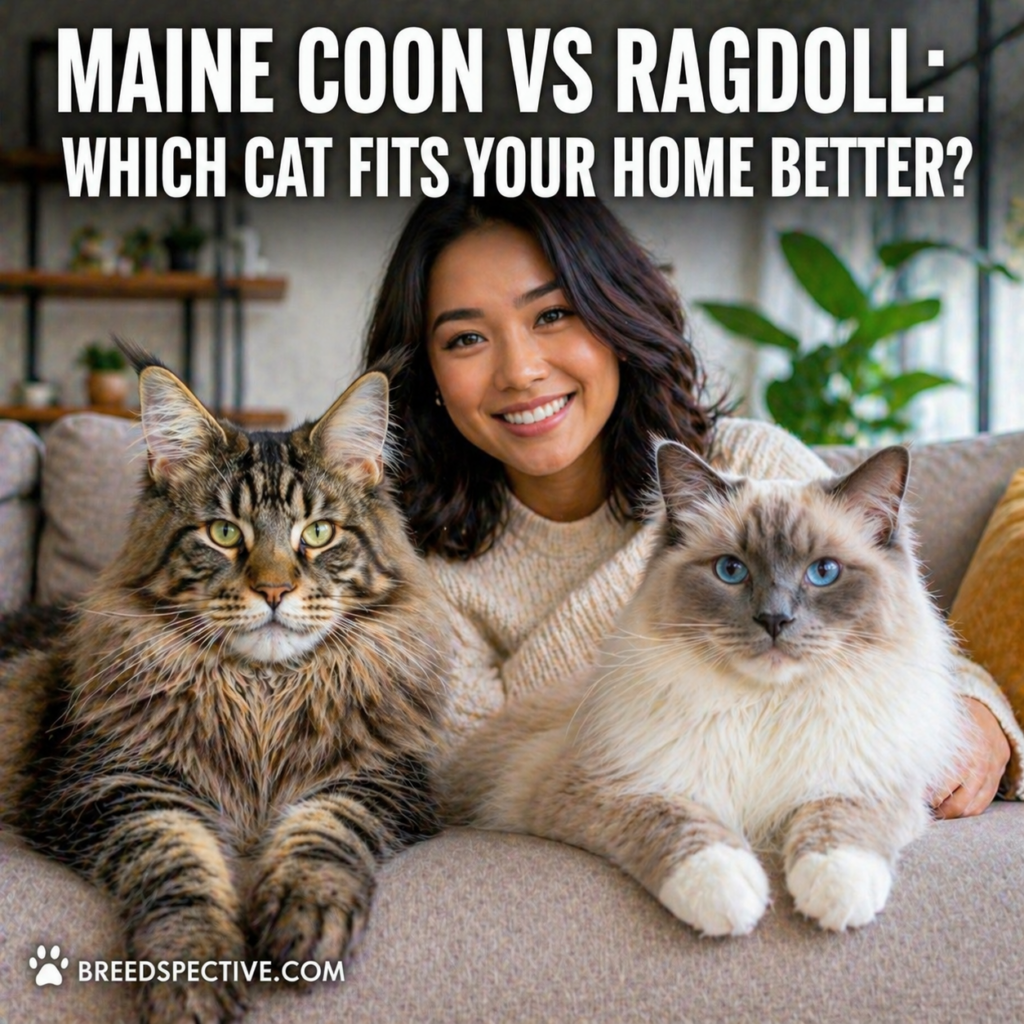
The Maine Coon and Ragdoll are both large, affectionate cats, but the Maine Coon is generally the more active, rugged and independently curious of the two, while the Ragdoll is known for a calmer, gentle and people-oriented temperament. Both can make excellent family companions, but their grooming, activity, health considerations and preferred interaction styles make them better suited to different households. The Cat Fanciers’ Association
Maine Coon vs Ragdoll at a Glance
| Trait | Maine Coon | Ragdoll |
|---|---|---|
| Size | Large; males commonly 13–18 lb., females 9–13 lb. | Large; males commonly 15–20 lb., females 10–15 lb. |
| Build | Long, muscular and rugged | Long, substantial and heavily boned |
| Personality | Friendly, easygoing, playful and curious | Gentle, calm, sociable and affectionate |
| Activity level | Moderate; often playful into adulthood | Moderate; playful but generally relaxed |
| Coat | Shaggy, variable-length coat | Plush, silky semi-long coat |
| Grooming | Regular combing; needs vary by coat texture | Weekly combing; monitor for tangles |
| Vocal style | Often chirps and trills | Generally soft and conversational |
| Family fit | Strong fit for active, social homes | Strong fit for households wanting a close companion |
| Health screening | HCM, hips and other breed-relevant testing | HCM and other breeder-recommended testing |
| Best match | Someone wanting a social but active, curious cat | Someone wanting a gentle, affectionate companion |
TICA identifies both as large breeds. Mature male Maine Coons commonly average 13–18 pounds, while TICA lists mature male Ragdolls at 15–20 pounds. Females of both breeds are generally smaller. Individual cats can fall outside these ranges, and size alone should never be a breeder’s main selection goal. TICA
Maine Coon and Ragdoll Origins
These cats may occupy a similar size category today, but they arrived there through very different histories.
Maine Coon: A Natural New England Breed
The Maine Coon is a natural American breed with deep roots in New England.
Its exact ancestry isn’t known. CFA traces the breed’s roots to New England, where cats arriving with early settlers adapted over generations to the region’s harsh climate. Its substantial body, shaggy coat and heavily tufted paws became characteristic of the breed. The Cat Fanciers’ Association
Stories about Maine Coon origins have produced plenty of folklore. One old myth claimed that domestic cats interbred with raccoons, which is genetically impossible. Other stories connected them with seafaring captains or even Marie Antoinette.
The historical record is clearer once cat shows began.
CFA documents Maine Coons at a Boston show in 1878, and a brown tabby Maine Coon named Cosey won Best Cat at the first major American cat show at Madison Square Garden in 1895. The Cat Fanciers’ Association
The breed later declined in the show world as other longhaired cats became fashionable, but dedicated breeders revived interest. CFA granted the Maine Coon Championship status in 1976. The Cat Fanciers’ Association
Ragdoll: Deliberately Developed in California
The Ragdoll has a much more recent and documented origin.
CFA traces the breed to Ann Baker in Riverside, California, during the 1960s. Baker developed the breed from selected domestic longhaired cats, beginning with a white cat named Josephine. She selectively bred subsequent generations for appearance and temperament. The Cat Fanciers’ Association
The breed’s name came from reports that Josephine’s descendants tended to relax when handled, although CFA specifically notes that going limp when held is not characteristic of every modern Ragdoll. The Cat Fanciers’ Association
CFA accepted Ragdolls for registration in 1993 and granted Championship status in 2000. The Cat Fanciers’ Association
The contrast is useful: the Maine Coon developed naturally in the northeastern United States, while the Ragdoll was intentionally established through selective breeding in 1960s California.
Personality: Independent Companion or Close Follower?
Both breeds are sociable, but neither should be reduced to the generic label “friendly.”
Living With a Maine Coon
CFA describes the Maine Coon as gentle, easygoing and active, with an amiable temperament that adapts well to different environments. The Cat Fanciers’ Association
That combination is a large part of the breed’s appeal.
A Maine Coon can enjoy being involved with its household without necessarily demanding continuous physical contact. Many retain a curious, playful attitude and want to investigate what is happening around them.
Their size can make ordinary cat behavior more noticeable. A Maine Coon climbing a cat tree, racing through a hallway or stretching across a desk occupies considerably more space than a seven-pound cat.
For a more detailed personality profile, see our Maine Coon personality, energy and social traits.
Living With a Ragdoll
CFA describes the Ragdoll as gentle, calm and sociable, as well as loving without necessarily being demanding. The Cat Fanciers’ Association
Ragdolls tend to be strongly interested in people. They may follow family members around the house, settle nearby and participate quietly in everyday routines.
The stereotype that every Ragdoll wants to be constantly carried should be treated cautiously. Personality varies between individual cats, and even CFA notes that the famous tendency to go limp when held isn’t universal. The Cat Fanciers’ Association
A prospective owner should therefore choose a Ragdoll because its general temperament and care requirements are appealing—not because they expect a guaranteed lap cat.
Our Ragdoll personality, energy and social traits guide covers the breed in greater detail.
Energy: The Maine Coon Usually Wants More Action
Neither breed has the nonstop intensity associated with some highly active cats, but there is a meaningful difference in everyday activity.
CFA characterizes the Maine Coon as easygoing yet active. The Cat Fanciers’ Association
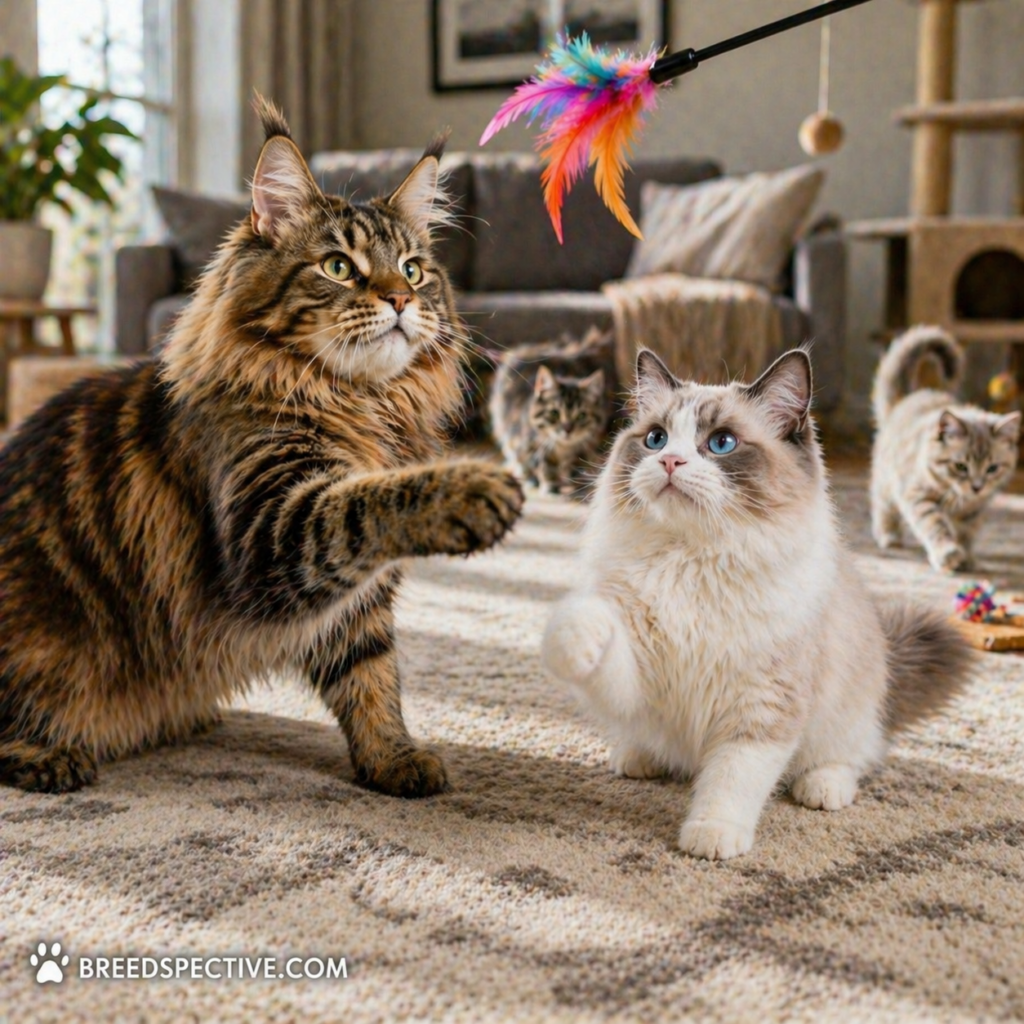
That makes interactive play particularly important. Good outlets include wand toys, sturdy cat trees, tunnels, balls, food puzzles and retrieving games for cats that enjoy them.
Because Maine Coons are large and powerful, furniture needs to match the cat. A narrow, lightweight cat tree designed around a much smaller cat may wobble or provide platforms that are simply too cramped.
Ragdolls play too. CFA describes them as playful and trainable, noting that some can learn behaviors such as fetching and coming when called. The Cat Fanciers’ Association
However, their overall temperament is generally described as placid and calm.
For either breed, plan for several short periods of interactive play throughout the day rather than assuming a relaxed adult cat doesn’t need exercise.
Trainability and Mental Stimulation
Cats aren’t trained exactly like dogs, but both of these breeds can learn household routines and reward-based behaviors.
CFA describes Maine Coons as easy to train, while Ragdolls are described as trainable enough to learn fetching and recall-like behaviors. The Cat Fanciers’ Association
Useful skills can include:
- Entering a carrier voluntarily
- Coming when called
- Accepting brushing and nail care
- Using scratching posts
- Following a target
- Retrieving toys
- Cooperating with routine handling
The Maine Coon’s curiosity can make food puzzles, exploration and interactive toys particularly worthwhile.
Ragdolls benefit from enrichment too. Calm doesn’t mean mentally inactive, and allowing a cat to spend most of every day sleeping without opportunities to play can contribute to an overly sedentary lifestyle.
Grooming: Both Need Combing, but Coat Texture Matters
Both breeds have substantial coats, yet the maintenance isn’t identical.
Maine Coon Grooming
The mature Maine Coon has a shaggy, two-layered coat with shorter fur around the shoulders and longer hair along areas such as the belly, britches and ruff.
TICA notes that coat texture varies considerably between Maine Coons. Some have silkier coats requiring relatively modest maintenance, while cats with cottonier coats can require daily combing and more extensive grooming. TICA recommends introducing regular combing during kittenhood and continuing it throughout life. TICA
Pay particular attention to areas where friction encourages tangles, including:
- Armpits
- Belly
- Britches
- Behind the legs
- Ruff
- Areas around the tail
Waiting until a mat becomes tight against the skin makes grooming considerably harder and potentially uncomfortable.
Ragdoll Grooming
The Ragdoll has a plush, silky coat.
CFA recommends combing at least once or twice a week with a steel comb to remove loose hair and tangles. CFA also notes that Ragdolls lack the extremely dense insulating undercoat found in some longhaired cats, which can reduce matting. The Cat Fanciers’ Association
TICA similarly recommends weekly brushing or combing and suggests watching areas such as the armpits for tangles during shedding periods. TICA
Neither breed should be considered maintenance-free.
Routine care for both also includes nail trimming, dental care and periodic checks of the ears, skin and coat.
Health: HCM Screening Matters for Both Breeds
Hypertrophic cardiomyopathy (HCM) is an important consideration in both Maine Coons and Ragdolls.
HCM involves abnormal thickening of the heart muscle. Breed-specific genetic mutations associated with HCM have been identified in these breeds, which means DNA testing can provide useful information to breeders.
But DNA testing isn’t the entire picture.
Maine Coon HCM Screening
TICA recommends that responsible Maine Coon breeders use both genetic DNA testing and periodic echocardiograms evaluated by a board-certified veterinary cardiologist.
For Maine Coons, TICA specifically identifies the known A31P HCM mutation. It also cautions that genetic testing alone is insufficient because not every genetic cause of HCM has been identified. TICA
CFA likewise identifies both saliva-based testing and echocardiograms as tools used to address HCM in Maine Coons. The Cat Fanciers’ Association
TICA also notes that responsible Maine Coon breeders may screen for hip dysplasia, luxating patella, spinal muscular atrophy and pyruvate kinase deficiency. TICA
Ragdoll HCM Screening
HCM is also a recognized hereditary concern in Ragdolls.
CFA states that breeders routinely test for HCM and work to remove carrier cats from breeding programs. TICA likewise identifies a DNA test for an HCM mutation associated with Ragdolls. The Cat Fanciers’ Association
The existence of a DNA test doesn’t mean a negative result guarantees that a cat can never develop heart disease. Genetic screening addresses known mutations, not every possible cause of HCM.
Questions to Ask a Breeder
For either breed, ask:
- What HCM testing has been performed on both parents?
- Can you see the actual laboratory results?
- Are echocardiograms used in addition to DNA testing?
- At what ages were the parents screened?
- Have close relatives developed HCM?
- What other breed-specific health testing is performed?
Don’t accept “DNA clear” as a substitute for understanding exactly what was tested.
Responsible breeding reduces risk; it cannot provide a lifetime health guarantee.
Family Fit: Children and Other Pets
Both breeds have characteristics that can work well in family homes.
CFA characterizes Maine Coons as friendly, sweet-tempered and adaptable. Ragdolls are described as gentle, calm and sociable. The Cat Fanciers’ Association
That doesn’t make either breed automatically safe with every child.
Maine Coons With Families
A Maine Coon can be a particularly appealing choice for a household that wants an interactive cat.
Their combination of size, playfulness and social temperament can suit families where children enjoy participating in appropriate play.
Children still need to understand boundaries. Even a tolerant cat needs somewhere quiet to sleep and should never be chased, restrained or treated like a toy.
Ragdolls With Families
A Ragdoll’s calm and affectionate temperament can also work particularly well in a family setting.
However, the breed’s reputation for being relaxed should never be used as justification for excessive handling. A cat that tolerates being picked up isn’t necessarily enjoying it.
Allow the individual cat to choose when interaction ends.
Families comparing other options can also review our guide to the best cat breeds for apartment living, particularly if indoor space is a major consideration.
Other Pets
Either breed can potentially share a home successfully with other cats and cat-friendly dogs.
Introductions should still be gradual.
The temperament of the individual animals, previous experience with other pets and quality of the introduction matter more than assuming breed reputation guarantees compatibility.
Space and Apartment Living
Large cats don’t automatically require a large house.
What they do require is appropriately sized equipment and enough environmental enrichment.
For a Maine Coon, that can mean:
- Large litter boxes
- Strong scratching posts
- Stable climbing furniture
- Wide resting platforms
- A carrier rated for a larger cat
The same principle applies to Ragdolls. TICA identifies both as substantial cats, with mature males potentially reaching the upper teens or around 20 pounds. TICA
A smaller home can therefore work if it provides vertical territory, play opportunities, suitable litter facilities and places to retreat.
The Maine Coon’s more active nature may make climbing and interactive enrichment especially valuable. A Ragdoll may appear content to lounge more frequently, but it still needs daily opportunities for movement.
Independence and Time Alone
Neither breed should be selected on the assumption that a cat can automatically be ignored for most of the day.
Maine Coons are social cats but often combine household involvement with curiosity and independent exploration. CFA’s description of the breed as easygoing yet active captures this balance well. The Cat Fanciers’ Association
Ragdolls tend to place greater emphasis on human companionship. CFA describes them as loving, sociable and affectionate. The Cat Fanciers’ Association
That doesn’t mean every Ragdoll will become distressed when left alone or every Maine Coon is highly independent. Those claims would go beyond what breed alone can predict.
Instead, consider your household’s normal rhythm.
A person who wants frequent close companionship may particularly appreciate the Ragdoll. Someone who wants a social cat with a stronger playful and exploratory streak may lean toward the Maine Coon.
Our guide on how to choose the right cat breed for your home can help you weigh temperament against grooming, space and activity needs.
Cost: Maine Coon vs Ragdoll
There isn’t a reliable universal purchase price for either breed. Location, breeder, pedigree, health testing and availability all affect kitten prices.
The more useful comparison is what you will pay for throughout the cat’s life.
| Expense | Maine Coon | Ragdoll |
|---|---|---|
| Food | Potentially substantial for a large cat | Potentially substantial for a large cat |
| Routine veterinary care | Ongoing | Ongoing |
| HCM screening | Relevant breed-specific consideration | Relevant breed-specific consideration |
| Grooming | Usually manageable at home; varies with coat | Usually manageable at home with regular combing |
| Equipment | Large litter boxes, sturdy furniture and carrier | Large litter boxes, sturdy furniture and carrier |
| Dental care | Ongoing preventive consideration | Ongoing preventive consideration |
| Insurance | Optional; compare exclusions carefully | Optional; compare exclusions carefully |
| Emergency care | Financial planning recommended | Financial planning recommended |
Size can quietly increase costs.
Larger carriers, substantial cat trees and roomy litter boxes may cost more than equipment designed for an average-sized cat. Food consumption can also vary with body size, activity, age and the individual cat’s caloric needs.
Health testing is another area where shopping solely by kitten price can be misleading.
A breeder who performs documented DNA testing and appropriate cardiac screening incurs costs that a breeder skipping those measures does not. When comparing kittens, ask what the price includes rather than evaluating the number in isolation.
Verdict: Choose a Maine Coon or Ragdoll?
Choose a Maine Coon if you want a large, friendly cat with a playful and curious side. The breed can be an excellent match for an active household that enjoys interactive play and wants a sociable cat without expecting constant physical closeness. Be prepared for regular grooming, oversized cat equipment and responsible HCM screening.
Choose a Ragdoll if you want a large, gentle companion with a calm, affectionate and strongly people-oriented temperament. The breed can suit someone who enjoys having a cat nearby and is prepared for weekly coat care, appropriate play and breed-specific HCM screening.
Neither is a good choice if you want a small, virtually maintenance-free cat or aren’t prepared for grooming, large-cat equipment and potentially significant veterinary expenses.
The difference isn’t simply active Maine Coon versus cuddly Ragdoll. Individual personalities vary considerably. The more useful distinction is that the Maine Coon combines its sociable temperament with a rugged, active and curious character, while the Ragdoll was deliberately developed around a gentler, placid companion temperament. The Cat Fanciers’ Association