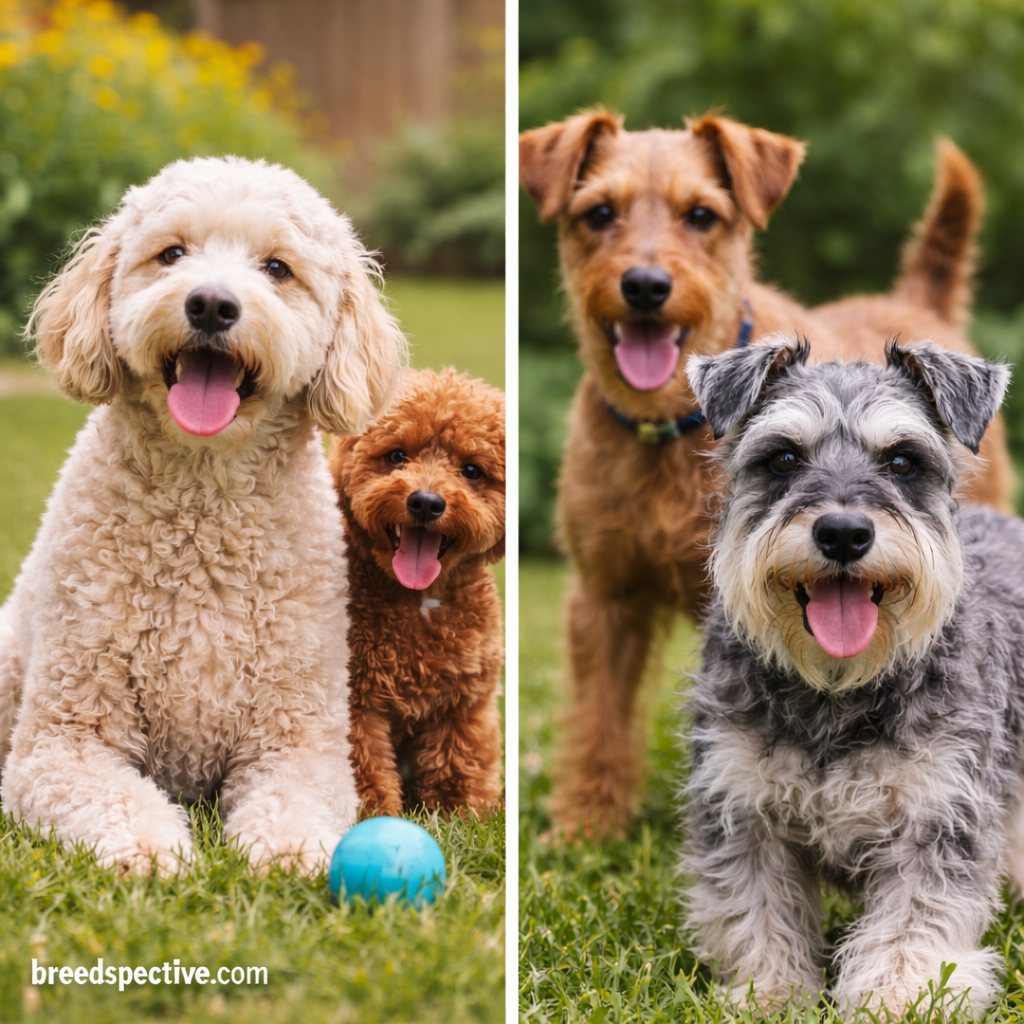
Popular low-shedding dog breeds include Poodles, Bichon Frises, Maltese, Schnauzers, Portuguese Water Dogs, Havanese, Yorkshire Terriers, and several wire-coated terriers. They leave less loose hair around the home than heavy-shedding breeds, but low shedding usually means more coat maintenance, not less, because loose hair can remain trapped in the coat and contribute to tangles and mats.
Low shedding also does not mean hypoallergenic. The American Academy of Allergy, Asthma & Immunology (AAAAI) states that there are no truly hypoallergenic dog breeds because dog allergens come from proteins in sources such as dander and saliva, not simply from shed hair.
Low-Shedding Dog Breeds at a Glance
| Breed | Shedding | Coat Type | Grooming Commitment | Main Trade-Off |
|---|---|---|---|---|
| Poodle | Very low | Curly | High | Regular clipping and brushing |
| Bichon Frise | Very low | Curly | High | Matting without regular grooming |
| Maltese | Very low | Long, silky | High | Frequent brushing |
| Miniature Schnauzer | Low | Wiry | Moderate–high | Clipping or specialized grooming |
| Portuguese Water Dog | Low | Curly/wavy | High | Active dog with substantial coat care |
| Havanese | Low | Long, soft | High | Regular brushing |
| Yorkshire Terrier | Low | Fine, long | High | Coat maintenance despite tiny size |
| Soft Coated Wheaten Terrier | Low | Soft, wavy | High | Tangles and mats |
| Labradoodle | Variable | Variable | Variable–high | Coat and shedding are unpredictable |
| Goldendoodle | Variable | Variable | Variable–high | Coat and shedding are unpredictable |
These categories describe typical coat tendencies rather than guarantees. Individual dogs can differ, and mixed breeds in particular can inherit different combinations of coat traits.
What Does Low-Shedding Actually Mean?
Every dog loses some hair and skin cells.
“Low-shedding” simply describes dogs that release noticeably less loose coat into their environment than breeds known for frequent or seasonal shedding.
With a Labrador Retriever, German Shepherd, or Siberian Husky, shed hair may be easy to see on clothing, floors, furniture, and bedding.
With many Poodles or Bichons, loose hairs tend to remain caught within the surrounding coat until brushing and grooming remove them.
That is why low shedding and low maintenance are not interchangeable.
A dog that deposits relatively little hair on the sofa may require far more brushing, combing, clipping, and professional grooming than a dog that sheds heavily.
If minimizing visible hair is your priority, low-shedding breeds can be an excellent fit.
If minimizing grooming is your priority, they may not be.
Why Do Some Dogs Shed Less?
Dogs have different coat structures and hair-growth patterns.
Some have dense double coats consisting of an outer coat and insulating undercoat. Others have continuously growing or slow-shedding coats that require regular trimming.
Coat texture also matters.
Curly hair can hold loose hairs within the coat rather than allowing them to fall easily onto the floor. Long, fine coats may shed relatively little but become tangled if not brushed.
This produces several common low-shedding coat types.
Curly coats
Poodles and Bichon Frises are classic examples.
Loose hair becomes caught within the curls, reducing the amount deposited around the home.
The trade-off is matting.
Without thorough brushing and combing, tangles can tighten close to the skin and become uncomfortable.
Long, continuously growing coats
Breeds such as the Maltese and Yorkshire Terrier can grow long coats while shedding relatively little.
These coats need regular brushing to remain free of tangles.
Many pet owners choose shorter clips because maintaining a floor-length coat requires significantly more work.
Wiry coats
Schnauzers and several terriers have coarse coat textures associated with relatively low shedding.
Traditional coat care for some wire-coated breeds involves hand-stripping, in which dead outer hairs are removed rather than simply clipped.
Pet grooming routines may differ from show-coat maintenance, so prospective owners should ask what care their chosen breed realistically requires.
Our guide to grooming needs by dog coat type explains these differences in more detail.
1. Poodle
The Poodle is one of the best-known low-shedding breeds and comes in Standard, Miniature, and Toy varieties.
Its dense curly coat sheds very little visibly because loose hairs tend to remain trapped in the surrounding curls.
That advantage creates a substantial grooming commitment.
Poodles need regular brushing and clipping. A neglected coat can mat, particularly in friction areas such as behind the ears, around the collar, under the legs, and where the limbs meet the body.
They are also active, intelligent dogs.
Someone choosing a Poodle simply because it sheds less may be surprised by the breed’s need for exercise, interaction, and mental stimulation.
Read our Poodle temperament, energy level, and lifestyle profile before making coat type the deciding factor.
2. Bichon Frise
The Bichon Frise combines small size with a curly coat that releases relatively little loose hair around the home.
The AKC includes Bichons among breeds commonly considered by people seeking low-shedding dogs and notes that their hair continues growing and requires regular grooming to prevent mats.
That makes the Bichon a good example of the basic low-shedding trade-off.
Less hair on your clothes does not mean less work.
A Bichon generally needs consistent brushing along with regular trimming.
Best for:
- People wanting a small low-shedding companion
- Owners prepared for professional grooming
- Households willing to brush consistently
3. Maltese
The Maltese has a long, silky coat that sheds relatively little.
Its small body also means there is simply less dog and coat to maintain than with a Standard Poodle or Portuguese Water Dog.
Still, a long Maltese coat can require substantial brushing.
Many companion Maltese are kept in shorter trims to simplify maintenance.
Best for:
- People wanting a very small dog
- Owners prioritizing minimal visible shedding
- Households comfortable with regular brushing or grooming appointments
Small size should not be confused with low maintenance.
4. Miniature Schnauzer
The Miniature Schnauzer offers a different coat from curly Poodle-type breeds.
Its characteristic wiry coat sheds relatively little but still requires regular maintenance.
Clipping is common for companion dogs, while traditional show-coat preparation may involve hand-stripping.
Schnauzers are also alert terriers rather than passive lap dogs. Temperament and activity level need to fit your household independently of the coat.
5. Portuguese Water Dog
The Portuguese Water Dog combines a low-shedding curly or wavy coat with a substantially more athletic lifestyle.
This matters because lists of “hypoallergenic dogs” often group breeds together by coat without explaining how different they are to live with.
A Portuguese Water Dog and a Maltese may both appeal to someone trying to reduce loose hair, but their size, exercise requirements, training needs, and daily routines are very different.
The Portuguese Water Dog suits active households prepared for both exercise and regular grooming.
6. Havanese
The Havanese is another smaller companion breed with a coat that sheds relatively little.
The AKC notes that the breed’s long coat needs regular grooming despite its limited shedding.
That combination can work well for someone who wants a small companion and is willing to maintain the coat.
A shorter pet trim can reduce some of the daily burden, but it does not eliminate grooming.
7. Yorkshire Terrier
Yorkshire Terriers are often described as having hair-like coats because of their long, fine texture.
They shed relatively little compared with many other breeds but require regular coat care.
A full-length Yorkie coat is a serious maintenance commitment. Shorter trims are much more practical for many companion homes.
Yorkies are also terriers.
Low shedding says nothing about barking, confidence, energy, or trainability, all of which should be considered separately.
8. Soft Coated Wheaten Terrier
The Soft Coated Wheaten Terrier offers another low-shedding option for someone wanting a larger dog than the typical toy companion breed.
Its soft coat can tangle and requires regular maintenance.
This breed also illustrates an important point: coat convenience should never outrank temperament and activity requirements when choosing a dog.
A household looking for a quiet, sedentary companion should not choose an energetic terrier solely because it leaves less hair on the furniture.
No Dog Is Truly Hypoallergenic
This is the most important distinction to make when discussing low-shedding dogs.
Low-shedding and hypoallergenic are not synonyms.
The AAAAI states that there are no truly hypoallergenic breeds of dogs or cats. Pet allergies are caused by proteins found in sources including dander, saliva, and urine, rather than by hair itself.
One major dog allergen is Can f 1. AAAAI clinical guidance identifies Can f 1 in dog dander, hair, and saliva, and dog-allergic people can respond to allergens that become airborne or spread through the home.
This means a hairless dog can still produce allergens.
A Poodle can still produce allergens.
A dog that leaves almost no visible hair on the sofa can still trigger symptoms.
The AKC likewise cautions that no purebred, mixed-breed, or designer dog can guarantee an allergy-free household.
Why shedding still gets associated with allergies
Hair can carry dander and other material through the environment.
A dog that sheds heavily can therefore distribute hair and associated allergens around furniture, carpeting, clothing, and bedding.
But reducing visible shed hair does not guarantee that the dog produces fewer allergenic proteins.
That is why “hypoallergenic” should be treated as a convenient informal description rather than a medical guarantee.
Individual Dogs Can Produce Different Allergen Levels
Breed labels are not precise allergy tests.
AAAAI guidance notes that dog allergens occur across breeds, while the AKC summarizes research showing that individual dogs can differ in the amount of allergen they produce.
That creates an important distinction.
Two dogs from the same breed may not cause exactly the same response in the same person.
Likewise, reacting mildly to one Poodle does not guarantee the same response to every Poodle.
For someone with known dog allergies, especially asthma or significant respiratory symptoms, choosing a breed from a “hypoallergenic” list should not replace medical advice.
AAAAI recommends working with an allergist to identify the actual allergy and develop an appropriate management plan.
Does Spending Time With a Dog Before Adoption Help?
It can provide useful information about your immediate response to that individual dog, but it cannot guarantee what living together will be like.
Allergen exposure in a home is continuous and allergens can accumulate in carpets, furniture, bedding, and other surfaces.
A short meeting at a breeder’s home or shelter therefore cannot prove that someone will remain symptom-free after months of living with the dog.
Still, if a person immediately develops significant symptoms around a particular dog, that information clearly matters.
Someone with diagnosed allergies should discuss the decision with an allergist rather than relying entirely on breed reputation.
Low-Shedding Does Not Mean Low-Grooming
This is the trade-off many owners discover after bringing the dog home.
Heavy-shedding breeds often dispose of dead coat by dropping it around the environment.
Many low-shedding breeds retain loose hair within the coat.
Someone has to remove it.
Depending on the breed and haircut, coat care may involve:
- Brushing several times per week
- Thorough combing close to the skin
- Regular bathing and drying
- Professional clipping
- Beard and facial cleaning
- Ear-area maintenance
- Removing tangles before they become mats
The exact schedule varies by breed, coat length, lifestyle, and individual dog.
A dog kept in a short pet trim may require a very different home routine from the same breed maintained in a long coat.
Professional grooming also needs to be part of the budget.
If paying for grooming every several weeks would become financially difficult, a low-shedding breed with a continuously growing coat may not be the most practical choice.
Why Matting Is More Than a Cosmetic Problem
Mats are dense tangles that tighten within the coat.
They can pull against the skin and make normal movement uncomfortable. Severe matting can also make it harder to inspect the skin and may complicate routine grooming.
High-friction areas deserve particular attention, including:
- Behind the ears
- Armpits
- Legs
- Belly
- Collar and harness areas
- Tail
- Beard and face
Brushing only the surface can leave tangles underneath.
For curly or long-coated dogs, a comb can help check whether grooming has actually reached through the coat rather than simply smoothing the top layer.
Are Labradoodles Low-Shedding?
Some are.
Some are not.
A Labradoodle combines Labrador Retriever and Poodle ancestry, and coat inheritance is not as predictable as simply assuming every puppy receives the Poodle’s low-shedding coat.
Individuals can develop curlier, wavier, or straighter coats and can differ in shedding.
The Labradoodle’s temperament and family compatibility also matter more to daily life than the “doodle” label alone.
Do not buy a Labradoodle based on a guarantee that it will be hypoallergenic.
No responsible coat prediction can turn the dog into an allergen-free animal.
Are Goldendoodles Low-Shedding?
The same caution applies to Goldendoodles.
Crossing a Golden Retriever with a Poodle can produce different coat outcomes.
Some Goldendoodles shed very little. Others shed noticeably.
Even a curly, low-shedding Goldendoodle still produces dog allergens and may require intensive grooming.
Before choosing one for its coat, consider the complete Goldendoodle temperament and family compatibility rather than assuming every Poodle cross offers identical characteristics.
Are Cavapoos Low-Shedding?
Cavapoos can also inherit different coat characteristics from their Cavalier King Charles Spaniel and Poodle ancestry.
Some develop curlier coats with relatively low shedding. Others may shed more.
Their smaller size does not eliminate coat maintenance.
A curly Cavapoo can require frequent brushing and professional grooming to prevent tangles.
Our Cavapoo temperament and family compatibility guide covers the non-coat factors that should also influence the decision.
Purebred vs. Poodle Mix: Which Coat Is More Predictable?
If predictable shedding is a high priority, an established breed with a consistently defined coat generally offers more predictability than a first-generation cross between breeds with very different coat characteristics.
A Poodle has generations of selection behind its recognizable curly coat.
A Poodle cross can inherit a combination of traits from both parents.
Later-generation breeding may change the probabilities, but individual variation remains.
That does not make mixed-breed dogs inferior.
It simply means prospective owners should be skeptical of absolute claims such as:
- “Guaranteed non-shedding”
- “Completely hypoallergenic”
- “Allergy-proof”
- “Maintenance-free coat”
Those promises go beyond what coat genetics or allergy science can reliably guarantee.
How to Reduce Dog Allergens at Home
For people with dog allergies who are medically able to live with a dog, reducing exposure may help manage the environment.
AAAAI suggests measures such as:
- Keeping the bedroom pet-free
- Washing bedding regularly
- Using HEPA filtration
- Cleaning carpeting and allergen-holding surfaces
- Limiting access to upholstered furniture
- Discussing symptoms and treatment with an allergist
These measures reduce exposure; they do not make the dog hypoallergenic.
Frequent bathing is sometimes suggested as another strategy, but bathing needs to be appropriate for the dog’s skin and coat. Excessive bathing can create its own skin problems, so veterinary and grooming advice is preferable to simply washing the dog as often as possible.
Common Low-Shedding Dog Myths
“Dogs with hair don’t shed.”
They do.
The amount and pattern may be much less noticeable, but hair is still lost.
“Low-shedding dogs don’t need much grooming.”
Often the opposite is true.
Coats that retain loose hair can require extensive brushing and professional grooming.
“Hypoallergenic means allergy-free.”
No dog is allergy-free.
AAAAI explicitly states that there are no truly hypoallergenic dog breeds.
“Poodle mixes never shed.”
Coat inheritance in mixed-breed dogs varies. A Labradoodle, Goldendoodle, or Cavapoo cannot automatically be assumed to inherit a low-shedding Poodle coat.
“A hairless dog cannot cause allergies.”
Hair is not the only source of dog allergens. Dander and saliva still matter.
“A dog that doesn’t bother one allergic person won’t bother another.”
Allergic sensitivities vary, as can allergen production among individual dogs.
How to Choose the Right Low-Shedding Dog
Start with lifestyle, then consider coat.
Ask:
- What adult size can I comfortably manage?
- How much daily exercise can I provide?
- How much barking can my living situation tolerate?
- How much training do I want to do?
- Can I brush the dog several times a week if needed?
- Can I afford recurring professional grooming?
- Do I actually have a diagnosed dog allergy?
- If so, have I discussed dog ownership with an allergist?
- Am I comfortable with a dog whose coat may require lifelong clipping?
- Would I still want this breed if it shed more than expected?
That final question is especially useful for Poodle mixes.
Choose the dog because its temperament, activity level, size, trainability, health considerations, and care requirements fit your household — not because someone promised it would never leave hair on your clothes.
Our broader guide to choosing the right dog breed for your lifestyle can help narrow those factors before coat type becomes the deciding feature.
Verdict: Who Should Choose a Low-Shedding Dog?
A low-shedding breed is a strong choice for someone who dislikes loose hair around the home and is willing to exchange vacuuming for regular coat maintenance.
The Poodle offers one of the most predictable low-shedding coats and comes in three sizes, but it needs grooming, exercise, and mental engagement. Bichon Frises, Maltese, Havanese, Yorkshire Terriers, and Miniature Schnauzers provide smaller alternatives, each with its own grooming and temperament requirements. The Portuguese Water Dog suits a more active household wanting a larger low-shedding breed.
Labradoodles, Goldendoodles, Cavapoos, and other Poodle crosses can shed very little, but their coats are less predictable and should never be sold as guaranteed hypoallergenic.
Low-shedding dogs are not the right choice for someone looking for a maintenance-free coat. They are also not a medically guaranteed solution to dog allergies.
For allergy-sensitive households, the most important distinction is simple: less hair around the house is a realistic expectation with some breeds; an allergen-free dog is not.