
Dachshund temperament is typically bold, clever, alert, affectionate, and surprisingly independent for such a small dog. Bred to pursue dangerous quarry underground, Dachshunds often behave more like determined working hounds than passive lap dogs, which helps explain their barking, digging, persistence, and occasional resistance to training.
Their compact size makes them practical for many homes, but small does not mean effortless. A Dachshund needs daily exercise, consistent training, careful weight management, and lifelong attention to back health.
Dachshund at a Glance
| Trait | Dachshund |
|---|---|
| Size | Standard and miniature |
| Typical weight | Standard: usually 16–32 pounds; miniature: 11 pounds or under at 12 months and older |
| Life expectancy | About 12–16 years |
| Exercise needs | Moderate; daily walks and play |
| Grooming | Low to moderate, depending on coat type |
| Trainability | Intelligent but independent and easily distracted |
| Good with children? | Can be, especially with respectful older children |
| Good with other pets? | Variable; socialization and prey drive matter |
| Vocal level | Often high |
| Best fit | Owners who want an interactive small dog and will manage its back, training, and barking |
The American Kennel Club’s official Dachshund standard describes the breed as clever, lively, courageous and persevering. The standard recognizes three coat varieties—Smooth, Wirehaired and Longhaired—and two sizes.
Dachshund History and Original Purpose
The Dachshund’s unusual proportions were developed for work, not simply appearance.
“Dachshund” translates from German as “badger dog.” These hounds were developed to pursue quarry into underground dens. Their short legs kept them close to the ground, while their elongated bodies allowed them to maneuver through tunnels.
The Dachshund Club of America explains that dogs described as badger dogs appeared in European records centuries ago, with dogs resembling modern Dachshunds documented by the early 1700s. German breeders later standardized the breed, and the first German breed club was established in 1888.
Badgers were not the Dachshund’s only quarry. The DCA describes the breed as a versatile hunting dog capable of going to ground, tracking, flushing game and retrieving.
The official AKC standard still reflects that working heritage. It calls for a dog with a keen nose, hunting spirit, loud voice and a body suited to working below ground.
That background explains a great deal about modern Dachshund behavior.
A dog expected to enter a dark tunnel after dangerous quarry needed courage, persistence and enough independence to make decisions without waiting for constant instructions. Those qualities remain present even in Dachshunds whose most demanding job is locating a treat under the sofa.
The breed has also become a cultural symbol. Waldi, a colorful striped Dachshund created for the 1972 Munich Games, became the first official Olympic mascot.
Dachshund Temperament in Everyday Life
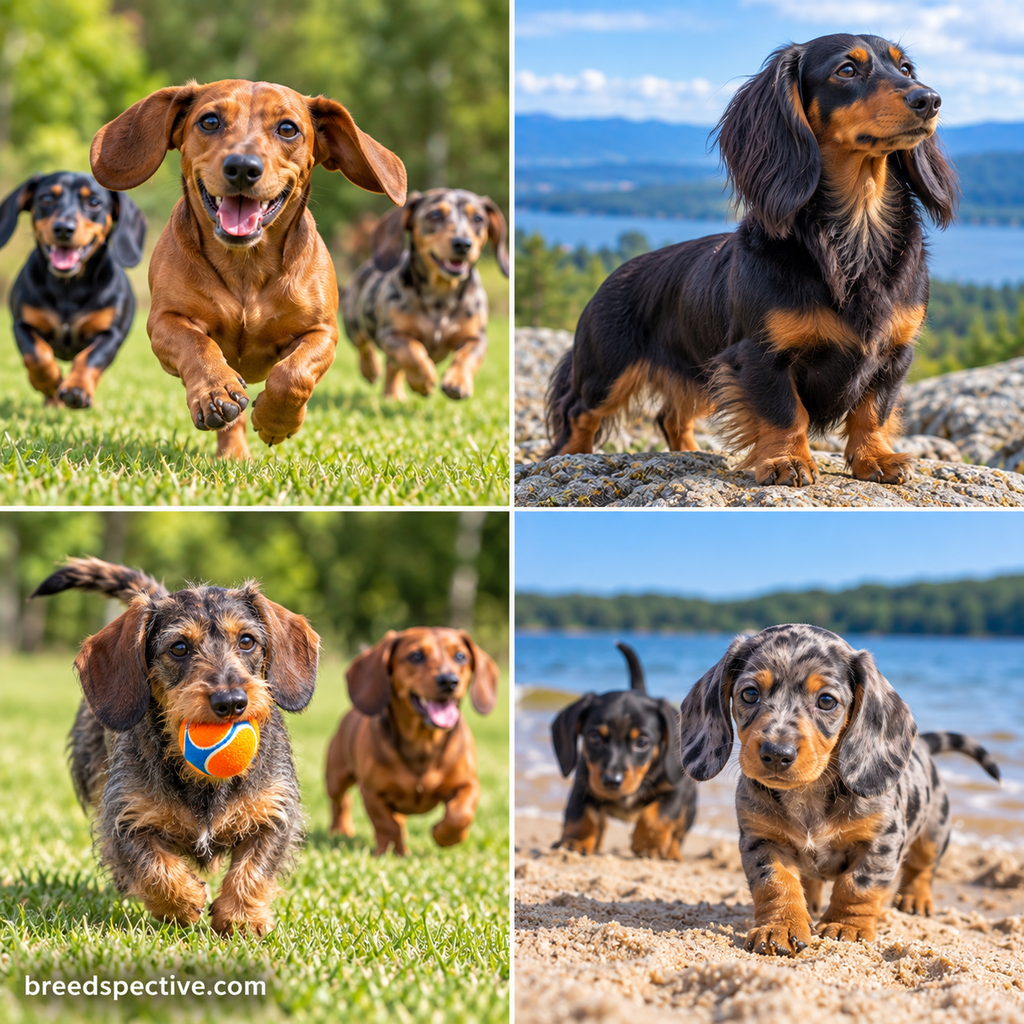
The AKC standard’s description of a clever, lively and courageous dog is a useful starting point, but living with those qualities produces some important trade-offs.
Bold Despite Their Size
Many Dachshunds behave as though nobody told them they were small.
They can approach unfamiliar noises, larger dogs and changes around the home with considerable confidence. This boldness is part of their appeal, but owners should prevent confidence from turning into unsafe confrontations.
A Dachshund does not need to challenge every dog it encounters.
Early socialization should expose puppies gradually to different people, appropriate dogs, surfaces, noises and environments while rewarding calm behavior.
Affectionate and People-Oriented
Dachshunds often form strong attachments to their households. Many enjoy sleeping beside their people, burrowing under blankets and staying close during quiet periods.
That affection can coexist with considerable independence.
A Dachshund may happily follow you around the house and then completely reassess your importance when an interesting scent appears outdoors.
People looking for a similarly small companion but a different personality profile can compare these traits with our guide to Chihuahua temperament, energy level, and lifestyle fit.
Alert and Vocal
Dachshunds tend to notice what is happening around them.
Their hunting heritage included using their voice, and the AKC standard specifically refers to the breed’s “loud tongue.” In a modern home, that can translate into barking at visitors, animals outside, hallway noises, deliveries or unfamiliar sounds.
For someone who appreciates an alert little watchdog, that may be desirable.
For someone living beside noise-sensitive neighbors, it can become one of the breed’s biggest drawbacks.
Dachshund Energy Level and Exercise Needs
Dachshunds have moderate exercise needs, but they should not be treated as sedentary lap dogs.
The AKC recommends regular exercise and notes that maintaining appropriate muscle tone and body weight is particularly important for supporting the Dachshund’s long back. Two moderate walks each day, combined with play and exploration, can provide a practical routine for many healthy adults.
Exercise can include:
- Controlled walks
- Sniffing and exploration
- Indoor games
- Food searches
- Gentle fetch
- Short training sessions
- Appropriate scent work
Dachshunds are hounds, so allowing time to investigate smells can make walks more mentally satisfying than simply covering distance as quickly as possible.
Exercise needs change with age and health. Puppies should receive age-appropriate activity, while dogs with diagnosed spinal or orthopedic problems need veterinary guidance.
A Dachshund is more active than some people expect from a dog this size. If low activity is a major requirement, compare the breed with our guide to low-energy dog breeds for apartment living.
Training a Dachshund
Dachshunds are intelligent. They are not necessarily interested in obeying simply because they understand what you want.
That distinction matters.
Their original work required independent decision-making, persistence and intense focus. Modern Dachshunds can learn household rules and obedience skills very well, but training generally works best when there is a clear reason for the dog to participate.
Use:
- Food rewards
- Short sessions
- Clear cues
- Consistent household rules
- Gradually increasing distractions
- Frequent reinforcement for desired behavior
Avoid turning training into a battle of wills.
Reward-based training gives the Dachshund a reason to choose the behavior you want. Repeating the same command while the dog practices ignoring it usually accomplishes the opposite.
Common Dachshund Behavior Problems and How to Manage Them
The most common frustrations with Dachshunds often have obvious connections to their original job.
Barking
Dachshunds can be surprisingly loud.
They may bark when somebody approaches the home, when they hear activity outside, when excited or when they want something. Barking can become self-reinforcing if the dog repeatedly rushes to a window, barks at a passerby and then watches that person “leave.”
Management can include limiting access to high-trigger windows, using privacy film or curtains, rewarding quiet behavior and teaching the dog to go to a mat when visitors arrive.
The goal should be reasonable control, not expecting a naturally vocal hound never to make noise.
Digging
A dog developed to pursue quarry underground comes with a reasonable chance of enjoying excavation.
Provide an acceptable outlet when possible. A designated digging area, supervised outdoor exploration, scent games and food-search activities can redirect some of that motivation.
Secure fencing also matters. Check the bottom of fences and gates rather than assuming a short-legged dog cannot escape.
House-Training Problems
Dachshunds have a reputation for being difficult to house-train, but consistency and management matter enormously.
Take puppies outside frequently, especially after waking, eating, drinking and active play. Use the same toilet area when practical and reward successful elimination immediately.
Indoors, supervision prevents the puppy from repeatedly rehearsing accidents. A properly introduced crate or small puppy-safe area can help when direct supervision is impossible.
Cold or wet weather may make some Dachshunds reluctant to stay outside long enough to eliminate, so owners still need to maintain the routine rather than simply accepting indoor accidents.
For realistic expectations during puppyhood, see our guide to potty-training timelines by dog breed.
Resource Guarding
Some Dachshunds may become possessive of food, chews, toys, beds or other valued resources.
Do not routinely take valued objects away merely to prove that you can. Instead, teach trading by offering something better and rewarding the dog for releasing objects voluntarily.
Growling is useful communication. Punishing the warning without addressing the underlying discomfort can make future behavior harder to predict.
Persistent or escalating guarding deserves help from a qualified reward-based trainer or veterinary behavior professional.
Chasing and Ignoring Recall
Dachshunds remain scent hounds.
An interesting trail or small animal can compete strongly with recall, so unsecured off-leash freedom should not be assumed to be safe simply because the dog performs well indoors.
A long training line allows recall practice without giving the dog an opportunity to disappear after a scent.
The same issue appears in other scent hounds. Our guide to Beagle temperament and lifestyle fit provides a useful comparison.
IVDD and Dachshund Back Protection
Back health deserves its own discussion because intervertebral disc disease, or IVDD, is an important concern in Dachshunds.
The Dachshund’s distinctive long body and short legs are associated with early degeneration of the intervertebral discs. UC Davis School of Veterinary Medicine identifies Dachshunds among the short-legged breeds in which Type I disc disease is seen most commonly and explains that Dachshunds can experience disc degeneration earlier in life.
Intervertebral discs sit between the vertebrae and function partly as shock absorbers. With degeneration, disc material can herniate and compress the spinal cord.
Signs can include:
- Back or neck pain
- Reluctance to move
- A hunched posture
- Weakness
- Wobbling or difficulty walking
- Loss of coordination
- Paralysis
Sudden weakness, severe pain or inability to walk requires prompt veterinary attention.
Protecting a Dachshund’s Back
No household strategy can eliminate the breed’s genetic susceptibility to IVDD, but owners can reduce unnecessary physical stress and support overall fitness.
Keeping a Dachshund lean is particularly important. Excess weight adds unnecessary load to an already vulnerable body structure.
Regular controlled exercise helps maintain useful muscle condition. The goal is not to prevent normal movement but to avoid unnecessary high-impact behavior.
The AKC advises owners to monitor activities that could result in back injury and specifically cautions against repeatedly running up and down stairs or jumping on and off furniture.
Practical household changes can include:
- Using a stable ramp for frequently accessed furniture
- Blocking unsupervised access to steep stairs when appropriate
- Discouraging repeated jumping from beds and sofas
- Providing non-slip surfaces on slick floors
- Keeping the dog at a healthy body condition
- Maintaining regular controlled exercise
When lifting a Dachshund, support both the front and rear of the body rather than allowing the hindquarters to hang unsupported.
Back protection should be a lifelong habit, not something introduced only after an injury.
Dachshunds and Children
Dachshunds can live successfully with children, but they are not automatically the easiest small breed for households with very young kids.
Their backs require careful handling, and a child should never be allowed to pick up, drop, sit on or roughly wrestle with a Dachshund.
The AKC notes that the breed may be better suited to older children who understand how to interact responsibly with dogs.
Supervision should protect both sides of the relationship. Children need rules about handling and respecting the dog’s resting areas, while the Dachshund needs appropriate training and somewhere quiet to retreat.
Dachshunds and Other Pets
Compatibility varies considerably by individual dog.
Properly socialized Dachshunds can live with other dogs, and many enjoy canine companionship. Their hunting background, however, means small animals may trigger predatory interest.
Cats may be compatible when introductions are gradual and the individual dog behaves appropriately around them. Rabbits, rodents and other small prey animals require particularly careful separation and management.
Do not assume that a Dachshund’s size eliminates prey drive.
Grooming the Three Dachshund Coat Types
Grooming requirements vary because Dachshunds come in three coat varieties.
Smooth Dachshunds have the simplest routine. Regular brushing or wiping removes loose hair and keeps the coat clean.
Longhaired Dachshunds need more frequent brushing to prevent tangles, particularly around the ears, legs and other feathered areas.
Wirehaired Dachshunds have a harsher outer coat and undercoat and require more coat maintenance. Owners interested in maintaining the traditional texture may use hand stripping rather than simply clipping the coat.
All varieties also need routine nail trimming, dental care and ear checks.
Dachshund Health Screening
Responsible breeders should perform breed-appropriate health testing before breeding.
The Dachshund Club of America’s health statement, in conjunction with OFA/CHIC guidance, identifies core screening that includes:
- Patellar evaluation
- Eye examination by a board-certified veterinary ophthalmologist
- Cardiac evaluation
The DCA also identifies other conditions that breeders should consider, including IVDD and progressive retinal atrophy, as meaningful screening methods become available.
Prospective buyers should ask for the actual registered results rather than accepting “health tested” as a complete answer.
A CHIC number means the required breed-specific testing has been completed and results have been made publicly available according to program requirements. It should not be interpreted as a guarantee that a dog or its offspring will never develop disease.
Health screening reduces uncertainty; it does not eliminate it.
How Much Does a Dachshund Cost Per Year?
Dachshunds eat less than large dogs, but veterinary care, preventive medication, insurance and emergency treatment can still make ownership expensive.
A reasonable U.S. planning budget might look like this:
| Expense | Practical annual planning range |
|---|---|
| Food and treats | $250–$600 |
| Routine veterinary care | $300–$700 |
| Parasite prevention | $150–$350 |
| Toys, chews and enrichment | $100–$300 |
| Grooming/basic supplies | $75–$400 |
| Training | $0–$500+ |
| Pet insurance | $300–$900+ |
| Typical planning total | About $1,175–$3,750+ |
These are budgeting estimates rather than fixed national prices. Coat type, location, insurance coverage, food choice, age and individual health can move the total considerably.
They also exclude major emergencies, boarding, daycare, professional dog walking, dental procedures and the initial cost of acquiring and equipping for the dog.
Because spinal problems can require advanced imaging, specialist treatment or surgery, prospective Dachshund owners should consider how they would handle a major veterinary bill before bringing the dog home.
Who Is a Dachshund Best Suited To?
A Dachshund can be an excellent match for someone who wants a small dog with a large amount of personality.
Good matches often include people who:
- Want an affectionate, interactive companion
- Can provide daily walks and mental stimulation
- Appreciate an alert dog
- Are patient about training
- Can tolerate some barking
- Will manage jumping and back health
- Can maintain a healthy body weight
- Want a small dog without expecting a passive lap dog
Their size can make them practical in apartments and smaller homes, provided barking and exercise are properly managed.
Who Should Think Twice About a Dachshund?
This breed may be frustrating for someone who wants effortless obedience, a consistently quiet dog or a pet that can be handled roughly without consequence.
Think carefully if:
- You strongly dislike barking
- You want dependable off-leash freedom with little training
- You are unwilling to manage furniture jumping or stairs
- You cannot budget for potential spinal care
- Small children will have unsupervised access to the dog
- You expect a small breed to need almost no exercise
- You do not want to work through house-training patiently
Appearance should not make the decision. The long body and short legs are memorable, but the hunting temperament attached to that body is what owners live with every day.
Before choosing any breed, our guide to finding the right dog breed for your lifestyle can help you compare the traits that matter over a dog’s entire life.
Verdict: Is a Dachshund Right for You?
A Dachshund is right for someone who wants a clever, affectionate and entertaining small hound and is willing to accept the independence that comes with it. Daily walks, scent-based enrichment, consistent training, sensible barking management and careful attention to back health should be considered normal parts of ownership.
A Dachshund is not the best fit for someone seeking a silent lap dog, effortless house-training or a dog that will automatically prioritize commands over an interesting scent. Their physical structure also creates responsibilities that do not disappear just because the dog is young and healthy.
Choose a Dachshund if you want the complete breed: a compact companion with the confidence, persistence and instincts of the underground hunter it was developed to be.