
There is no scientifically established potty-training timeline for each individual dog breed. Breed and especially adult size can influence the process, but age, bladder capacity, previous training, routine and owner consistency usually matter more than whether your puppy is a Labrador, Chihuahua or Dachshund.
As a practical expectation, house-training usually takes weeks to months, not days. Toy and small puppies often need more frequent bathroom trips because of their smaller size, while an individual puppy of any breed can take longer to become completely reliable.
Potty Training Timeline at a Glance
It is more useful to think about house-training by developmental stage and size than to promise that a particular breed will be trained within a certain number of weeks.
| Puppy stage/type | What to expect |
|---|---|
| 8–10 weeks | Very frequent bathroom opportunities and close supervision |
| 10–12 weeks | Beginning to recognize the routine, but accidents remain normal |
| 3–4 months | Increasing physical control and clearer habits with consistent training |
| 4–6 months | Many puppies show substantial improvement, but reliability varies |
| 6+ months | Continued accidents may still reflect training gaps, schedule problems or individual development |
| Toy/small breeds | Often require more frequent trips and may take longer to become reliably house-trained |
| Adult newly adopted dogs | May learn quickly if previously trained, or need a complete restart if their history is unknown |
These are planning ranges rather than deadlines. A puppy that still needs active supervision at six months has not automatically failed, and a puppy that goes several days without an accident at four months should not automatically be given unrestricted access to the house.
Why Potty Training Timelines Vary
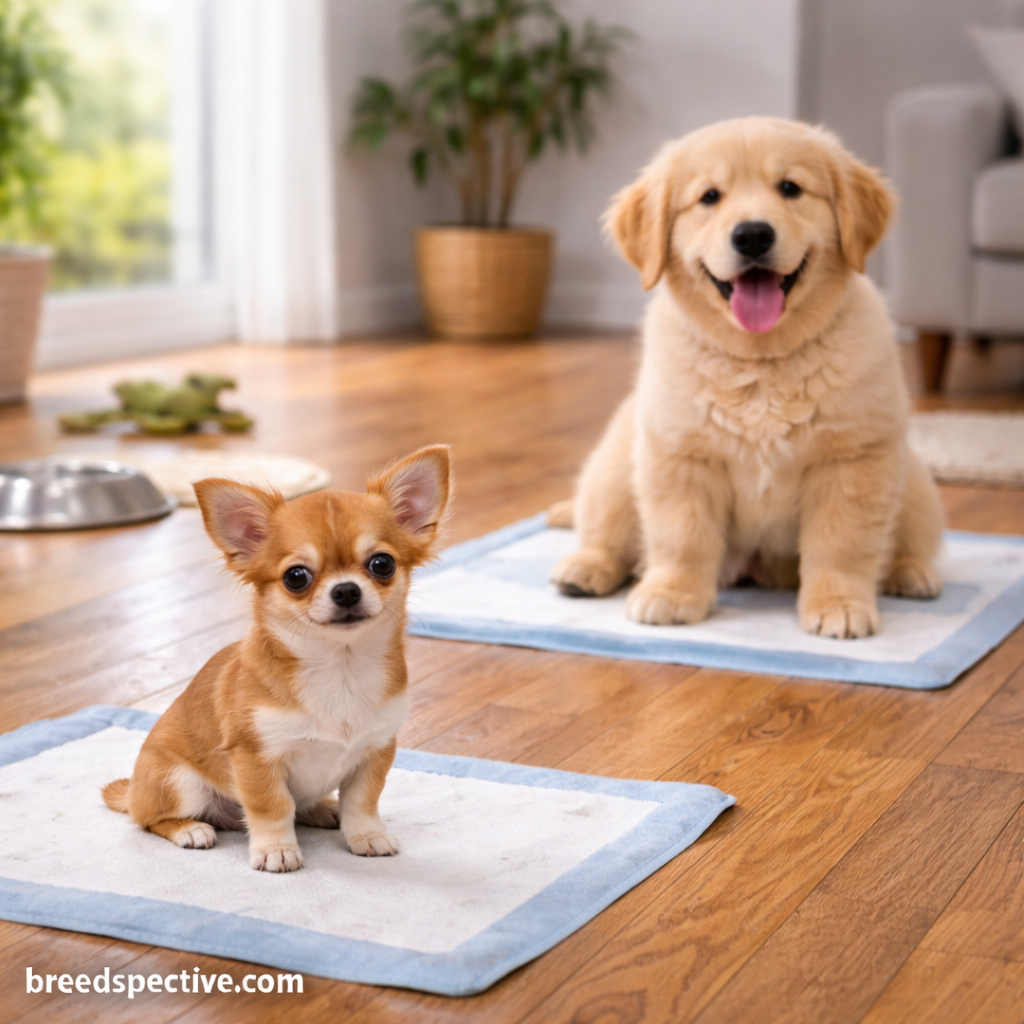
Successful house-training depends on two processes happening at the same time.
First, the puppy needs enough physical maturity to control elimination for a reasonable period. Second, the puppy has to learn where you want elimination to happen.
Those are not the same skill.
A young puppy can understand that going outside earns a reward and still have an accident because the opportunity to go outside came too late.
The American Kennel Club (AKC) recommends a consistent house-training schedule built around predictable events such as waking, eating, drinking and playing. It also emphasizes supervision and limiting opportunities for accidents while the puppy is learning. (akc.org)
Breed can influence the process indirectly through size, temperament and behavior, but it should not be treated as a stopwatch.
How Long Can a Puppy Hold Its Bladder?
A commonly used rule of thumb is that a puppy may be able to hold its bladder for approximately one hour for every month of age, plus one hour.
Under that guideline, a three-month-old puppy might manage roughly four hours under favorable circumstances.
Do not treat that number as a schedule you should force a puppy to follow.
Puppies often need to eliminate much sooner after:
- waking from sleep;
- eating;
- drinking;
- vigorous play;
- training or excitement; and
- coming out of a crate.
Individual puppies also vary.
The AKC advises taking young puppies outside frequently and specifically after waking, meals and play rather than waiting for the maximum theoretical holding time. (akc.org)
A useful house-training routine therefore tries to prevent the accident before the puppy needs to hold it.
Why Toy and Small Breeds Can Take Longer
Toy breeds have a reputation for being difficult to house-train, but labeling them stubborn misses an important practical issue: they are physically small.
A Chihuahua puppy has much less body capacity than a large-breed puppy. That means the margin for error between “doesn’t need to go yet” and “needs to go now” can be small.
Owners may also unintentionally make training harder with small dogs.
An accident from a tiny puppy is easier to overlook than one from a large puppy. Small dogs may consequently receive more indoor freedom before their bathroom habits are reliable.
Weather can complicate matters too. A very small dog may be more reluctant to remain outdoors in cold or wet conditions, which can make consistency harder for the household.
The answer is not harsher training. It is tighter management.
Take a toy-breed puppy outside frequently, supervise indoor freedom and reward successful outdoor elimination immediately.
Anyone considering a very small dog should account for this practical side of ownership alongside personality. Our Chihuahua temperament, energy level and lifestyle fit guide covers the broader realities of living with the breed.
Are Large Dogs Easier to Potty Train?
Large-breed puppies can sometimes appear easier to house-train because their physical capacity develops differently from that of tiny dogs, but size does not guarantee fast training.
A Labrador Retriever puppy still needs supervision. A German Shepherd puppy still needs to learn the correct bathroom location. A Great Dane puppy can still have accidents if the household misses its signals.
Larger dogs also make mistakes that are considerably harder to ignore.
The practical advantage is not that large breeds inherently understand house-training better. It is that owners may have a little more physical margin as bladder control develops.
Training principles remain the same regardless of size: frequent opportunities, supervision, consistent location and immediate reinforcement.
Does Breed Intelligence Make Potty Training Faster?
Trainability can help a puppy recognize routines, but “smart dog” does not automatically mean “house-trained dog.”
Breeds known for responsiveness to training may quickly associate going outside with a reward. Even so, a highly trainable 10-week-old puppy is still a 10-week-old puppy with immature bladder control.
That distinction matters.
A Border Collie might learn the household routine quickly while still needing frequent bathroom trips. Conversely, a dog that takes longer to respond to obedience cues can still become perfectly reliable in the house.
If ease of training is a major factor in choosing your next dog, our guide to the easiest dog breeds to train and why looks at trainability more broadly.
Why Some Dog Breeds Seem Harder to House-Train
Some breeds develop reputations for difficult house-training because several challenges can overlap.
Small Body Size
As discussed above, toy and small dogs need frequent opportunities and leave owners less room for scheduling mistakes.
Independent Behavior
Some dogs are less focused on human direction than breeds selected for close cooperative work.
That does not make them incapable of learning. It can mean the owner needs to make the desired behavior especially clear and worthwhile.
Dachshunds are commonly described as independent and determined dogs, characteristics that can influence training beyond house-training alone. Prospective owners can read our Dachshund temperament, energy level and lifestyle fit guide for a broader picture.
Previous Living Conditions
Breed may have nothing to do with the difficulty.
A puppy raised in conditions where sleeping, eating and elimination areas were not clearly separated may arrive with different habits from a puppy that has already begun learning a structured routine.
An adult rescue dog may have an unknown training history.
Treat the dog in front of you rather than assuming the breed explains every accident.
Owner Routine
A surprising amount of “difficult house-training” is actually inconsistent management.
If one person takes the puppy outside every two hours while another waits until the puppy asks, or outdoor successes are rewarded only occasionally, the puppy receives a less predictable lesson.
House-training becomes easier when the humans follow the routine too.
A Sample Daily Potty Schedule for a Young Puppy
A schedule should follow the individual puppy rather than an exact clock, but a structured day helps prevent accidents.
Here is an example for a young puppy that is eating three meals per day:
| Time/event | What to do |
|---|---|
| 6:30 a.m. | Outside immediately after waking |
| 6:45 a.m. | Breakfast and water |
| 7:00 a.m. | Outside again after eating |
| 8:00 a.m. | Outside after play/activity |
| 9:00 a.m. | Bathroom opportunity before rest |
| After waking from nap | Go directly outside |
| 12:00 p.m. | Lunch |
| 12:15 p.m. | Outside after eating |
| Afternoon | Frequent trips based on age, drinking, naps and activity |
| 5:00 p.m. | Dinner |
| 5:15 p.m. | Outside after eating |
| Evening | Bathroom breaks after play and drinking |
| Before bed | Final planned bathroom trip |
| Overnight | Very young puppies may still need an overnight trip |
This is an example, not a requirement to use these exact times.
The important pattern is what happens around the clock: wake → outside, meal → outside, play → outside, nap → outside.
That pattern is much easier for a puppy to learn than random bathroom trips.
House-training also needs to fit into everything else a puppy requires. Our guide to daily care routines for dogs at every life stage puts bathroom breaks alongside feeding, exercise, training and preventive care.
How to Reward Outdoor Potty Success
Timing matters.
Take the puppy to the intended bathroom area and give it enough opportunity to eliminate. When the puppy finishes, reward promptly so the connection between the behavior and reward is clear.
Do not wait until you have walked back through the house and reached the kitchen to produce a treat. By then, the puppy may associate the reward with coming inside rather than eliminating outdoors.
Praise, food rewards or another reward your puppy values can reinforce the behavior.
AVSAB supports reward-based training methods and advises against aversive methods for dog training and behavior modification. (avsab.org)
The goal is straightforward: make the correct behavior easy to perform and worthwhile to repeat.
Why Punishing Accidents Can Backfire
Finding urine on the floor after the fact does not create a useful training opportunity.
The puppy cannot go back and change what happened.
Scolding, rubbing a puppy’s nose in an accident or using other punishment does not clearly teach the desired bathroom location. A puppy may instead learn that eliminating in front of a person is unsafe.
That can create a particularly frustrating pattern: the puppy refuses to eliminate while the owner is watching outdoors, then finds a hidden location indoors.
AVSAB recommends reward-based training and states that aversive methods are not necessary for effective dog training. (avsab.org)
If you catch an accident beginning, calmly interrupt when possible and take the puppy to the appropriate location. If you discover it later, clean it thoroughly and adjust the schedule or supervision.
An accident is information. Ask what management failure allowed it to happen.
How Crate Training Fits Into Potty Training
A crate can be a useful house-training management tool because dogs generally prefer not to eliminate in the area where they sleep.
The AKC includes crate training as one method that can assist with house-training when the crate is appropriately sized and used correctly. (akc.org)
The crate should provide enough room for the puppy to stand, turn around and lie down comfortably. An excessively large crate can allow a puppy to sleep at one end and eliminate at the other.
But a crate does not increase the puppy’s physical bladder capacity.
Leaving a puppy confined longer than it can reasonably hold its bladder can force it to soil the crate, undermining the very habit you are trying to encourage.
A crate should also never become punishment for an accident.
Think of it as a management tool for periods when active supervision is not possible—not a shortcut that replaces frequent bathroom trips.
Supervision Is What Prevents Most Early Accidents
During active house-training, a puppy should generally be in one of three situations:
- Outside for a bathroom opportunity.
- Indoors under active supervision.
- Safely confined or in a puppy-proofed controlled area when direct supervision is not possible.
Giving a young puppy unrestricted access to multiple rooms makes accidents harder to detect and creates more opportunities to rehearse the wrong behavior.
Freedom should expand gradually.
If the puppy remains reliable in a controlled area, add access carefully rather than opening the entire house after two accident-free days.
This management-heavy stage is one of the adjustments new owners often underestimate. Our guide to what to expect during your first 30 days with a new pet covers the broader transition into life with a new dog.
How to Handle Nighttime Potty Training
Nighttime is different because the household is asleep and the puppy is inactive.
Very young puppies may still require an overnight bathroom trip.
Keep nighttime outings simple. Take the puppy to the bathroom location, allow elimination, reward calmly and return to bed. Turning a 2 a.m. bathroom trip into 30 minutes of play can accidentally teach the puppy that waking the household starts an entertaining nighttime activity.
As the puppy matures, overnight capacity generally improves.
Again, individual development matters more than trying to meet a specific deadline.
What About Pee Pads?
Indoor pads can be useful in particular situations, but they change the training objective.
If your eventual goal is exclusively outdoor elimination, teaching the puppy that an indoor surface is acceptable can create an additional transition later.
That does not mean pads are inherently wrong. Owners in high-rise buildings, people with limited mobility and households facing specific veterinary or environmental constraints may have legitimate reasons to establish an indoor bathroom location.
Decide what the long-term rule is supposed to be and train consistently toward it.
Cleaning Accidents Properly Matters
Dogs can return to locations that still carry elimination odors even when humans can no longer smell them.
Clean accidents promptly with a product designed for pet waste and follow its directions. Avoid simply covering the odor with fragrance.
Also reconsider why the accident occurred.
Was the puppy left too long? Did you miss a post-meal trip? Was the puppy allowed out of sight? Did excitement interrupt the normal schedule?
Fixing that cause is more valuable than becoming frustrated with the floor.
When Potty Training Suddenly Goes Backward
Regression does not always mean the dog has forgotten its training.
Changes in schedule, a move, a new household member or disruption to the normal bathroom routine can contribute to accidents. In those situations, temporarily returning to a stricter schedule and closer supervision may help.
Medical problems are another possibility.
A dog that was reliably house-trained and suddenly begins urinating or defecating indoors should not automatically be treated as a training problem. Increased urgency, changes in frequency, discomfort or other symptoms warrant veterinary attention.
The same applies to a puppy that appears to urinate unusually frequently or cannot make reasonable progress despite careful, consistent training.
When Is a Puppy Fully Potty Trained?
Do not define success as “has not had an accident this week.”
A reliably house-trained dog understands the expected bathroom location, can communicate or follow the household’s bathroom routine and remains dependable under ordinary circumstances.
Reliability should also survive reasonable changes in daily life.
Continue supervising and reinforcing the routine after early success rather than removing all structure immediately.
House-training is usually won through repetition: hundreds of correct bathroom trips gradually become the dog’s normal habit.
Verdict: Which Breeds Are Easiest to Potty Train?
Breed alone cannot reliably tell you how many weeks house-training will take. Larger puppies may have a practical advantage in physical capacity, while toy breeds such as Chihuahuas often require more frequent trips and tighter management. Trainable breeds may learn the routine quickly, but intelligence cannot give a very young puppy adult bladder control.
House-training is a good fit for an owner who can provide frequent bathroom opportunities, supervise closely, reward outdoor success and accept that accidents are part of puppy development.
A young puppy is a poor fit for a household that routinely needs the dog to remain alone longer than its developmental needs allow and has no alternative care arrangement.
The most useful question is therefore not “Which breed can be potty trained in four weeks?” It is “Can my household provide the schedule this particular puppy needs until the habit and physical control catch up with each other?”