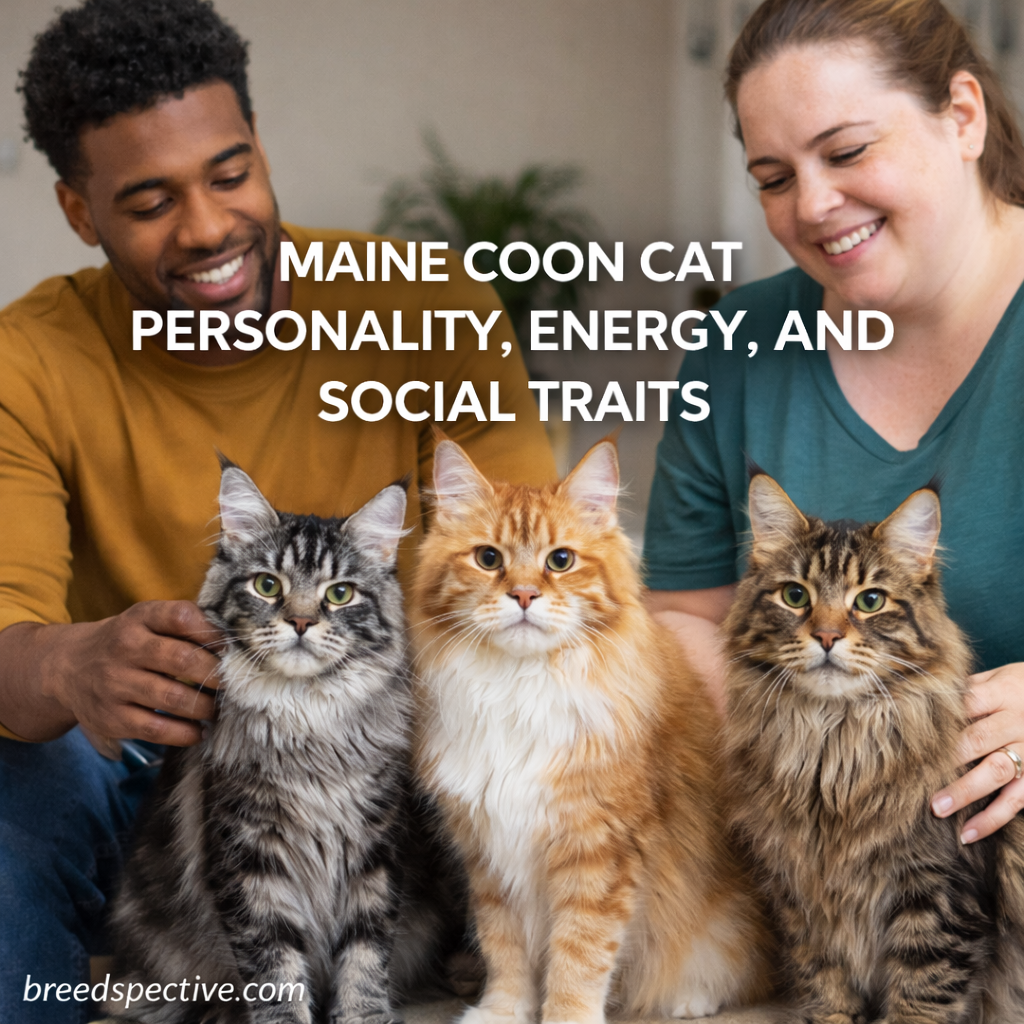
The typical Maine Coon cat personality is friendly, sociable, playful, intelligent, and relatively easygoing. These large cats often enjoy staying close to their people without demanding constant physical attention, giving them a useful balance of companionship and independence.
The Cat Fanciers’ Association (CFA) describes the breed as gentle and easygoing yet active, while The International Cat Association (TICA) characterizes Maine Coons as sweet-tempered, friendly cats that often follow their people around the home. Individual temperament varies, but the breed is generally known for being social rather than aloof.
Maine Coon at a Glance
| Trait | Maine Coon |
|---|---|
| Size | Large; TICA lists females around 12–15 lb and males around 18–22 lb |
| Lifespan | TICA lists 12.5+ years |
| Activity level | Moderate; playful without typically being hyperactive |
| Grooming | Moderate; regular combing is necessary |
| Vocalness | Usually moderate to low; known for chirps and trills |
| Good with children | Generally yes, with respectful handling |
| Good with other cats | Generally yes, with proper introductions |
| Good with dogs | Often, particularly with cat-friendly dogs |
| Typical personality | Gentle, social, curious, playful and intelligent |
| Maturity | Slow; full physical development can take 3–5 years |
Maine Coons are among the largest pedigreed domestic cats. TICA notes that the breed develops slowly and may not reach full size until roughly three to five years old. CFA likewise describes the Maine Coon as a large, rugged cat with a sociable and intelligent temperament.
Maine Coon History and Origins
The Maine Coon is closely associated with New England and particularly the state of Maine. Its exact ancestry is uncertain, and colorful stories about the breed’s beginnings have circulated for generations.
One old story claimed that Maine Coons resulted from domestic cats breeding with raccoons. That is biologically impossible. Other legends connected the breed to Marie Antoinette’s cats, Viking voyages, or a sea captain named Coon.
The more plausible explanation is less dramatic.
CFA describes the Maine Coon’s roots as lying in New England, where domestic cats accompanying settlers and ships contributed to a population that adapted to the region’s climate. Longhaired cats arriving aboard later ships may also have contributed to the breed that eventually developed.
The resulting cats were suited to life in the Northeast. Maine Coons developed substantial bodies, shaggy coats, bushy tails and heavily furred paws. They also earned a reputation as capable working cats and mousers.
The connection to Maine became official: the Maine Coon is the official state cat of Maine, a designation established in state law.
Cosey and the 1895 Cat Show
The Maine Coon also has an important place in American cat-show history.
In May 1895, a major cat show was held at Madison Square Garden in New York. A brown tabby female Maine Coon named Cosey was selected as the show’s best cat.
CFA’s historical account records that Cosey received a silver medal and engraved silver collar. That collar is now preserved by the CFA Foundation’s Feline Historical Museum.
The breed later declined in show-ring prominence as imported longhaired breeds became fashionable. Interest revived during the twentieth century, and CFA granted the Maine Coon championship status in 1976.
Maine Coon Personality in Everyday Life
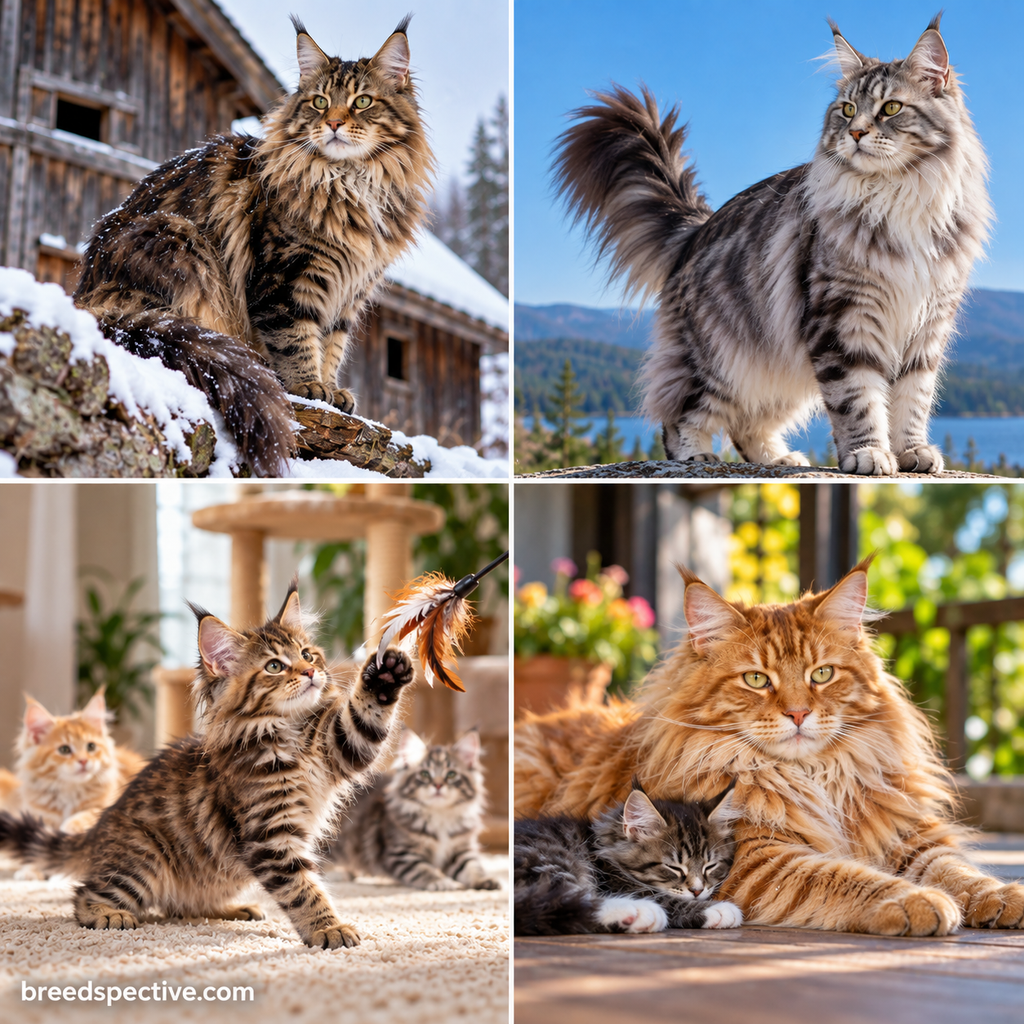
Maine Coons are large, sociable cats known for their sturdy build, playful nature, long coat, and interest in household activity.The Maine Coon’s appeal is not simply that it is large and fluffy. Its social style is a major reason people seek out the breed.
A Maine Coon will often want to know what is happening around the house. That may mean following someone into another room, investigating an activity or settling nearby while the household goes about its routine.
CFA describes Maine Coons as sociable, loyal and intelligent, while TICA notes that they tend to follow their people from room to room without necessarily demanding constant attention.
Affectionate Without Necessarily Being a Lap Cat
Prospective owners sometimes assume that a friendly breed will automatically be a dedicated lap cat.
That is not necessarily true of the Maine Coon.
Many prefer proximity to restraint. A Maine Coon might sit beside you, sleep nearby or follow you around without spending hours in your lap.
That can make the breed appealing to someone who wants a socially engaged cat but does not necessarily want constant physical contact.
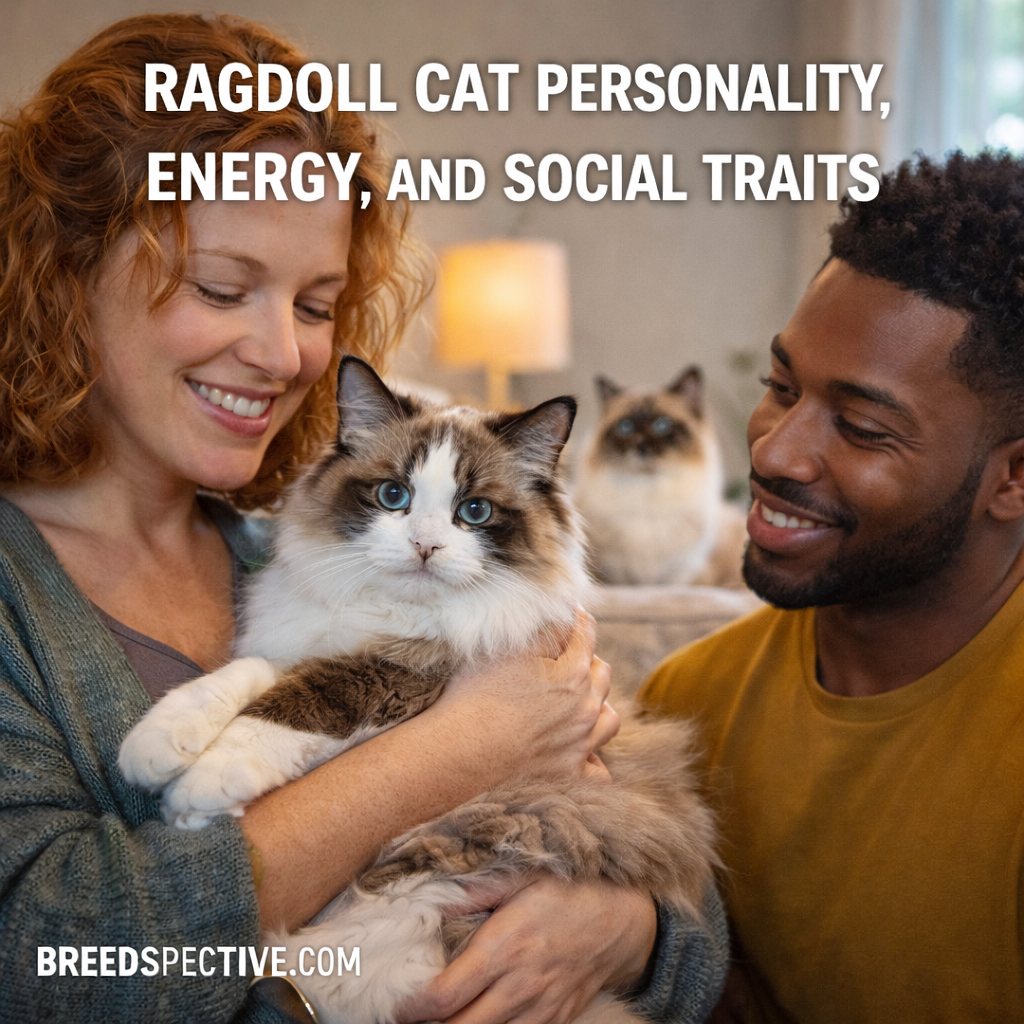
People specifically looking for a softer, frequently people-focused temperament may also want to read about the Ragdoll cat’s personality, energy, and social traits.
They Stay Playful for a Long Time
Maine Coons mature unusually slowly compared with many cats.
TICA states that they can take three to five years to reach full size, with its current breed profile noting that full maturity is typically around four years. The organization also describes the breed as retaining a playful, kitten-like disposition into adulthood.
That does not mean a four-year-old Maine Coon behaves exactly like a kitten. Rather, owners should expect a long developmental period and a cat that may remain interested in games well beyond kittenhood.
Common activities include chasing toys, interactive wand play and investigating puzzle toys. TICA also notes that some Maine Coons play fetch, learn simple commands or walk on a leash after appropriate training.
How Energetic Is a Maine Coon?
The Maine Coon is best thought of as moderately active rather than sedentary or intensely high-energy.
A healthy adult should have regular opportunities to run, chase, scratch, climb and play. At the same time, this is not generally a breed that requires the near-constant stimulation associated with some highly active cats.
Interactive play is still part of responsible care.
Useful enrichment includes:
- Wand and chase toys
- Large, sturdy scratching posts
- Puzzle feeders
- Cat trees designed for heavier cats
- Tunnels and floor-based games
- Window observation areas
- Toy rotation to maintain novelty
Because Maine Coons become large, equipment needs some thought. A lightweight cat tree designed for a much smaller cat may wobble or have platforms that are simply too cramped.
Look for stable structures with adequately sized resting surfaces rather than buying based only on height.
Social Behavior With Children and Other Pets
Maine Coons are commonly considered good candidates for family and multi-pet households.
CFA reports that they generally get along well with children and other animals. TICA similarly describes Maine Coons as social cats suited to families that may also have dogs and other cats.
Breed tendencies are not guarantees, however.
A cat’s socialization, past experiences, age and individual personality still matter. Children should know how to interact without grabbing, chasing or cornering the cat, and dogs should be introduced gradually.
Do not assume a Maine Coon will automatically become friends with an existing pet simply because of its breed.
For households deciding between two large, sociable breeds, our Maine Coon vs Ragdoll comparison looks more closely at their practical differences.
How Vocal Are Maine Coons?
One of the breed’s more distinctive characteristics is its communication style.
Maine Coons can vocalize, but CFA does not characterize them as an especially talkative breed. Their repertoire may include chirps, trills, purrs and occasional meows. TICA similarly highlights the breed’s tendency to communicate with softer chirping or trilling sounds.
Individual cats vary considerably, so a quiet household is never guaranteed.
If vocalness is a major factor in choosing a cat, ask a breeder about the personalities of the kitten’s parents and adult relatives.
Who a Maine Coon Suits — and Who Should Avoid One
Maine Coons can suit a surprisingly broad range of homes because their personality combines social interest with some independence.
They are particularly worth considering if you want a cat that:
- Enjoys being involved in household life
- Remains playful as an adult
- Can potentially live with children or other pets
- Is affectionate without necessarily requiring constant lap time
- Has a relatively easygoing social style
- Can receive regular grooming and interactive play
The breed is less suitable for someone who wants an extremely low-maintenance cat.
The coat requires upkeep. Their large bodies mean bigger carriers, beds, litter boxes and cat furniture are often necessary. Food and veterinary expenses can also be significant over a cat’s lifetime.
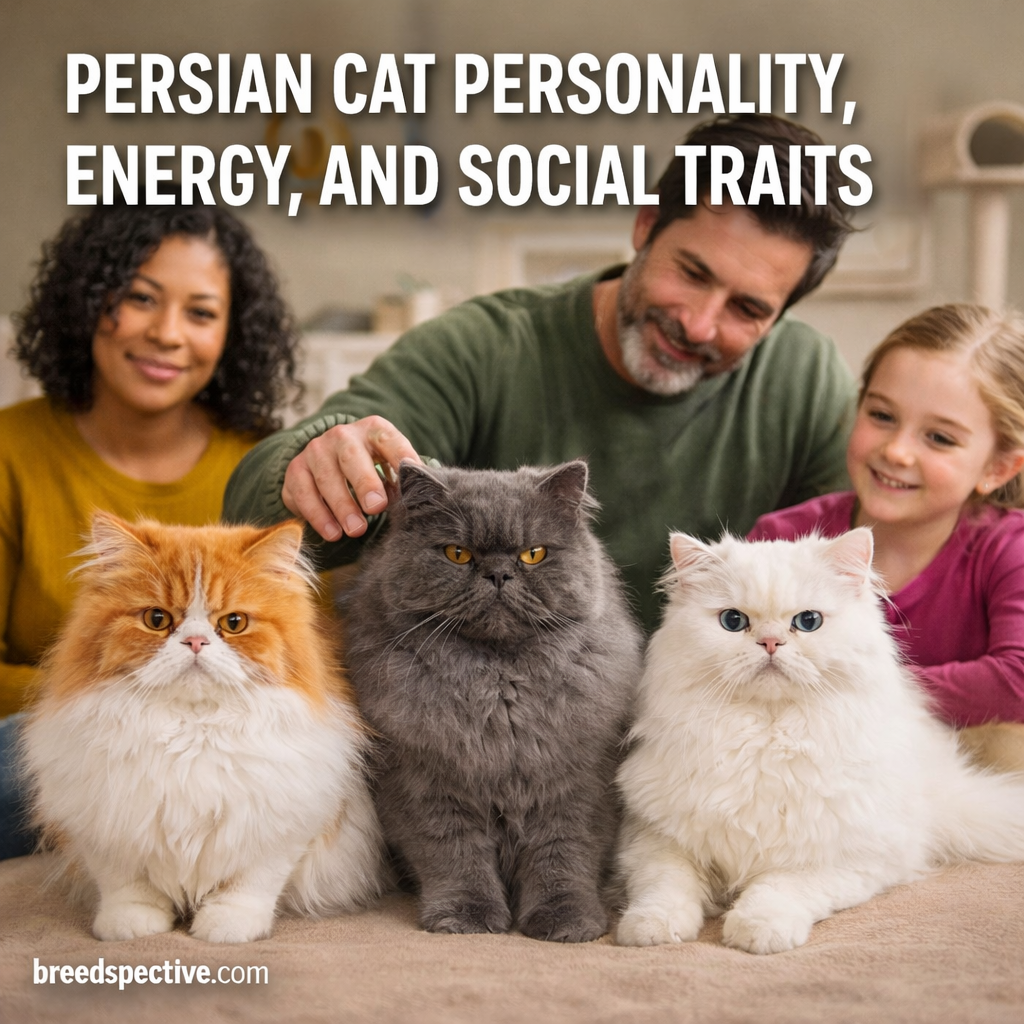
Someone primarily seeking a quieter, more sedentary longhaired companion might want to compare the Persian cat’s personality and energy level before deciding.
Can Maine Coons Live in Apartments?
They can, provided the home accommodates their physical size and behavioral needs.
A large house is not automatically better than an apartment. What matters is whether the cat has sufficient usable space, enrichment, appropriate scratching surfaces and opportunities to exercise.
The catch is size.
An adult Maine Coon needs a genuinely large litter box, sturdy furniture and enough room to move comfortably. A tiny apartment filled with undersized equipment is different from an apartment intentionally arranged around a large cat.
Our guide to the best cat breeds for apartment living covers the broader factors worth considering in a smaller home.
Maine Coon Grooming and Care
The Maine Coon has a semi-long, shaggy coat developed in association with the harsh climate of northeastern North America.
TICA describes the mature coat as having two layers, with longer hair around areas such as the belly, hindquarters and ruff. Coat texture varies between individual cats, which means grooming requirements vary as well.
How Often Should You Brush a Maine Coon?
TICA notes that some coats remain manageable with approximately weekly combing, while cottonier coats can require considerably more attention. Regular grooming should begin while the cat is young so handling becomes familiar.
Pay particular attention to areas where friction encourages tangles, including:
- Behind the front legs
- Around the hindquarters
- Under the belly
- Around the ruff
- Behind the ears
Do not repeatedly pull at a tight mat. Severe matting can sit close to the skin, where attempting to cut it out at home risks injury.
Nails also need routine trimming, and dental care should be discussed with your veterinarian.
A predictable schedule makes these tasks easier. Our daily care routine for cats at every life stage provides a framework for feeding, grooming, play, litter maintenance and health observations.
Litter Boxes Need to Match the Cat
A large cat needs an appropriately sized litter box.
The cat should be able to enter, turn around, dig and position itself comfortably. Cleanliness and placement matter too.
If a previously reliable Maine Coon begins eliminating outside the box, do not assume the cat is simply misbehaving. Medical conditions and environmental factors can contribute to inappropriate elimination.
Our guide explaining why cats avoid the litter box and how to fix it covers when to investigate the environment and when veterinary attention may be needed.
Maine Coon Health Issues to Screen For
No breed is guaranteed to develop a particular disease, but responsible Maine Coon breeding should include attention to inherited health risks.
Hypertrophic Cardiomyopathy
Hypertrophic cardiomyopathy (HCM) causes abnormal thickening of the heart muscle and is the most commonly diagnosed cardiac disease in cats.
Cornell University College of Veterinary Medicine identifies the Maine Coon among breeds with a recognized predisposition to HCM. A mutation in the MYBPC3 gene has also been identified in Maine Coons and is associated with increased HCM risk.
The UC Davis Veterinary Genetics Laboratory offers testing for the Maine Coon-associated A31P mutation. However, UC Davis specifically notes that its DNA test detects that particular mutation; genetic testing should therefore not be treated as proof that a cat can never develop HCM.
CFA notes that responsible health screening may involve both genetic testing and echocardiography.
Ask breeders exactly what cardiac screening they perform rather than accepting “HCM clear” without documentation.
Spinal Muscular Atrophy
Spinal muscular atrophy (SMA) is another inherited condition identified in Maine Coons.
According to the UC Davis Veterinary Genetics Laboratory, SMA results from loss of motor neurons and causes progressive instability, gait abnormalities and muscle atrophy in affected cats. Signs generally begin when affected kittens are around three to four months old.
SMA is inherited as an autosomal recessive condition, and DNA testing can identify clear cats, carriers and affected cats.
Hip and Joint Screening
Large body size also makes orthopedic health worth discussing with a breeder.
TICA notes that Maine Coons may be susceptible to joint disorders and that breeders may screen breeding cats for conditions including hip dysplasia and luxating patella. CFA likewise identifies hip-dysplasia screening by X-ray as one of the health-testing tools used within the breed.
A responsible breeder should be able to explain what testing has been performed and provide documentation rather than relying on verbal assurances.
Realistic Maine Coon Costs
The cost of owning a Maine Coon extends well beyond the kitten’s purchase price.
Breeder prices vary substantially by region, pedigree, age, demand, breeding rights and other factors. Because those prices change frequently, there is no single purchase-price figure that reliably represents the breed everywhere.
A better budget considers the cat’s lifetime needs.
| Expense | What to Budget For |
|---|---|
| Purchase or adoption | Initial acquisition cost varies widely |
| Veterinary care | Exams, vaccinations, preventive care and treatment |
| Food | Ongoing expense for a large adult cat |
| Grooming | Combs, brushes and potentially professional grooming |
| Litter | Larger boxes can mean greater litter use |
| Furniture | Heavy-duty cat trees, scratchers and beds |
| Carrier | A carrier large and strong enough for an adult Maine Coon |
| Dental care | Home prevention and veterinary treatment when needed |
| Emergency care | Emergency savings or suitable pet insurance |
The breed’s size can quietly increase costs. Products designed around an average 8- or 10-pound cat may be unsuitable for an adult Maine Coon approaching twice that weight.
The initial purchase price should therefore be viewed as only one part of the financial commitment.
Choosing a Maine Coon Responsibly
Start with health and temperament rather than choosing the largest kitten or most dramatic coat.
Ask a breeder about:
- HCM screening and cardiac history
- Relevant DNA testing, including SMA
- Hip or orthopedic screening
- Veterinary records
- Temperament of the parents
- How kittens are socialized
- Pedigree documentation
- The age kittens leave for new homes
- The breeder’s contract and return policy
Be cautious when a seller markets kittens almost entirely around exceptional size. CFA’s breed standard specifically states that quality should not be sacrificed for size.
A Maine Coon is supposed to be substantial, but bigger is not automatically better or healthier.
If you are comparing several breeds rather than committed to a Maine Coon, our guide to choosing the right cat breed for your home can help you compare temperament, activity, grooming and household compatibility before making a decision.
Verdict: Is a Maine Coon Right for You?
A Maine Coon is well suited to someone who wants a large, sociable and playful cat that enjoys participating in household life without necessarily demanding constant attention. Families and multi-pet households may also appreciate the breed’s generally friendly temperament, provided introductions and interactions are handled properly.
It is less suitable for someone seeking the lowest possible grooming and ownership costs. The long coat requires maintenance, the large body demands appropriately sized equipment, and responsible ownership includes paying attention to breed-associated health concerns such as HCM and SMA.
The Maine Coon’s size is impressive, but personality should be the deciding factor. Choose one because you want an intelligent, companionable cat that stays involved in daily life—not simply because you want one of the largest domestic cat breeds.