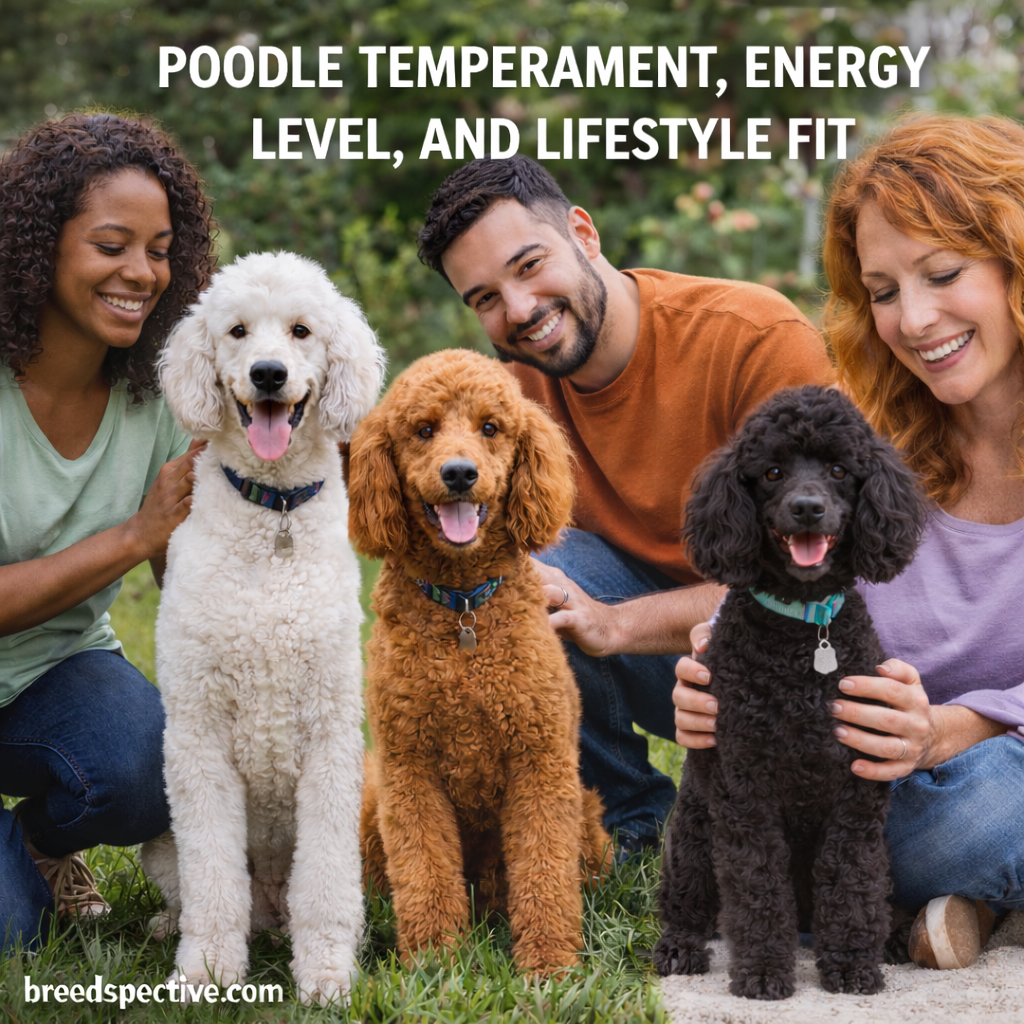
Poodle temperament is typically intelligent, active, alert, people-oriented, and highly responsive to training. Standard, Miniature, and Toy Poodles share the same basic breed character, but size changes what daily exercise, handling, family life, and some health considerations look like.
The polished show coat can disguise what is fundamentally an athletic working breed. The official Poodle Club of America breed standard describes the Poodle as a “very active, intelligent” dog, and those traits matter much more in everyday ownership than its glamorous appearance.
Poodle at a Glance
| Trait | Poodle |
|---|---|
| Size | Toy: 10 inches or under; Miniature: over 10 to 15 inches; Standard: over 15 inches |
| Life expectancy | Commonly about 10–18 years, varying by size and individual |
| Exercise needs | Moderate to high |
| Grooming | High; regular clipping plus home coat maintenance |
| Trainability | Very high |
| Good with children? | Often, but size and child behavior matter |
| Good with other pets? | Often, with appropriate socialization |
| Shedding | Low, but coat maintenance is demanding |
| Best fit | Interactive household that enjoys training and can commit to grooming |
Under the AKC standard, Toy, Miniature, and Standard Poodles are three size varieties of the same breed. The standard is essentially the same across the varieties except for height requirements.
That distinction is useful because a Toy Poodle is not simply a different small companion breed that happens to share the name. The varieties retain recognizable Poodle traits, including intelligence, activity, alertness, and a distinctive dense, curly coat.
Standard vs. Miniature vs. Toy Poodle
Size affects lifestyle fit considerably.
| Standard Poodle | Miniature Poodle | Toy Poodle | |
|---|---|---|---|
| AKC height | Over 15 inches | Over 10 to 15 inches | 10 inches or under |
| Activity | Moderate-high to high | Moderate-high | Moderate, often energetic in shorter sessions |
| Exercise style | Long walks, swimming, retrieving, sports | Walks, games, agility, training | Walks, indoor play, training, enrichment |
| Handling | Athletic, substantial dog | Compact but sturdy | Small and physically delicate |
| Children | Often well suited to respectful families | Often adaptable | Better protected from rough handling |
| Space | Adaptable if exercised | Highly adaptable | Very adaptable |
| Grooming workload | Highest due to coat surface area | High | High despite smaller size |
| Common screening emphasis | Hips, eyes and additional Standard-specific testing | Eyes, patellas, hips, PRA-prcd | Eyes, patellas, PRA-prcd |
Individual dogs vary. Size should not be used as a shortcut for assuming temperament.
A highly active Miniature can be more demanding than a relaxed Standard, and a Toy Poodle still needs walks, training, play, and mental stimulation despite fitting easily on a lap.
Poodle History and Original Purpose
The Poodle’s association with France is so strong that people often assume it originated there.
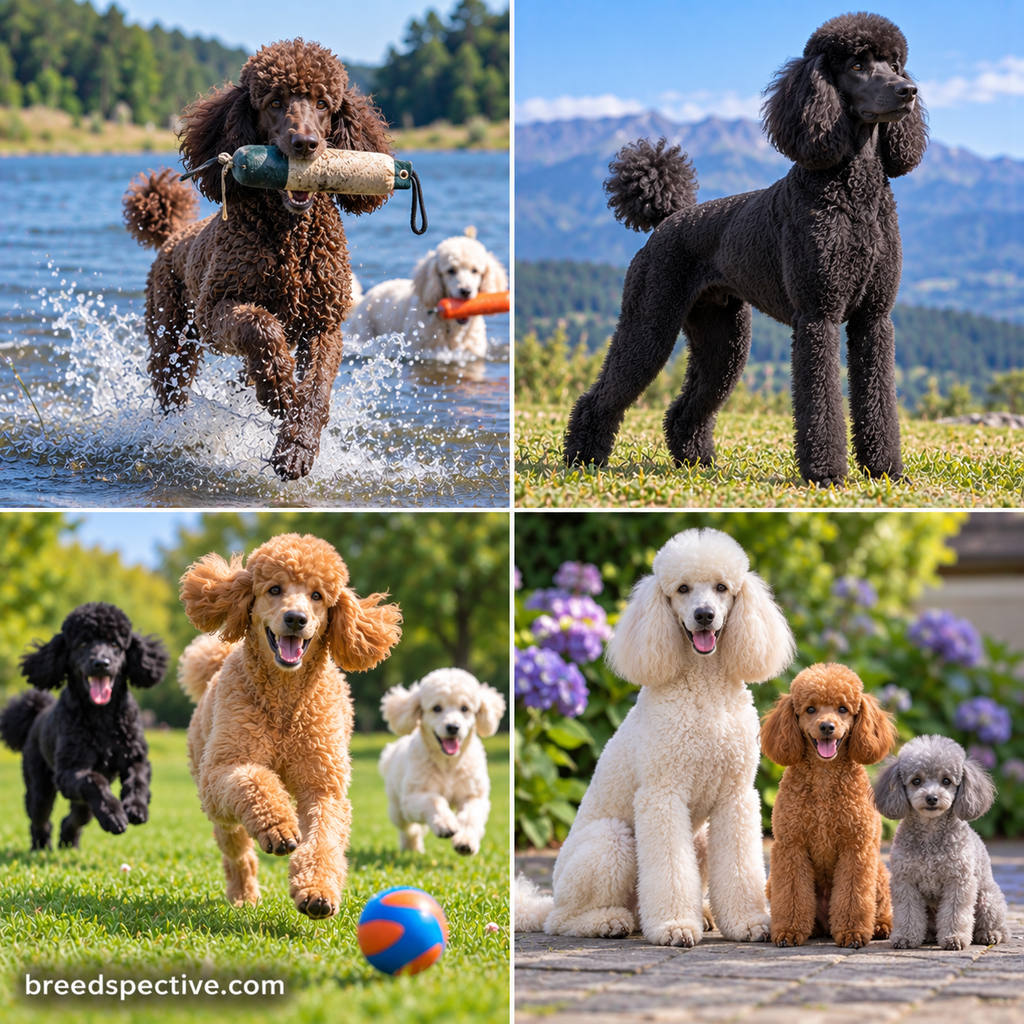
The breed is the national dog of France, but the American Kennel Club traces its development as a water retriever to Germany. Its name is connected to the German word pudeln, referring to splashing in water. In France, the breed became known as the Caniche, referring to its role as a duck dog.
The Standard Poodle’s original job was retrieving waterfowl.
That required more than swimming ability. A useful retriever needed athleticism, intelligence, responsiveness to a handler, persistence, and enough confidence to work in water and challenging environments.
Those characteristics help explain the modern Poodle.
Even Poodles that never retrieve a bird frequently enjoy swimming, carrying toys, learning complex behaviors, searching for objects, and participating in activities with their owners.
The Famous Poodle Haircut Started as Working Equipment
The traditional Poodle clip looks decorative today, but its origins were practical.
A full, dense coat could interfere with efficient swimming. Hunters trimmed portions of the dog’s coat to reduce drag while retaining hair around vulnerable areas such as the chest and joints for protection in cold water.
The AKC describes the historic clip as a compromise between mobility in the water and protection of joints and vital areas.
Fashion eventually exaggerated and refined that practical haircut into the elaborate show presentation now associated with Poodles.
Underneath it is still an athletic retriever.
Poodle Temperament in Everyday Life
Living with a Poodle means living with a dog that notices things.
Poodles tend to learn routines quickly. They often recognize patterns surrounding meals, walks, visitors, bedtime, departures, and training sessions long before an owner deliberately teaches them.
That intelligence is convenient when the dog learns desirable habits.
It is less convenient when the dog discovers that barking opens the back door or stealing a sock starts a chase.
People-Oriented and Interactive
Most Poodles want substantial interaction with their household.
They can enjoy resting beside their owners, but they are not typically dogs that are content to spend their entire day disengaged from people.
Training, walks, games, exploration, and other shared activities provide useful outlets.
Owners should still teach independence. A people-focused puppy benefits from gradually learning to relax alone rather than receiving constant attention from the day it arrives.
Alert Without Needing to Be Aggressive
Poodles can make effective alert dogs.
They tend to notice footsteps, doors, unfamiliar noises, and people approaching the home. Some individuals are naturally more reserved with strangers than the stereotypically enthusiastic retriever breeds.
Alertness should not become chronic suspicion or uncontrolled barking.
Socialization should teach the puppy that unfamiliar people, environments, surfaces, sounds, grooming procedures, and everyday events are normal parts of life.
How Much Exercise Does a Poodle Need?
Exercise requirements depend partly on size, age, health, and individual drive.
As a practical starting point, a healthy adult Standard Poodle may need roughly 60–90 minutes of combined physical activity and interactive mental work each day. Miniatures often thrive with approximately 45–75 minutes, while Toys may do well with roughly 30–60 minutes, divided into manageable sessions.
These are planning ranges rather than veterinary prescriptions.
Quality matters as much as duration.
A Poodle’s day might combine:
- Brisk walks
- Fetch
- Swimming
- Scent games
- Obedience training
- Agility
- Food puzzles
- Hide-and-seek games
- Learning tricks
- Exploring new environments
The AKC describes Poodles as active dogs with strong swimming ability and exceptional capacity for learning.
A ten-minute training session can sometimes tire an intelligent Poodle more effectively than another repetitive lap around the block.
Poodle Trainability
Poodles are exceptionally trainable.
They learn associations quickly, tend to engage closely with handlers, and can excel across obedience, agility, retrieving, service work, therapy work, scent-related activities, and other dog sports. The breed’s history includes both practical retrieving work and performance roles that took advantage of this learning ability.
Reward-based training is a particularly good fit.
Useful early skills include:
- Recall
- Loose-leash walking
- Settle or place
- Calm greetings
- Leave it
- Drop it
- Grooming cooperation
- Handling feet, ears and face
- Remaining alone calmly
- Quiet behavior on cue
Poodles can learn unwanted routines just as rapidly.
If barking repeatedly gets attention, the dog learns to bark. If jumping gets greetings, jumping becomes productive. If refusing grooming always ends the session, resistance can become an effective strategy.
Their intelligence is one reason Poodles feature naturally in discussions of the easiest dog breeds to train and why, but easy learning does not mean ownership requires little effort.
Common Poodle Behavior Problems
Most Poodle behavior problems are manageable, but intelligence can make inconsistent rules particularly obvious to the dog.
Excessive Alert Barking
Poodles can be vocal when something changes in their environment.
Block repetitive visual triggers when necessary, acknowledge an appropriate alert, and teach the dog what to do afterward—for example, moving to a mat and settling.
Allowing hours of window barking makes the behavior increasingly practiced.
Separation-Related Behavior
A strongly attached Poodle can struggle if independence has never been taught.
Begin with short, uneventful absences and gradually build duration. Provide safe enrichment and make alone time a normal part of puppyhood.
Panic, destructive escape attempts, prolonged vocalization, or other severe distress should be discussed with a veterinarian or qualified behavior professional.
Boredom and Destructive Behavior
Intelligent dogs create their own activities when nothing else is available.
Rotate toys, incorporate scent work, train new behaviors, provide appropriate chews, and give the dog meaningful daily exercise.
Nervousness
Poor socialization, stressful experiences, or individual temperament can contribute to fearfulness.
Do not overwhelm a worried dog in an attempt to “socialize” it. Controlled exposure at a comfortable distance combined with positive experiences is more productive than forcing interactions.
Attention-Demanding Behavior
A Poodle can quickly discover which behaviors make humans respond.
Whining, pawing, barking, dropping toys repeatedly, or interrupting people can become habitual if they reliably produce attention.
Meet the dog’s legitimate needs while also rewarding calm independent behavior.
Are Poodles Good Family Dogs?
Poodles can make excellent family dogs.
Their trainability and interactive personality suit households that want the dog actively involved in family life.
Size changes the equation.
Standard Poodles are physically better able to cope with an active household but can accidentally knock over a small child. Toy Poodles are easier to carry and need less physical space, but their small bodies make rough handling more dangerous.
Children should be taught to respect the dog regardless of size.
That means no climbing, chasing, pulling hair, interfering with food, or disturbing a sleeping dog.
Poodles and Other Pets
Many Poodles live successfully with other dogs and cats.
Early socialization, controlled introductions, and individual temperament matter more than simply assuming compatibility because of breed.
Remember that the Standard Poodle developed as a hunting retriever. Some individuals may show interest in birds or other moving animals.
Teach calm behavior around household pets and supervise interactions when necessary.
Low Shedding Does Not Mean Low Maintenance
One of the biggest misconceptions surrounding Poodles is that their coat is easy because they shed relatively little.
It is not.
Loose hairs tend to remain caught within the curly coat rather than dropping freely around the house. That means fewer hairs on furniture, but it also contributes to tangling and mat formation if the coat is neglected.
Our guide to low-shedding dog breeds explains why low shedding and low maintenance are separate characteristics.
Realistic Poodle Grooming Requirements
A clipped companion Poodle generally requires thorough brushing and combing multiple times per week, with frequency depending on coat length and style.
Professional grooming is commonly needed approximately every 4–8 weeks for owners who do not clip their dogs themselves.
Longer coats require substantially more home maintenance.
A realistic routine includes:
- Brushing and combing to the skin
- Professional or home clipping
- Bathing and drying
- Nail trimming
- Ear monitoring
- Dental care
- Face and sanitary-area maintenance as needed
Standard Poodles require more grooming time simply because there is more dog and more coat.
Owners who maintain elaborate show-style clips face a dramatically greater workload than owners using short companion trims.
Professional grooming prices vary widely by location, dog size, coat condition, and requested style. As a planning estimate, grooming can easily become several hundred to well over $1,000 per year, particularly for Standards receiving regular professional service.
If professional grooming every month or two sounds financially or logistically unrealistic, a Poodle may not be the right choice.
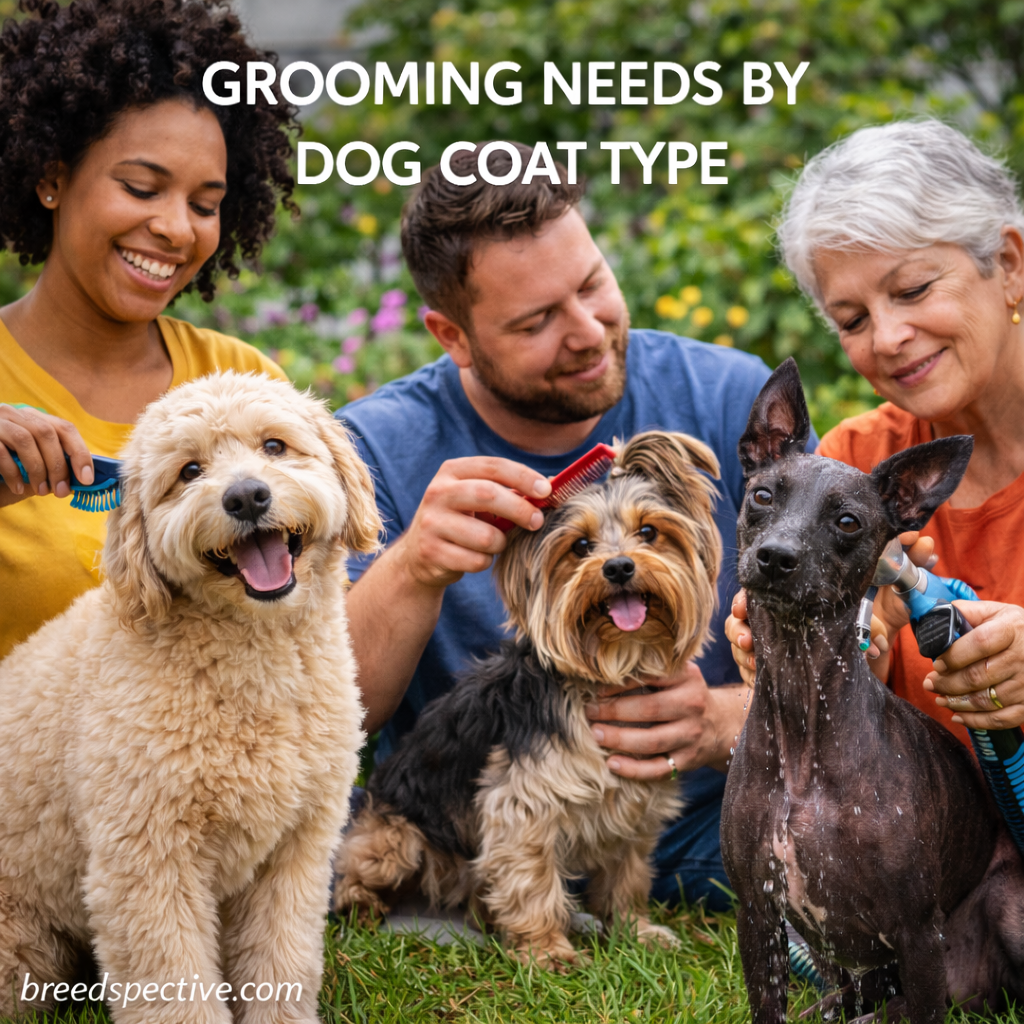
Our guide to grooming needs by dog coat type provides additional context for comparing the Poodle coat with lower-maintenance alternatives.
Poodle Health Testing Varies by Size
Because the three varieties differ in some health priorities, buyers should verify testing appropriate to the specific Poodle size they are considering.
The Poodle Club of America’s current health statement recommends the following core screening.
Toy Poodle
Recommended testing includes:
- DNA testing for prcd-progressive retinal atrophy
- Regular eye examination by a veterinary ophthalmologist
- Patellar luxation evaluation
Miniature Poodle
Miniatures receive the same core recommendations as Toys, plus:
- Hip dysplasia evaluation through OFA radiographs or PennHIP
Standard Poodle
Current PCA recommendations include:
- Hip evaluation through OFA or PennHIP
- Eye examination
- Autoimmune thyroiditis evaluation
- DNA testing for neonatal encephalopathy with seizures
- DNA testing for von Willebrand disease type I
PCA health guidance also discusses additional testing and screening relevant to Standard Poodles.
Prospective buyers should look up actual results rather than accepting “health tested” as a complete answer.
Testing a dog through a consumer DNA panel alone does not substitute for the orthopedic, ophthalmologic, cardiac, thyroid, or other evaluations recommended for the variety.
Health Concerns to Discuss With Your Veterinarian
Screening reduces uncertainty but cannot guarantee that a dog will remain healthy.
Orthopedic disease is particularly relevant when evaluating breeding Standards and Miniatures, while patellar luxation screening is emphasized for Toy and Miniature Poodles. Eye disease is relevant across the varieties, which is why ophthalmologic examinations feature prominently in PCA recommendations.
Standard Poodle owners should also know the signs of gastric dilatation-volvulus, or GDV, commonly called bloat. This is an emergency in which the stomach becomes distended and may twist.
A rapidly enlarging abdomen, repeated unsuccessful attempts to vomit, excessive salivation, restlessness, weakness, or collapse requires immediate veterinary attention.
Ask your veterinarian about individual risk and whether preventive gastropexy is appropriate, particularly when discussing another abdominal procedure such as spaying or neutering.
Poodles and “Doodle” Crosses
The Poodle’s intelligence and low-shedding coat have contributed to its use in many popular crosses.
A Poodle mix does not automatically inherit a predictable Poodle coat, shedding level, size, or temperament. Genetics do not distribute parental characteristics according to a buyer’s preferred checklist.
Someone considering a Poodle cross should evaluate the actual cross rather than assuming it will behave exactly like a Poodle with a few characteristics from the other breed.
Breedspective covers three popular examples separately:
- Labradoodle temperament and family compatibility
- Goldendoodle temperament and family compatibility
- Cavapoo temperament and family compatibility
People primarily attracted to the low-shedding coat should consider whether a purebred Poodle already provides the intelligence, athleticism, size options, and coat characteristics they are looking for.
How Much Does a Poodle Cost Per Year?
Size makes a substantial difference in food and some medical expenses, while grooming can be a major cost across all three varieties.
A practical U.S. planning budget is:
| Expense | Practical annual planning range |
|---|---|
| Food and treats | $250–$1,000 |
| Routine veterinary care | $300–$900 |
| Parasite prevention | $150–$450 |
| Toys and enrichment | $100–$400 |
| Professional grooming | $500–$1,500+ |
| Training/classes | $0–$600+ |
| Pet insurance | $400–$1,400+ |
| Typical planning total | About $1,700–$6,250+ |
These figures are planning estimates rather than fixed national prices.
A Toy generally eats far less than a Standard, while professional grooming for a large Standard commonly costs more. Owners who learn to clip their Poodle at home can reduce recurring professional costs but must buy equipment and invest considerable time in learning coat care.
Emergency treatment, chronic illness, boarding, daycare, advanced dental treatment, and specialized veterinary care are additional expenses.
Who Is a Poodle Best Suited To?
A Poodle is a strong match for someone who wants a highly trainable dog and enjoys interacting with it.
Good matches often include people who:
- Enjoy teaching and training
- Can provide daily physical activity
- Want a dog that participates in household life
- Appreciate an alert, responsive personality
- Want relatively little loose hair around the home
- Can commit to regular coat maintenance
- Enjoy dog sports or enrichment activities
- Want several size options within the same breed
Poodles can also adapt well to apartment living when their exercise and mental needs are consistently met.
A yard is convenient but does not replace interaction.
Who Should Think Twice About a Poodle?
The breed is less suitable for someone who equates low shedding with easy maintenance.
Think carefully if:
- Regular professional grooming is outside your budget
- You do not want to brush or comb a dog
- You want a dog requiring little mental stimulation
- You dislike alert barking
- The dog will routinely spend long periods without interaction
- You prefer an independent temperament
- You do not want to train consistently
- You expect a Toy Poodle to need virtually no exercise because it is small
The Poodle’s intelligence can make ownership wonderfully interactive, but it also makes boredom and inconsistent rules more noticeable.
Before selecting a variety, compare your schedule, grooming budget, activity level, household members, and preferred dog size using our guide to choosing the right dog breed for your lifestyle.
Verdict: Is a Poodle Right for You?
A Poodle is right for an owner who wants an exceptionally trainable, active, people-oriented dog and is willing to provide daily exercise, mental challenges, companionship, and substantial coat maintenance. The three sizes provide unusual flexibility: Standards offer a larger athletic companion, Miniatures pack considerable activity and intelligence into a compact body, and Toys provide classic Poodle traits in a very small package.
A Poodle is not right for someone looking for a wash-and-wear dog simply because it sheds less than many breeds. Coat care is a genuine commitment, and an intelligent Poodle left bored, isolated, or inconsistently trained can develop barking, anxiety, attention-seeking, and other frustrating habits.
Choose a Poodle because the breed’s intelligence, activity, responsiveness, and close relationship with people fit your life. The elegant haircut is only the surface of what was originally—and still is—a remarkably capable working dog.