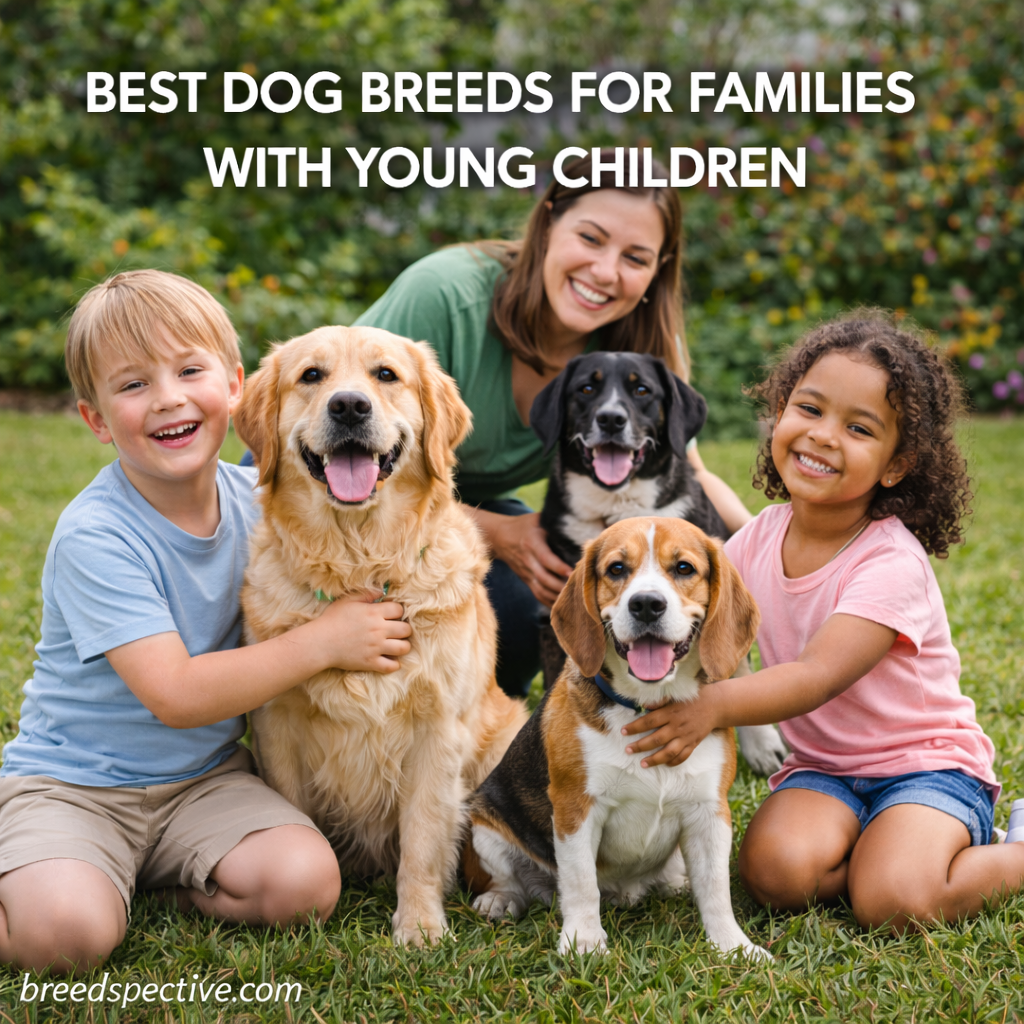
The best dog breeds for families with young children include Labrador Retrievers, Golden Retrievers, Poodles, Beagles, Boxers, Cavalier King Charles Spaniels, Bichon Frises, and Newfoundlands. For most families, a Labrador or Golden Retriever is a strong place to start because both combine trainability, sociability, and family-oriented temperaments — but size, exercise needs, the individual dog’s history, and adult supervision matter just as much as breed.
There is no breed that is automatically safe with toddlers. The CDC recommends supervising young children around all dogs, including trusted family pets, and notes that most bites involving young children happen during ordinary interactions with familiar dogs.
Best Family Dogs at a Glance
| Rank | Breed | Size | Energy | Strongest Family Trait | Main Trade-Off |
|---|---|---|---|---|---|
| 1 | Labrador Retriever | Medium–large | High | Social and trainable | Excitable when young |
| 2 | Golden Retriever | Medium–large | Moderate–high | Gentle, cooperative nature | Exercise and coat care |
| 3 | Poodle | Varies | Moderate–high | Highly trainable | Grooming commitment |
| 4 | Beagle | Small–medium | Moderate–high | Social, sturdy companion | Scent-driven independence |
| 5 | Boxer | Medium–large | High | Playful family orientation | Can overwhelm toddlers |
| 6 | Cavalier King Charles Spaniel | Small | Moderate | Gentle companion style | Small size requires careful handling |
| 7 | Bichon Frise | Small | Moderate | Social, manageable size | Regular grooming |
| 8 | Newfoundland | Giant | Moderate | Generally gentle demeanor | Enormous size and expense |
This ranking prioritizes qualities useful in homes with young children: trainability, manageable temperament, sociability, physical robustness, and the ability to participate in family life.
It does not mean every Labrador is safer than every Beagle or every mixed-breed dog. Individual temperament, health, previous experiences, training, socialization, and the behavior of the children all affect compatibility.
What Makes a Dog a Good Match for Young Children?
Families often search for the “most patient” or “gentlest” breed. Those qualities are useful, but they are only part of the decision.
A good family match should also have exercise and training requirements the adults can realistically meet.
Look for:
- A social temperament compatible with a busy household
- Trainability
- Appropriate activity for the family’s routine
- A manageable adult size
- Comfortable handling when properly introduced
- An ability to settle after activity
- No known history of aggression toward children
The AVMA recommends selecting a dog carefully for the specific household rather than making an impulse decision. It also stresses that children need an adult who remains responsible for supervising the dog’s daily care.
Before narrowing the choice specifically around children, our broader guide to choosing the right dog breed for your lifestyle can help you account for exercise, space, budget, grooming, and experience.
1. Labrador Retriever
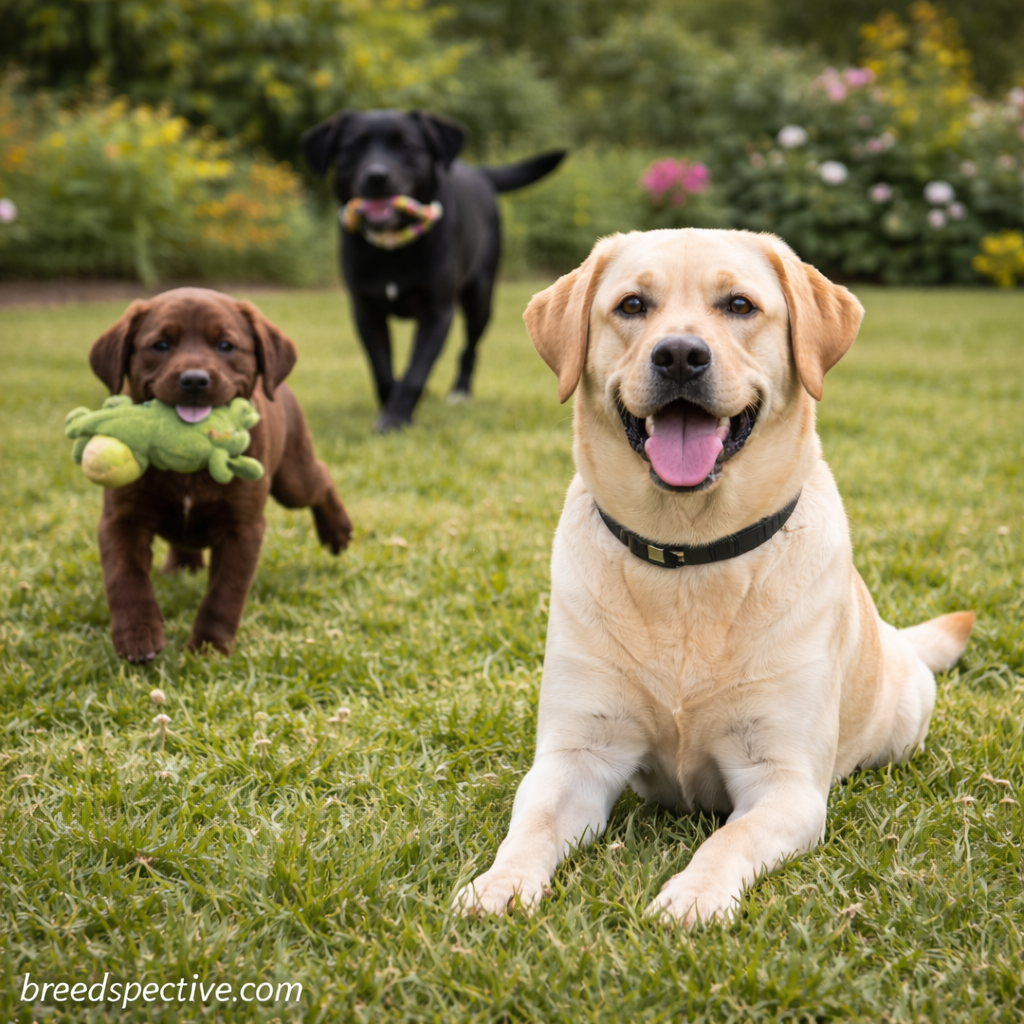
For many active families, the Labrador Retriever offers one of the strongest combinations of sociability, trainability, physical sturdiness, and enthusiasm for family activities.
Labs are substantial enough that ordinary interactions with children are less physically risky for the dog than they may be with a tiny toy breed.
The downside is energy.
A young Labrador can be exuberant. Running, jumping, carrying objects, and enthusiastic greetings can easily knock a toddler down.
That makes training particularly important during puppyhood and adolescence.
Best for families that:
- Want an active dog
- Enjoy walks and outdoor activities
- Have time for daily exercise and training
- Want a medium-to-large companion
- Can manage an energetic adolescent dog
A Labrador is a poor choice for a family wanting a quiet dog requiring minimal exercise.
Our Labrador Retriever temperament and lifestyle profile covers those everyday demands in more detail.
2. Golden Retriever
Golden Retrievers are another strong family option when the adults can provide enough activity, training, grooming, and companionship.
They are trainable sporting dogs and can participate in walks, games, outdoor outings, and other family activities.
Goldens are not small, sedentary dogs.
Young individuals can be energetic and physically enthusiastic, and adults require regular exercise. Their longer coats also create more grooming work than a Labrador’s.
Best for families that:
- Want a social, involved companion
- Have an active household
- Can provide consistent training
- Do not mind regular brushing and shedding
- Want a dog capable of participating in family activities
Families deciding between the two retrievers can use our Labrador vs. Golden Retriever family comparison to compare their practical differences.
For a closer look at the breed itself, see the Golden Retriever’s temperament, energy, and lifestyle fit.
3. Poodle
Poodles deserve more consideration as family dogs than their elaborate show coats sometimes suggest.
Standard, Miniature, and Toy Poodles differ considerably in size, which gives families options. They are highly trainable dogs and can be active, engaging companions.
For families with very young children, size deserves careful thought.
A Standard Poodle is physically more robust but also large enough to knock down a toddler. A Miniature Poodle may offer a middle ground for households that want a smaller dog without going to the tiniest end of the size range.
The major trade-off is grooming.
Poodle coats require regular maintenance and professional grooming may become a significant recurring expense.
Best for families that:
- Prioritize trainability
- Enjoy interactive dogs
- Can provide exercise and mental stimulation
- Accept substantial grooming requirements
- Want a choice of sizes
4. Beagle
Beagles can fit families looking for a smaller but physically sturdy dog.
They tend to be active, curious dogs that enjoy exploring their environment. Their size can be easier to manage than a large retriever while being less physically delicate than many tiny companion breeds.
The trade-off comes from their hound heritage.
Beagles were developed to follow scent. That can translate into distraction outdoors, enthusiastic sniffing, and a greater need for secure management than families might expect from a relatively small dog.
They can also be vocal.
Best for families that:
- Want a smaller active dog
- Enjoy walking and outdoor exploration
- Can manage a scent-driven hound
- Have secure outdoor arrangements
- Do not expect effortless off-leash reliability
Read our Beagle temperament, energy, and lifestyle guide before assuming its moderate size makes it automatically easy.
5. Boxer
Boxers can be deeply engaging family companions for households that actively want a playful, energetic dog.
Their physical sturdiness can be an advantage around children compared with a fragile toy breed.
It can also be their biggest drawback.
An excited Boxer is powerful enough to send a small child to the floor without any aggressive intent. Families with toddlers need to take jumping, leash manners, greetings, and indoor impulse control seriously.
Best for families that:
- Want an energetic dog
- Enjoy active play
- Have time for training
- Can physically manage a strong dog
- Are comfortable supervising boisterous interactions
The Boxer’s temperament, energy, and lifestyle fit is particularly worth reviewing if you have toddlers rather than older children.
6. Cavalier King Charles Spaniel
For families that want a smaller companion, the Cavalier King Charles Spaniel can offer a gentler style than a large, exuberant working or sporting breed.
Its smaller size also makes the dog easier for an adult to physically manage.
But small dogs introduce the opposite problem.
A toddler can accidentally injure a small dog by falling on it, grabbing it, trying to carry it, or handling it roughly. A small dog’s tolerance should never be used as permission for a child to treat it like a stuffed animal.
Health is another major consideration when researching Cavaliers. Prospective owners should investigate breed-related health concerns and responsible breeding practices carefully.
Best for families that:
- Prefer a smaller companion
- Have relatively calm children
- Can closely supervise handling
- Want moderate rather than intense exercise
7. Bichon Frise
The Bichon Frise can suit families wanting a cheerful, social dog in a smaller package.
Bichons can participate in play and household activity without bringing the physical mass of a Labrador, Boxer, or Newfoundland into the home.
Again, small size requires appropriate child behavior.
Toddlers should not be allowed to pick up, chase, corner, or climb on a Bichon.
The coat is another commitment. Regular grooming is part of ownership rather than an optional cosmetic extra.
Best for families that:
- Want a small companion dog
- Can supervise young children closely
- Accept regular grooming
- Want an interactive household pet
8. Newfoundland
The Newfoundland is often associated with a calm, gentle temperament, but families should not let the “gentle giant” image obscure the practical reality of owning a giant dog.
Size changes almost everything.
Food, beds, crates, transportation, grooming, veterinary logistics, and physical handling become larger considerations. Even a friendly Newfoundland can accidentally knock over a small child simply by moving through a tight space.
Drool and coat maintenance also come with the territory.
Best for families that:
- Specifically want a giant breed
- Have adequate space
- Can handle substantial grooming
- Have the budget for a very large dog
- Are prepared to train a giant puppy before it becomes a giant adult
A Newfoundland should be chosen because the family is prepared for giant-breed ownership, not simply because of its reputation with children.
What Is the Best Dog for Toddlers?
For a household with toddlers, the Labrador Retriever and Golden Retriever are strong breeds to research first if the family wants an active medium-to-large dog and can provide training and exercise.
But there is no universally safest “toddler breed.”
A calm adult dog with a documented history of living successfully with young children may be a more predictable choice than an unknown puppy from a breed with a family-friendly reputation.
Toddlers create particular challenges because they:
- Move unpredictably
- Fall frequently
- Make sudden noises
- May grab without understanding the consequences
- Cannot reliably recognize canine warning signals
- May approach dogs at inappropriate times
That means the adults’ management system matters enormously.
Families new to dogs should also consider the breeds and characteristics discussed in our best dog breeds for first-time owners guide.
Size Matters in Both Directions
Families sometimes assume smaller dogs are automatically safer around small children.
That is too simplistic.
Large dogs
A large dog can:
- Knock a toddler down
- Accidentally step on a child
- Pull an adult holding a stroller
- Reach food and toys at child height
- Turn jumping into a significant safety issue
Training and management need to account for that strength.
Tiny dogs
A very small dog creates different concerns.
A toddler can accidentally injure a tiny dog by dropping it, falling on it, stepping on it, or attempting to carry it.
A frightened or hurt dog may also defend itself.
The most practical size depends on the family. For many households, a physically robust small-to-medium or medium-to-large dog is easier to integrate than either extreme, provided its activity and temperament also fit.
Child-and-Dog Safety Matters More Than Breed Reputation
No breed should be treated as “child-proof.”
The CDC states that children are more likely than adults to be bitten by dogs and that injuries to children tend to be more severe. Most bites affecting young children happen during everyday activities while interacting with familiar dogs.
That makes the family dog part of bite-prevention planning, not an exception to it.
The AVMA likewise emphasizes that any dog can bite and that young children cannot reliably interpret canine body language. It recommends adult supervision of interactions between children and dogs, including the family’s own dog.
Never leave a young child alone with a dog
Being in the house is not the same as actively supervising.
An adult needs to be close enough to recognize when either the dog or child needs a break and intervene immediately.
CDC guidance specifically says not to let young children play with dogs without supervision, even when the child already knows the dog and even when it is the family pet.
Teach children when to leave the dog alone
Children should learn not to disturb a dog that is:
- Eating
- Sleeping
- Resting in its safe space
- Caring for puppies
- Hiding or attempting to get away
- Chewing a valued item
- Showing signs it wants interaction to stop
The CDC specifically advises against disturbing dogs while eating or sleeping and recommends leaving dogs alone when they are seeking space.
Do not allow climbing, hugging, or rough handling
Children may intend affection when they hug a dog around the neck, lie on it, pull its ears, or put their face close to the dog’s face.
The dog may experience that interaction very differently.
Teach children to interact without trapping or restraining the dog.
Give the dog a child-free retreat
A crate, gated room, bed, or another designated area can give the dog somewhere to rest without being followed.
Children need to learn that when the dog enters that area, interaction stops.
Learn basic canine body language
Families should pay attention when a dog attempts to disengage from an interaction.
Moving away, hiding, avoiding contact, or becoming uncomfortable should prompt the adult to separate dog and child rather than asking the dog to tolerate more.
AVMA guidance specifically points out that young children are not equipped to interpret dog body language on their own.
The adult has to do that job.
Puppy or Adult Dog for a Family With Small Children?
Puppies are appealing, but they are not necessarily the easiest option for families with toddlers.
Puppies commonly require housetraining, frequent supervision, socialization, training, and management of chewing and energetic play.
That can create two simultaneous supervision jobs: puppy and toddler.
An adult dog may offer more information about:
- Adult size
- Energy level
- Sociability
- Handling tolerance
- Behavior around children
- Behavior around other animals
- Ability to settle indoors
For some families, an adult dog living in a foster home with a known history around children can therefore be easier to evaluate than a puppy.
Regardless of age, the CDC advises families to make sure a dog is appropriate for their household before adopting or buying and suggests discussing the choice with a veterinarian.
Adoption or Breeder?
Either route can produce an excellent family companion.
The important question is how much reliable information you can obtain about the individual dog.
When adopting
Ask the shelter or foster caregiver:
- Has this dog lived with children?
- What ages?
- How does it respond to handling?
- How does it behave around food and toys?
- What is its normal activity level?
- Does it startle easily?
- Does it have a known bite or aggression history?
- How does it behave around other pets?
Do not rely solely on a breed label assigned from appearance.
When choosing a breeder
Research health and temperament, not just color and availability.
Ask about health screening appropriate to the breed, how puppies are raised and socialized, the temperaments of the parents, veterinary care, and what support the breeder provides after placement.
Families should be prepared to walk away when the available dog does not fit the household, regardless of how appealing the puppy is.
Match the Dog’s Energy to the Whole Family
A dog does not become easier to exercise because children are present.
Adults remain responsible for meeting the dog’s needs.
A Labrador, Golden Retriever, or Boxer may fit beautifully into an active family that spends time outdoors. The same dog can become difficult in a household that wants a calm companion but has little time for daily activity.
Children’s enthusiasm for getting a dog should not be counted as guaranteed future dog-care labor.
The AVMA specifically states that while children can participate in pet care, an adult ultimately needs to be willing and available to supervise and take responsibility.
Choose according to what the adults can sustain.
Breeds That Require More Careful Consideration
There is no responsible universal list of breeds that are “bad with children.”
The CDC emphasizes that any dog can bite, particularly when scared, nervous, eating, guarding something, playing, caring for puppies, or feeling unwell.
Instead of excluding dogs solely by breed, be more cautious when the individual dog or household involves:
- A known history of aggression
- Severe fear or anxiety around children
- Guarding behavior the family is not equipped to manage
- Activity needs far beyond the family’s routine
- Size or strength the adults cannot safely control
- Extreme sensitivity to noise or unpredictable movement
- A strong mismatch between the dog’s needs and the household
Breed tendencies still help with selection, but they do not replace evaluation of the individual animal.
Verdict: Which Family Dog Is the Best Fit?
The Labrador Retriever ranks first for families that want an active, trainable, social dog and are prepared to manage the exercise and exuberance of a young Lab.
The Golden Retriever is an equally strong breed to research for families comfortable with a large, active dog and greater coat maintenance.
A Poodle is particularly appealing when trainability matters and regular grooming is acceptable. A Beagle offers a smaller, sturdy alternative for families comfortable managing hound behavior, while a Boxer suits active households prepared for considerable strength and enthusiasm.
Families wanting a small dog should consider the Cavalier King Charles Spaniel or Bichon Frise, but young children must be taught to handle smaller dogs carefully. The Newfoundland suits families deliberately prepared for the costs, space, grooming, and physical realities of a giant breed.
None of these breeds is right for a household expecting the dog’s temperament to replace supervision. For families with toddlers and preschoolers, the adults’ ability to supervise interactions, recognize canine body language, teach respectful handling, and meet the dog’s needs matters more than any family-friendly label attached to a breed.