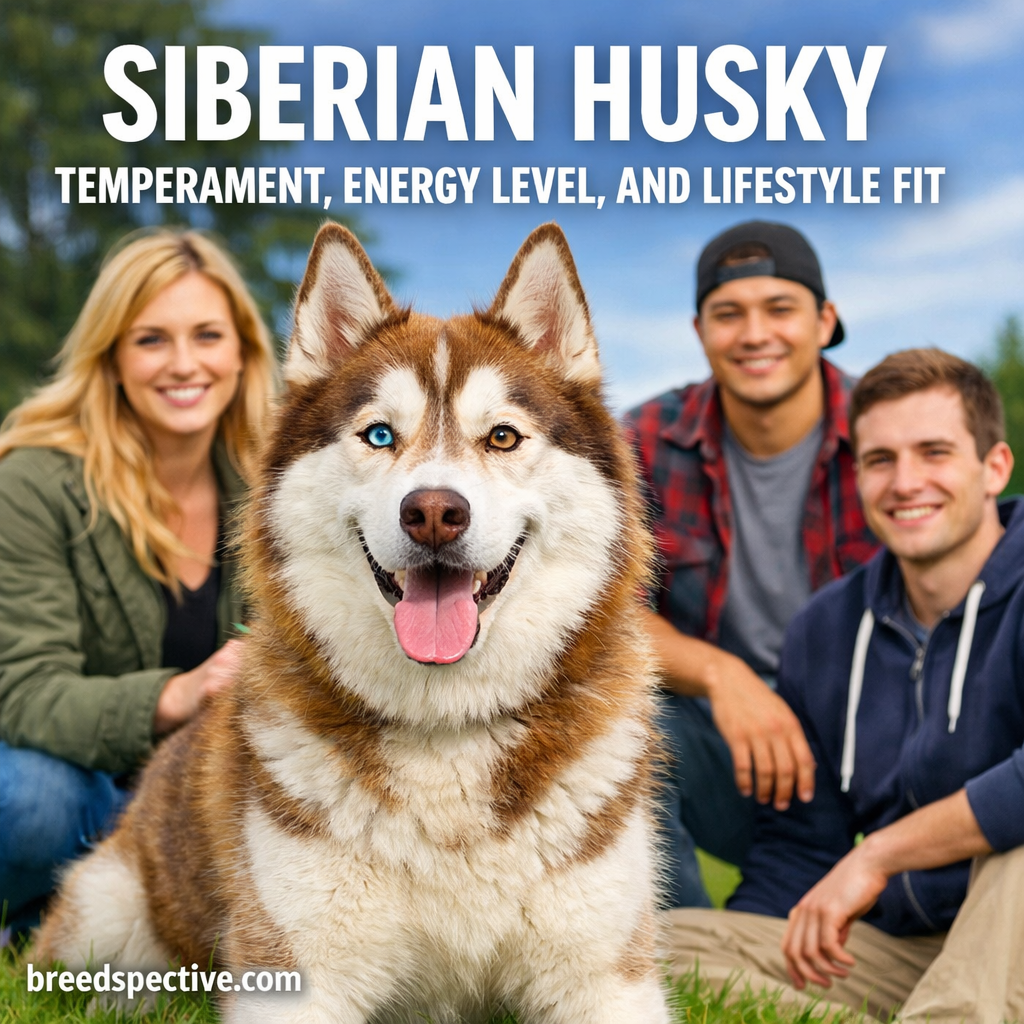
Siberian Husky temperament is typically friendly, energetic, outgoing, independent, and mischievous rather than naturally protective. Huskies usually enjoy people and other dogs, but their enormous drive to run, strong prey instinct, independent decision-making, and need for substantial exercise can make them far more difficult to manage than their appearance suggests.
This is an endurance sled dog designed to move efficiently for miles, not a decorative northern companion. A Husky can be affectionate and entertaining at home, but owners need secure containment, realistic expectations about recall, considerable tolerance for shedding, and a daily routine that gives an athletic working dog something productive to do.
Siberian Husky at a Glance
| Trait | Siberian Husky |
|---|---|
| Height | Males: 21–23.5 inches; females: 20–22 inches |
| Weight | Males: 45–60 pounds; females: 35–50 pounds |
| Life expectancy | About 12–14 years |
| Exercise needs | High |
| Grooming | Moderate normally; very high during seasonal shedding |
| Trainability | Intelligent but independent |
| Good with children? | Often, with supervision and appropriate behavior |
| Good with other dogs? | Often very social |
| Good with small pets? | Significant caution because of prey drive |
| Watchdog/guarding ability | Generally poor; usually friendly toward strangers |
| Best fit | Active household prepared for exercise, containment and shedding |
The AKC standard describes the Siberian Husky as a medium-sized working dog built for carrying a light load at moderate speed over great distances. Males should weigh 45–60 pounds and females 35–50 pounds, making the breed considerably lighter than many people expect from photographs.
That relatively light, efficient build is intentional. The Husky was developed for endurance rather than massive pulling power.
Siberian Husky History and Original Purpose
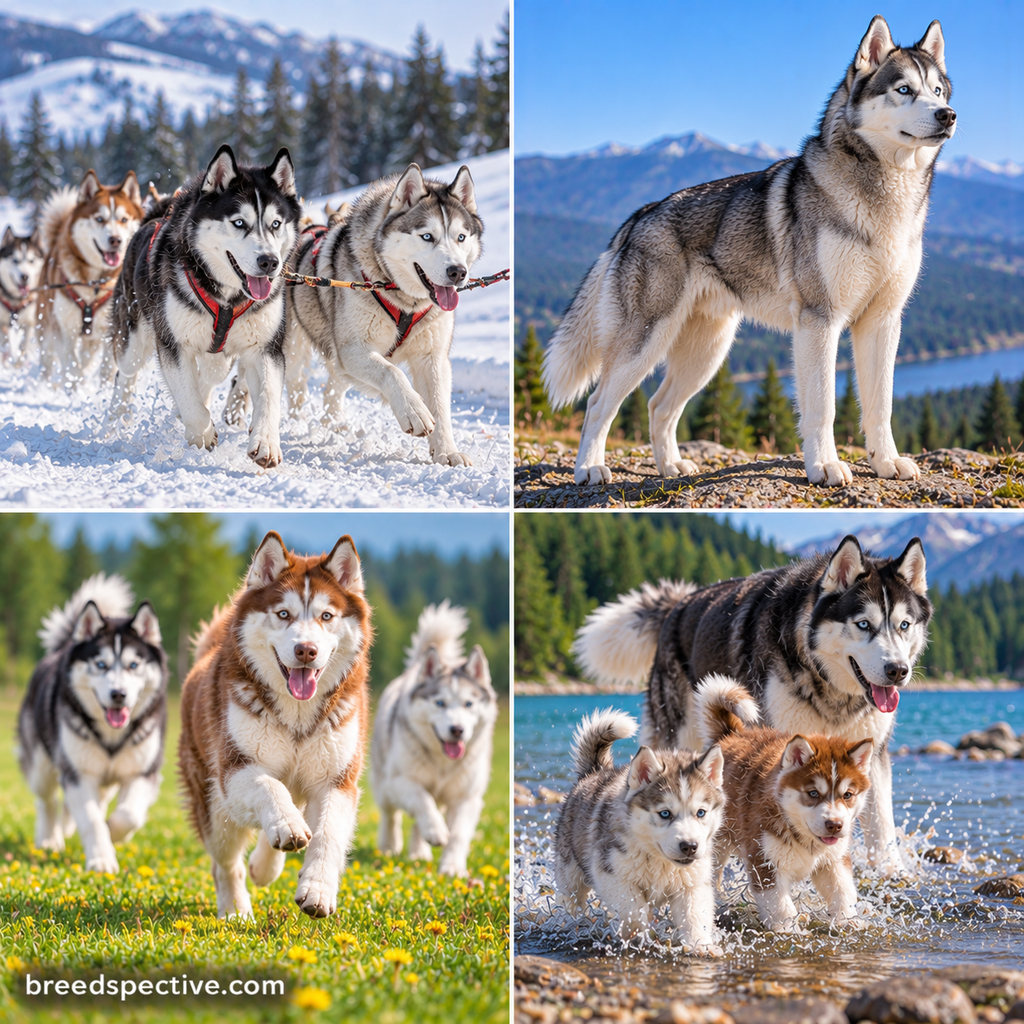
The Siberian Husky was developed by the Chukchi people of northeastern Siberia as an endurance sled dog.
Dogs worked in teams, transporting relatively light loads across immense distances in an unforgiving northern environment. The Siberian Husky Club of America (SHCA) traces the breed directly to these Chukchi dogs and notes that significant numbers were brought to Alaska in the early 1900s, where their long-distance racing ability quickly attracted attention.
The breed’s original job explains much of the modern Husky temperament.
A successful sled dog needed to cooperate with other dogs, tolerate sustained activity, work efficiently rather than lumber along under excessive weight, and remain capable of functioning in difficult conditions.
That heritage remains visible in a modern Husky’s desire to run.
Togo, Balto, and the 1925 Serum Run
The Siberian Husky became closely associated with one of the most famous events in sled-dog history.
In 1925, a diphtheria outbreak threatened Nome, Alaska. With conventional transportation severely limited by winter conditions, teams of sled dogs relayed lifesaving antitoxin toward the isolated community.
Two dogs became particularly famous.
Leonhard Seppala and his experienced lead dog Togo covered the longest and one of the most dangerous portions of the effort. AKC’s historical account says Togo and Seppala traveled 264 miles in total during their involvement in the mission.
Balto, leading Gunnar Kaasen’s team, completed the final 53-mile leg into Nome and consequently became the public symbol of the serum run.
The story is a useful reminder of what Siberian Huskies were bred to do: work in a team, travel extraordinary distances, and keep moving through demanding conditions.
Siberian Husky Temperament in Everyday Life
The typical Husky personality is social but not necessarily obedient.
That distinction catches many first-time owners by surprise.
A Husky can genuinely enjoy you while simultaneously deciding that chasing a rabbit is more interesting than responding to your recall cue.
Friendly With People
Despite the wolf-like appearance, the Siberian Husky was not developed primarily as a guard dog.
SHCA describes the breed as affectionate without being excessively dependent and generally welcoming toward strangers. AKC similarly notes that the breed’s friendliness tends to make it an ineffective watchdog.
Someone wanting a naturally suspicious property guardian should choose a breed for which those characteristics are actually typical.
A Husky may look intimidating through a window, but appearance and guarding temperament are very different things.
Independent and Intelligent
Huskies are intelligent dogs.
They are not necessarily eager to repeat commands simply because an owner asks.
Sled dogs historically had to work with humans while possessing enough physical and mental independence to perform for long periods. In a modern home, that can produce a dog that learns a command quickly but does not treat compliance as automatic.
Training therefore needs to be rewarding, consistent, and worth the dog’s attention.
This differs from the intense handler focus seen in some herding breeds. Owners comparing demanding working dogs may find our guide to Border Collie temperament and lifestyle fit useful for seeing how high energy can appear in very different forms.
How Much Exercise Does a Siberian Husky Need?
A healthy adult Husky commonly needs around 90–120 minutes of purposeful daily physical activity and mental engagement, with some individuals capable of substantially more.
Treat that as a practical planning range rather than a veterinary prescription.
Good activities include:
- Brisk walks
- Hiking
- Running with a conditioned adult dog
- Canicross
- Bikejoring where safely practiced
- Sledding or dryland mushing
- Structured play
- Scent games
- Training
- Secure off-leash exercise in a properly enclosed area
A casual trip around the block is unlikely to satisfy an athletic young Husky.
Owners should also avoid assuming that a large backyard solves the exercise problem. Many Huskies will simply explore the fence, dig, lounge, or search for an escape route unless someone provides purposeful activity.
Before choosing any working breed, compare its needs with your actual weekday schedule using our guide to matching a dog’s energy level to your daily routine.
Huskies Are Famous Escape Artists for a Reason
Containment deserves its own section because it can determine whether Husky ownership succeeds.
AKC specifically warns about the breed’s strong instinct to run and recommends keeping Siberians leashed or within securely fenced areas. Its breed-history material likewise describes them as accomplished escape artists.
A bored or motivated Husky may:
- Dig under fencing
- Exploit loose gates
- Push through weak barriers
- Dash through an open door
- Climb or jump surprisingly well
- Run when released rather than remaining near home
Do not build your safety plan around the assumption that training will eventually eliminate this tendency.
Train recall anyway—it remains an essential skill—but combine training with physical management.
A securely fenced exercise area, identification tag, registered microchip, careful door habits, and leash use in unenclosed areas provide layers of protection.
For this breed, management is not an admission that training failed. It is sensible recognition of what generations of selection produced.
Prey Drive Can Be a Serious Problem
The Husky’s friendly attitude toward people and dogs does not guarantee safety around small animals.
SHCA explicitly warns that Siberian Huskies can have strong predatory instincts and identifies animals such as rabbits, birds, guinea pigs, hamsters, squirrels and cats as potential targets.
Individual dogs vary.
Some Huskies live successfully with cats, especially when raised alongside them, but early exposure does not erase genetic predatory behavior or guarantee lifelong safety.
Owners with small pets should plan for physical separation where appropriate rather than relying entirely on verbal control.
Outdoor cats, rabbits and wildlife can be particularly stimulating because running itself may trigger pursuit.
Are Siberian Huskies Good With Children?
Many Siberian Huskies are social family dogs.
SHCA’s historical discussion notes the breed’s longstanding association with Chukchi families and describes a character that is generally friendly toward people.
Still, child-dog compatibility is never automatic.
An excited Husky can jump, pull, mouth during play, or knock down a small child without aggression being involved. Children should not climb on dogs, disturb them while sleeping, interfere with meals, or chase a dog that is trying to leave.
Adult supervision remains necessary.
Huskies and Other Dogs
This is often one of the breed’s stronger areas.
Siberian Huskies were developed to work in teams, and many retain a sociable attitude toward other dogs. AKC specifically notes their pack heritage and tendency to get along with canine companions.
That does not mean every adult Husky will like every dog.
Introductions, socialization, individual temperament, resource management and the behavior of the other dog still matter.
People choosing between northern working breeds should also avoid treating them as interchangeable. Our Siberian Husky vs. Alaskan Malamute comparison covers their practical differences in greater detail.
Common Siberian Husky Behavior Problems
Most difficult Husky behaviors make more sense when viewed through the breed’s original purpose.
Pulling on the Leash
Pulling comes naturally to a dog descended from generations of harness workers.
Start loose-leash training early. Reward the position you want, stop reinforcing forward movement on a tight leash, and practice where distractions are manageable before expecting polished behavior in exciting environments.
Harness sports and polite leash walking can coexist if the dog is taught clear contextual cues.
Running Away
Treat this as a safety issue rather than stubbornness.
Build recall with high-value reinforcement, but continue using fences and leashes where necessary.
Digging
Digging can become recreational, especially in an under-stimulated dog.
Increase appropriate activity, supervise the yard, protect vulnerable fence lines, and consider providing a designated digging area if the dog strongly enjoys the behavior.
Destructive Behavior
A young Husky with energy to burn can be remarkably creative.
Provide physical exercise, safe chewing options, food puzzles, scent games, training, and appropriate confinement when unsupervised.
Crate training can be useful, but a crate should not become a substitute for meeting the dog’s daily needs.
Vocalizing
Huskies are famous for expressive vocal behavior.
Howling, whining and other dramatic sounds may be more characteristic than constant conventional barking, although individuals vary.
Before choosing one for an apartment, consider neighbors and building acoustics—not merely whether the lease permits dogs.
Siberian Husky Grooming and Shedding
The coat is beautiful and functional.
It is also a major source of loose hair.
The AKC breed standard calls for a double coat of medium length, with a soft, dense undercoat and straighter outer guard hairs. The standard specifically notes that losing the undercoat during shedding season is normal.
AKC ownership guidance describes heavier shedding periods about twice per year, when substantial quantities of undercoat may come loose.
Expect:
- Weekly brushing during ordinary periods
- Much more frequent brushing during coat blows
- Large amounts of loose undercoat
- Regular vacuuming
- Nail care
- Dental care
- Occasional bathing
The coat normally does not require routine clipping.
Our guide to grooming needs by dog coat type explains how double coats differ from continuously growing coats and other coat structures.
If loose hair throughout the home is a major frustration for you, a Husky is a poor choice.
Huskies in Hot Weather
A Siberian Husky can live in warmer regions, but its heavy double coat requires sensible heat management.
Cornell University College of Veterinary Medicine identifies dogs with thick or dark coats as having increased heatstroke risk and specifically uses Siberian Huskies as an example of a double-coated breed.
During hot weather:
- Exercise early in the morning or later in the evening
- Provide shade and cool indoor space
- Keep fresh water available
- Avoid strenuous midday activity
- Watch pavement temperature
- Reduce exercise intensity when conditions demand it
- Learn the signs of overheating
Cornell lists heavy panting, seeking shade, reluctance to play and drooling among early warning signs. Weakness, confusion, vomiting, breathing difficulty, seizures or collapse can indicate a life-threatening emergency requiring immediate veterinary attention.
Do not assume northern ancestry makes a Husky immune to environmental extremes in either direction.
Those Blue—and Sometimes Mismatched—Eyes
Siberian Huskies can have brown eyes, blue eyes, one of each, or parti-colored eyes.
The AKC breed standard explicitly accepts all of these.
Having one blue and one brown eye is called heterochromia, and in this breed it is an accepted appearance rather than a breed-standard fault.
Eye color should not be the deciding factor when selecting a puppy.
Temperament, health testing, breeder practices and suitability for your household matter far more than a particular eye color.
Siberian Husky Health Screening
The Siberian Husky Club of America’s current health statement calls for more than a basic DNA panel.
Its 2024 breeding recommendations include:
- Hip evaluation through OFA, PennHIP or another recognized equivalent registry
- Annual eye examination beginning at a minimum of 12 months, performed by a board-certified veterinary ophthalmologist and registered through OFA’s CAER or SHCA’s SHOR system
- Siberian Husky Shaking Puppy Syndrome Type 1 (SPS1) genetic testing
- Siberian Husky Polyneuropathy Type 1 (SHPN1) genetic testing
The AKC’s current Working Group health-testing requirements list the same four areas based on national breed-club recommendations.
SHCA emphasizes that DNA testing by itself is not equivalent to complete breed-appropriate health testing.
What a CHIC Number Means
OFA’s Canine Health Information Center works with parent clubs to establish breed-specific screening requirements.
SHCA explains an important detail buyers sometimes miss: receiving a CHIC number means the required testing was completed and made publicly available; it does not mean every result was normal.
Look at the actual results for both parents.
Do not stop at a breeder saying “CHIC certified” or “DNA clear.”
Hip Dysplasia
Hip screening remains part of SHCA’s recommended breeding protocol.
The club accepts OFA, PennHIP and recognized equivalent evaluations under its current health statement.
Prospective owners should verify the parents’ orthopedic results in the appropriate public registry rather than relying on a verbal assurance.
Eye Disease
Eye screening is particularly important in this breed.
SHCA identifies hereditary cataracts, corneal dystrophy and progressive retinal atrophy among inherited eye concerns documented in Siberian Huskies. Because some abnormalities can emerge over time, the club’s current breeding guidelines call for recurring ophthalmologist examinations rather than treating one puppyhood eye check as permanent clearance.
How Much Does a Siberian Husky Cost Per Year?
The purchase or adoption fee is only the beginning.
A practical annual U.S. planning budget is:
| Expense | Practical annual planning range |
|---|---|
| Food and treats | $450–$900 |
| Routine veterinary care | $300–$900 |
| Parasite prevention | $150–$450 |
| Toys and enrichment | $150–$500 |
| Grooming/supplies | $100–$400 |
| Training/classes | $100–$700+ |
| Pet insurance | $400–$1,400+ |
| Typical planning total | About $1,650–$5,250+ |
These are budgeting estimates rather than fixed national prices.
Emergency veterinary treatment, boarding, daycare, professional grooming, fencing upgrades, escape-proofing and specialized dog-sport equipment can raise the total.
For a Husky, secure containment can itself become an ownership expense. Repairing an inadequate fence after discovering the dog’s abilities is usually more expensive and stressful than planning appropriately before the dog arrives.
Should You Get a Husky? Checklist
A Husky deserves a realistic decision rather than an appearance-driven one.
A Siberian Husky may fit your household if most of these statements are true:
- I can provide roughly 90–120 minutes of meaningful daily activity for a healthy adult.
- I enjoy active outdoor routines.
- I am comfortable using a leash even if my dog learns good recall.
- I can provide genuinely secure containment.
- I can tolerate substantial seasonal shedding.
- I am willing to train an intelligent dog that may be independent rather than automatically compliant.
- I understand that friendliness does not eliminate prey drive.
- I can safely manage interactions with cats or small animals.
- I have a plan for exercise during hot weather.
- I am comfortable with howling and other vocal behavior.
- I want an active companion rather than a guard dog.
- I will verify breed-specific health testing before buying a puppy.
If several of those requirements feel like compromises you hope the individual dog simply won’t have, reconsider the breed.
Our broader guide to choosing the right dog breed for your lifestyle can help separate characteristics you genuinely want from ones you would merely tolerate.
Verdict: Is a Siberian Husky Right for You?
A Siberian Husky is right for an active owner who wants a friendly, athletic, social working dog and can provide substantial exercise, secure containment, consistent training and an outlet for its desire to run. The breed can be an engaging family companion for people who appreciate independence and do not need automatic obedience or natural guarding behavior.
A Husky is not right for someone who wants reliable off-leash freedom in unenclosed areas, dislikes heavy shedding, keeps vulnerable small pets without a realistic management plan, or expects a beautiful northern dog to be satisfied with occasional walks. Hot-climate owners also need to organize exercise around safe temperatures rather than expecting the dog to adapt to strenuous midday activity.
The Siberian Husky’s striking eyes and wolf-like outline attract attention, but neither is what defines the breed. Its defining traits come from generations of endurance work: the desire to run, the ability to work alongside other dogs, physical stamina, independence, and an unusually social personality. Those qualities are exceptional in the right home and exhausting in the wrong one.