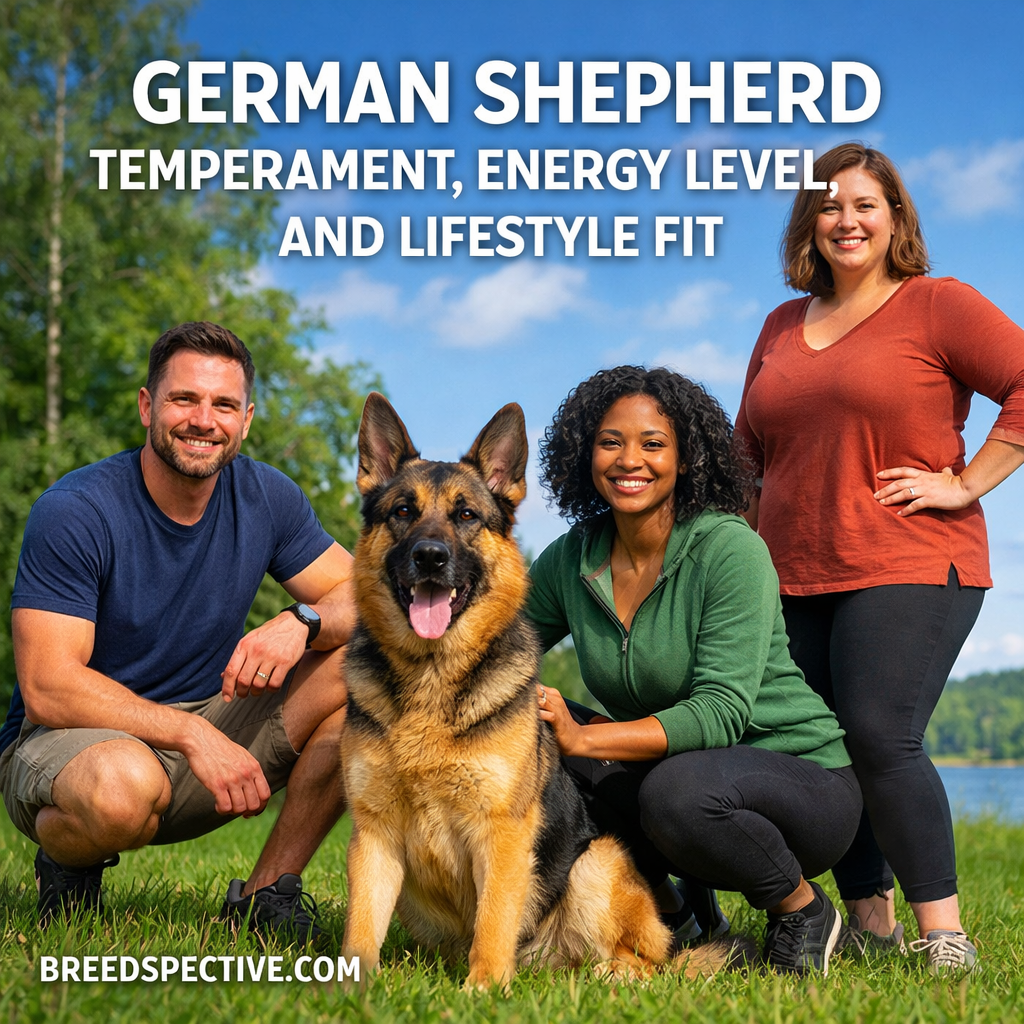
German Shepherd temperament should be confident, intelligent, alert, trainable, and somewhat reserved with strangers without being fearful or indiscriminately aggressive. This is an energetic working breed that forms strong bonds with its household and usually needs considerably more training, exercise, and mental engagement than the average companion dog.
A well-bred, well-socialized German Shepherd can be a steady family companion as well as an exceptional working partner. Poor breeding, inadequate socialization, or insufficient outlets for its drive can produce a powerful dog that is difficult to manage.
German Shepherd at a Glance
| Trait | German Shepherd Dog |
|---|---|
| Size | Males: 24–26 inches; females: 22–24 inches |
| Typical weight | Roughly 50–90 pounds, depending on sex and build |
| Life expectancy | About 9–13 years |
| Exercise needs | High; substantial daily physical and mental activity |
| Grooming | Moderate to high; double coat sheds heavily |
| Trainability | Very high, with consistent reward-based training |
| Good with children? | Can be excellent with training and supervision |
| Good with other pets? | Variable; socialization and individual temperament matter |
| Protective tendency | Naturally alert and watchful |
| Best fit | Active, training-oriented household that wants an involved working breed |
The official AKC German Shepherd Dog standard describes the ideal temperament as direct and fearless but not hostile, self-confident, approachable, poised, eager, and alert. It specifically states that nervousness, timidity, and lack of confidence are not typical of correct breed character.
German Shepherd History and Original Purpose
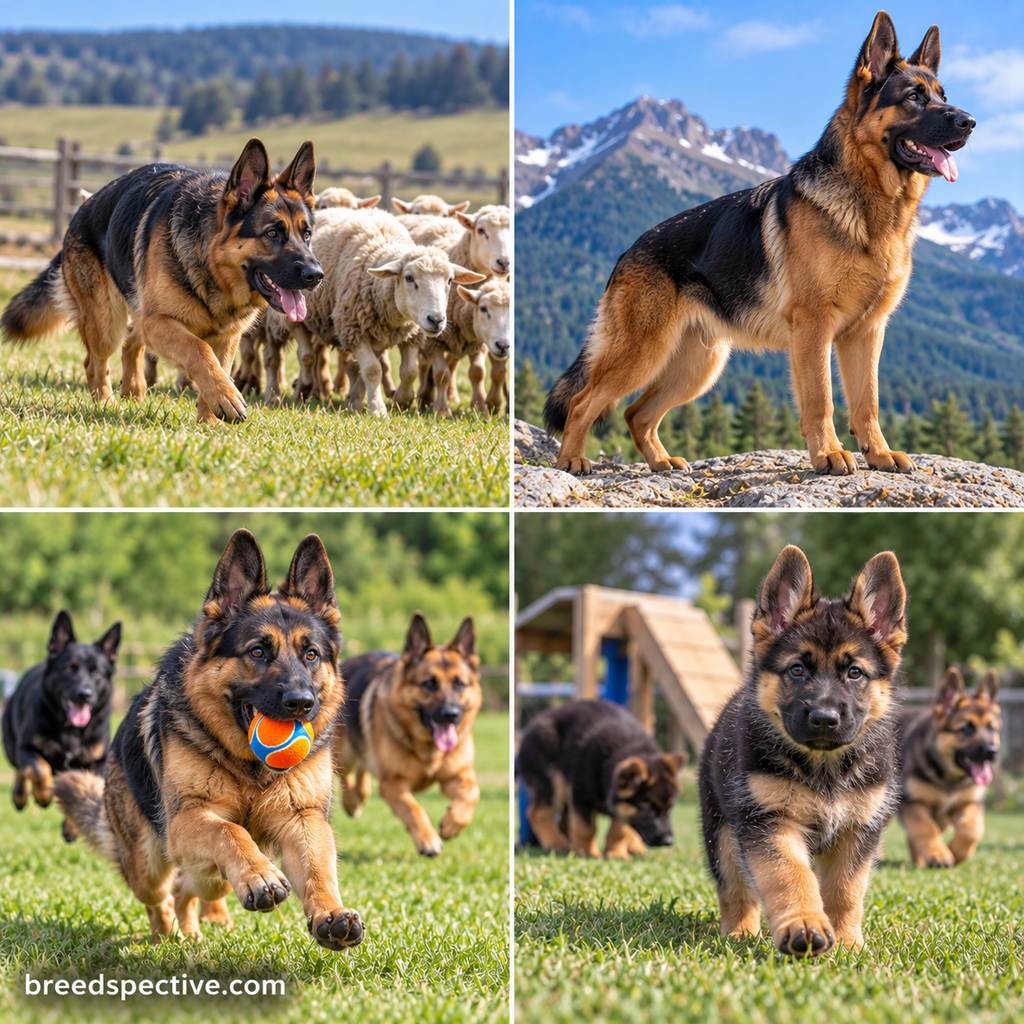
The German Shepherd Dog was created around function.
During the late 1800s, German sheep-herding dogs varied considerably between regions. German cavalry officer Max von Stephanitz wanted to standardize these working dogs into a versatile breed defined by intelligence, sound structure, temperament, and usefulness.
In 1899, von Stephanitz and his colleague Artur Meyer encountered a working sheepdog named Hektor Linksrhein at a dog show. Von Stephanitz purchased him, renamed him Horand von Grafrath, and registered him as the first German Shepherd Dog. He and Meyer also established the Verein für Deutsche Schäferhunde, or SV, that year.
Horand became a foundation of the developing breed.
Von Stephanitz emphasized utility rather than creating a dog solely for appearance. As traditional herding work declined, he promoted German Shepherds for other jobs, including messenger, sentry, rescue, military, and protection work.
That versatility remains one of the breed’s defining characteristics. Modern German Shepherds work in law enforcement, search and rescue, service roles, scent detection, herding, obedience, tracking, and dog sports.
The breed’s public profile increased dramatically after World War I. American soldier Lee Duncan rescued a German Shepherd puppy from a battlefield area in France and brought him to the United States. That dog became Rin Tin Tin, who appeared in numerous silent films during the 1920s and helped turn the German Shepherd into a Hollywood star.
German Shepherd Temperament in Everyday Life
The breed standard gives a more useful picture of correct German Shepherd temperament than the simplistic label “protective.”
A German Shepherd should be confident enough that it does not need to react aggressively to ordinary life.
Loyal Without Needing to Love Everyone
German Shepherds tend to form strong attachments to their households.
They are not supposed to approach every stranger as a new best friend. The AKC standard specifically describes a degree of aloofness and says the breed does not lend itself to immediate and indiscriminate friendships.
That reserve should not become fearfulness.
A stable German Shepherd should be capable of encountering unfamiliar people without panicking, hiding, lunging, or treating every stranger as a threat.
This distinction is especially important when choosing a puppy or adult dog. Nervousness should not be excused as “protective instinct.”
Naturally Alert and Watchful
German Shepherds notice changes in their environment.
Many monitor doors, visitors, unfamiliar sounds, and activity around the property. Their history as herders, sentries, and service dogs selected for attentiveness and responsiveness.
That can make them effective watchdogs without any specialized protection training.
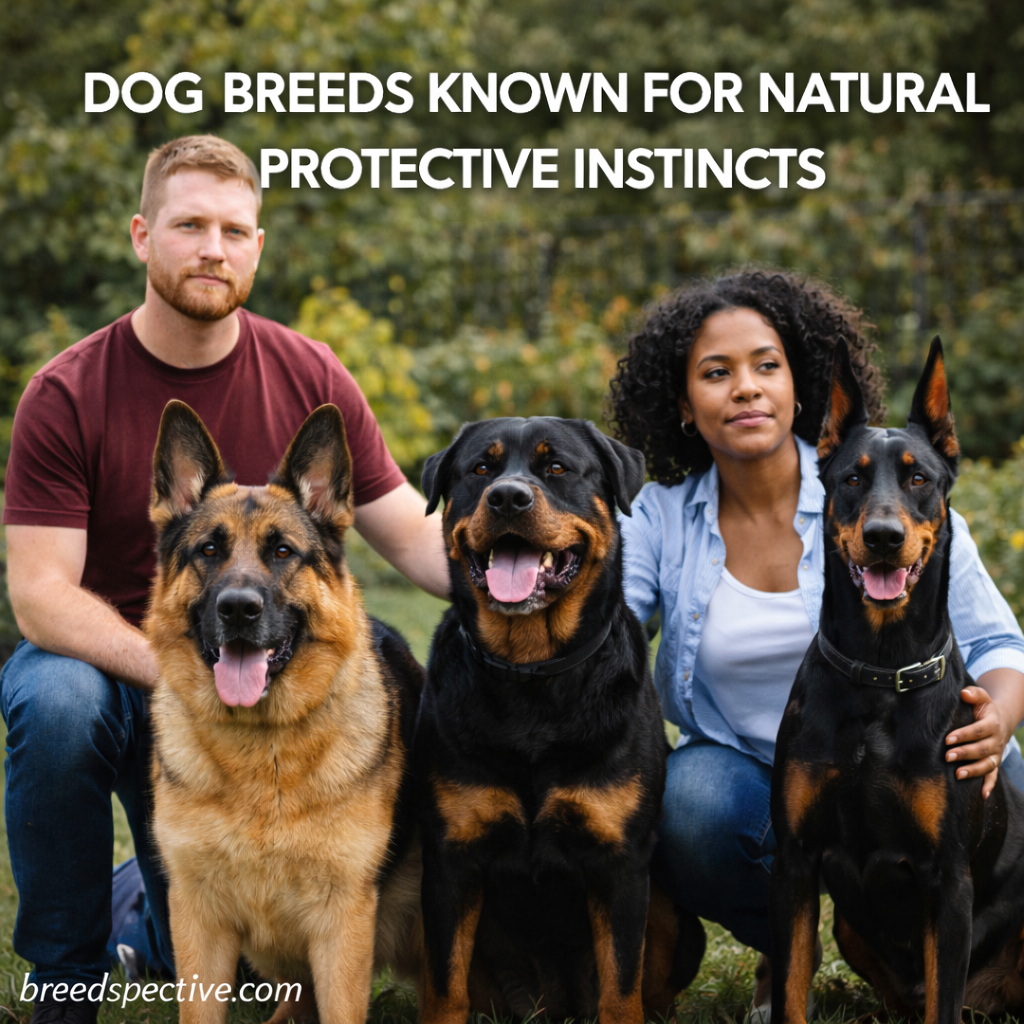
Owners interested in this characteristic can compare the German Shepherd with other dog breeds known for natural protective instincts.
A family companion does not need to be trained to threaten people to demonstrate correct German Shepherd temperament.
How Much Exercise Does a German Shepherd Need?
A healthy adult German Shepherd typically needs about 90–120 minutes of combined physical activity, training, and mental work each day, although individual requirements vary considerably.
That does not mean two hours of nonstop running.
A practical routine could include:
- A 30–45 minute morning walk
- 10–15 minutes of obedience or scent work
- Fetch or structured play
- Another substantial walk or activity session later
- Short training opportunities throughout the day
German Shepherds were developed to work for extended periods rather than simply sprint for a few minutes and return to the sofa.
Mental exercise matters almost as much as physical exercise.
Searching for hidden objects, tracking scents, practicing obedience, learning new behaviors, carrying out structured tasks, and participating in dog sports can provide productive outlets for the breed’s intelligence.
Owners comparing highly trainable working breeds may also find our guide to Border Collie temperament, energy level, and lifestyle fit useful.
Puppies Need a Different Exercise Plan
Do not give a growing German Shepherd puppy an adult endurance routine.
Puppies need free movement, exploration, play, training, and age-appropriate walks without repetitive forced running or excessive high-impact exercise.
German Shepherds are also susceptible to orthopedic problems, making healthy growth, appropriate body condition, and sensible exercise particularly relevant.
Training a German Shepherd
German Shepherds are highly trainable, but trainability should not be confused with being automatically well behaved.
A smart dog learns undesirable habits just as efficiently as desirable ones.
Early priorities should include:
- Recall
- Loose-leash walking
- Calm greetings
- Handling and grooming
- Leave it and drop it
- Settling on cue
- Neutrality around strangers and dogs
- Reliable response around distractions
Reward-based training works particularly well when the dog understands how to earn access to food, toys, play, movement, and other things it values.
The breed’s aptitude for learning is one reason German Shepherds regularly appear among discussions of the easiest dog breeds to train and why, but ease of learning does not reduce the owner’s workload. It often increases the need for meaningful engagement.
Working-Line vs. Show-Line German Shepherds
“German Shepherd” describes one breed, but breeding goals can produce meaningful differences between individual lines.
The labels working line and show line are broad categories rather than guarantees of temperament.
Working Lines
Breeders selecting primarily for police work, protection sports, tracking, herding, or other demanding performance roles may prioritize traits such as:
- High motivation to work
- Strong toy or prey drive
- Persistence
- Environmental confidence
- Physical endurance
- Fast responses
- Strong engagement with a handler
A high-drive working-line German Shepherd can be outstanding in the correct home but excessive for someone who simply wants a pleasant family companion.
These dogs may require substantial daily training in addition to exercise.
Show Lines
Show-line breeding places greater emphasis on conformation to a particular breed standard while responsible breeders should still prioritize sound temperament, movement, and working ability.
Individual show-line dogs can still be energetic, driven, and capable working dogs.
It is therefore inaccurate to assume that every working-line dog is intense or that every show-line dog is calm.
Ask a breeder about the actual parents.
How do they behave around strangers? What work or sports do they perform? Can they settle indoors? Have they passed temperament testing? What were previous litters like?
Those answers tell you considerably more than a line label.
For another close comparison involving working intensity, see German Shepherd vs. Belgian Malinois: key differences explained.
The German Shepherd “Sloped Back” Debate
German Shepherd structure is frequently oversimplified online, particularly in discussions of show dogs.
The official AKC standard does not call for a weak, deformed, or excessively long back.
It describes the German Shepherd as strong, agile, well-muscled, balanced, and longer than tall. The standard specifically says that the breed’s desired length should come from the overall proportions of the forequarter, withers, and hindquarter rather than from an excessively long back.
The standard does describe the topline as sloping from the high point of the withers into a level back and then into a gradually sloping croup. It also requires the hindquarters to be broad, muscular, and balanced with the forequarters.
Photographs can exaggerate the appearance because German Shepherds are traditionally shown in a distinctive stacked position with one rear leg placed farther back. The AKC notes that this show pose differs from the square stance used for many breeds.
Structure and hip health also are not interchangeable concepts.
You cannot reliably determine whether a German Shepherd has hip dysplasia simply by looking at its topline in a photograph. Hip and elbow health should be evaluated through appropriate orthopedic screening.
Are German Shepherds Good Family Dogs?
They can be.
A well-socialized German Shepherd with a stable temperament can be deeply affectionate with its family while remaining appropriately reserved with strangers.
Size and intensity still matter around children.
An enthusiastic 70-pound adolescent can knock over a young child without intending harm. Children should also be taught not to climb on the dog, interfere with meals, disturb it while sleeping, or treat it as playground equipment.
Supervision protects both dog and child.
Families should be especially careful about allowing territorial behavior to develop around children’s friends. A dog should not be expected to decide independently which running, shouting, or wrestling children represent a genuine threat.
German Shepherds and Other Pets
Compatibility varies.
German Shepherds can live successfully with other dogs and cats, especially when introduced carefully and socialized appropriately. Individual prey drive, social tolerance, sex, age, and previous experiences all influence the outcome.
Some individuals may chase smaller animals.
Dog-to-dog neutrality is a useful training goal even if the German Shepherd does not need or want to socialize with every unfamiliar dog.
For comparison with another powerful breed that combines family attachment with protective tendencies, see our guide to Rottweiler temperament, energy level, and lifestyle fit.
Common German Shepherd Behavior Problems
Many problems become much harder to manage once a German Shepherd reaches adult size.
Reactivity Toward Dogs or Strangers
Barking and lunging can arise from fear, frustration, over-arousal, territorial behavior, or previous learning.
Do not automatically interpret reactivity as desirable protection.
Create enough distance that the dog can remain responsive, reward calm observation, and gradually work around controlled triggers. Significant aggression or fear warrants professional help.
Excessive Barking
German Shepherds are naturally alert, but constant barking should not become their primary occupation.
Limit opportunities to rehearse window and fence barking. Teach a place cue and reinforce calm behavior after an appropriate alert.
Pulling on the Leash
A strong adult Shepherd can make walks miserable if pulling has been reinforced since puppyhood.
Reward a loose leash from the beginning. Practice first in low-distraction environments and gradually increase difficulty.
Destructive Behavior
Chewing, digging, pacing, and dismantling household objects can occur when a young working dog has insufficient activity or no appropriate outlet.
Exercise helps, but adding training and enrichment is usually more productive than simply trying to exhaust the dog physically.
Chasing and Over-Arousal
Moving bicycles, wildlife, other dogs, and running people can trigger excitement or chase behavior in some individuals.
Teach disengagement and recall under controlled conditions. Long lines provide useful security while these skills develop.
Overprotectiveness
Owners sometimes accidentally reward suspicious behavior because it appears impressive.
The goal for a family German Shepherd should be confidence and control, not a dog that makes independent decisions about whom to threaten.
German Shepherd Health Screening
Responsible breeding matters considerably in this breed.
The German Shepherd Dog Club of America (GSDCA) currently lists three requirements for a German Shepherd to receive CHIC certification:
- OFA hip evaluation
- OFA elbow evaluation
- A passing GSDCA Temperament Test submitted to OFA
The GSDCA’s more extensive Health Award of Merit adds cardiac and thyroid screening and requires publication of degenerative myelopathy DNA results.
A CHIC number does not mean every result was normal. The CHIC system is designed to encourage completion and public disclosure of breed-specific screening.
Prospective buyers should look up individual dogs in the OFA database rather than accepting “health tested” as sufficient.
Hip and Elbow Dysplasia: OFA and PennHIP Explained
Hip and elbow screening deserve particular attention in German Shepherds.
OFA Hip Evaluation
The Orthopedic Foundation for Animals evaluates standardized hip radiographs for evidence of hip dysplasia.
For final OFA hip certification, dogs are evaluated at 24 months or older. Normal hips can receive Excellent, Good, or Fair classifications. Borderline and dysplastic classifications are not equivalent to passing certifications.
The important question for a puppy buyer is not whether the parents appear athletic. It is whether appropriate imaging has actually been performed and the results can be verified.
PennHIP
PennHIP approaches hip assessment differently.
Instead of assigning the same type of descriptive grade used by OFA, PennHIP measures passive hip laxity and reports a Distraction Index (DI). A lower DI represents tighter hip joint laxity, while a higher value represents greater laxity.
PennHIP can therefore provide breeders with another objective tool for evaluating hip quality and making breeding decisions.
OFA and PennHIP should not be treated as competing versions of the same score. They use different methodologies and report different information.
Elbow Screening
Elbow dysplasia is another relevant orthopedic concern.
Cornell University College of Veterinary Medicine identifies German Shepherd Dogs among breeds with a high prevalence of elbow dysplasia and notes that genetics play a role in the condition.
OFA elbow screening uses radiographs to look for evidence of developmental abnormalities and arthritic change.
Ask to see results for both hips and elbows, not hips alone.
Other Health Considerations
Degenerative Myelopathy
Degenerative myelopathy is a progressive neurological disease affecting the spinal cord.
DNA testing is available, but genetic status is not a simple prediction of which individual dog will eventually become clinically affected. The GSDCA therefore requires publication of DM testing for its Health Award of Merit while noting that the result itself does not disqualify a dog from that award.
Bloat and GDV
German Shepherds are deep-chested dogs, which makes gastric dilatation-volvulus, commonly called GDV or bloat, another condition owners should understand.
GDV occurs when the stomach distends and twists. A swollen abdomen, repeated unsuccessful attempts to vomit, restlessness, excessive salivation, weakness, or collapse require emergency veterinary attention.
Owners should discuss individual risk and preventive options with their veterinarian rather than waiting for an emergency.
Grooming and Shedding
German Shepherds have a double coat and shed throughout the year, with heavier seasonal shedding.
Expect regular brushing—often several times per week—and considerably more loose hair than you would get from a short-coated, single-coated breed.
Routine care also includes:
- Nail trimming
- Dental care
- Ear checks
- Skin and coat monitoring
- Weight management
Bathing can be done as needed rather than on an excessively frequent schedule.
If having dog hair on clothing, floors, furniture, and car upholstery is unacceptable, the German Shepherd is a difficult breed to recommend.
How Much Does a German Shepherd Cost Per Year?
A large, active dog costs substantially more to maintain than its purchase or adoption price suggests.
A reasonable U.S. planning budget for an adult German Shepherd might look like this:
| Expense | Practical annual planning range |
|---|---|
| Food and treats | $700–$1,400 |
| Routine veterinary care | $350–$900 |
| Parasite prevention | $200–$500 |
| Toys and enrichment | $200–$600 |
| Grooming/basic supplies | $100–$400 |
| Training/classes | $100–$1,000+ |
| Pet insurance | $500–$1,500+ |
| Typical planning total | About $2,150–$6,300+ |
These are budgeting estimates rather than fixed national prices. Location, diet, insurance, age, health, and how extensively you train or compete with the dog can change the total considerably.
They also exclude emergencies, boarding, daycare, professional walking, orthopedic surgery, advanced diagnostics, and initial equipment.
A serious orthopedic or medical problem can cost thousands of dollars beyond routine yearly expenses.
Who Is a German Shepherd Best Suited To?
A German Shepherd fits best with someone who wants training and activity to be part of dog ownership rather than chores to complete as quickly as possible.
Good matches often include owners who:
- Can provide substantial daily exercise
- Enjoy obedience and training
- Want an involved, intelligent dog
- Can manage a strong 50–90-pound animal
- Will prioritize early socialization
- Appreciate a naturally watchful temperament
- Can tolerate substantial shedding
- Have time for mental enrichment
- Will investigate breeder temperament and health testing carefully
A yard can be convenient, but it is not a substitute for training or exercise.
An active owner in an apartment can meet a Shepherd’s needs better than a sedentary owner with several acres.
Who Should Think Twice About a German Shepherd?
This breed can become overwhelming when chosen mainly for its appearance, intelligence, or reputation as a protector.
Think carefully if:
- You want a low-energy dog
- You dislike daily training
- You are away for long periods without a plan for the dog
- Heavy shedding bothers you
- You want a dog that automatically welcomes every stranger
- You cannot safely handle a large, powerful adolescent
- You want protection without investing heavily in socialization and control
- You are uncomfortable managing potential orthopedic and other health expenses
- You expect a backyard to provide enough stimulation by itself
First-time ownership is possible, but a beginner should be prepared to learn quickly and select an individual dog with an appropriate temperament rather than automatically choosing the most intense working-line puppy available.
Before committing, compare your schedule, experience, activity level, and expectations using our guide to choosing the right dog breed for your lifestyle.
Verdict: Is a German Shepherd Right for You?
A German Shepherd is right for an active owner who wants an intelligent, trainable, watchful dog and is prepared to make exercise, socialization, and training part of everyday life. In the right household, the breed’s confidence, loyalty, versatility, and desire to work can make it an exceptionally capable companion.
A German Shepherd is not right for someone seeking an easy, low-effort family pet or a dog that can spend most of its life entertaining itself. Poorly managed energy, fear, reactivity, pulling, territorial behavior, and destructive habits become much more serious when attached to a powerful adult dog.
Choose the breed for the complete German Shepherd temperament—confidence, intelligence, reserve, athleticism, trainability, and working drive—not simply because you want a dog that looks protective.