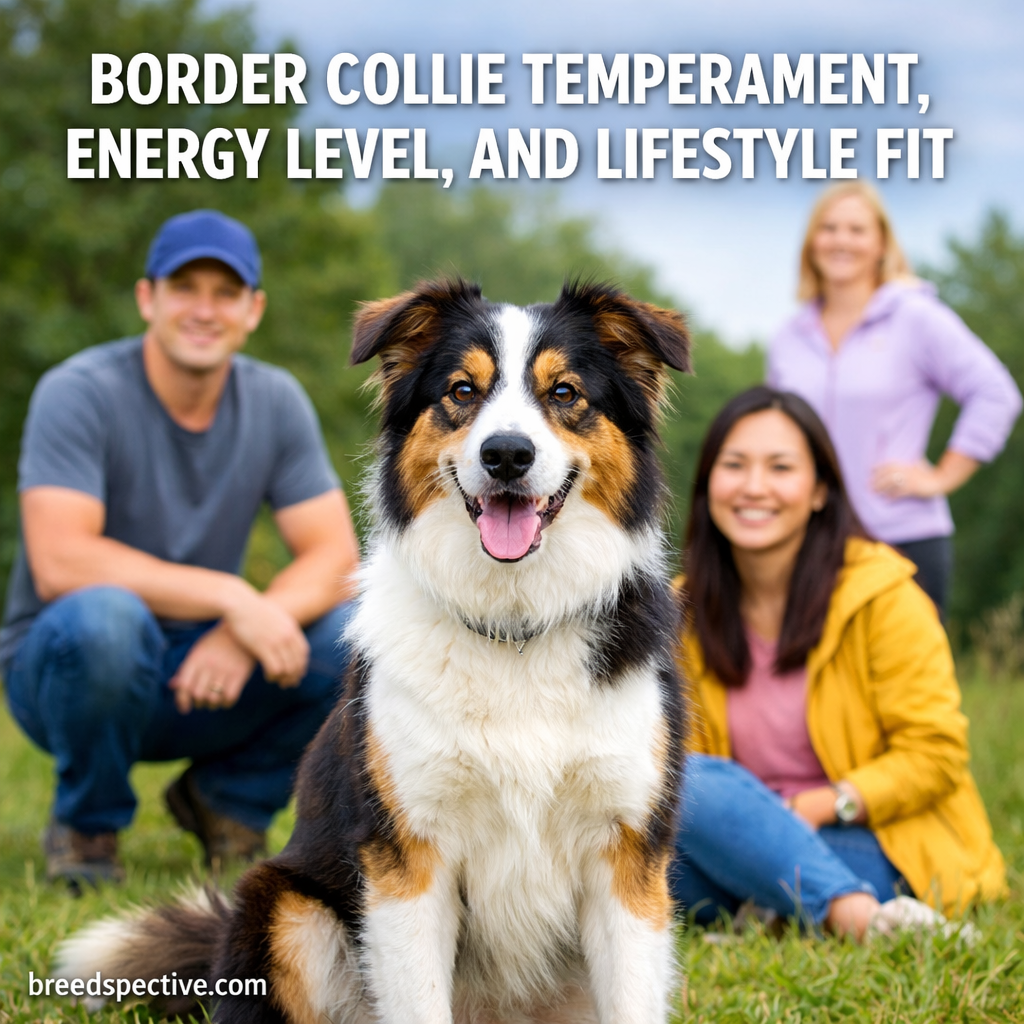
Border Collie temperament is typically intensely intelligent, energetic, responsive, observant, and strongly driven to work. These dogs can form close bonds with their families and learn extraordinarily quickly, but their herding instincts, sensitivity to movement, and need for structured activity make them one of the more demanding breeds to live with.
A Border Collie does not simply need “lots of exercise.” It needs opportunities to think, respond to cues, solve problems, control movement, and work cooperatively with a person. Without those outlets, the same traits that make the breed exceptional on a sheep field can turn into chasing, barking, fixation, pacing, or compulsive attempts to control everything that moves.
Border Collie at a Glance
| Trait | Border Collie |
|---|---|
| Height | Males: 19–22 inches; females: 18–21 inches |
| Weight | Commonly about 30–55 pounds |
| Life expectancy | About 12–15 years |
| Exercise needs | Very high |
| Grooming | Moderate; rough and smooth double coats shed |
| Trainability | Exceptional |
| Good with children? | Can be, but herding behavior and intensity require management |
| Good with other dogs? | Often, with appropriate socialization |
| Good with small pets? | Variable; movement can trigger chasing/herding |
| Best fit | Highly active owner interested in training, sports or structured work |
The AKC standard describes the Border Collie as a medium-sized, athletic working sheepdog with intelligence, alertness, agility and endurance central to breed type. Males stand approximately 19–22 inches and females 18–21 inches at the shoulder.
Border Collie History and Original Purpose
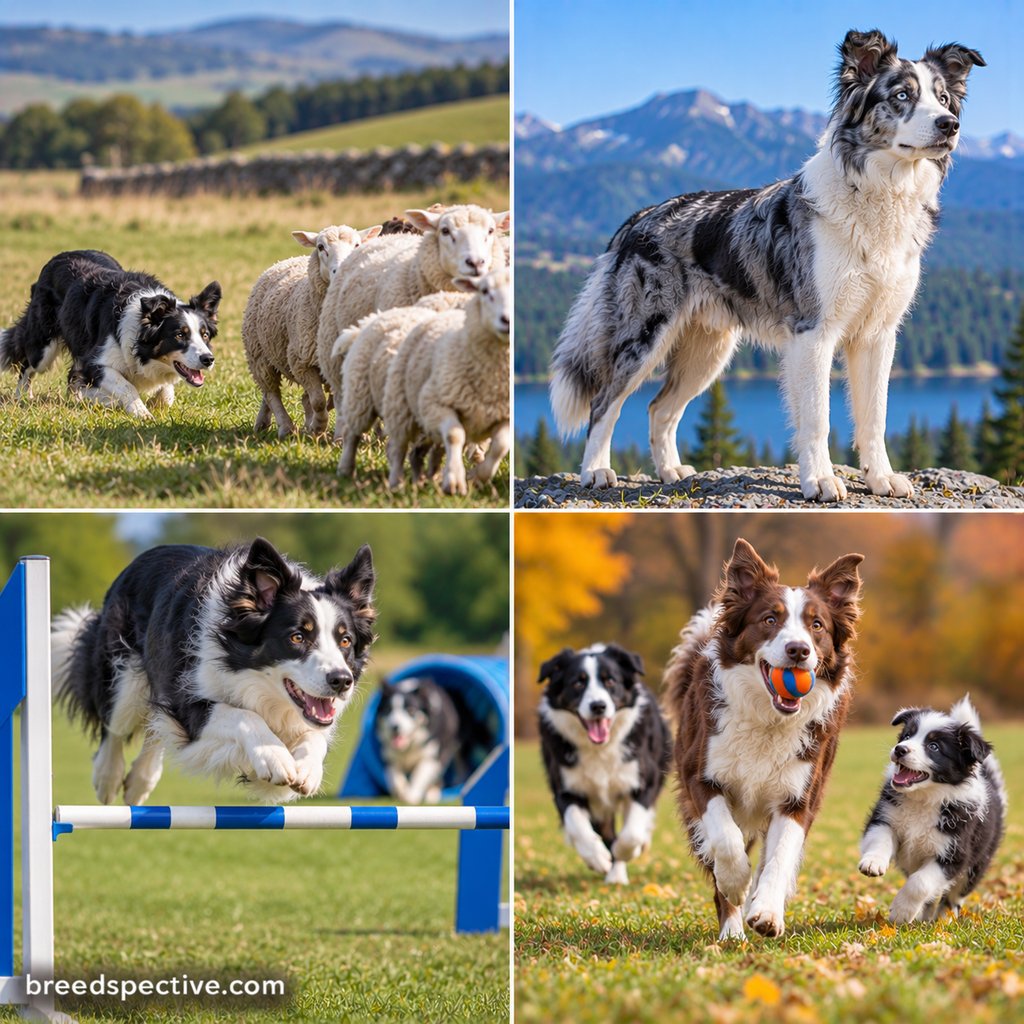
The Border Collie developed in the rugged border country between England and Scotland, which is where the breed takes its name.
For generations, shepherds selected dogs primarily for their ability to control livestock rather than for a uniform appearance. The terrain, weather, size of grazing areas and demands of sheep farming rewarded dogs with stamina, agility, intelligence and the ability to respond to a handler from considerable distances.
AKC’s breed history notes that working collies became indispensable to flock owners in this Anglo-Scottish border region. The first formal sheepdog trial was held in Wales in 1873, giving exceptional working dogs another avenue through which to influence future generations.
Old Hemp and the Modern Border Collie
One dog became especially influential.
Old Hemp, born in 1893, is widely regarded as the foundation sire of the modern Border Collie. His working style and ability became highly influential in subsequent breeding, and AKC historical material identifies him as a major ancestor of the modern breed.
The Border Collie’s famous “eye”—an intense stare used in controlling livestock—remains one of its most recognizable working characteristics.
A working Border Collie may lower its body, stare intently, stalk and strategically change position to influence sheep without physically wrestling with them. Those patterns help explain behaviors owners sometimes see directed toward children, bicycles, cats, running dogs and other moving targets.
The breed was fully recognized by the American Kennel Club in 1995, although its working history extends much further back.
Border Collie Temperament in Everyday Life
Border Collies tend to notice details that many dogs ignore.
A door opening, a child’s running pattern, the sound preceding a walk, a neighbor’s routine or the precise location where a toy is normally stored can quickly become meaningful.
That attentiveness makes them exceptionally responsive working partners.
It can also make them intense household companions.
Highly Intelligent and Fast to Learn
The Border Collie’s reputation for intelligence has some remarkable individual examples behind it.
In a 2011 study published in Behavioural Processes, researchers John Pilley and Alliston Reid reported that a Border Collie named Chaser learned and retained the proper names of 1,022 objects. Experiments also showed that she could distinguish object names from commands directed toward those objects.
Chaser was an exceptional individual who received intensive training, so her performance should not be treated as a promise that every Border Collie will learn a thousand words.
It does illustrate the breed’s extraordinary capacity for learning.
That capacity works both ways. A Border Collie can learn a recall cue quickly, but it can just as quickly learn that barking makes someone throw a ball, staring at the cupboard produces treats, or chasing the vacuum creates an exciting game.
Border Collies naturally belong in discussions of the easiest dog breeds to train and why, but trainability should never be confused with low-maintenance ownership.
Sensitive and Observant
The AKC temperament description characterizes the Border Collie as intelligent, alert, affectionate and potentially reserved with strangers, while stating that shyness, fearfulness and resentment are undesirable.
Many Border Collies respond strongly to their environment.
Chaotic movement, loud noises, inconsistent routines or overly confrontational training can be difficult for sensitive individuals. Clear communication and reward-based training are generally better suited to a dog bred to pay extraordinarily close attention to its handler and surroundings.
What Does “A Border Collie Needs a Job” Actually Mean?
This phrase is repeated so often that it can become meaningless.
A pet Border Collie does not need a flock of sheep or eight hours of farm work. It does need structured activities that combine movement, thinking and interaction with a handler.
Throwing a ball continuously for an hour provides exercise, but it does not necessarily satisfy the entire behavioral need.
A more useful weekday might include:
- A 30–45 minute brisk morning walk with several short obedience exercises
- Five minutes of practicing directional cues or position changes
- Breakfast delivered through a search game rather than a bowl
- A short midday scent or object-finding exercise
- An evening 30–45 minute hike, run, structured fetch session or sport practice
- Ten minutes learning a new behavior
- Deliberate practice settling quietly afterward
On another day, “work” might mean an agility class, herding lesson, scent-work session, disc practice, advanced obedience, tracking, trick training or helping carry out a series of learned household tasks.
Even games can be structured.
Instead of throwing a ball until the dog is exhausted, ask for a down, send the dog around an object, release it to retrieve, request a return to heel, then teach it to settle between repetitions.
Now the dog is using impulse control, listening skills, movement and problem-solving rather than simply becoming fitter at chasing.
That is much closer to what “giving a Border Collie a job” means in a normal household.
How Much Exercise Does a Border Collie Need?
For a healthy adult Border Collie, roughly 90–120 minutes of purposeful physical activity and mental work per day is a reasonable planning range, with some working-line individuals capable of considerably more.
Individual needs vary with age, health, genetics and temperament.
Useful activities include:
- Hiking
- Running with a conditioned adult
- Herding
- Agility
- Flyball
- Disc sports
- Structured retrieving
- Scent work
- Tracking
- Advanced obedience
- Long exploratory walks
A secure yard is useful but does not meet these needs by itself.
The dog needs interaction and direction.
Owners comparing their actual schedule with the breed’s demands should use our guide to matching a dog’s energy level to your daily routine before assuming that weekend hiking will compensate for five sedentary weekdays.
Can You Exercise a Border Collie Too Much?
Trying to solve every behavioral problem by adding more running can backfire.
A dog conditioned to run for two hours every day becomes extremely fit. That does not necessarily teach it to relax inside the house.
Border Collies need an off switch as well as activity.
Teach calm behaviors deliberately. Reward the dog for resting on a bed, settling while people eat, waiting quietly before play, and relaxing after exercise.
A well-managed Border Collie should be capable of doing nothing sometimes.
Border Collies With Children
Border Collies can be affectionate family dogs, but their herding instincts create a specific challenge around children.
Fast-running children may trigger stalking, circling, chasing and attempts to control movement. AKC specifically notes the breed’s tendency to herd animals and people and suggests that homes with older, well-behaved children can be easier matches.
Nipping at heels should not be dismissed as harmless because “the dog is herding.”
Interrupt the pattern early and redirect the dog into an appropriate activity.
Children also need rules: no chasing the dog, grabbing it while resting, interfering with food, or deliberately exciting it into frantic movement.
Border Collies and Other Pets
Many Border Collies live successfully with other dogs.
Cats and smaller animals require more individual assessment because movement can activate stalking and chasing patterns. A Border Collie may stare intensely at another pet without intending physical harm, but constant monitoring can still be stressful for the animal being targeted.
Teach disengagement.
The goal is not simply preventing the dog from catching another pet. The Border Collie should learn that it does not have responsibility for controlling every animal in the house.
Common Border Collie Behavior Problems
Many challenging behaviors are extensions of useful working traits.
Herding Children, Dogs or Vehicles
Interrupt stalking and chasing before the dog reaches full intensity.
Use distance from triggers, reward disengagement, teach a reliable recall and provide appropriate outlets such as herding, treibball, structured fetch or dog sports.
Chasing vehicles is particularly dangerous and requires physical management as well as training.
Motion Sensitivity
Bicycles, joggers, skateboards, lawn equipment and cars can become fixation targets.
Practice observing movement from a distance where the dog can remain responsive. Reward checking back with the handler instead of allowing repeated lunging or chasing.
Excessive Ball or Toy Fixation
Some Border Collies become obsessed with retrieving.
Control access rather than throwing the toy every time the dog demands it.
Use clear beginnings and endings for games, include impulse-control exercises, and teach the dog to settle without a toy present.
Shadow or Light Chasing
Repeated fixation on shadows, reflections or moving lights deserves attention.
Do not deliberately entertain a Border Collie with laser pointers or reflected light.
Persistent repetitive behavior can become difficult to interrupt. Discuss severe or compulsive patterns with a veterinarian or qualified veterinary behavior professional rather than attempting to exhaust the dog out of them.
Barking and Pacing
First examine the routine.
A dog receiving little purposeful activity may be expressing frustration, but adding random exercise is not always the complete solution.
Combine suitable physical activity with training, enrichment, predictable rest and reinforcement of calm behavior.
Reactivity
Some Border Collies become highly responsive to dogs, movement, sounds or unfamiliar situations.
Create distance before the dog is overwhelmed and reinforce calm observation and attention to the handler. Do not repeatedly force close exposure under the label of socialization.
People comparing intense herding breeds may also find our guide to Border Collie vs. Australian Shepherd: which is more demanding? helpful.
Border Collie Grooming and Shedding
Border Collies come in rough and smooth coat varieties, and both have weather-resistant double coats.
Routine grooming is manageable compared with continuously growing breeds.
Plan to brush thoroughly about once or twice per week during ordinary periods and more frequently during seasonal shedding. AKC likewise recommends regular brushing and notes that additional grooming is useful when shedding increases.
Routine care also includes:
- Nail trimming
- Dental care
- Ear checks
- Bathing as needed
- Checking paws and coat after outdoor activity
The breed sheds. Someone seeking a low-shedding dog should look elsewhere.
Border Collie Health Testing
A breeder saying that puppies are “vet checked” is not equivalent to health-testing the parents.
The Orthopedic Foundation for Animals’ CHIC program works with parent clubs to establish breed-specific screening protocols. A CHIC number means the dog completed the tests required under its breed’s protocol and the results were made public; it does not mean every result was normal.
For Border Collies, buyers should verify the current Border Collie Society of America/OFA-CHIC recommendations and inspect the actual records for the sire and dam rather than accepting a generic claim of genetic testing.
Hip Dysplasia
Hip evaluation is particularly relevant in an athletic dog expected to run, turn and jump.
OFA evaluates hip radiographs for abnormalities and arthritic changes associated with hip dysplasia. Formal OFA hip certification is based on appropriately positioned radiographs evaluated through its screening program.
Ask to see the parents’ results in the public database.
Eye Health
Breed-appropriate ophthalmologic screening is another area prospective owners should verify.
A normal-looking eye does not tell a puppy buyer whether the breeding dog has received the recommended specialist examination or applicable genetic testing.
The broader principle matters: use DNA results where validated DNA tests exist, orthopedic screening where structural disease is the concern, and specialist examinations where those are recommended. One consumer DNA panel cannot replace every category.
Border Collie vs. German Shepherd Temperament
Both breeds are intelligent working dogs, but their traditional work selected for different behavioral patterns.
Border Collies specialize in controlling livestock through movement, positioning, responsiveness and sustained concentration. German Shepherds developed into more multipurpose herding and working dogs with different guarding tendencies and physical characteristics.
Someone attracted primarily to trainability should compare those differences in our German Shepherd temperament and lifestyle guide rather than assuming all highly intelligent working breeds behave similarly.
How Much Does a Border Collie Cost Per Year?
A practical U.S. annual planning budget looks roughly like this:
| Expense | Practical annual planning range |
|---|---|
| Food and treats | $400–$900 |
| Routine veterinary care | $300–$900 |
| Parasite prevention | $150–$450 |
| Toys and enrichment | $150–$500 |
| Grooming/basic supplies | $100–$300 |
| Training, classes or sports | $100–$1,000+ |
| Pet insurance | $400–$1,400+ |
| Typical planning total | About $1,600–$5,450+ |
These are budgeting estimates rather than fixed national prices.
Dog sports can significantly increase costs. Agility lessons, herding access, competition fees, specialized equipment, daycare, boarding and emergency veterinary care are additional.
For many Border Collie households, training and enrichment deserve a larger budget than grooming.
Who Is a Border Collie Best Suited To?
A strong match is someone who genuinely enjoys doing things with a dog.
That may include:
- Runners and hikers
- Dog-sport enthusiasts
- People interested in advanced training
- Farmers or livestock handlers
- Owners who enjoy teaching new skills
- Active households with predictable routines
- People prepared to provide both exercise and structured rest
A Border Collie does not require a farm.
It does require an owner prepared to replace farm work with other meaningful activities.
Who Should Think Twice About a Border Collie?
This breed is a poor match when its intelligence is the main attraction but the workload is not.
Think carefully if:
- You want a relaxed companion requiring a couple of short walks
- You dislike training
- Your dog will routinely spend long days alone
- Heavy shedding bothers you
- Your household is extremely chaotic
- You have no plan for managing herding behavior around children
- You expect a yard to provide enough exercise
- You want to exhaust the dog physically without providing mental work
- You dislike intense, highly observant dogs
Apartment living is possible, but only when the lifestyle outside the apartment meets the dog’s needs. Square footage matters less than what happens during the rest of the day.
Before choosing the breed, compare those requirements with your household using our guide to choosing the right dog breed for your lifestyle.
Verdict: Is a Border Collie Right for You?
A Border Collie is right for an active, highly engaged owner who wants training and structured activity to become part of everyday life. For that person, the breed’s responsiveness, athleticism, problem-solving ability and desire to work alongside a human can make it an exceptional partner.
A Border Collie is not right for someone who mainly wants a famously smart dog but prefers a low-effort companion. Intelligence does not reduce the work of ownership here—it increases the dog’s capacity to notice patterns, demand engagement and invent behaviors when its needs are poorly directed.
The best Border Collie household does more than keep the dog physically tired. It gives that remarkable working brain useful problems to solve, teaches it when to work, and—just as importantly—teaches it when the job is finished.