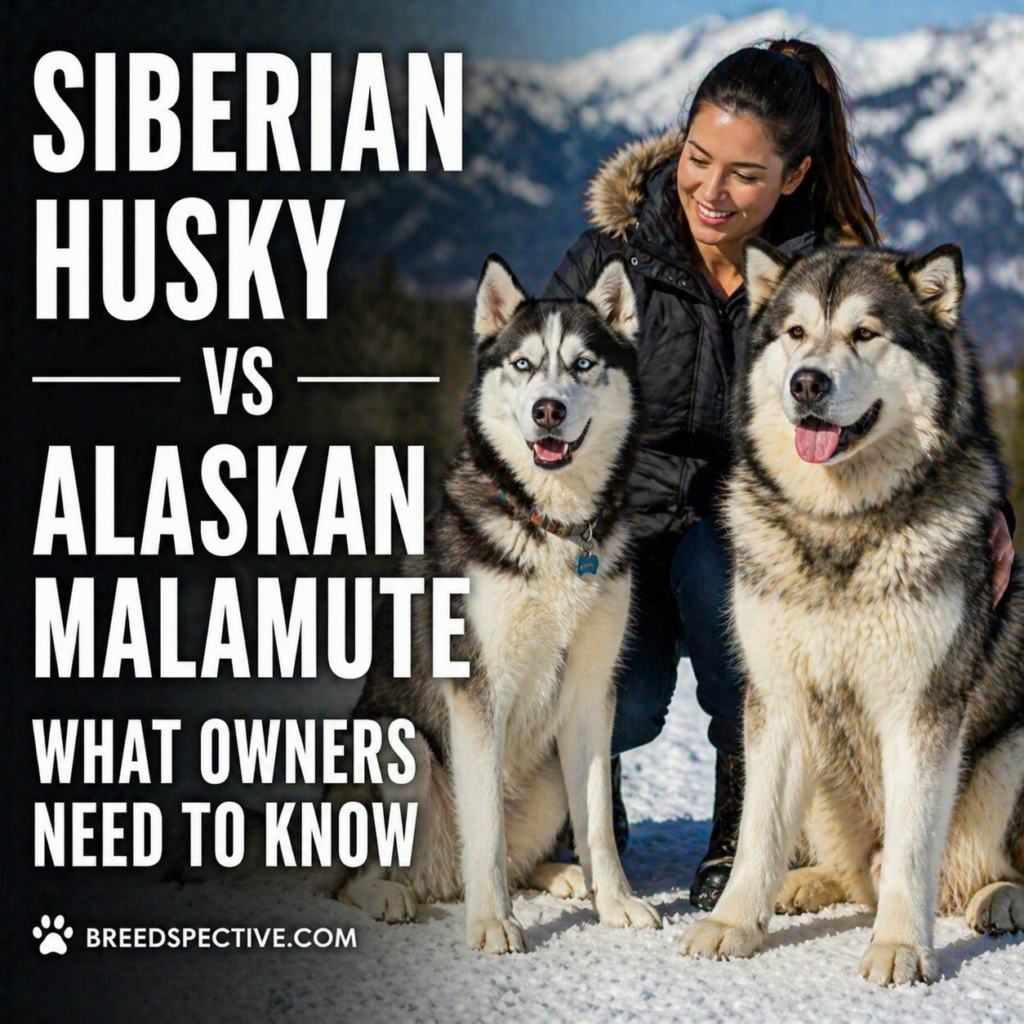
The Siberian Husky and Alaskan Malamute are Arctic sled dogs, but the Husky is smaller and lighter, developed for speed and endurance while pulling relatively light loads, whereas the Malamute is substantially larger and was developed to haul heavy freight. Both are intelligent, independent, athletic dogs with thick double coats and demanding exercise needs, but the Malamute adds considerably more size and physical power to the ownership equation. Siberian Husky Club of America, Inc
Siberian Husky vs Alaskan Malamute at a Glance
| Trait | Siberian Husky | Alaskan Malamute |
|---|---|---|
| Size | Medium | Large and substantially heavier |
| Weight | Males 45–60 lb.; females 35–50 lb. | Breed standard centers around 85 lb. males and 75 lb. females |
| Original work | Endurance sled dog; speed over distance with lighter loads | Heavy freight hauling and packing |
| Temperament | Friendly, gentle, alert and outgoing | Affectionate, loyal, playful, dignified and strong-willed |
| Energy | High | High |
| Trainability | Intelligent but independent | Intelligent, powerful and independent |
| Guarding | Poor fit for traditional guard work | Size can deter, but not developed as a guard dog |
| Coat | Dense double coat | Dense, coarse double coat |
| Shedding | Heavy seasonal shedding | Heavy seasonal shedding |
| Physical management | Athletic and quick | Considerably stronger and heavier |
| Best fit | Active owners prepared for an independent endurance breed | Experienced, active owners comfortable managing greater size and strength |
The physical difference is significant. The Siberian Husky Club of America (SHCA) standard emphasizes medium size and moderate bone and specifically states that the Husky should never appear heavy enough to suggest a freighting dog. The Alaskan Malamute Club of America (AMCA), by contrast, describes the Malamute as the largest of the traditional Arctic breeds and emphasizes strength and endurance. Siberian Husky Club of America, Inc
Different Sled Dogs Built for Different Jobs
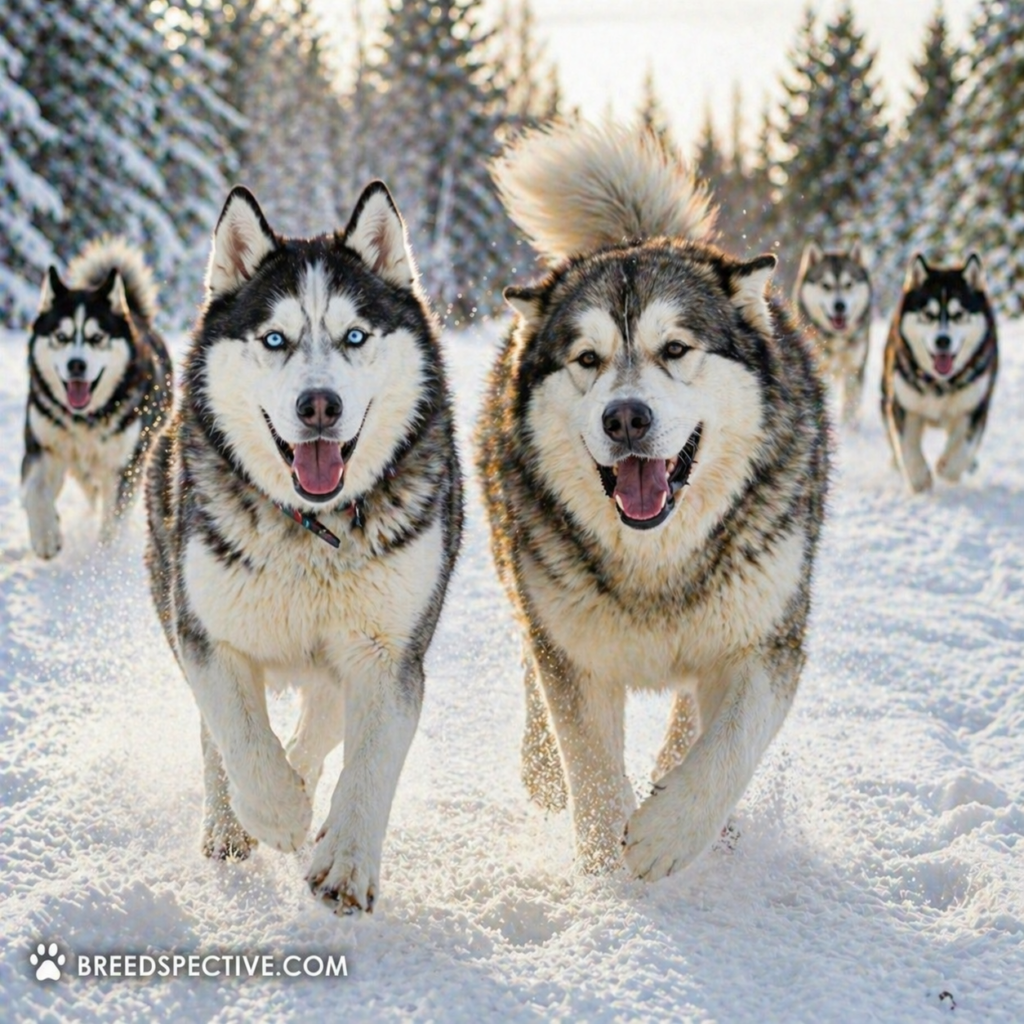
The breeds can look similar to an unfamiliar eye, but their histories explain why they shouldn’t be treated as interchangeable.
Siberian Husky: An Endurance Sled Dog
The Siberian Husky was developed by the Chukchi people of northeastern Asia as an endurance sled dog.
SHCA records that Siberian dogs arrived in Alaska in the early 1900s and quickly demonstrated their ability in long-distance sled racing. A team entered the 1909 All Alaska Sweepstakes, a 408-mile race, despite initially attracting skepticism because the Siberians were smaller than many competing sled dogs. Siberian Husky Club of America, Inc
Their performance helped establish the breed’s reputation.
Siberians subsequently became prominent racing dogs, with teams associated with Leonhard Seppala becoming particularly influential. The breed received AKC recognition in 1930, and SHCA was established in 1938. Siberian Husky Club of America, Inc
The Husky’s build reflects its purpose. It is an efficient, moderate dog capable of covering substantial distances rather than an oversized animal designed primarily to move maximum weight.
Alaskan Malamute: The Heavy Hauler
The Alaskan Malamute had a different assignment.
AMCA’s historical material describes the breed as an Arctic dog used for tasks including hauling heavy sledges and packing supplies. AKC similarly characterizes the Malamute as the heavy-freight hauler of sled dogs, developed for moving substantial loads over long distances rather than racing at high speed. AMCA Website
The breed takes its name from the Mahlemut (also rendered Mahlemiut) people, an Iñupiaq people associated with northwestern Alaska. AMCA notes that their relative geographic isolation helped preserve the dogs even as imported dogs during the Alaskan Gold Rush changed other native sled-dog populations. AMCA Website
This historical division remains the easiest way to understand the breeds physically:
Husky: lighter endurance athlete. Malamute: heavier freight dog.
Temperament: Friendly Doesn’t Mean Easy
Neither breed was developed primarily to guard property.
SHCA’s official standard describes the Siberian Husky as friendly and gentle, alert and outgoing, specifically noting that the breed shouldn’t display the possessiveness or excessive suspicion associated with a guard dog. Siberian Husky Club of America, Inc
That can surprise someone expecting a wolf-like dog to be naturally protective.
A Siberian may look intimidating to someone unfamiliar with the breed, but appearance shouldn’t be confused with guarding temperament.
Malamutes aren’t conventional guard dogs either. AMCA’s breed information states that the Malamute is unsuitable for guard work, although its sheer size may discourage an intruder. AKC
The Husky Personality
Siberian Huskies tend to be social and interested in people.
SHCA describes them as affectionate without being excessively dependent and notes that they generally aren’t suspicious of strangers. Their intelligence is paired with an independent streak. Siberian Husky Club of America, Inc
That independence matters in everyday life.
A Husky may understand what you’re asking without sharing your enthusiasm for doing it. Owners expecting the automatic handler focus associated with some working breeds may find this frustrating.
Our Siberian Husky temperament, energy level and lifestyle guide explores these traits in more depth.
The Malamute Personality
Malamutes are affectionate dogs, but their size and self-confidence create a different management challenge.
AMCA describes the mature Malamute as dignified, strong-willed and self-confident. Its owner education material also warns that some Malamutes may become intolerant of other dogs of the same sex, making careful introductions and management important. AKC
A strong-willed 80-plus-pound dog requires more physical management than a smaller dog displaying the same behavior.
Energy: Both Require Serious Daily Activity
The question isn’t whether either breed needs exercise. Both do.
The more useful distinction is how their bodies were designed to work.
Siberian Huskies were developed for endurance and efficient movement. Their history includes long-distance racing, and SHCA’s standard repeatedly emphasizes free movement and the ability to cover distance. Siberian Husky Club of America, Inc
Malamutes were designed around power and endurance while moving heavy loads.
For modern companion dogs, suitable activities can include:
- Brisk walks
- Hiking
- Running with physically mature dogs
- Canicross
- Appropriate pulling sports
- Structured play
- Scent games
- Obedience practice
- Food puzzles
- Other dog sports appropriate to the individual
Exercise should be adjusted for age, conditioning, weather and health.
Neither breed is well served by spending most of the day inactive and receiving only a short walk around the block.
Our guide to matching a dog’s energy level to your daily routine can help translate “high energy” into the time commitment it creates.
Escape Management Is Part of Husky Ownership
Secure containment deserves particular attention with Siberian Huskies.
SHCA warns prospective owners that Siberians should not be allowed to run loose and specifically discusses their desire to run. It recommends securely fenced areas and controlled exercise rather than assuming obedience will reliably override the breed’s instincts. Siberian Husky Club of America, Inc
That changes how an owner needs to think about the yard.
A fence isn’t merely a convenience. Gates, gaps and potential escape routes deserve regular inspection.
Off-leash reliability should never be assumed because a Husky behaves perfectly inside the home or training class.
Malamutes also require secure confinement. AMCA’s owner material explicitly warns that they may run away and become lost and stresses that owners must keep them safely contained. AKC
For both breeds, responsible management beats confidence in a dog’s recall.
Trainability: Intelligent but Independent
Huskies and Malamutes are intelligent working dogs, but neither was developed to wait constantly for detailed human instructions.
That distinction matters.
Training a Siberian Husky
SHCA describes the Siberian as intelligent and tractable while also acknowledging an independent spirit that can challenge an owner. Siberian Husky Club of America, Inc
Training works best when it is consistent, rewarding and worth the dog’s attention.
Owners should prioritize practical skills such as:
- Leash manners
- Recall practice
- Waiting at doors and gates
- Handling for grooming
- Leave it
- Drop it
- Settling calmly
- Cooperative veterinary handling
Recall training is valuable even when a dog won’t routinely be trusted off leash. It can still become critical if a gate is accidentally left open or equipment fails.
Training an Alaskan Malamute
AMCA similarly characterizes Malamutes as highly intelligent but strong-willed. Its owner guidance stresses fairness and patience in training. AKC
The major difference is physical consequence.
A poorly leash-trained 50-pound Husky is difficult. An inadequately trained Malamute with significantly greater body mass and pulling strength can be even harder to control.
Early leash work and calm household manners should therefore be treated as necessities rather than optional accomplishments.
Prey Drive and Other Animals
The Siberian Husky’s friendly attitude toward humans shouldn’t be confused with low predatory instinct.
SHCA specifically warns that Siberians can have strong predatory instincts toward smaller animals, naming animals such as rabbits, birds, guinea pigs, hamsters and cats as potential targets. Siberian Husky Club of America, Inc
That doesn’t mean no Husky can live successfully with a cat. Individual history, socialization and management matter.
It does mean prospective owners shouldn’t assume friendliness toward humans automatically extends to every animal.
Malamute households should also evaluate compatibility individually, especially where other dogs are concerned. AMCA specifically cautions that some mature Malamutes can become intolerant of dogs of the same sex. AKC
Breeder or rescue knowledge about the individual dog can therefore be more useful than a blanket claim that either breed is universally “good with pets.”
Grooming: Prepare for a Lot of Undercoat
Both breeds developed coats suitable for severe northern conditions.
That means substantial shedding.
Siberian Husky Grooming
The Siberian has a double coat consisting of a soft, dense undercoat protected by an outer coat.
Routine brushing helps remove loose hair, and coat maintenance becomes considerably more intensive when seasonal shedding releases large quantities of undercoat.
The coat’s natural structure is functional, so owners shouldn’t treat routine shaving as a solution to shedding.
Alaskan Malamute Grooming
The Malamute also has a dense double coat designed for Arctic conditions.
Its heavier body and substantial coat mean owners should expect serious seasonal shedding and regular brushing.
A good grooming routine includes:
- Thorough brushing down to the undercoat
- Checking for compacted loose coat
- Nail trimming
- Dental care
- Ear checks
- Bathing when appropriate
Our guide to grooming needs by dog coat type explains how double coats differ from single coats and why the right tools and technique matter.
If a home free of dog hair is a priority, neither breed is a practical choice.
Hot Weather Requires More Planning
A thick Arctic coat doesn’t automatically mean these dogs cannot live anywhere outside the far north, but hot conditions change how owners need to manage exercise.
Strenuous activity should be planned around safe weather conditions, with access to shade, water and a cool indoor environment.
The same principle applies to every dog during extreme heat, but it becomes especially relevant when choosing a breed developed specifically for cold climates and endurance work.
A prospective owner in a warm region should consider how reliably they can provide safe exercise during hot months before choosing either breed.
Health: What Responsible Breeders Should Test
Breed-specific health screening should be part of the purchase decision.
Siberian Husky Health Screening
SHCA’s current health statement requires several evaluations for breeders following its ethical breeding guidelines.
These include:
- Hip evaluation
- Annual eye examination by a board-certified veterinary ophthalmologist
- Genetic testing for Siberian Husky Shaking Puppy Syndrome Type 1 (SPS1)
- Genetic testing for Siberian Husky Polyneuropathy Type 1 (SHPN1)
SHCA has historically identified hip dysplasia and inherited eye disease as major areas requiring breed-wide attention. Siberian Husky Club of America, Inc
A breeder should be willing to provide actual documentation rather than simply saying that the parents are healthy.
Alaskan Malamute Health Screening
AMCA maintains a health program addressing inherited and breed-relevant conditions in Alaskan Malamutes.
Its health resources cover concerns including chondrodysplasia, cone degeneration, polyneuropathy, alopecia and seizures or epilepsy, among other health topics. AMCA Website
Prospective owners should ask breeders which current AMCA-recommended tests have been completed on both parents and request documentation of the results.
For either breed, useful questions include:
- Which health tests were performed?
- Can you show the results?
- At what age were the parents evaluated?
- Have close relatives developed inherited disease?
- How long did parents and grandparents live?
- What health issues have appeared in the breeder’s lines?
No screening program guarantees a disease-free dog. Its purpose is to make breeding decisions using better information and reduce avoidable risk.
Family Fit: Which Is Better With Children?
Both breeds can live successfully in family households, but their suitability isn’t identical for every family.
Siberian Huskies With Families
SHCA describes Siberians as gentle and friendly and notes a historical association with family life among the Chukchi people. Siberian Husky Club of America, Inc
Their challenge around children is often energy rather than guarding behavior.
A playful Husky can be exuberant, and children need to understand appropriate boundaries around any dog.
Malamutes With Families
AMCA describes Malamute puppies as affectionate and lively and notes that Malamutes can love children. It also stresses supervision because they are large dogs. AKC
That qualification matters.
A friendly Malamute can still accidentally knock over a small child. Adults should supervise interactions and handle the dog’s training rather than expecting children to control a powerful sled dog.
Neither breed should be chosen as a babysitter or left unsupervised with young children.
Space: A Yard Helps, but It Doesn’t Solve Everything
A large yard can make life easier with either breed, particularly because secure outdoor space gives owners another controlled exercise option.
But acreage doesn’t substitute for involvement.
A bored Husky can still look for a way out of a large property. A Malamute can still develop undesirable habits without sufficient training and activity.
Apartment living creates additional logistical challenges because every exercise opportunity must be deliberately provided, but home size alone isn’t the central question.
The better question is: How much structured activity can you provide every day?
Cost: Husky vs Malamute
There is no reliable universal puppy price for either breed. Location, pedigree, breeder, health testing and availability all affect purchase cost.
Lifetime expenses are more informative.
| Expense | Siberian Husky | Alaskan Malamute |
|---|---|---|
| Food | Moderate for an athletic medium dog | Potentially higher because of greater size |
| Routine veterinary care | Ongoing | Ongoing |
| Health screening | Breed-specific testing matters | Breed-specific testing matters |
| Grooming | Mostly home care, but substantial shedding | Mostly home care, with substantial coat maintenance |
| Training | Strongly recommended | Strongly recommended |
| Exercise equipment | Potential cost for running/pulling activities | Durable equipment particularly important |
| Containment | Secure fencing is a major consideration | Secure, sturdy containment important |
| Emergency care | Financial planning recommended | Financial planning recommended |
The Malamute’s greater size can increase costs for food, medication, crates, beds, carriers and other equipment.
The Husky can create a different kind of expense if secure fencing needs improvement. A yard that works perfectly for another breed may not provide the level of containment an individual Husky requires.
Both breeds also demand a considerable investment of time.
Are Either Good First Dogs?
Neither is an obvious beginner breed.
A Siberian Husky combines high exercise requirements with independence, prey drive, substantial shedding and a strong desire to run. SHCA explicitly advises prospective owners to understand these characteristics before bringing one home. Siberian Husky Club of America, Inc
The Malamute adds even greater physical size and strength.
AMCA’s owner education material is similarly candid about the breed’s potential for digging, chewing, escaping, howling and strong-willed behavior. It stresses safe confinement, adequate exercise, training, grooming and lifelong care. AKC
A dedicated first-time owner can learn a great deal, but enthusiasm shouldn’t be mistaken for preparation.
Someone primarily attracted by blue eyes, wolf-like appearance or social-media images of sled dogs in snow should consider easier breeds before making a commitment that may last well over a decade.
Verdict: Choose a Siberian Husky or Alaskan Malamute?
Choose a Siberian Husky if you want a medium-sized, social and athletic endurance dog and genuinely enjoy substantial daily exercise. You should be comfortable managing an independent temperament, secure containment, heavy shedding and potentially strong predatory instincts around smaller animals.
Choose an Alaskan Malamute if you want a much larger, immensely powerful northern working dog and are comfortable handling its strength, independence and substantial exercise and grooming requirements. Malamutes make more sense for owners who specifically want the heavier freight-dog type and have the experience and physical ability to manage one safely.
Neither breed is right for you if you want dependable off-leash freedom, minimal shedding, low exercise requirements or a naturally protective guard dog. Both require owners willing to organize a meaningful part of everyday life around exercise, training and management.
Before committing to either, use your normal workweek—not your ideal weekend—to evaluate the decision. Our guide to choosing the right dog breed for your lifestyle can help with that comparison.
The essential distinction is rooted in what these dogs were created to do: the Siberian Husky is the smaller endurance sled dog built to move efficiently and cover distance, while the Alaskan Malamute is the substantially larger powerhouse developed to move heavy freight. Siberian Husky Club of America, Inc