
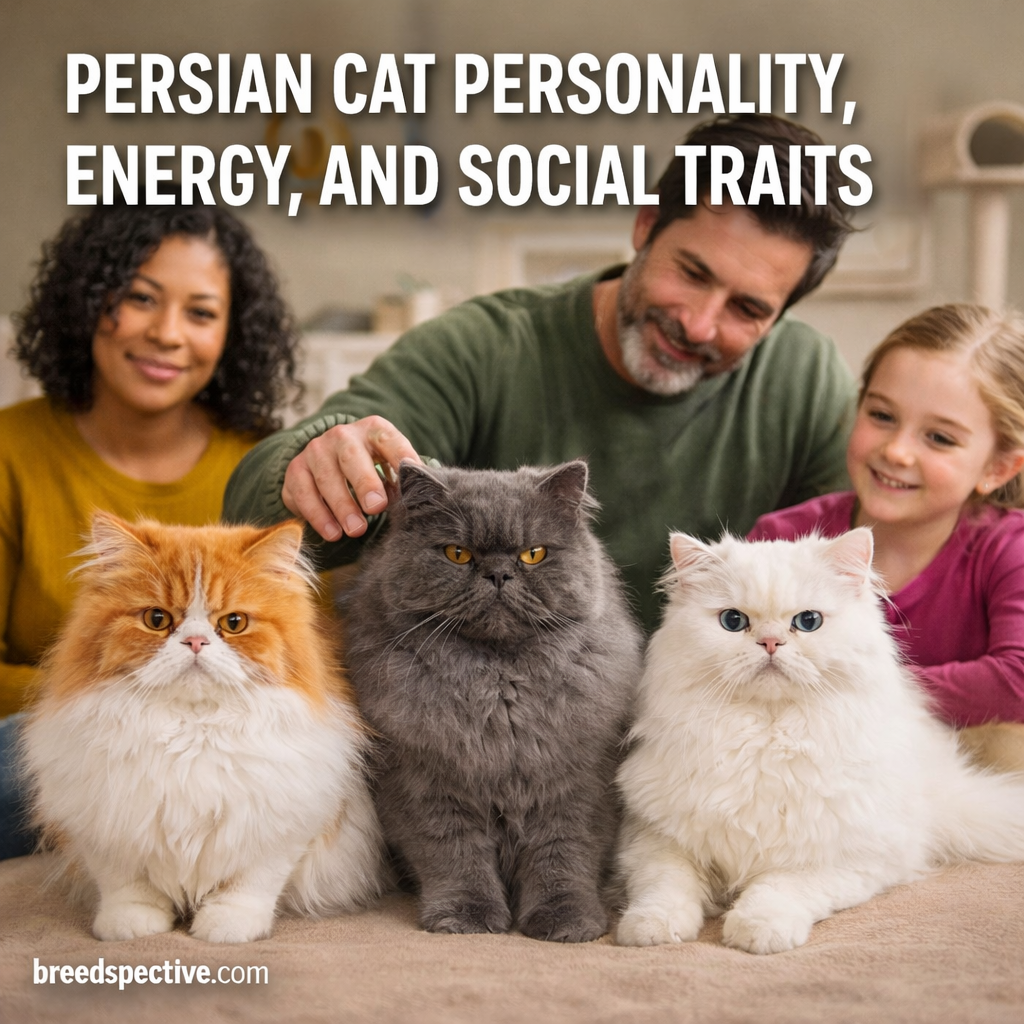
The typical Persian cat personality is gentle, quiet, affectionate, and relatively low-energy. Persians generally prefer calm companionship and short periods of play over constant activity, making them appealing to people who want a relaxed indoor cat—but their intensive grooming and facial care mean they are not a low-maintenance breed.
The Cat Fanciers’ Association (CFA) describes Persians as sweet, affectionate, and quiet, while The International Cat Association (TICA) characterizes them as gentle cats that favor calm surroundings and gentle handling. Individual personalities vary, but a peaceful, people-oriented temperament is strongly associated with the breed.
Persian Cat at a Glance
| Trait | Persian |
|---|---|
| Size | Medium, with a compact, muscular build |
| Lifespan | TICA lists approximately 8–11 years |
| Activity level | Low to moderate |
| Grooming | Very high; daily coat and facial care |
| Vocalness | Generally quiet |
| Good with children | Often, especially with gentle children |
| Good with other cats | Often, with appropriate introductions |
| Good with dogs | Can be, particularly with calm, cat-friendly dogs |
| Typical personality | Gentle, affectionate, placid, people-oriented |
| Coat | Long, dense and available in many colors and patterns |
Persians can look larger than they actually are because of their enormous coats. Underneath the hair is a compact, heavily built cat with a broad chest, short legs and substantial musculature rather than a tall or long frame. TICA classifies them as medium-sized cats, while CFA describes the breed’s characteristic body type as solid and “cobby.”
Persian Cat History and Origins
The Persian is one of the oldest established pedigreed cat breeds, although its earliest ancestry is not completely documented.
CFA traces an important point in the breed’s European history to 1626, when Italian traveler and trader Pietro della Valle returned from Persia with a heavily coated longhaired cat. Longhaired cats from Persia and cats associated with the Turkish Angora were subsequently part of the development of the longhaired cats that became today’s Persian.
Selective breeding increasingly emphasized the Persian’s round head, compact body, dense coat and short facial structure.
The breed became closely associated with the emerging cat fancy in Britain. TICA notes that Persians appeared in Britain’s early cat shows and became established favorites during the Victorian period. Queen Victoria’s well-known interest in longhaired cats helped reinforce their fashionable status in Victorian Britain.
By the late 1800s, Persians were being imported into the United States. CFA records them as one of the six foundation breeds recognized when the organization was established in 1906.
Today’s Persian comes in an extensive range of colors and patterns, but the breed’s defining features remain its compact body, round head, large eyes and exceptionally long coat.
Persian Personality in Everyday Life
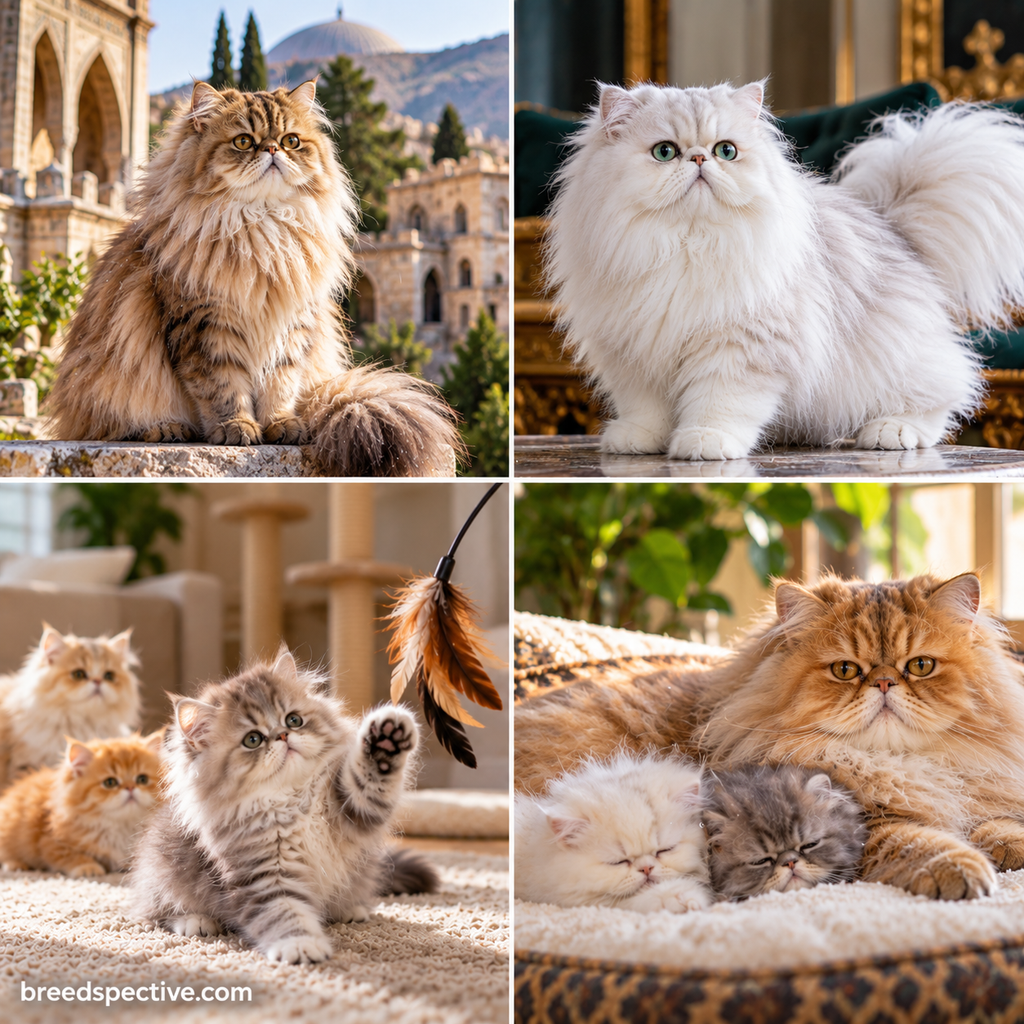
A Persian generally approaches household life at a slower pace than a highly athletic breed.
TICA describes Persians as gentle and quiet cats that enjoy calm environments. CFA similarly portrays them as placid cats that enjoy affection but are less inclined toward climbing curtains, invading countertops or constantly exploring high places.
That does not mean a Persian spends its entire life sleeping.
Affection Without Constant Demands
Persians tend to enjoy human attention but are not typically characterized by relentless demands for interaction.
A Persian may settle beside someone on the sofa, accept petting, nap nearby or climb onto a lap when the mood strikes. TICA notes that they enjoy being close to their people but can also be comfortable at home without continuous attention.
This makes the breed attractive to people who want companionship without the intensity associated with some highly active cats.
For another breed known for a gentle, people-focused temperament, see our guide to the Ragdoll cat’s personality, energy, and social traits.
Persians Prefer the Ground to the Rafters
One practical difference between Persians and many athletic breeds is how they use space.
TICA notes that Persians generally prefer staying closer to the ground rather than seeking the highest possible perch. CFA similarly describes them as unlikely to climb curtains or routinely invade countertops.
They should still have scratching surfaces, comfortable observation areas and opportunities to move around the home. A stable, moderately sized cat tree can provide enrichment without requiring an elaborate wall-mounted climbing system.
Their quieter nature also makes them worth considering for smaller homes. Our guide to the best cat breeds for apartment living covers the other factors that matter when choosing a cat for limited space.
How Energetic Is a Persian Cat?
Persians are low-to-moderate-energy cats, but low energy should not be confused with needing no exercise.
TICA describes the breed as placid with occasional bursts of kitten-like activity. Persians may suddenly chase a ball or race through a room before returning to a favorite resting place. Interactive toys, balls and other simple games can encourage daily movement.
A practical routine might include two or three short play periods spread through the day rather than one long, intense workout.
Useful options include:
- Wand toys moved at a manageable pace
- Lightweight balls
- Toy mice
- Puzzle feeders
- Low climbing platforms
- Scratching posts
- Window observation areas
Regular play becomes particularly useful for a cat that would otherwise spend much of the day resting.
Social Behavior With Children and Other Pets
A Persian can fit into a family home, but the household’s style matters.
CFA describes Persians as compatible with children and capable of peacefully coexisting with other pets. TICA similarly notes that they can enjoy being combed or petted by children but are unlikely to participate enthusiastically in boisterous games.
That distinction is useful.
A calm child who understands how to handle a cat respectfully can be a better match than a child who wants constant chasing, carrying or rough play.
The same principle applies to other pets. A relaxed cat or cat-friendly dog may coexist comfortably with a Persian after gradual introductions. A relentlessly energetic animal that continually chases or pesters the Persian can create a poor match regardless of breed stereotypes.
How Vocal Are Persian Cats?
Persians are generally considered quiet cats.
TICA describes their voices as soft and harmonious and notes that they often communicate through their large, expressive eyes. CFA similarly lists “quiet” among the breed’s defining personality characteristics.
Individual cats can still become vocal when hungry, uncomfortable or seeking attention. Breed tendencies are never guarantees about a particular animal.
Someone specifically prioritizing a peaceful home may appreciate this characteristic, but the trade-off is substantial grooming.
Who a Persian Suits — and Who Should Avoid One
Persians tend to work best for people who value a relaxed companion more than an athletic one.
A Persian may be a good fit if you:
- Prefer a calmer indoor cat
- Enjoy a cat that likes affection without constant activity
- Have time for daily grooming
- Can clean around the eyes routinely
- Are comfortable monitoring a flat-faced breed for health problems
- Prefer moderate rather than intense play
- Can provide a stable indoor environment
The breed is a poor fit for someone who wants a genuinely low-maintenance pet.
That distinction deserves emphasis. Low energy and low maintenance are not the same thing.
A shorthaired cat may require much less coat maintenance even if it is more active. Persian ownership involves brushing, combing, facial care and close attention to tangles throughout the cat’s life.
Before choosing solely on appearance, use our guide to choosing the right cat breed for your home to compare grooming, temperament, activity and long-term care requirements.
Persian Grooming and Care Needs
The Persian’s coat is one of its defining characteristics and its biggest routine-care commitment.
TICA states plainly that the coat requires daily attention. Its grooming guidance recommends daily combing with a metal comb to prevent tangles from progressing into mats and to remove loose hair.
Longhaired cats such as Persians are also at greater risk of hairballs than shorthaired cats, according to Cornell University’s College of Veterinary Medicine.
A Realistic Daily Persian Grooming Routine
Plan on roughly 10–20 minutes of hands-on grooming most days for a typical pet Persian, although coat texture, shedding, the cat’s condition and tolerance can change that substantially.
A useful kit includes:
- Stainless-steel comb with wide and fine teeth
- Cat-appropriate grooming brush
- Nail clippers
- Soft cotton pads or clean cloths for the face
- Cat-safe dental-care supplies recommended by your veterinarian
Start with the comb rather than simply brushing over the coat’s surface. Work gently through the fur and pay close attention to friction areas such as the armpits, belly, chest, behind the ears and hindquarters.
TICA notes that some Persian coat textures mat more readily than others. Mats are not merely cosmetic: they can pull against the skin and become painful.
Do not use scissors close to the skin to remove severe mats. Cat skin can be surprisingly easy to cut, particularly when it is pulled upward inside a tight mat.
Daily Eye and Face Cleaning
Facial care deserves its own routine.
TICA recommends regular cleaning of the Persian’s flat face and specifically notes that the eyes should be wiped daily because tearing can stain the surrounding coat.
Use a clean, soft, damp cloth or pad and gently wipe accumulated discharge from around the eye area. Use a clean section for each eye and avoid rubbing the eye itself.
Persistent redness, squinting, swelling, changes in discharge or apparent discomfort deserve veterinary attention rather than repeated cosmetic cleaning.
Bathing, Nails and Teeth
TICA recommends regular bathing for the Persian coat and suggests establishing the routine when the cat is young. The appropriate frequency for an individual pet depends on coat condition and lifestyle.
Nails need regular trimming, and dental care should become part of the routine rather than something addressed only after disease develops.
Our daily care routines for cats at every life stage can help organize grooming alongside feeding, litter maintenance, play and health checks.
Flat-Faced Persians and Brachycephaly
Modern Persians vary considerably in facial structure.
Some have an extremely shortened, flattened face commonly described informally as peke-faced, while less extreme Persians are often called doll-faced or traditional Persians. These informal descriptions are useful to pet buyers, although they should not be confused with separate recognized breeds.
The difference is more than cosmetic.
International Cat Care has raised welfare concerns about extreme brachycephaly—the medical term for a shortened skull—in Persian-type cats. Severe shortening can compromise normal anatomy and is associated with problems involving breathing, the eyes and tear drainage.
Cornell University’s College of Veterinary Medicine likewise identifies Persians and Himalayans as brachycephalic cats and notes their predisposition to certain respiratory problems.
This is one reason many owners and welfare-focused breeders prefer a less extreme facial structure with more open nostrils and a more functional nose.
When evaluating a kitten, do not choose the flattest face simply because it looks distinctive. Look at breathing, nostril openness and overall facial structure, and ask the breeder directly about respiratory and eye health within the line.
Health Issues to Screen For
A responsible breeder should be willing to discuss inherited disease openly and provide documentation of relevant testing.
Polycystic Kidney Disease
Polycystic kidney disease (PKD1) is one of the most important inherited diseases associated with Persians.
The UC Davis Veterinary Genetics Laboratory states that hereditary PKD1 is commonly seen in Persians and cats with Persian ancestry. Affected cats develop multiple kidney cysts and can later develop kidney failure. The condition is autosomal dominant, meaning one copy of the disease-associated variant can cause disease.
Cornell University similarly identifies PKD as an inherited disorder occurring most frequently in Persian cats.
DNA testing is available, making this a condition prospective buyers can specifically ask breeders about.
Request the parents’ actual test results rather than accepting a vague statement that the line is “healthy.”
Progressive Retinal Atrophy
TICA advises Persian owners and breeders to consider screening for eye conditions including progressive retinal atrophy (PRA). UC Davis also offers genetic testing for a recessive form of PRA associated with Persians.
Ask what genetic screening has been performed and whether the breeder can provide documentation.
Hypertrophic Cardiomyopathy
Hypertrophic cardiomyopathy (HCM) involves abnormal thickening of the heart muscle.
Cornell University’s College of Veterinary Medicine identifies Persians among breeds with a predisposition to HCM.
Your veterinarian can advise on appropriate cardiac assessment for an individual cat. Breeders should also be willing to discuss heart disease within their lines.
Breathing and Eye Problems
Facial structure deserves separate consideration from inherited DNA conditions.
TICA advises owners to discuss respiratory and eye problems with breeders and veterinarians. Extreme brachycephalic anatomy can contribute to impaired breathing and abnormal tear drainage, making facial structure a legitimate health consideration when selecting a Persian.
Persian vs British Shorthair
Persians and British Shorthairs can both appeal to someone seeking a calmer cat, but their day-to-day maintenance is very different.
| Trait | Persian | British Shorthair |
|---|---|---|
| Coat | Long and flowing | Short and dense |
| Grooming commitment | High; daily attention | Considerably lower |
| Activity | Low to moderate | Low to moderate |
| General social style | Gentle and affectionate | Calm and often more reserved |
| Facial structure | Short-faced; can be extremely brachycephalic | Round-faced but not typically Persian-flat |
| Daily eye cleaning | Often needed | Usually not a defining routine |
| Best for | Owners who want a calm longhaired companion and accept intensive grooming | Owners wanting a sturdy, calm cat with easier coat maintenance |
The Persian’s biggest disadvantage in this comparison is maintenance. Its biggest attraction is the combination of a dramatic long coat and gentle temperament.
The British Shorthair offers a much easier coat but has its own personality and health considerations. See our complete guide to the British Shorthair cat’s personality, energy, and social traits before choosing between them.
Litter Box and Everyday Care
Persians need the same basic resources as other cats: clean water, nutritionally complete food appropriate for their life stage, scratching surfaces, comfortable resting places and clean litter boxes.
Their long coat makes litter-box cleanliness particularly relevant because waste and litter can become caught in the fur around the hindquarters.
Check this area during daily grooming and discuss sanitary trimming with a veterinarian or professional groomer if necessary.
A sudden change in litter-box habits should not simply be blamed on personality. Medical problems, litter preference, stress, box location and cleanliness can all play a role. Our guide to why cats avoid the litter box and how to fix it explains how to approach the problem systematically.
Realistic Persian Cat Costs
The purchase price is only one part of Persian ownership.
Breeder prices vary by region, pedigree, age, coat, breeding rights and other factors, so a single national purchase-price estimate can quickly become misleading. More useful is understanding which expenses continue throughout the cat’s life.
| Expense | What to Plan For |
|---|---|
| Purchase or adoption | Highly variable initial cost |
| Veterinary care | Routine exams, preventive care, illness and emergencies |
| Food | Complete diet appropriate for age and health |
| Grooming equipment | Quality combs, brushes, nail and facial-care supplies |
| Professional grooming | Potential recurring expense if coat care becomes difficult |
| Litter | Ongoing lifetime expense |
| Dental care | Home prevention plus veterinary treatment when required |
| Health screening | May include diagnostic testing based on veterinary advice |
| Emergency care | Emergency savings or suitable pet insurance |
The financial difference between a Persian and an easier-care shorthaired cat can become significant if professional grooming is regularly needed.
Time is another cost. Spending 10–20 minutes grooming on most days amounts to roughly 60–120 hours of grooming over a year. That estimate does not include bathing, nail care, dental care or veterinary visits.
Anyone who dislikes grooming should take that commitment seriously before bringing home a Persian.
Choosing a Persian Responsibly
Choose health and temperament before facial extremity, coat color or show-ring appearance.
Ask a breeder for clear information about:
- PKD1 genetic testing
- Eye-health screening
- Cardiac history and HCM
- Respiratory problems within the line
- The facial structure of parents and close relatives
- Veterinary records
- Kitten socialization
- Grooming experience
- Pedigree documentation
- The breeder’s contract and return policy
Watch the cat breathe. Look at the nostrils and eyes. A dramatically flat face should never take priority over normal function.
You should also be realistic about your willingness to maintain the coat for the next decade or longer. Paying for occasional professional grooming does not eliminate the need for regular care at home.
Verdict: Is a Persian Cat Right for You?
A Persian is well suited to someone who wants a gentle, quiet and affectionate indoor companion and prefers moderate play to constant activity. Their calm social style can work especially well in households where interactions are gentle and the cat has comfortable places to rest.
A Persian is not a good choice for someone seeking a low-maintenance cat. The coat needs daily attention, the face often needs daily cleaning, and prospective owners should take breed-associated kidney, heart, eye and respiratory concerns seriously.
The trade-off is straightforward: Persians are low-energy cats with high care requirements.
If you genuinely enjoy grooming and want a quieter companion, those requirements may fit comfortably into your routine. If daily coat and facial maintenance sounds like a chore you are likely to skip, a shorthaired breed is the more practical choice.