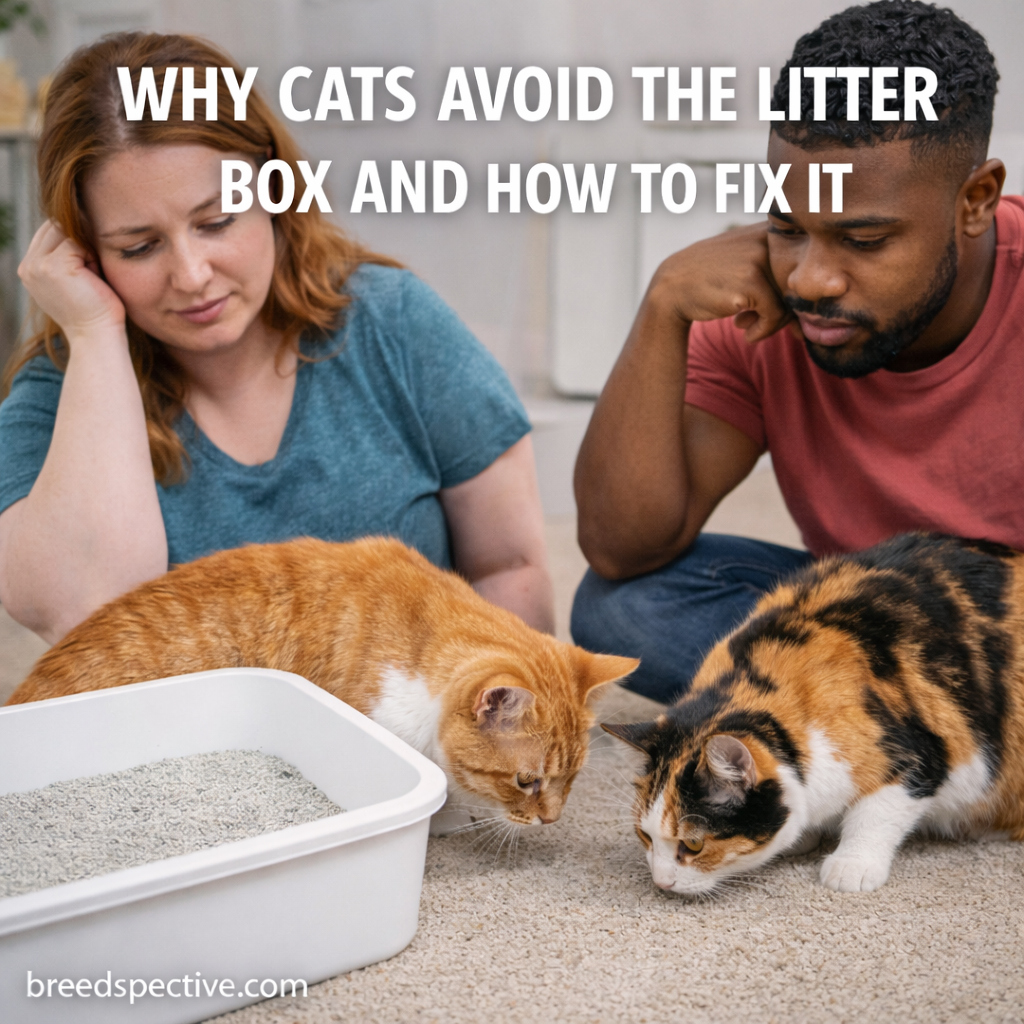
Cats usually avoid the litter box because of a medical problem, an unsuitable box or litter setup, stress, conflict with another pet, or a negative experience associated with the box. A sudden change in litter habits should start with a veterinary check—not punishment—because urinary, digestive, mobility and pain-related problems can all contribute to house-soiling.
The AAFP/ISFM Guidelines for Diagnosing and Solving House-Soiling Behavior in Cats specifically emphasize that house-soiling is not an act of spite or anger. The most effective approach is to identify the cause systematically, beginning with health and then examining the cat’s litter boxes, litter preferences, locations and home environment. (catvets.com)
Step 1: Rule Out a Medical Problem First
If a cat that previously used the litter box reliably suddenly starts urinating or defecating elsewhere, contact your veterinarian.
Do not spend several weeks experimenting with new litter before considering health.
The AAFP/ISFM house-soiling guidelines identify medical problems as an important possible cause of house-soiling and recommend a thorough veterinary assessment. Urinary problems can include bladder inflammation, stones and other urinary tract disorders, while fecal house-soiling may be associated with constipation, diarrhea or other gastrointestinal problems. (catvets.com)
Mobility and pain matter too.
An older cat with arthritis may still understand exactly where the litter box is but find a tall entry or trip down a flight of stairs uncomfortable. A cat experiencing pain while urinating may also develop a negative association with the location where that discomfort occurred.
Watch for changes such as:
- repeated trips to the litter box;
- straining;
- crying or unusual behavior around elimination;
- urinating very small amounts;
- blood in urine or stool;
- constipation or diarrhea;
- licking around the urinary area;
- difficulty entering the box; or
- a sudden change in normal litter-box habits.
Some urinary problems can become emergencies. A cat repeatedly attempting to urinate but producing little or no urine needs prompt veterinary attention, particularly because urinary obstruction can be life-threatening.
Even without obvious symptoms, a new house-soiling problem deserves medical consideration before it is labeled behavioral.
Step 2: Determine What the Cat Is Actually Doing
Not every urine deposit outside the litter box represents the same problem.
A cat may be:
- urinating or defecating outside the box, or
- urine marking.
Those behaviors can have different causes.
A cat eliminating normally outside the box may squat and leave a larger amount of urine on a horizontal surface such as carpet, bedding or a floor.
Urine marking often serves a communication function and may occur on vertical surfaces. The AAFP/ISFM guidelines treat house-soiling and marking as behaviors that require assessment of both the cat’s health and physical or social environment. (catvets.com)
Do not assume that marking means the cat is “getting revenge.” Identifying the pattern simply gives you better information about what to investigate next.
Step 3: Make Sure You Have Enough Litter Boxes
A widely used guideline is:
one litter box per cat, plus one additional box.
That means:
| Number of cats | Starting number of litter boxes |
|---|---|
| 1 | 2 |
| 2 | 3 |
| 3 | 4 |
| 4 | 5 |
The AAFP’s feline environmental guidance uses this general approach because access matters, particularly in multi-cat homes.
But simply putting three boxes beside one another does not necessarily give three cats three meaningful choices.
Boxes should be distributed around the home rather than clustered in a single location. If one cat can guard the doorway leading to every litter box, another cat may effectively have no safe bathroom.
The Feline Veterinary Medical Association’s guidance also recommends placing boxes in different locations and providing accessible boxes on different floors where appropriate, helping reduce the chance that another animal can block access. (catvets.com)
In a one-cat household, a second box can still be useful. It gives the cat another location and can reveal preferences you would otherwise miss.
Step 4: Reconsider the Litter Itself
Cats care about what is underneath their paws.
The AAFP/ISFM house-soiling guidelines recommend evaluating litter preference as part of troubleshooting rather than assuming all commercial litters are interchangeable. Cats often favor soft substrates that allow digging and burying.
For many cats, a good starting choice is a fine-textured, unscented clumping litter.
Strong fragrance may appeal more to the human buying the litter than to the cat using it.
Problems can begin after seemingly minor changes:
- switching from unscented to scented litter;
- changing from a fine texture to large pellets;
- replacing clumping litter with a different substrate;
- adding strong litter deodorizer; or
- suddenly changing brands or formulas.
If the problem began shortly after changing litter, returning to the previous product is a sensible first experiment.
Run a Simple Litter Preference Test
When the preferred substrate is unclear, offer choices.
Set up two otherwise similar boxes in suitable locations with different litter types. Keep the boxes clean and observe which one the cat consistently chooses.
Change one variable at a time.
If you simultaneously replace the box, litter, location and cleaning routine, you will not know which change helped—or which one the cat dislikes.
Step 5: Check the Size and Design of the Box
A litter box can technically accommodate a cat without being comfortable to use.
The AAFP/ISFM guidelines recommend boxes large enough to allow normal movement and elimination behavior. Cats may want room to enter, turn, investigate the substrate, dig and position themselves without feeling cramped.
Many commercial litter boxes are relatively small, especially for large adult cats.
If your cat’s body occupies most of the usable space, try a larger box.
Covered vs. Uncovered Boxes
Covered boxes can contain scattered litter and hide waste from human view, but those benefits do not necessarily matter to the cat.
A covered box can retain odors and may give a cat fewer ways to monitor or exit the area. Some cats use covered boxes without difficulty; others prefer open boxes.
Preference testing is more useful than assuming one design is universally superior.
If you currently use only covered boxes and the cat is avoiding them, offer a large uncovered alternative and see what happens.
Entry Height Matters for Kittens and Senior Cats
A tall-sided box may contain litter effectively but become difficult for a kitten, senior cat or cat with mobility problems to enter.
Choose an entry the cat can comfortably step over.
For an older cat, changing to a low-entry box can sometimes be a more meaningful modification than changing the litter itself.
Routine observation becomes increasingly valuable as cats age. Our guide to daily care routines for cats at every life stage covers how litter monitoring fits into everyday health care.
Step 6: Put the Box Somewhere the Cat Can Actually Use It
Humans often choose litter-box locations based on where they least want to see a litter box.
Cats have different priorities.
A suitable location should be:
- easy to reach;
- reasonably quiet;
- away from sudden disturbances;
- separate from food and water;
- somewhere the cat does not feel trapped; and
- accessible at all times.
International Cat Care advises placing litter trays in quiet, accessible locations and separating toileting areas from food and water resources. (icatcare.org)
A box beside a washing machine can seem conveniently hidden until the machine enters a loud spin cycle while the cat is using it.
A basement box may work for a healthy young cat but become less practical for an older animal with mobility problems.
A box behind a door can become inaccessible when the door is accidentally closed.
Think about the journey to the box from the cat’s perspective.
Step 7: Improve Litter-Box Cleaning
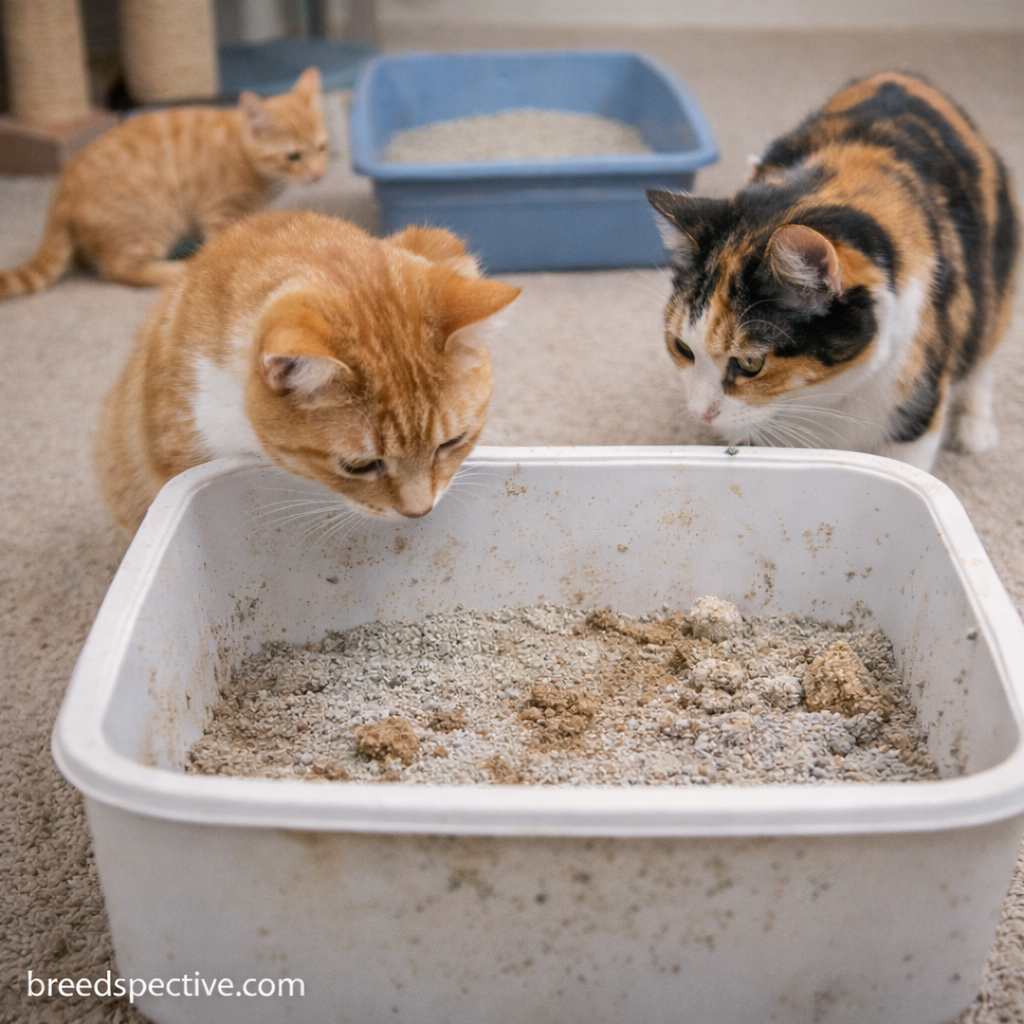
Cats do not need a sterile bathroom, but waste should not accumulate until the box becomes unpleasant to use.
Scoop boxes regularly—often at least daily, and more frequently when needed in multi-cat homes.
Cleaning also gives you useful information. You become familiar with the cat’s normal urine and stool patterns and are more likely to notice a change.
When washing the box, avoid turning it into a strongly perfumed object. The goal is a clean box, not one saturated with fragrances.
Replace litter according to the type being used and how heavily the box is used rather than following an arbitrary schedule that ignores its actual condition.
If a box remains unpleasant despite regular cleaning because old plastic has retained odors or the surface has become badly scratched, replacement may be reasonable.
Step 8: Look for Stress and Conflict in the Home
Once medical causes and obvious litter-box problems have been addressed, look beyond the box.
The AAFP/ISFM environmental guidelines emphasize that cats need safe places and appropriately distributed resources, including food, water, toileting areas, scratching surfaces, play opportunities and resting locations. When those needs are not met, stress can contribute to unwanted behaviors. (catvets.com)
Potential disruptions include:
- moving to a new home;
- introducing another cat;
- adding a dog;
- a new baby or household member;
- renovations;
- unfamiliar outdoor cats near windows;
- major schedule changes; or
- conflict between resident cats.
If your cat has recently moved in, the broader adjustment process may also be relevant. Our guide to what to expect during your first 30 days with a new pet explains why new cats often need time and a smaller, predictable environment while settling in.
Multi-Cat Conflict Can Be Subtle
Do not look only for obvious fights.
One cat may intimidate another by sitting near a hallway, staring, following or blocking access to important resources.
If the litter box is located at the end of a route controlled by another cat, the more timid cat may choose somewhere else.
This is why spreading litter boxes around the home matters. The same principle applies to food, water, resting locations and other resources.
Step 9: Clean Previous Accident Areas Thoroughly
Once a cat has repeatedly eliminated in a particular area, that location can become part of the established pattern.
Clean soiled areas thoroughly with an appropriate product designed to break down pet waste odors. The AAFP’s house-soiling guidance recommends enzyme-based cleaning of affected areas as part of environmental management. (catvets.com)
Avoid simply covering the smell with perfume.
Then make the preferred litter-box option easier and more appealing.
Depending on the situation, placing a litter box temporarily near a repeatedly used accident location may help reveal that the cat has a strong location preference. Once consistent use is established, changes can be made gradually.
Step 10: Do Not Punish the Cat
Scolding, spraying, hitting, rubbing a cat’s nose in waste or forcibly placing the cat in a litter box does not solve the underlying problem.
The AAFP/ISFM guidelines explicitly reject the idea that house-soiling is motivated by spite. Current feline behavioral guidance also warns that punishment and aversive methods can increase distress and worsen undesirable behavior. (catvets.com)
Punishment can be especially counterproductive if the cat already feels unsafe around the litter area.
The useful question is not “How do I stop the cat from doing this?”
It is “Why is the cat choosing this location instead of the litter box?”
That shift leads to much more practical troubleshooting.
Step 11: Consider Age, Body Size and Physical Ability
Litter-box preferences are sometimes attributed to breed when the more relevant factors are physical characteristics and individual history.
A large cat needs enough room to turn and posture comfortably. A long-haired cat may react differently to litter sticking to its coat or paws. A senior cat may need a low entrance and boxes positioned closer to its preferred living areas.
Breed can therefore influence what setup is convenient, but there is no reliable rule that a particular breed must use a particular litter.
Individual preference matters more.
If you are choosing a cat and trying to anticipate the broader demands of ownership, our guide to choosing the right cat breed for your home covers differences in activity, grooming and household fit.
Likewise, living in a small home does not eliminate the need for well-distributed resources. Prospective owners can use our guide to cat breeds suited to apartment living when considering how a cat’s needs fit limited space.
A Step-by-Step Litter Box Reset
When the cause is not immediately obvious, work through the problem in order rather than randomly changing products.
| Step | What to do |
|---|---|
| 1. Health | Arrange veterinary assessment, especially for a sudden change |
| 2. Pattern | Determine whether the cat is eliminating outside the box or marking |
| 3. Quantity | Start with one box per cat plus one extra |
| 4. Litter | Offer a soft, unscented litter and test preferences if necessary |
| 5. Box | Provide a large, comfortable box with an accessible entrance |
| 6. Location | Use quiet, accessible locations with safe entry and exit |
| 7. Cleaning | Scoop frequently and avoid strong fragrances |
| 8. Environment | Look for household stress and competition between cats |
| 9. Accident sites | Clean thoroughly with an appropriate pet-waste product |
| 10. Monitor | Track which changes improve or worsen litter-box use |
Changing one major variable at a time makes the cat’s response easier to interpret.
The exception is when the existing arrangement is clearly inadequate—for example, three cats sharing one dirty box in a noisy utility room. In that situation, several obvious deficiencies may need correcting immediately.
When the Problem Does Not Improve
Persistent house-soiling deserves another look rather than endless experimentation with litter brands.
Return to your veterinarian if the problem continues, especially when symptoms change or medical concerns remain possible.
For complicated behavioral cases, veterinary behavioral expertise may be useful. The AAFP guidance recommends referral to an appropriately qualified veterinary behavior professional when environmental changes and initial management do not resolve the problem. (catvets.com)
Keep notes about:
- where accidents occur;
- whether they involve urine or feces;
- time of day;
- litter-box use;
- interactions with other pets;
- changes in the household; and
- which interventions you have already tried.
Patterns that seem random can become much clearer when written down.
Verdict: Is Litter Box Avoidance Usually Fixable?
Many litter-box problems can improve when the underlying cause is identified, but the solution depends on what the cat is communicating. A dirty box needs better maintenance; a cramped box needs more space; inter-cat conflict requires better resource distribution; and a medical problem needs veterinary treatment rather than behavioral correction.
This troubleshooting approach is right for owners willing to investigate the problem systematically, provide multiple appropriate boxes and adjust the home around the cat’s actual preferences.
It is not compatible with expecting punishment to teach the cat a lesson or assuming that repeated accidents are deliberate misbehavior.
Start with the veterinarian, then work through litter, box size, location, cleanliness and household stress. The fastest route back to reliable litter-box use is usually not forcing the cat to accept the existing setup—it is finding out why that setup stopped working.