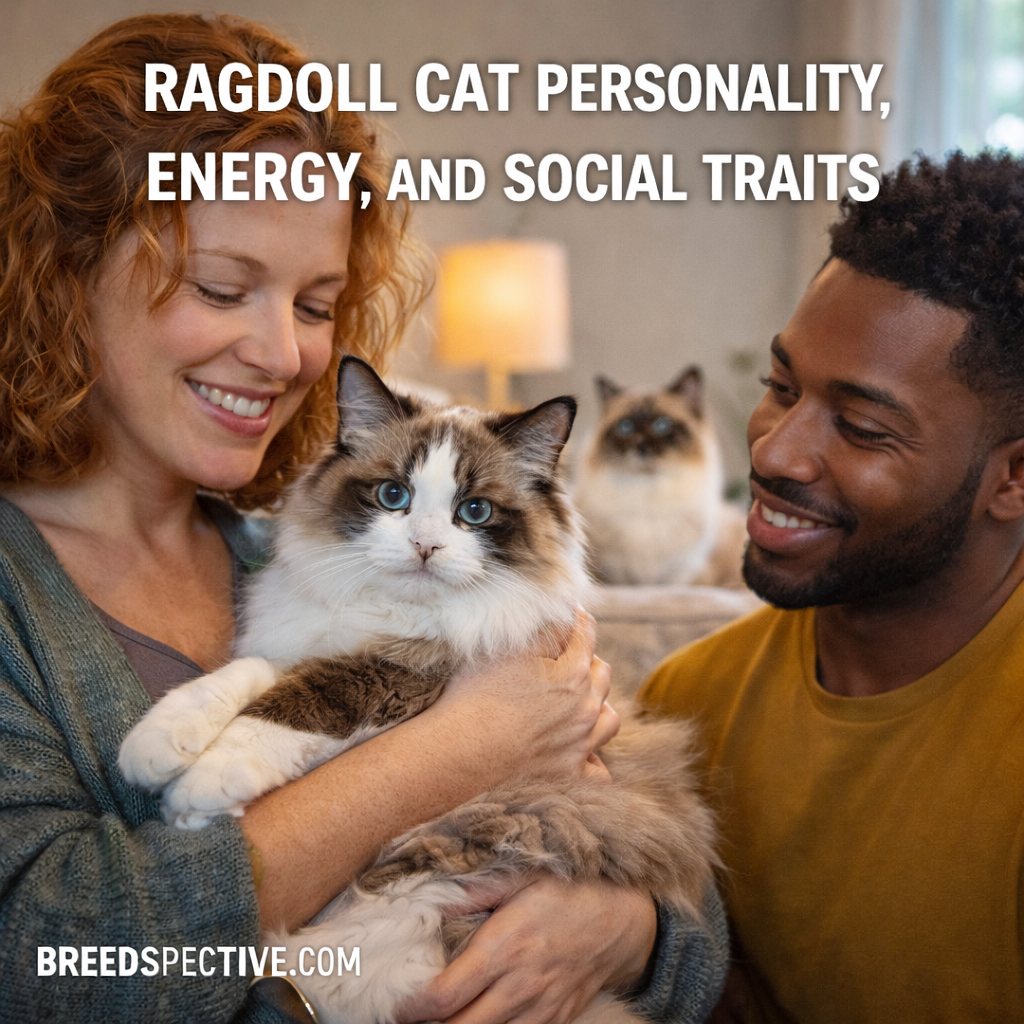
The typical Ragdoll cat personality is affectionate, calm, sociable, and people-oriented, with a playful side that is usually less intense than that of highly active breeds. Ragdolls often enjoy following family members around, relaxing nearby, and participating in gentle play, but they still need regular interaction and exercise rather than being treated as passive lap cats.
The Cat Fanciers’ Association (CFA) describes Ragdolls as docile, placid, affectionate, and sociable. The International Cat Association (TICA) similarly characterizes them as loving, quiet cats with laid-back dispositions, although kittens and young adults can be much more energetic.
Ragdoll Cat at a Glance
| Trait | Ragdoll |
|---|---|
| Size | Large; TICA lists females up to 10–15 lb and males around 15–20 lb |
| Lifespan | Many reach their mid-to-high teens, according to TICA |
| Activity level | Low to moderate |
| Grooming | Moderate; usually weekly or more often during shedding |
| Vocalness | Generally quiet |
| Good with children | Generally yes, with respectful handling |
| Good with other cats | Generally yes, with proper introductions |
| Good with dogs | Often, particularly with cat-friendly dogs |
| Typical personality | Affectionate, gentle, social, playful and laid-back |
| Maturity | Slow; may take around four years to reach full size |
Ragdolls are among the larger pedigreed cats. TICA describes them as substantial, muscular cats and notes that they mature slowly, sometimes requiring about four years to reach their full size and weight.
Ragdoll Breed History and Origins
The Ragdoll is a relatively modern American breed.
Breeder Ann Baker developed the Ragdoll in Riverside, California, during the early 1960s. According to TICA and CFA, a white domestic longhaired cat named Josephine was central to the breed’s foundation. Baker selectively bred Josephine’s descendants and other domestic longhaired cats for the appearance and temperament she wanted.
TICA identifies cats including Josephine, Daddy Warbucks, Blackie, Buckwheat, and Fugianna among the animals involved in the breed’s early foundation. Other breeders later continued developing the Ragdoll independently of Baker, helping establish it with major cat registries.
TICA accepted Ragdolls for championship competition when the organization began in 1979. CFA accepted the breed for registration in 1993 and advanced it to championship status in 2000.
Why Are They Called Ragdolls?
The name comes from the breed’s association with becoming relaxed or “floppy” when held, somewhat like a cloth rag doll.
There is an important qualification to that famous description.
CFA’s breed history explains that Ann Baker associated the characteristic with foundation cat Josephine and that it inspired the Ragdoll name, but CFA also notes that going limp when held is not typical of every modern Ragdoll. TICA likewise says many Ragdolls relax in someone’s arms, rather than claiming that every cat does.
A Ragdoll should therefore never be purchased on the assumption that it will tolerate unlimited carrying or handling. Individual preferences and body language still matter.
Why Ragdoll Kittens Change Color
A Ragdoll kitten’s appearance changes substantially as it grows.
Ragdolls are pointed cats. Their coat-color genetics produce less pigment in warmer areas of the body and darker pigmentation in cooler areas such as the ears, face, legs, and tail. The UC Davis Veterinary Genetics Laboratory explains that colorpoint cats carry genetic variants associated with this temperature-sensitive pigment production.
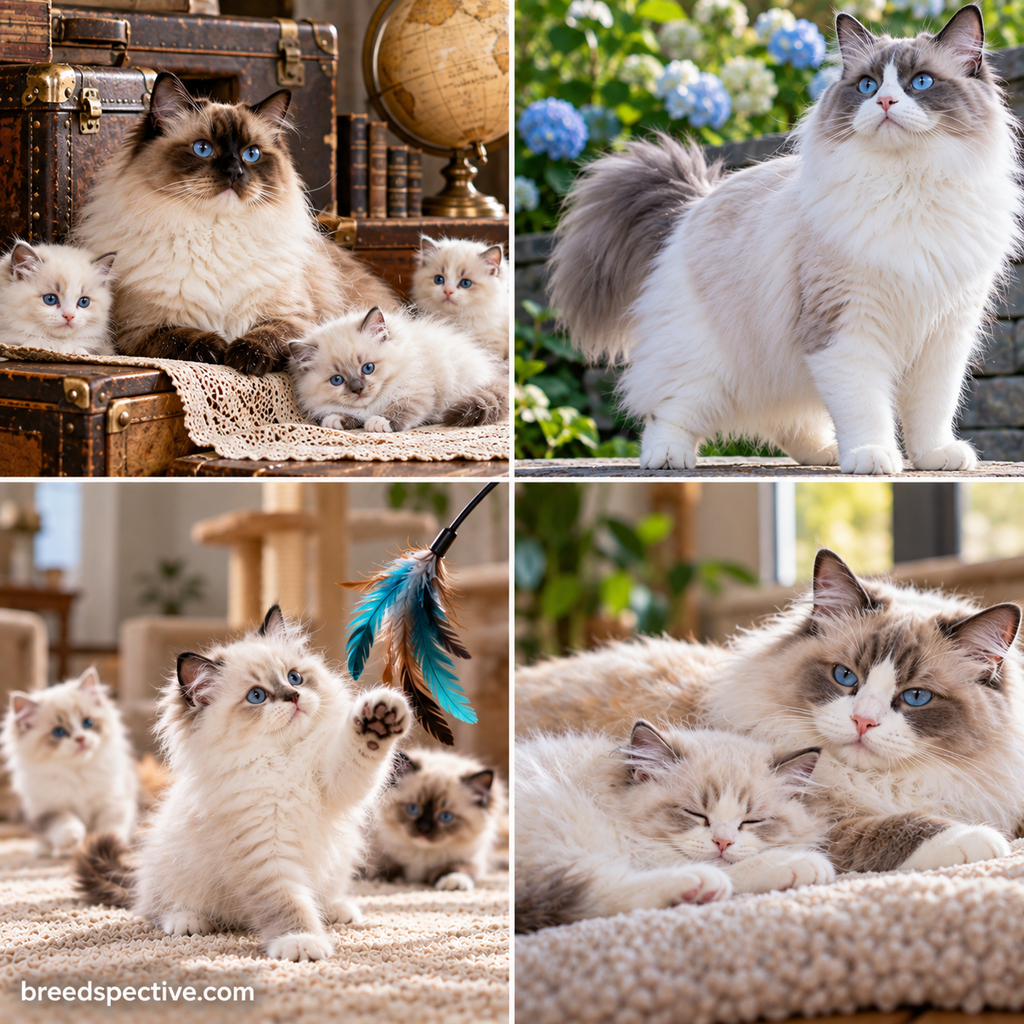
Ragdoll kittens are born almost entirely white, and their point colors gradually become visible as they grow.
Development is slow. TICA notes that a Ragdoll may not achieve its full adult coloration until approximately three years of age and may require around four years to reach full physical maturity.
Recognized Ragdolls have blue eyes and pointed coloration. Patterns include colorpoint, mitted, and bicolor, with several possible point colors and variations.
Ragdoll Personality in Everyday Life
The Ragdoll’s defining characteristic is not simply calmness. It is the combination of calmness and social interest in people.
TICA describes the breed as loving, quiet, and relaxed, while CFA characterizes Ragdolls as affectionate without being excessively demanding. Both organizations also emphasize their sociable nature.
In practical terms, that can mean a cat that wants to occupy the same room as its family without constantly demanding entertainment.
They Often Want to Be Near You
Ragdolls have a reputation for following household members from room to room. TICA even notes that they are sometimes nicknamed “puppy cats” because of their tendency to follow people and because some can learn games such as fetch.
That does not mean every Ragdoll is clingy.
Some are lap cats. Others prefer lying beside someone or settling nearby. Personality, early socialization, age, household experience, and the individual cat all influence how affection is expressed.
A Ragdoll’s friendliness should also not be interpreted as permission to ignore signs that it wants to be put down or left alone.
Calm Does Not Mean Inactive
Ragdolls are generally less intense than highly athletic breeds, but they still play.
TICA specifically warns against assuming that their relaxed temperament means they do not need exercise. Kittens and young adults can be rambunctious, and adult Ragdolls should receive interactive play to maintain healthy body condition.
Useful activities include:
- Wand and feather toys
- Balls and rolling toys
- Puzzle feeders
- Fetch-style games
- Sturdy scratching posts
- Stable cat trees
- Short training sessions
Because Ragdolls are large cats, choose climbing furniture with platforms and bases capable of supporting a substantial adult.
How Energetic Is a Ragdoll?
A Ragdoll generally falls into the low-to-moderate activity range.
Expect periods of play followed by plenty of lounging rather than continuous climbing and racing around the home. Young cats can be considerably more energetic than mature adults.
TICA recommends interactive play to help adult Ragdolls maintain appropriate body condition and avoid excess weight gain.
Two or three manageable play sessions distributed through the day can work better for this temperament than expecting one prolonged, strenuous session.
This activity level makes Ragdolls potentially suitable for smaller homes, provided they still have room to play, scratch, climb, and retreat. Our guide to the best cat breeds for apartment living covers the other factors that matter when choosing a cat for limited space.
Ragdolls With Children and Other Pets
Ragdolls have a reputation for fitting well into family and multi-pet households.
TICA says they generally get along with children and other pets, including dogs, while CFA describes them as sociable and adaptable companions.
That reputation should not become an excuse for rough handling.
Even a tolerant Ragdoll needs children to respect its boundaries. A child should learn not to pull the tail, squeeze the cat, chase it, or continue holding it when it wants to leave.
Introductions to other animals should also be gradual. Breed temperament cannot guarantee compatibility between two particular pets.
People comparing two large, social breeds can read our Maine Coon vs Ragdoll comparison for a closer look at their practical differences.
For a deeper look at another large, sociable cat, see our guide to the Maine Coon’s personality, energy, and social traits.
How Vocal Are Ragdoll Cats?
Ragdolls are generally considered relatively quiet.
TICA specifically describes them as loving, quiet cats and suggests that someone seeking a particularly talkative breed may find the Ragdoll unsuitable.
Individual cats vary, of course.
A Ragdoll may meow for food, greet family members, communicate discomfort, or become more vocal when it wants something. Quiet should therefore be interpreted as a breed tendency rather than a guarantee of silence.
For people attracted to calm cats but interested in a somewhat different social style and a short coat, our guide to the British Shorthair’s personality, energy, and social traits provides a useful comparison.
Who a Ragdoll Suits — and Who Should Avoid One
Ragdolls generally suit people who want a cat that participates in family life without requiring extremely vigorous daily exercise.
A Ragdoll may be a good match if you:
- Want an affectionate, people-oriented cat
- Prefer moderate rather than intense activity
- Have time for regular interactive play
- Can maintain a semi-long coat
- Want a large indoor companion
- Have respectful children or compatible pets
- Enjoy a cat that may follow you around the home
The breed is less suitable if you specifically want a highly independent cat requiring little social engagement.
Ragdolls also are not maintenance-free. Their coat needs routine combing, their large bodies require appropriately sized equipment, and responsible owners need to pay attention to weight and breed-associated health risks.
If you are still comparing breeds, our guide to choosing the right cat breed for your home can help you weigh temperament, activity, grooming, size, and household compatibility.
Ragdoll Grooming and Coat Care
The Ragdoll has a semi-long, soft, silky coat. TICA describes the coat as having relatively little undercoat compared with some heavily coated longhaired breeds, which helps reduce the tendency toward severe matting—but it does not eliminate grooming.
Plan on combing a Ragdoll at least weekly, with additional attention when shedding increases or whenever tangles begin developing.
A Practical Ragdoll Grooming Routine
A stainless-steel comb is particularly useful because it can reach through the coat rather than merely smoothing the surface.
TICA specifically recommends combing through to the skin and watching areas such as the armpits for tangles during heavier shedding periods.
A basic grooming kit can include:
- Stainless-steel comb
- Cat-appropriate grooming brush
- Nail clippers
- Cat toothbrush and veterinary-approved toothpaste
- Soft cloth for occasional facial cleaning
- Cat-safe bathing supplies when needed
Start at the head and shoulders and work systematically along the body. Pay extra attention behind the front legs, around the hindquarters, underneath the body, and anywhere friction causes the coat to bunch together.
If the comb catches, do not repeatedly pull against the skin. Work through a small tangle carefully. Severe matting is safer handled by a veterinarian or experienced professional groomer.
How Much Do Ragdolls Shed?
Ragdolls do shed despite occasional claims that they are virtually non-shedding.
TICA notes that shedding can become more noticeable during seasonal coat changes, particularly in spring and fall.
Regular combing removes loose hair before much of it ends up on furniture or is swallowed during self-grooming.
No cat breed should be assumed to be hypoallergenic simply because its coat sheds less than expected.
Do Ragdolls Need Baths?
Routine bathing is not necessary on a rigid schedule for every pet Ragdoll, but TICA notes that the breed can be introduced to bathing and blow-drying from a young age.
Bathing may be useful when the coat becomes dirty, oily, or difficult to maintain. The frequency should reflect the individual cat’s coat and health rather than an arbitrary calendar.
Nails also require regular trimming, and dental care should form part of preventive healthcare.
Our daily care routines for cats at every life stage can help organize grooming alongside feeding, play, litter maintenance, and routine health observations.
Litter Box and Everyday Care
Large cats need appropriately sized equipment.
A Ragdoll should be able to enter its litter box, turn comfortably, dig, and position itself without being cramped. Small covered boxes marketed for average-sized cats may be uncomfortable for a large adult Ragdoll.
Keep boxes clean and place them in accessible locations where the cat does not feel trapped.
A sudden change in litter-box habits should not automatically be interpreted as stubbornness. Medical conditions, stress, litter preference, cleanliness, location, and conflict with another pet can all contribute.
Our guide to why cats avoid the litter box and how to fix it explains how to approach a change systematically.
Ragdoll Health Issues to Screen For
Ragdolls can develop the same illnesses as other cats, but hypertrophic cardiomyopathy deserves particular attention when choosing a breeder.
Hypertrophic Cardiomyopathy
Hypertrophic cardiomyopathy, or HCM, causes abnormal thickening of the muscular walls of the heart.
Cornell University College of Veterinary Medicine identifies Ragdolls among breeds in which HCM occurs more frequently and notes that a mutation involving the cardiac protein myosin-binding protein C has been identified in affected Ragdoll lines.
The UC Davis Veterinary Genetics Laboratory confirms that a Ragdoll-specific genetic variant associated with increased HCM risk has been identified and offers DNA testing for it.
TICA recommends choosing breeders who test breeding cats for the Ragdoll HCM mutation.
However, a negative DNA test should not be interpreted as proof that a cat can never develop HCM. Cornell notes that feline HCM has complex causes, and echocardiography remains the gold standard for diagnosing the disease.
Ask a breeder:
- Whether both parents have been DNA tested for the known Ragdoll HCM variant
- Whether cardiac disease has occurred in close relatives
- What additional cardiac screening is performed
- Whether test documentation is available
A reputable breeder should be comfortable answering specific health questions rather than simply saying the kittens are “vet checked.”
Weight and Body Condition
A Ragdoll’s substantial build can make excess weight harder for an inexperienced owner to recognize.
TICA notes that the breed naturally has a small abdominal fat pad but recommends evaluating condition around the spine and ribs and asking a veterinarian to demonstrate appropriate body-condition assessment.
Do not deliberately overfeed a young Ragdoll in an attempt to produce the biggest possible adult.
Size is largely determined by genetics, sex, development, and overall health. Appropriate nutrition should support healthy growth rather than maximum weight.
Regular play is also part of weight management, particularly after the energetic kitten and adolescent stages begin to settle.
Realistic Ragdoll Cat Costs
The initial purchase price is only one component of Ragdoll ownership.
Breeder prices differ substantially according to location, pedigree, age, breeding rights, demand, and other factors. A single national purchase-price figure can therefore become outdated quickly.
Long-term expenses are more useful for planning.
| Expense | What to Plan For |
|---|---|
| Purchase or adoption | Variable initial cost |
| Veterinary care | Exams, preventive care, illness and emergencies |
| Food | Ongoing expense for a large cat |
| Grooming supplies | Combs, brushes, nail and coat-care products |
| Professional grooming | Optional but potentially useful for difficult coat problems |
| Litter | Larger boxes may increase litter use |
| Cat furniture | Sturdy trees, beds and scratching posts sized for a large cat |
| Carrier | Large, strong carrier suitable for an adult Ragdoll |
| Dental care | Preventive home care and veterinary treatment when required |
| Emergency care | Emergency savings or suitable pet insurance |
The breed’s size matters financially. A carrier, bed, scratching post, or cat tree designed for a small adult cat may need replacing once a Ragdoll reaches maturity.
Health screening should also influence how you evaluate breeders. A cheaper kitten from parents without documented screening is not necessarily the less expensive choice over the cat’s lifetime.
Choosing a Ragdoll Responsibly
Temperament and health should come before coat color.
Ask a breeder about:
- HCM genetic testing
- Cardiac history within the pedigree
- Veterinary records
- Temperament of the parents
- How kittens are socialized
- Pedigree documentation
- When kittens leave for their new homes
- What vaccinations and preventive care have been provided
- The breeder’s contract and return policy
Be cautious of exaggerated promises.
A breeder cannot guarantee that a kitten will grow into a cat that always goes limp when picked up, never scratches, loves every child, or gets along with every animal.
Those claims turn breed tendencies into guarantees they cannot be.
A well-bred Ragdoll should still be treated as an individual cat with its own preferences, boundaries, and personality.
Verdict: Is a Ragdoll Cat Right for You?
A Ragdoll is well suited to someone who wants a large, affectionate, relatively calm cat that enjoys being involved with its household. Their moderate activity level can work well for indoor living, while their sociable temperament can make them a good candidate for families and compatible multi-pet homes.
They are not the best choice for someone who wants a highly independent cat requiring minimal interaction or grooming. Regular combing, appropriately sized equipment, interactive play, weight management, and careful attention to HCM screening are all part of responsible Ragdoll ownership.
The famous floppy temperament should be treated as a possibility, not the reason to buy the breed. The more dependable attractions are the Ragdoll’s generally gentle social style, substantial size, silky coat, and preference for companionship.
For an owner prepared to provide that companionship and routine care, those characteristics are what make the Ragdoll distinctive.