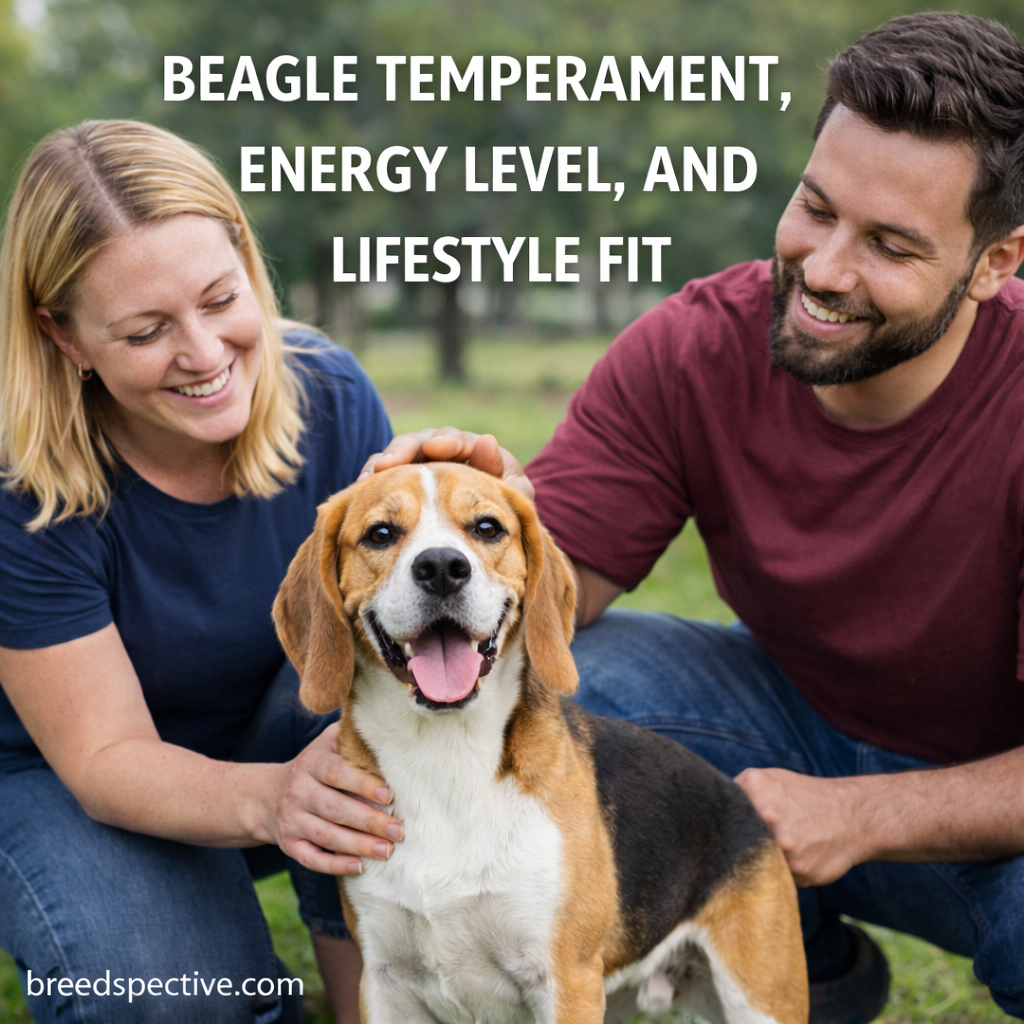
Beagle temperament is typically friendly, curious, social, energetic, and strongly influenced by scent. These compact hounds can be excellent family companions, but their independence, loud baying, appetite, and tendency to follow their noses make them more demanding than their cheerful appearance suggests.
A Beagle is usually happiest with people or other dogs nearby, regular opportunities to sniff and explore, and an owner willing to manage the breed’s hunting instincts rather than expecting perfect off-leash obedience.
Beagle at a Glance
| Trait | Beagle |
|---|---|
| Size | Two AKC varieties: 13 inches and under; over 13 to 15 inches |
| Typical weight | Under 20 pounds for many smaller Beagles; roughly 20–30 pounds for the larger variety |
| Life expectancy | About 10–15 years |
| Exercise needs | Moderate to high; daily walks, exploration, play, and scent work |
| Grooming | Low to moderate; short coat with regular shedding |
| Trainability | Intelligent and food-motivated, but easily distracted by scent |
| Good with children? | Often yes, with appropriate supervision and socialization |
| Good with other dogs? | Usually; Beagles were developed to work in packs |
| Vocal level | High; barking, howling, and baying are normal breed behaviors |
| Best environment | Active home with companionship and secure outdoor space or controlled walks |
The American Kennel Club’s Beagle breed standard describes two size varieties: hounds not exceeding 13 inches and those over 13 but not exceeding 15 inches. The standard emphasizes a sturdy, functional hound built to work in the field.
Beagle Origin and Original Purpose
The Beagle’s behavior makes much more sense when you know what the breed was designed to do.
Beagles are scent hounds developed to pursue quarry, particularly hare and rabbit. According to the National Beagle Club of America, Beagle-type hunting dogs have a long history in Europe, and the recognizable breed was established in England centuries ago. Hare hunting with packs helped preserve and shape the breed.
This work required a dog that could:
- Find and follow scent independently
- Continue tracking despite distractions
- Work alongside other hounds
- Cover ground for extended periods
- Communicate while following a trail
- Make decisions without constantly looking to a handler
Those traits remain obvious in modern companion Beagles.
A Beagle stopping in the middle of a walk to investigate a smell is not simply being difficult. Following scent is one of the behaviors generations of breeding reinforced.
The breed’s extraordinary nose still has practical uses. The USDA’s detector-dog program uses specially trained Beagles at U.S. airports to locate prohibited or potentially risky agricultural products such as fruits, vegetables, and meats in passenger baggage.
Beagles have also become cultural icons. Snoopy, created by Charles M. Schulz for Peanuts, is described by the Charles M. Schulz Museum as the world’s most famous Beagle.
Beagle Temperament in Everyday Life
The AKC describes the breed as merry, companionable, curious, and energetic. In a suitable home, that generally translates into an affectionate dog that wants to participate in household life rather than watch it from a distance.
Friendly and Social
Most well-socialized Beagles are naturally sociable. Their pack-hunting background helps explain why many enjoy other dogs and why they often adapt well to busy family environments.
They can be enthusiastic rather than reserved with visitors, so anyone wanting a naturally aloof or imposing watchdog should look elsewhere.
Their social nature also has a downside: some Beagles struggle when routinely isolated for long periods. A household in which everyone leaves early and returns late may require dog walking, daycare, family help, or another arrangement to break up the day.
Affectionate Without Being a Lap Dog All Day
Beagles generally enjoy attention and physical affection, but they also want to investigate their environment. A Beagle may happily curl up beside you after exercise and then become intensely focused the moment an interesting smell appears outside.
That combination of companionship and independence is central to Beagle temperament.
Good With Children
Beagles can make very good family dogs. Their manageable size, playful disposition, and generally sociable temperament are useful qualities in a household with children.
No breed, however, makes supervision unnecessary. Children should learn not to disturb a sleeping dog, grab ears, climb on the dog, or interfere with meals.
If family compatibility is your priority, compare the Beagle with other options in our guide to the best dog breeds for families with young children.
Usually Comfortable With Other Dogs
Pack hunting required Beagles to work around other hounds, and many modern Beagles remain notably dog-social.
Cats are more individual. Some Beagles live peacefully with cats, especially when raised with them, but a scent hound’s pursuit instincts should not be ignored. Rabbits and other small prey animals require particularly careful management and secure separation.
Beagle Energy Level and Exercise Needs
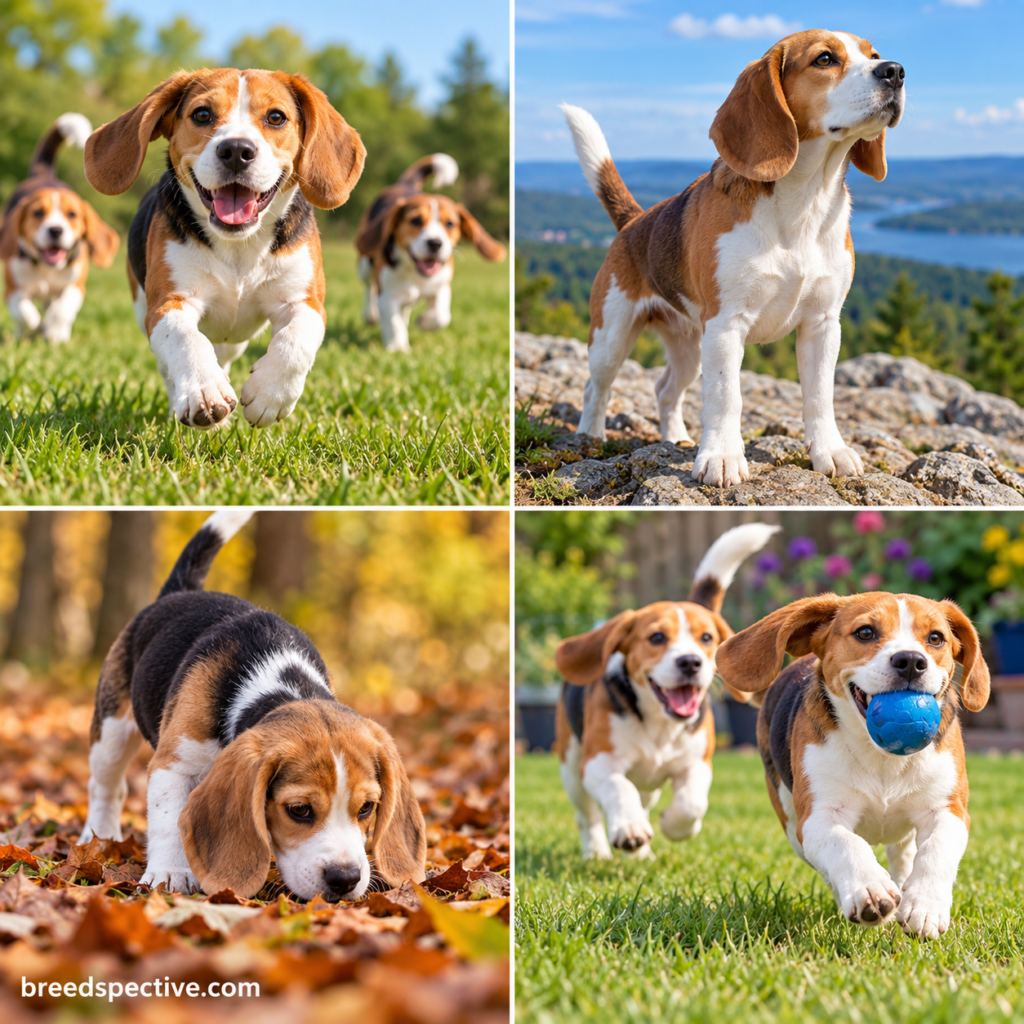
Beagles are small, but they are not sedentary.
A healthy adult needs meaningful daily activity rather than a few quick bathroom trips. For many households, planning around roughly an hour or more of combined walking, play, training, and scent-based activity is a more realistic starting point than treating the Beagle as a low-exercise small dog.
The exact amount varies with age, health, individual temperament, weather, and intensity of activity. Puppies and senior dogs require different routines from healthy adults.
What matters just as much as mileage is how the Beagle gets to use its brain.
A brisk walk is useful. A walk that also allows controlled sniffing can be even more satisfying for a scent hound. Food puzzles, hide-and-seek games, nose work, tracking exercises, and short training sessions provide productive outlets for behaviors the breed was developed to perform.
If exercise requirements are a major factor in choosing a breed, use our guide to matching a dog’s energy level to your daily routine before deciding.
Training a Beagle
Beagles are intelligent, but intelligence and obedience are not the same thing.
Food can make them highly motivated learners. At the same time, an outdoor environment contains thousands of smells competing with you for attention.
Training usually works best with:
- High-value food rewards
- Short sessions
- Clear, consistent cues
- Gradually increasing distractions
- Reward-based recall practice
- Scent games used as rewards
- Management that prevents unwanted behavior from becoming habitual
Punishing a Beagle for investigating scent does not remove the underlying instinct. Training should instead teach the dog when exploration is allowed and when attention needs to return to the handler.
The Beagle Recall Problem
Reliable recall is one of the biggest practical challenges of owning a Beagle.
A dog that responds perfectly in the kitchen may appear to forget its name when it finds a fresh scent trail outdoors. This is exactly why recall should be practiced gradually rather than tested for the first time in an unsecured park.
Use a long training line while developing recall. Reward heavily for returning, practice around progressively stronger distractions, and avoid repeatedly calling when you know the dog is unlikely to respond.
Even a well-trained Beagle may never be an ideal candidate for unrestricted off-leash exercise in open areas.
Secure fencing matters too. Gates should latch properly, and owners should routinely check the fence line for gaps or opportunities to dig or squeeze through.
If effortless off-leash reliability is one of your highest priorities, a scent hound may not be the easiest match.
Baying, Howling, and Barking
Beagles can be loud.
Their distinctive bay is different from an ordinary bark: it is a drawn-out hound vocalization associated with the breed’s history of pursuing quarry in packs. Vocal communication helped hunters and other dogs keep track of a hound working a scent.
Modern Beagles may vocalize because they:
- Detect an interesting scent
- See an animal outside
- Become excited
- Want attention
- Are frustrated
- Are bored
- Dislike being alone
Exercise and enrichment can reduce boredom-related noise, while window coverings or restricting access to high-trigger areas can help with visual triggers.
For separation-related vocalization, simply correcting the noise is unlikely to address the cause. Gradual alone-time training and, where necessary, help from a qualified trainer or veterinary behavior professional are better approaches.
This is an especially important consideration for apartments. A Beagle can live in an apartment if its needs are met, but shared walls make frequent baying much harder to manage.
Food Theft and the Beagle Appetite
Food motivation is useful during training. It can also create household problems.
Many Beagles are remarkably persistent when food is accessible. Counter surfing, raiding bags, investigating trash, and grabbing unattended meals can quickly become learned habits because occasionally succeeding provides a powerful reward.
Management is more reliable than expecting constant self-control.
Keep food away from counter edges, use secure trash containers, close pantry doors, and prevent access to unattended plates. Measure meals rather than estimating portions, and account for training treats in the dog’s daily food intake.
Food puzzles and scent games can turn that motivation into something useful.
Common Beagle Behavior Problems and What to Do
Pulling Toward Scents
Why it happens: scent is exceptionally rewarding.
What helps: teach loose-leash walking in low-distraction areas, reward check-ins, use sniffing as a controlled reward, and allow dedicated sniff walks rather than demanding a formal heel for an entire outing.
Ignoring Recall
Why it happens: competing smells can be more rewarding than returning.
What helps: long-line training, high-value rewards, progressive distraction training, and secure areas rather than unnecessary off-leash risks.
Escaping and Wandering
Why it happens: a scent trail can lead a Beagle well beyond the yard.
What helps: secure fencing, supervised outdoor time, reliable gates, identification tags, microchipping, and avoiding unsupervised roaming.
Howling When Left Alone
Why it happens: pack-oriented dogs may find isolation difficult.
What helps: teach alone time gradually, provide appropriate enrichment, arrange midday care when necessary, and seek professional help if the dog shows signs of separation anxiety.
Destructive Behavior
Why it happens: boredom, insufficient activity, adolescence, or distress can all contribute.
What helps: exercise, scent work, safe chewing options, environmental management, and identifying the actual trigger rather than assuming the dog is being spiteful.
Potty-Training Difficulties
Consistency matters more than breed stereotypes. Puppies need frequent outdoor opportunities, close supervision, predictable meals, and immediate reinforcement for eliminating in the correct location.
Our dog breed potty-training timeline guide explains what owners should realistically expect during house training.
Grooming and Routine Care
The Beagle’s short, dense hound coat is relatively straightforward to maintain. Regular brushing removes loose hair and helps control shedding.
Owners should also establish routines for:
- Nail trimming
- Dental care
- Ear checks
- Bathing as needed
- Weight monitoring
Their hanging ears can reduce airflow through the ear canal, so redness, odor, discharge, persistent scratching, or head shaking warrants veterinary attention rather than repeated home treatment without a diagnosis.
Beagle Health Issues to Screen For
Beagles are not defined by poor health, but responsible breeding still requires health screening.
The National Beagle Club of America’s health guidance and the Orthopedic Foundation for Animals’ CHIC program identify screening tests intended to help breeders make informed decisions.
For Beagles, the club-approved CHIC screening program includes:
- Hip dysplasia evaluation through OFA or PennHIP
- Eye examination by a board-certified veterinary ophthalmologist
- DNA testing for Musladin-Lueke Syndrome (MLS)
- Cardiac evaluation
- OFA evaluation for autoimmune thyroiditis
The National Beagle Club also lists additional optional testing, including screening for patellar luxation and DNA tests for conditions such as Lafora epilepsy, Factor VII deficiency, and neonatal cerebellar cortical degeneration.
A CHIC number should not be misunderstood as a guarantee that every result was normal. OFA explains that CHIC certification means the required breed-specific screenings were completed and the results were made publicly available.
Prospective puppy buyers should therefore ask for the parents’ actual results rather than accepting “health tested” as sufficient information.
Epilepsy
Cornell University’s College of Veterinary Medicine identifies Beagles among breeds in which idiopathic epilepsy occurs more commonly. Idiopathic epilepsy causes recurrent seizures without an identifiable underlying cause and is diagnosed after other potential causes are excluded.
Any seizure warrants veterinary guidance. Cornell advises that an active seizure lasting more than five minutes or multiple seizures within 24 hours can constitute an emergency.
Hypothyroidism
Cornell also lists Beagles among breeds commonly diagnosed with hypothyroidism. Possible signs include unexplained weight gain, lethargy, reduced activity, cold intolerance, hair loss, poor coat quality, and recurring skin or ear problems.
Diagnosis requires veterinary examination and appropriate blood testing rather than symptoms alone.
Intervertebral Disc Disease
UC Davis School of Veterinary Medicine includes Beagles among breeds affected by Type I intervertebral disc disease. Disc material can degenerate and compress the spinal cord, with signs ranging from pain to serious neurological impairment.
Sudden back or neck pain, weakness, difficulty walking, or paralysis requires prompt veterinary attention.
How Much Does a Beagle Cost Per Year?
There is no meaningful single annual figure that applies to every Beagle. Veterinary prices, insurance, food, boarding, training, and emergency care vary dramatically by location and individual dog.
For budgeting purposes, a U.S. owner might reasonably plan for ordinary recurring expenses in categories such as these:
| Expense | Practical annual planning range |
|---|---|
| Food and treats | $400–$900 |
| Routine veterinary care | $300–$700 |
| Parasite prevention | $150–$400 |
| Toys, chews, enrichment and supplies | $150–$400 |
| Grooming/basic care supplies | $50–$200 |
| Training | $0–$600+ |
| Pet insurance | $300–$900+ |
| Typical planning total | About $1,350–$4,100+ |
These are budgeting estimates, not fixed prices. They exclude major emergencies, chronic disease treatment, professional dog walking, daycare, boarding, and the initial cost of acquiring and equipping for the dog.
A Beagle that needs regular daycare because nobody is home during the workday can cost substantially more each year than one living in a household where someone is usually present.
Who Is a Beagle Best Suited To?
A Beagle can be a strong match for someone who wants an outgoing, playful companion and does not mind structuring daily life around a scent hound.
Good matches often include people who:
- Want a social family dog
- Enjoy daily walks and outdoor exploration
- Like interactive training rather than expecting automatic obedience
- Can provide regular companionship
- Are comfortable managing food access
- Have secure fencing or are willing to use a leash or long line
- Can tolerate barking, howling, and occasional baying
- Enjoy nose work and enrichment activities
If you are still comparing breeds broadly, our guide to choosing the right dog breed for your lifestyle can help separate traits you enjoy from traits that may become frustrating over years of ownership.
Who Should Think Twice About a Beagle?
A Beagle is less suitable if you want a dog that is naturally quiet, highly handler-focused, reliably easy to exercise off leash, or content to spend long days alone.
Think carefully if you:
- Live somewhere where noise complaints would be a serious problem
- Want dependable off-leash freedom with minimal training
- Are away from home for most of every day
- Do not enjoy daily walks or enrichment
- Want a dog that naturally ignores food and household temptations
- Keep small prey animals without the ability to separate them securely
- Expect obedience to override hunting instincts in every situation
Size alone should never be used to predict difficulty. For another small scent-hound comparison, see our guide to Dachshund temperament and lifestyle fit. If you are considering a more powerful, athletic family dog instead, compare these traits with the Boxer’s temperament, energy level, and lifestyle fit.
Verdict: Is a Beagle Right for You?
A Beagle is right for an owner who wants a cheerful, social, active scent hound and is prepared to work with the breed’s instincts. Give this dog companionship, structured exercise, opportunities to sniff, reward-based training, secure boundaries, and sensible food management, and the qualities that once made the Beagle an effective pack hunter can translate well into family life.
A Beagle is not the right choice for someone seeking a quiet, low-effort dog with effortless recall. Baying can be disruptive, food theft requires management, and a compelling scent can compete with even well-practiced commands.
The deciding question is not simply whether you like Beagles. It is whether you want to live with the behaviors that make a Beagle a Beagle.