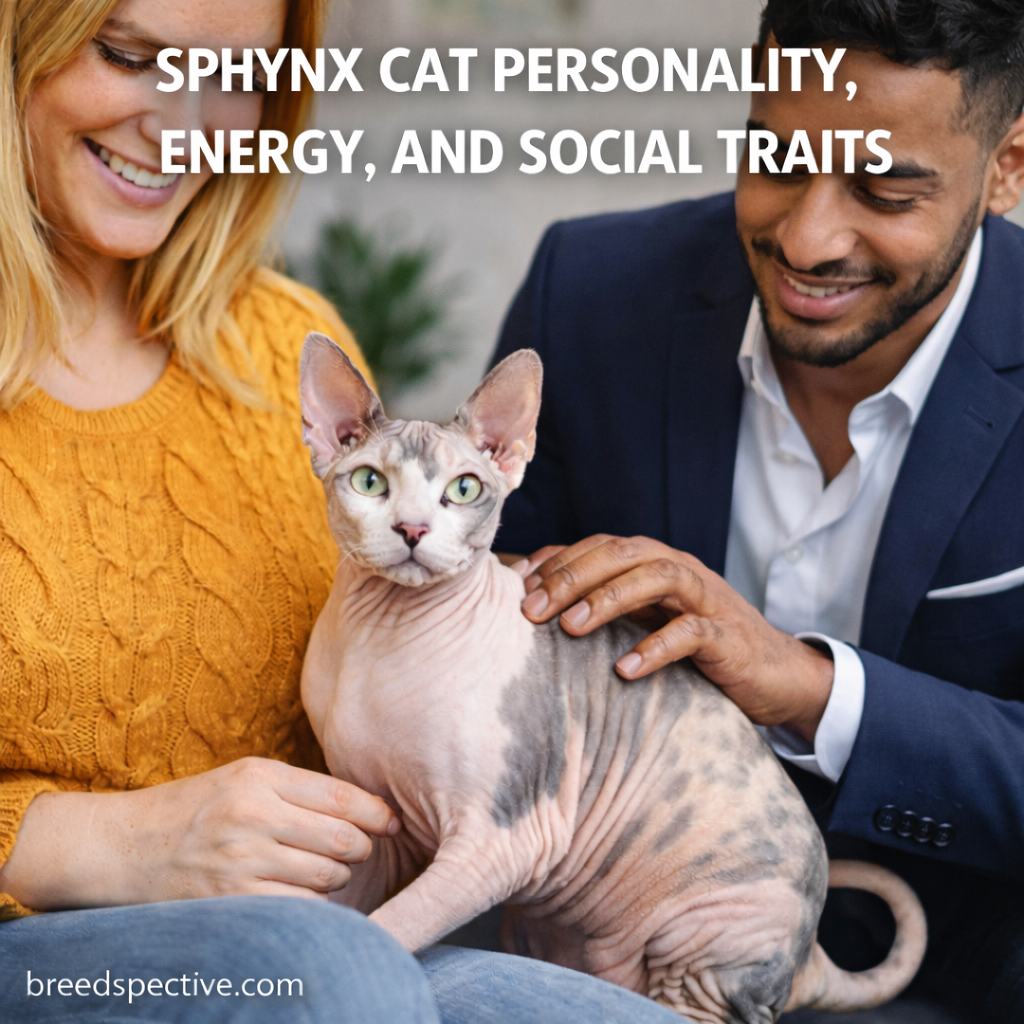
The Sphynx cat personality is affectionate, outgoing, curious and highly people-oriented. These active cats tend to seek attention, follow their people around the home and make themselves part of everyday activities rather than quietly observing from another room. The Cat Fanciers’ Association (CFA) describes the Sphynx as curious, outgoing and intelligent, while also emphasizing that its need for companionship may not suit everyone. The Cat Fanciers’ Association
Their unusual appearance can give the impression that grooming will be easy, but the opposite is often true. Sphynx cats require regular skin care and bathing, and prospective owners also need to consider warmth, social needs and breed-related health concerns.
Sphynx Cat at a Glance
| Trait | What to Expect |
|---|---|
| Size | Medium-sized, muscular and substantial |
| Lifespan | Varies with genetics, health and veterinary care |
| Activity level | Moderate to high; playful, curious and athletic |
| Grooming | Higher than appearance suggests; regular bathing and skin care required |
| Vocalness | Moderate to talkative |
| Good with children | Often, with gentle and respectful handling |
| Good with other pets | Often; many appreciate compatible animal companions |
| Affection level | High |
| Independence | Relatively low |
| Best environment | Warm indoor home with frequent interaction and enrichment |
CFA describes the Sphynx as a medium-sized, substantial cat with sturdy bones and good muscle development rather than a delicate animal. Despite its exposed skin and slender-looking limbs, a healthy Sphynx should have an athletic, muscular body. The Cat Fanciers’ Association
Sphynx Breed History and Origin
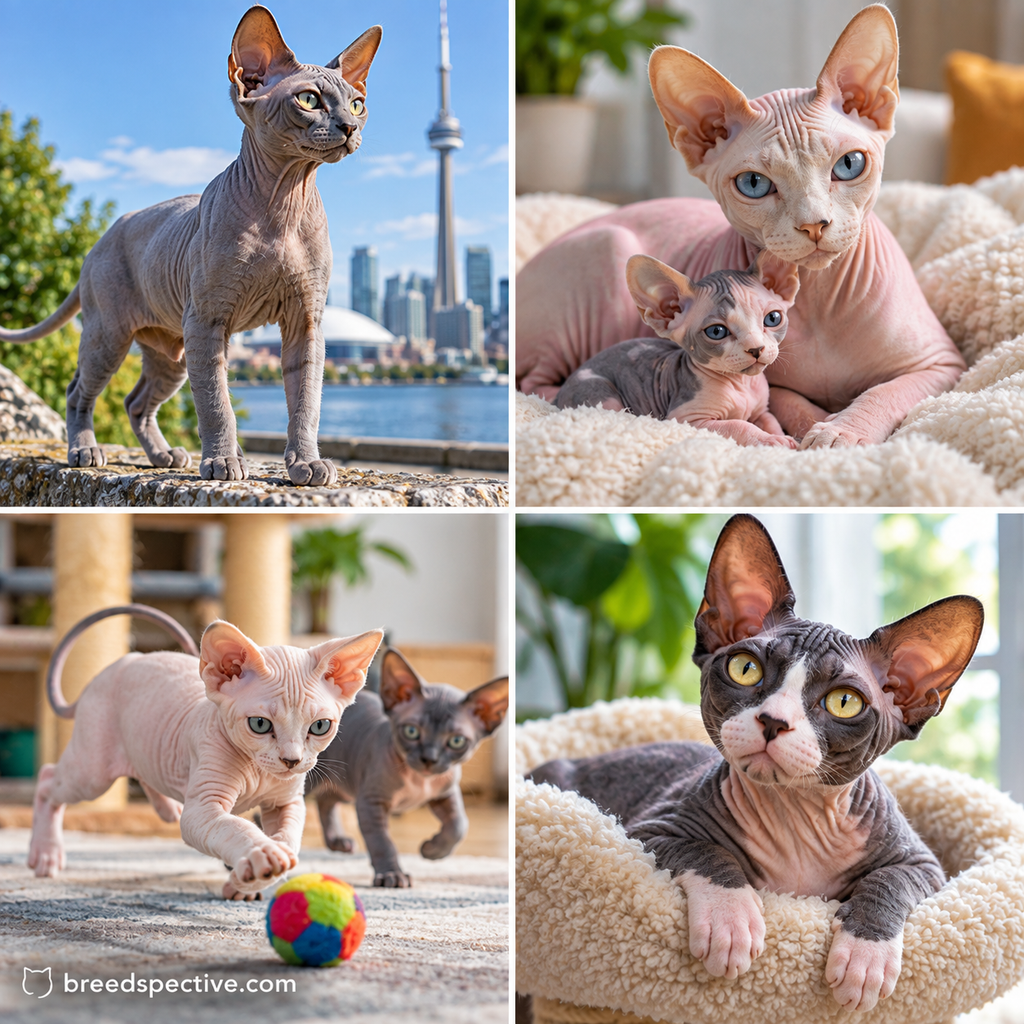
The modern Sphynx is a relatively recent breed, and despite its Egyptian-sounding name, its development began in Canada.
In 1966, a domestic cat in Toronto gave birth to a naturally hairless kitten. The kitten, named Prune, had inherited a spontaneous genetic mutation responsible for hairlessness. TICA’s breed history also identifies Prune as the kitten behind the first attempts to establish what would become the modern Sphynx. TICA
The early breeding program was not the only source of hairless cats. In 1975, two cats carrying the same mutation appeared in Minnesota and were named Epidermis and Dermis. According to CFA, these cats were bred with American Shorthairs and Devon Rex cats and contributed to the developing Sphynx gene pool. The Cat Fanciers’ Association
Breeders continued working with hairless and normally coated cats over several decades to develop the modern breed.
CFA accepted Sphynx cats for registration in 1998 and advanced them to Championship status in 2002. The Cat Fanciers’ Association
Sphynx Cats Aren’t Completely Hairless
“Hairless cat” is a convenient description, but it isn’t completely accurate.
CFA’s breed standard allows the body to range from apparently hairless to being covered with soft, peach-like fuzz. Fine hair can also occur on areas such as the nose, feet, ears and tail. The Cat Fanciers’ Association
Run your hand over many Sphynx cats and the skin therefore won’t feel completely bare. It can have a soft texture often compared with a peach or suede.
The amount of fuzz can vary between individuals, and CFA notes that seasonal and hormonal changes may also affect hair development. The Cat Fanciers’ Association
Sphynx Personality in Everyday Life
A Sphynx generally isn’t a cat that wants to live independently in the background.
CFA describes the breed as curious, outgoing and very intelligent. It also notes that Sphynx cats tend to follow their people from room to room and clearly communicate what they want. The Cat Fanciers’ Association
That makes the breed highly engaging, but potentially demanding.
Affection and Human Attachment
Physical closeness is a prominent part of Sphynx behavior.
CFA describes Sphynx cats as attention- and affection-seeking “body heat magnets” that may remain close to their people for long periods. The Cat Fanciers’ Association
Expect behaviors such as climbing onto a lap, sleeping beside you, following you through the house or settling against another warm body.
Warmth and affection overlap with this breed. A Sphynx seeking your lap may be enjoying both your company and your body heat.
This personality can be extremely rewarding for someone who wants an involved companion. It can be frustrating for someone who prefers a more self-contained pet.
If the social side of the Sphynx appeals to you, compare it with the Siamese cat’s personality, energy, and social traits, another breed known for strong involvement with its household.
Energy and Play
The Sphynx is active rather than sedentary.
CFA characterizes the breed as lively and describes a muscular body built for activity. The breed’s curiosity also means enrichment should involve more than leaving a few toys on the floor. The Cat Fanciers’ Association
A practical home setup can include:
- Wand toys for interactive chasing
- Balls and lightweight toys
- Puzzle feeders
- Scratching surfaces
- Stable cat trees or climbing furniture
- Warm elevated resting places
- Several opportunities for interactive play throughout the day
Rotate toys rather than leaving everything available permanently. Novelty gives an inquisitive cat another reason to investigate and play.
The Bengal cat’s personality, energy, and social traits provides a useful comparison if high activity and intelligence are major factors in your breed decision.
Intelligence and Curiosity
Curiosity is one of the Sphynx’s defining characteristics.
CFA specifically describes the breed as “very intelligent” and “anything but shy.” The Cat Fanciers’ Association
In everyday life, that combination means owners should provide safe opportunities to explore rather than relying entirely on passive entertainment.
Food puzzles, training games, climbing structures and interactive play can all provide useful mental stimulation. Cat-proofing matters too: an inquisitive cat is more likely to investigate accessible cupboards, shelves, houseplants and small objects.
Vocalization and Communication
Sphynx cats should not be expected to remain silent.
CFA notes that they may maintain a steady stream of chatter as they follow people around the home. Although they aren’t necessarily loud, CFA explicitly cautions against considering them a quiet breed. The Cat Fanciers’ Association
Some owners will enjoy that interaction. Others may prefer a cat that communicates more subtly.
If a quiet home is important to you, vocalness deserves consideration alongside appearance and affection level when choosing a breed.
Children and Family Life
Sphynx cats can work well in family households, but their exposed skin changes how they should be handled.
CFA notes that the breed is popular with children while cautioning that Sphynx skin is delicate and unsuitable for rough play. The Cat Fanciers’ Association
Children should be taught to let the cat approach voluntarily and to avoid pulling, squeezing or rough handling. The cat should always have a quiet place where it can retreat without being followed.
Other Cats and Dogs
The Sphynx’s social nature can extend to other animals.
CFA specifically notes that the breed thrives on the companionship of other cats and may not do well when routinely left alone for long periods. The Cat Fanciers’ Association
A compatible feline companion may therefore be valuable in households where people are regularly away.
Dogs and cats should still be introduced gradually. Breed tendencies don’t override individual temperament, previous socialization or the behavior of the other animal.
Who a Sphynx Suits — and Who Should Avoid One
The Sphynx is best suited to someone who genuinely wants an interactive cat.
A good home is prepared to provide:
- Frequent companionship
- Regular interactive play
- Indoor warmth and comfortable sleeping areas
- Routine bathing and skin care
- Ear and nail maintenance
- Preventive veterinary care
- Appropriate health screening
- Mental stimulation and climbing opportunities
The breed can suit families, couples, singles and multi-pet households when those needs are met. A smaller home isn’t automatically a problem either; enrichment and interaction can matter more than sheer floor space. Our guide to the best cat breeds for apartment living covers the broader considerations for cats in compact homes.
A Sphynx is less suitable for someone who wants a low-maintenance cat, dislikes frequent grooming, travels extensively without reliable pet care or wants a cat comfortable with minimal interaction.
Appearance shouldn’t drive the decision by itself. Use our guide on how to choose the right cat breed for your home to compare temperament, activity, grooming and practical care requirements.
Sphynx Grooming and Care Routine
The Sphynx demonstrates why “no fur” and “no grooming” aren’t the same thing.
A normal coat absorbs and distributes some of a cat’s natural skin oils. With little conventional fur to perform that role, oil accumulates on Sphynx skin instead.
CFA states that the breed has very oily skin that requires regular bathing. The Cat Fanciers’ Association
Bathing a Sphynx
Bathing needs vary between individuals, so there isn’t a single schedule that suits every Sphynx.
A practical routine is:
- Inspect the skin first. Check for excessive oil, dirt, redness, sores or other changes.
- Use comfortably warm water. Avoid water that is excessively hot or cool.
- Choose a cat-appropriate cleanser. Human shampoos may contain ingredients or fragrances unsuitable for feline skin.
- Wash gently. The goal is to remove excess oil and dirt, not aggressively scrub the skin.
- Rinse thoroughly. Don’t leave cleanser trapped in skin folds.
- Dry completely. Gently towel-dry the cat and return it to a comfortably warm environment.
Bathing too aggressively isn’t a solution to persistent skin problems. Redness, lesions, recurring irritation, unusual odor or sudden changes in oil production warrant veterinary advice.
Skin Checks
Bath time provides a useful opportunity to inspect the entire body.
Look for changes in skin color or texture, sores, unusual lumps, persistent crusting or irritated areas.
The Sphynx’s exposed skin also requires sensible protection from environmental extremes. Keeping the breed primarily indoors makes it easier to control temperature and sun exposure.
Ear Cleaning
The Sphynx’s large ears lack the heavy internal hair found in some cats, and visible wax or debris may accumulate.
Inspect the ears regularly. If cleaning is necessary, use a veterinarian-approved feline ear-cleaning product and follow the product or veterinarian’s directions.
Never push cotton swabs deep into the ear canal.
Persistent redness, strong odor, discharge, repeated head shaking or discomfort should be assessed by a veterinarian rather than treated as ordinary dirt.
Nails and Paws
Check the nails and paws during regular grooming.
Trim claws as needed and gently remove visible buildup around the nail beds when appropriate. Avoid cutting into sensitive tissue.
Combining nail care, ear inspection and a skin check into the same routine makes it easier to notice changes early.
Keeping a Sphynx Warm
Sphynx cats actively seek warmth. CFA describes them as body-heat seekers that often remain close to people. The Cat Fanciers’ Association
Provide several comfortable options, such as soft blankets, enclosed beds and sleeping areas away from drafts.
Clothing isn’t automatically necessary. If cat clothing is used, it should fit properly, allow normal movement and be removed regularly so the skin underneath can be checked.
Avoid placing a cat where it can lie directly against dangerously hot heaters or other uncontrolled heat sources.
A Practical Sphynx Care Schedule
| Frequency | Care task |
|---|---|
| Daily | Social interaction, play, fresh water, feeding and litter-box care |
| Regularly | Inspect skin, ears, paws and nails |
| As needed | Bathe based on oil buildup and veterinary guidance |
| As needed | Clean ears with an appropriate feline ear product |
| As needed | Trim nails and clean visible debris around nail beds |
| Ongoing | Provide warm resting areas and indoor enrichment |
| Veterinary schedule | Preventive exams, dental assessment, vaccines and appropriate health screening |
For the rest of the cat’s routine, our daily care routines for cats at every life stage covers feeding, hygiene, enrichment and preventive care.
Litter Box Habits and Household Routine
Sphynx cats don’t require a special litter-box system simply because they’re nearly hairless.
Provide clean, accessible boxes in appropriate locations and watch for changes in elimination habits.
Sudden house-soiling shouldn’t automatically be treated as misbehavior. Medical problems, stress, litter preferences and environmental changes can all contribute to litter-box avoidance.
Our guide to why cats avoid the litter box and how to fix it explains common causes and practical troubleshooting steps. Sudden, persistent or painful-looking elimination changes require veterinary attention.
Sphynx Health Issues to Screen For
A responsible Sphynx breeder should be willing to discuss health problems openly and provide information about screening performed on breeding cats.
Hypertrophic Cardiomyopathy
Hypertrophic cardiomyopathy (HCM) deserves particular attention in this breed.
HCM causes abnormal thickening of the muscular walls of the heart. CFA identifies hypertrophic cardiomyopathy among the Sphynx’s breed-specific health concerns and states that testing has become an important part of efforts to manage the condition. The Cat Fanciers’ Association
A prospective buyer should ask:
- What cardiac screening is performed on breeding cats?
- How frequently are breeding cats screened?
- Can the breeder provide documentation?
- Has HCM occurred in close relatives?
- What other health testing is performed?
Screening isn’t a lifetime guarantee. A normal result tells you about the cat’s condition at the time of examination; it cannot promise that heart disease will never develop.
That makes ongoing veterinary care important even when a kitten comes from screened parents.
Other Health Concerns
CFA also identifies hereditary myopathy, sensitive digestive systems, periodontal disease, some skin conditions and respiratory problems in kittens among concerns associated with the breed. The Cat Fanciers’ Association
These are potential concerns rather than a prediction that an individual Sphynx will develop them.
Prospective owners should ask about health history across the breeder’s lines rather than focusing solely on whether the kitten currently appears healthy.
Are Sphynx Cats Hypoallergenic?
A Sphynx should not be considered hypoallergenic simply because it lacks a conventional coat.
CFA specifically warns against assuming the breed is low-allergen. Although regular bathing can remove some allergens present on the skin, CFA says this does not make the Sphynx a low-allergen cat. The Cat Fanciers’ Association
Someone with cat allergies should therefore not purchase a Sphynx on appearance alone.
Spend time around adult Sphynx cats before committing, and discuss significant allergies with an appropriate medical professional.
Realistic Cost of Owning a Sphynx
A Sphynx can be relatively expensive to acquire and maintain.
CFA describes Sphynx cats as among the higher-priced breeds. The Cat Fanciers’ Association Purchase prices vary considerably with breeder, pedigree, region, age and availability, so a single dollar figure can quickly become misleading.
The more useful approach is to budget for the cat’s entire life:
| Expense | What to Budget For |
|---|---|
| Purchase or adoption | Potentially substantial initial expense; varies widely |
| Veterinary care | Preventive exams, vaccines and illness or injury treatment |
| Health screening | Cardiac assessment and other testing recommended for the individual cat |
| Grooming | Cat-safe bathing, ear and nail-care supplies |
| Food | Complete and balanced nutrition appropriate for life stage |
| Dental care | Home care plus veterinary dental assessment and treatment when necessary |
| Pet insurance | Optional; premiums, deductibles and exclusions vary |
| Home setup | Litter boxes, carrier, warm beds, toys, scratchers and climbing furniture |
| Emergency care | Savings or another financial plan for unexpected veterinary treatment |
When comparing breeders, don’t evaluate value purely by kitten price.
Documented health screening, appropriate veterinary care, responsible breeding practices and good socialization are more meaningful than finding the cheapest available kitten.
Pet insurance can also be worth investigating before bringing the cat home. Read exclusions carefully, particularly provisions concerning hereditary or pre-existing conditions.
Verdict: Is a Sphynx the Right Cat for You?
The Sphynx is right for someone who wants a highly affectionate, active and involved companion and is comfortable with a cat that may follow them around, seek physical contact and communicate frequently.
It also requires an owner willing to accept the practical side of hairlessness. Regular bathing and skin checks, ear and nail care, warm sleeping areas and responsible health screening are part of Sphynx ownership. This is not a low-maintenance breed simply because there is little fur to brush.
A Sphynx is a poor match for someone seeking a quiet, independent cat that can routinely spend long periods alone or requires minimal grooming. CFA specifically notes that the breed craves companionship and may not do well when left alone for long periods. The Cat Fanciers’ Association
For the right household, however, that need for interaction is the appeal: the Sphynx is a conspicuous participant in family life rather than a distant observer.