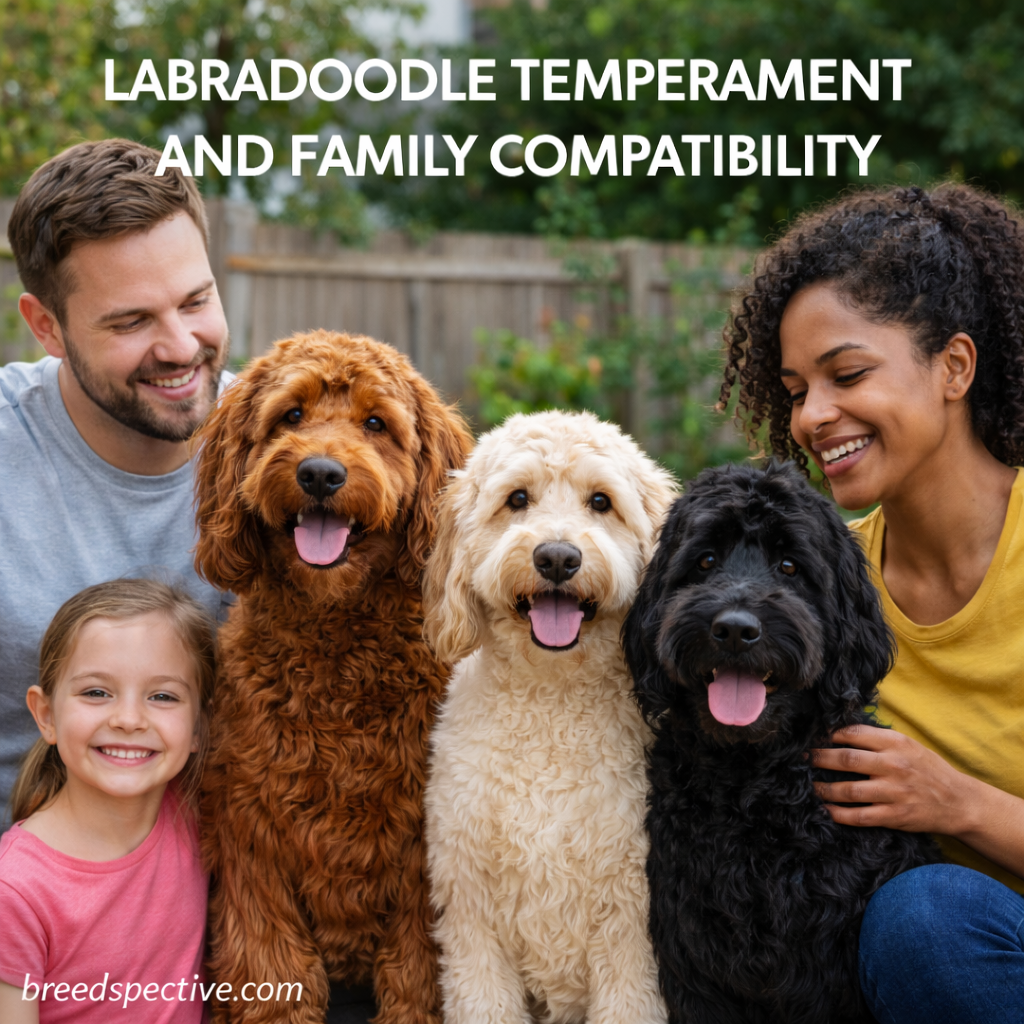
Labradoodle temperament is typically social, energetic, intelligent, playful, and strongly people-oriented, reflecting traits found in both Labrador Retrievers and Poodles. Many make excellent family companions, but a Labradoodle is not automatically calm, non-shedding, allergy-friendly, or easy to own—the cross can vary considerably in coat, size, energy, and personality.
For the right household, that combination can produce an affectionate, highly trainable dog that enjoys being involved in daily family life. The trade-offs are substantial exercise needs, potentially demanding grooming, excitable adolescent behavior, and the need to choose a breeder who properly health-tests both sides of the pedigree.
Labradoodle at a Glance
| Trait | Typical Labradoodle |
|---|---|
| Parent breeds | Labrador Retriever × Poodle |
| Size | Variable; depends heavily on Poodle parent and breeding |
| Coat | Straight, wavy or curly |
| Shedding | Variable; low shedding is possible but not guaranteed |
| Exercise needs | Moderate-high to high |
| Grooming | Moderate-high to very high |
| Trainability | Usually high |
| Good with children? | Often, with training and supervision |
| Good with other dogs? | Often |
| Good with cats? | Often possible with appropriate introductions |
| Alone-time tolerance | Variable; many are strongly people-oriented |
| Best fit | Active household wanting a social, trainable companion |
Because Labradoodles are crosses rather than a standardized breed, there is more variation than buyers sometimes expect. Two Labradoodles can differ substantially in coat, shedding, size, energy and behavior.
Where Did the Labradoodle Come From?
The modern Labradoodle story has an unusually well-documented starting point.
In 1989, Wally Conron, then breeding manager for the Royal Guide Dogs Association of Australia, crossed a Labrador Retriever with a Standard Poodle while trying to produce a suitable guide dog for a vision-impaired woman in Hawaii whose husband had dog allergies.
The aim was practical: combine the Labrador’s established guide-dog working qualities with a coat that might work better in that particular household.
One puppy, Sultan, went on to work as her guide dog. Conron later became deeply critical of the designer-dog trend that followed, telling Australia’s ABC that he regretted the unregulated breeding the Labradoodle concept helped inspire.
That history is worth remembering because the original Labradoodle was not created simply to produce a fashionable teddy-bear appearance.
Both sides of the cross are working dogs.
Labradors were developed as retrieving dogs and remain energetic, highly social companions. Our guide to Labrador Retriever temperament and lifestyle fit explains the behaviors that side of the pedigree can contribute.
Poodles are also athletic retrievers rather than purely decorative companion dogs. The Poodle Club of America breed standard describes the Poodle as very active and intelligent.
Our Poodle temperament and lifestyle guide covers those traits in more detail.
Labradoodle Temperament in Everyday Life
A well-adjusted Labradoodle is commonly an interactive dog.
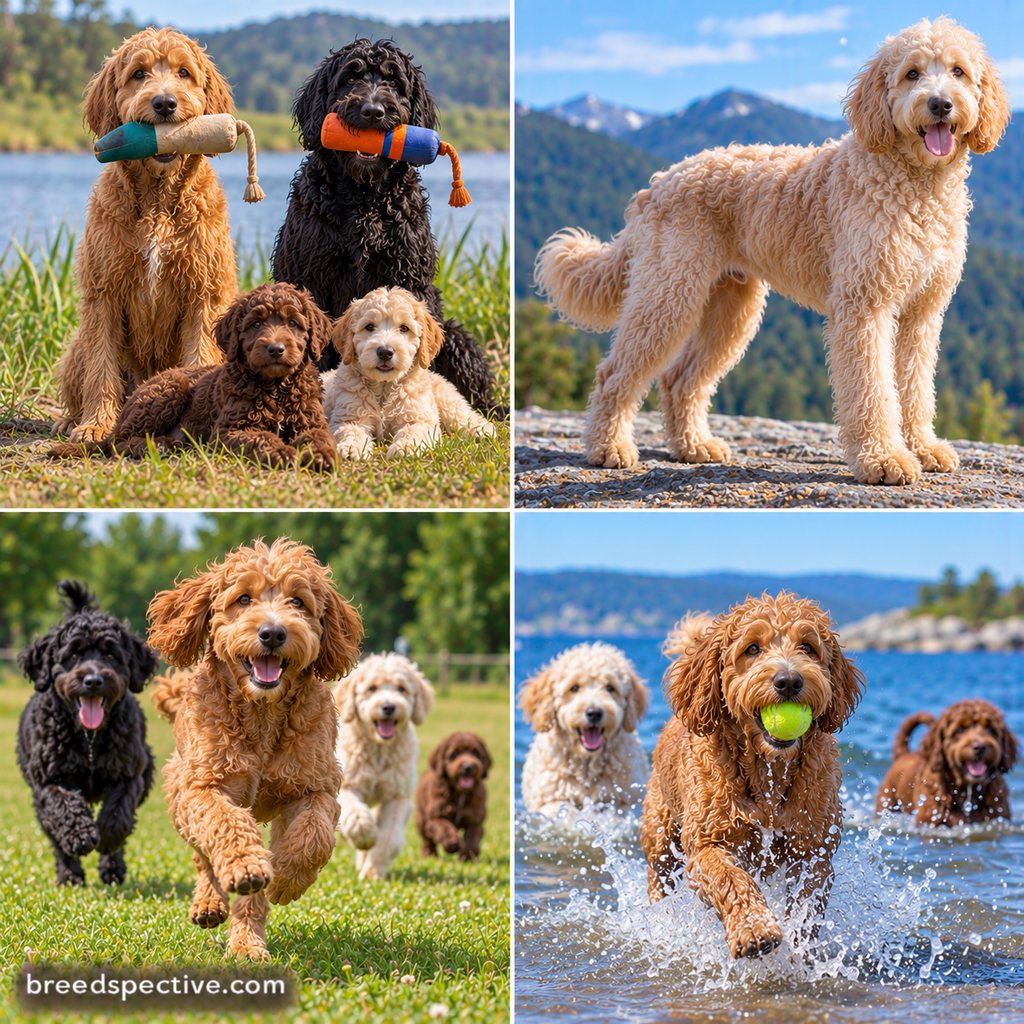
Many want to greet people, carry objects, play, retrieve, train, explore and remain close to household activity.
That makes them appealing family dogs, but it can also make young Labradoodles considerably more work than their friendly appearance suggests.
Friendly and Social
Many Labradoodles inherit a strong interest in people.
A well-socialized dog may enjoy visitors and outings rather than displaying the stranger reserve seen in more naturally protective breeds.
Friendly does not necessarily mean calm.
An enthusiastic adolescent may jump on visitors, drag its owner toward another dog, steal objects for attention, or become wildly excited when children start running.
Training calmness is therefore just as important as teaching sit, down and shake.
Intelligent and Trainable
Both parent breeds are capable working dogs, so Labradoodles often learn quickly.
Prioritize practical skills:
- Recall
- Loose-leash walking
- Leave it
- Drop it
- Settle on a bed
- Four paws on the floor for greetings
- Waiting at doors
- Cooperative grooming
- Calm behavior around food
- Remaining alone for gradually increasing periods
Positive reinforcement works particularly well when rewards include food, toys, retrieving, play and access to activities the dog already enjoys.
Mouthiness and Carrying Things
Labrador ancestry can bring a pronounced desire to carry objects.
Puppies may pick up shoes, children’s toys, socks, towels or anything else within reach.
Do not turn stolen objects into a chase game.
Teach a reliable trade or “drop it” cue and keep appropriate retrieving toys available. Prevention also matters: puppy-proofing is easier than practicing emergency trades for every missing sock.
Jumping and Excitable Greetings
Jumping is particularly common in friendly young dogs because it often works.
The puppy jumps. A person talks to it, touches it or pushes it away. From the puppy’s perspective, jumping successfully produced interaction.
Instead, consistently reward four paws on the floor.
This matters more as the dog grows. A large Labradoodle greeting a small child or older adult with the same enthusiasm it had at 15 pounds can easily knock someone over without any aggressive intent.
Are Labradoodles Good Family Dogs?
Many are excellent family companions when their activity level matches the household.
They tend to work best in homes where the dog is expected to participate—walking, playing, training and spending time with the family—rather than simply occupying the backyard.
Labradoodles and Children
Their playful, social nature can pair well with children.
Supervision is still necessary.
Children should learn not to:
- Climb on the dog
- Pull its coat, ears or tail
- Take food or chews
- Disturb it while sleeping
- Corner it
- Encourage rough jumping
- Chase a dog trying to leave
Larger Labradoodles can be physically exuberant, particularly during adolescence.
A friendly dog still needs boundaries.
Labradoodles and Other Pets
Many can coexist successfully with other dogs and cats after appropriate introductions.
Both parent breeds have retrieving backgrounds, however, so do not assume that every Labradoodle will completely ignore moving animals.
Individual temperament, early experience and training matter.
Can Labradoodles Handle Being Alone?
They can learn to, but independence should be deliberately taught.
A puppy that spends every waking minute beside someone may have difficulty when the household routine suddenly changes.
Practice short, uneventful periods apart from the beginning. Use a safe puppy area, comfortable resting place and appropriate enrichment, gradually increasing duration as the puppy succeeds.
Boredom and separation anxiety are not the same thing.
Chewing a forgotten shoe after an under-stimulating day may be ordinary opportunistic behavior. Panic, frantic escape attempts, persistent distress and self-injury during absences require a different response and should be discussed with a veterinarian or qualified behavior professional.
Labradoodle Exercise Needs
Expect a genuinely active dog.
For many healthy adult Labradoodles, approximately 60–90 minutes of total daily physical activity is a practical starting range rather than a medical prescription. Some individuals will want more.
Good outlets include:
- Brisk walks
- Fetch
- Swimming where conditions are safe
- Hiking
- Scent games
- Retrieving exercises
- Training
- Food puzzles
- Age-appropriate dog sports
Do not rely exclusively on physical exhaustion.
Continually increasing running or fetch can create an extremely fit dog that still has not learned how to settle indoors.
Combine physical exercise with sniffing, training and periods of calm.
Puppies should receive age-appropriate play and exploration rather than repetitive high-impact exercise designed to exhaust them.
F1, F1B and F2 Labradoodle Coats
Generation terminology describes ancestry. It does not guarantee a particular coat or shedding level.
| Generation | Typical ancestry | Coat expectations |
|---|---|---|
| F1 | Labrador Retriever × Poodle | Broad variation from more Labrador-like to wavy or curly |
| F1B | Usually F1 Labradoodle × Poodle | Greater chance of Poodle-like coat characteristics |
| F2 | Usually F1 Labradoodle × F1 Labradoodle | Considerable variation can occur among littermates |
An F1 is a first-generation Labrador-Poodle cross.
An F1B generally means an F1 Labradoodle bred back to a Poodle.
An F2 commonly refers to two F1 Labradoodles bred together.
Ask to see the actual pedigree rather than relying on the label alone.
Generation does not tell you whether the parents have good temperaments, whether they passed health screenings, or whether the puppies were raised responsibly.
Do Labradoodles Shed?
Yes, some do.
Others shed relatively little.
An F1 puppy may inherit a more Labrador-like coat that releases considerably more hair, while another may develop a curlier coat that retains loose hairs.
Retaining hair within a curly coat creates another problem: matting.
Lower shedding often means more grooming, not less.
No breeder should promise that every Labradoodle will be completely non-shedding.
Are Labradoodles Hypoallergenic?
No dog is truly allergen-free.
The common misconception is that dog allergy is simply an allergy to loose hair. In reality, allergens are associated with substances including dander and saliva, and hair can help distribute those allergens around the environment.
That means reduced shedding does not guarantee that a particular person will tolerate a particular dog.
Our guide to low-shedding dog breeds and allergies explains the distinction.
This is particularly relevant given the Labradoodle’s history. The original project sought a working guide dog that could meet one household’s allergy-related needs; that should not be interpreted as evidence that every Labradoodle is hypoallergenic.
If allergies are a major factor in your decision, do not rely on the word “Labradoodle” or an F1B label as a medical guarantee.
Labradoodle Grooming Expectations
The fluffy doodle coat can require substantial maintenance.
Many Labradoodles need thorough brushing and combing several times each week, with professional grooming often needed approximately every 6–8 weeks, depending on coat type, coat length and how much maintenance is done at home.
High-friction areas deserve particular attention:
- Behind the ears
- Armpits
- Chest
- Legs
- Tail
- Collar area
- Harness area
A brush passing over the outer coat does not prove that the hair is tangle-free close to the skin. A comb should be able to move through the coat without repeatedly catching.
Straighter Labrador-like coats may shed more while requiring less intensive clipping. Curlier coats may release less hair around the house while demanding significantly more brushing and professional grooming.
Our guide to grooming needs by dog coat type explains why coat structure changes the maintenance workload.
Parent-Breed Health Testing to Ask Labradoodle Breeders For
Crossbreeding does not eliminate inherited health risk.
A responsible Labradoodle breeder should screen the Labrador parent for Labrador concerns and the Poodle parent according to the appropriate Poodle variety.
Labrador Retriever Parent
The Labrador Retriever Club lists these as minimum CHIC-related health clearances for Labradors:
- Hip evaluation
- Elbow evaluation
- Eye examination by a board-certified veterinary ophthalmologist
- Exercise-induced collapse (EIC) DNA testing
- D-locus DNA testing
The club additionally recommends screening for conditions including centronuclear myopathy (CNM), progressive rod-cone degeneration and cardiac disease.
Ask for actual results rather than accepting “our vet says the parents are healthy.”
Standard Poodle Parent
For Standard Poodles, the Poodle Club of America’s 2024 health statement recommends:
- Hip evaluation through OFA or PennHIP
- ACVO eye examination
- Autoimmune thyroiditis evaluation
- DNA testing for neonatal encephalopathy with seizures (NEwS), or clear-by-parentage status
- DNA testing for von Willebrand disease type I, or clear-by-parentage status
PCA’s CHIC information also includes breed-relevant screening such as thyroid, sebaceous adenitis and cardiac evaluation.
Miniature or Toy Poodle Parent
Smaller Labradoodles may involve Miniature or Toy Poodles, so do not use the Standard Poodle checklist automatically.
The Poodle Club of America recommends PRCD-PRA DNA testing, annual specialist eye examination and patellar evaluation for Toy Poodles. Miniatures have those recommendations plus hip evaluation through OFA or PennHIP.
The breeder should be able to explain which Poodle variety is behind the litter and which health tests apply.
A DNA Panel Is Not Complete Health Testing
Commercial genetic testing can be useful, but it cannot replace every recommended examination.
A DNA panel does not substitute for:
- Hip radiographs
- Elbow radiographs
- Specialist eye examinations
- Patellar evaluations
- Appropriate cardiac testing
The Orthopedic Foundation for Animals provides a public database that allows many results to be verified.
Ask for the registered names of both parents and check the records yourself.
How to Avoid Labradoodle Puppy Mills and Backyard Breeders
The history of the Labradoodle makes breeder scrutiny especially important.
Conron’s later criticism was not that Sultan had failed as a guide dog. His concern was what happened after Labradoodles became fashionable and breeders began producing crosses without consistent attention to health and temperament.
Better Signs
Look for a breeder who:
- Identifies both parents
- Provides verifiable health results
- Uses testing appropriate to each parent breed
- Discusses temperament honestly
- Can explain why the parents were paired
- Raises puppies in a clean, socially appropriate environment
- Provides veterinary records
- Uses a written contract
- Screens prospective homes
- Has a plan for dogs that need rehoming
- Discusses coat uncertainty rather than guaranteeing outcomes
Both parent clubs emphasize documented health screening and responsible placement practices. The Labrador Retriever Club’s breeder code calls for health documentation, buyer screening, written contracts and breeder responsibility if a dog needs rehoming. The Poodle Club of America similarly requires hereditary testing and proof of testing for buyers under its member code of ethics.
Red Flags
Be cautious when a seller:
- Always has multiple litters available
- Produces numerous designer crosses
- Cannot identify both parents
- Refuses to provide verifiable health results
- Claims crossbreeding eliminates genetic disease
- Guarantees a puppy will never shed
- Guarantees the dog is hypoallergenic
- Guarantees an exact adult size
- Uses only a commercial DNA panel as “full health testing”
- Focuses heavily on rare colors or tiny sizes
- Will sell immediately with almost no questions about your home
- Pressures you to send a deposit
A high price does not prove responsible breeding.
Neither does an F1B or multigenerational label.
Are Labradoodles Good for First-Time Owners?
They can be, provided the owner understands the workload.
Their intelligence, sociability and responsiveness can make training rewarding. On the other hand, an energetic adolescent Labradoodle with a high-maintenance coat is not necessarily an easy first dog.
A first-time owner should be comfortable budgeting for grooming, attending training classes, providing daily exercise and teaching calm behavior.
Our guide to the best dog breeds for first-time owners covers the broader qualities that make beginner ownership easier or harder.
Who Is a Labradoodle Best Suited To?
A Labradoodle can be a strong match for:
- Active families
- People who enjoy training
- Owners wanting an interactive companion
- Households prepared for regular grooming
- Families with respectful children
- Owners who can provide daily physical and mental activity
- People who want their dog involved in everyday life
A yard is useful but not essential.
An apartment-dwelling Labradoodle that receives adequate exercise, training and companionship may have a better life than one left alone in a large yard.
Who Should Think Twice About a Labradoodle?
This cross is a weaker fit if:
- You need guaranteed zero shedding
- You require a guaranteed allergy-safe dog
- You dislike brushing and professional grooming
- You want a low-energy companion
- The dog will routinely spend very long periods alone
- You do not want to manage jumping or adolescent exuberance
- You expect exact predictability in adult size or coat
- You are choosing primarily because Labradoodles look cute
Before committing, compare those needs against your actual schedule and household using our guide to choosing the right dog breed for your lifestyle.
Verdict: Is a Labradoodle Right for Your Family?
A Labradoodle is right for an active household that wants an affectionate, social and highly trainable companion and is prepared for substantial exercise, consistent training, regular coat maintenance and plenty of interaction.
It is not right for someone seeking a guaranteed hypoallergenic dog, predictable non-shedding coat, minimal grooming, low exercise requirements or a dog expected to spend most of its life alone.
The strongest reason to choose an individual Labradoodle is not the popularity of the cross or an F1, F1B or F2 label. Look instead for stable parent temperaments, appropriate Labrador and Poodle health testing, transparent breeding practices, thoughtful puppy raising and a dog whose expected activity level genuinely fits your household.