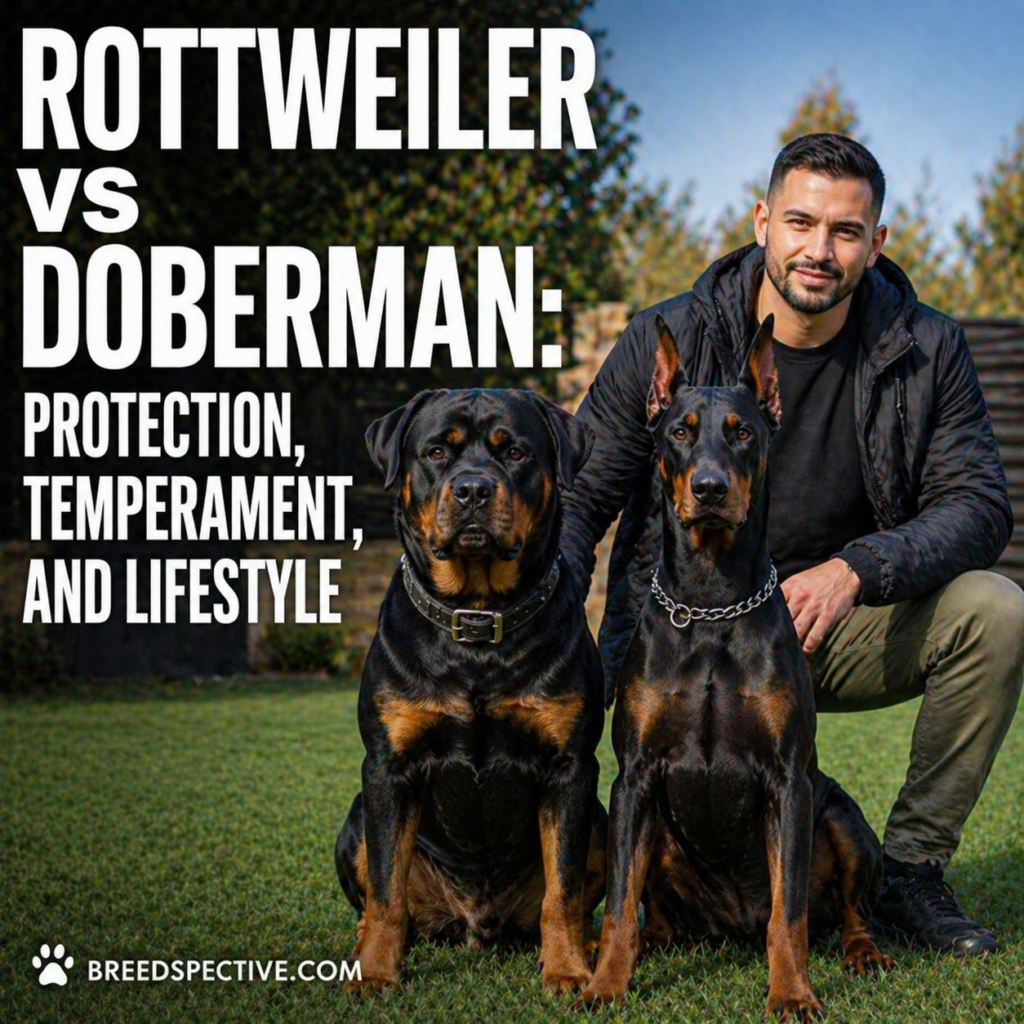
The Rottweiler and Doberman are powerful German working breeds with natural protective instincts, but they offer noticeably different ownership experiences. Rottweilers are heavier, more substantial dogs typically characterized by confidence and watchfulness, while Dobermans are leaner, faster and notably energetic, alert and closely involved with their people. Both require early socialization, consistent training and owners prepared to manage a large protective dog responsibly. American Kennel Club
Rottweiler vs Doberman at a Glance
| Trait | Rottweiler | Doberman Pinscher |
|---|---|---|
| Height | Males 24–27 in.; females 22–25 in. | Males 26–28 in.; females 24–26 in. |
| Weight | Males 95–135 lb.; females 80–100 lb. | Generally lighter and leaner than a Rottweiler |
| Build | Heavy, muscular and substantial | Square, athletic and built for speed and endurance |
| Temperament | Calm, confident, watchful | Energetic, alert, determined and loyal |
| Energy | High; needs daily exercise | High; particularly active and involved |
| Trainability | Highly trainable; can be strong-willed | Highly trainable and responsive |
| Protective instinct | Strong natural guardian | Strong natural guardian |
| Coat | Short double coat | Short, smooth, close coat |
| Grooming | Easy, but sheds | Relatively easy |
| Major health consideration | Joint, cardiac, eye and JLPP screening | DCM and other cardiac screening are particularly important |
| Best suited to | Structured, active homes comfortable with a very powerful dog | Active owners wanting an athletic, closely involved working dog |
AKC lists male Rottweilers at 24–27 inches and 95–135 pounds, with females at 22–25 inches and 80–100 pounds. The Doberman Pinscher Club of America (DPCA) standard places male Dobermans at 26–28 inches and females at 24–26 inches, describing the breed as square, compact, muscular and built for endurance and speed. American Kennel Club
Both Breeds Have German Working Roots
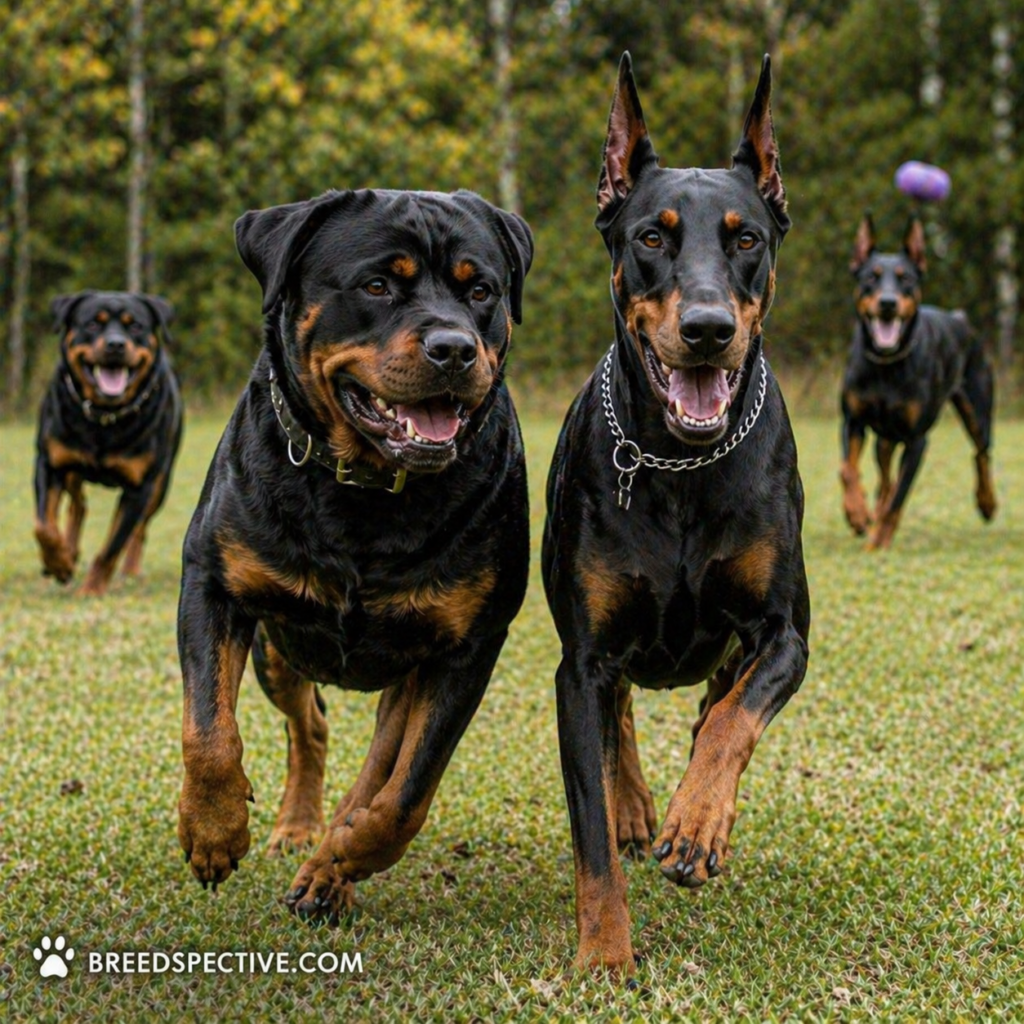
The Rottweiler and Doberman both originated in Germany, but the Rottweiler’s working history stretches much farther back.
Rottweiler: From Drover to Guardian
The Rottweiler’s ancestors are traditionally traced to mastiff-type dogs that accompanied Roman legions and helped drive and protect livestock.
These dogs eventually became associated with Rottweil, Germany, an important livestock-trading center. They worked with butchers, moving cattle and pulling carts loaded with meat to market. This eventually produced the name Rottweiler Metzgerhund, or Butcher’s Dog of Rottweil. American Kennel Club
As railroads replaced cattle drives and carting, those jobs declined. Rottweilers later found new work in policing, property protection and other roles requiring strength, intelligence and confidence.
The American Rottweiler Club (ARC) describes the breed’s traditional duties as guarding, livestock driving and cart pulling, with protective instinct and trainability later supporting military and police work. American Kennel Club
Doberman: Created as a Personal Protector
The Doberman’s origin is much more recent and closely associated with one person.
Louis Dobermann of Apolda, Germany, developed the breed around 1890. Dobermann was a tax collector whose work could take him into unsafe situations, and he sought a capable dog that could accompany and protect him.
AKC identifies Apolda in Thuringia as the breed’s place of origin and Louis Dobermann as its founder. The precise combination of breeds he originally used wasn’t documented, although several German working and terrier-type dogs contributed to the developing Doberman. American Kennel Club
That history explains a fundamental characteristic of the modern breed: the Doberman wasn’t simply developed to guard a location. Close cooperation with and protection of a human handler were central to its purpose.
Protection: Natural Instinct Doesn’t Replace Training
Both breeds have legitimate working histories as guardians.
That doesn’t mean a family pet should be encouraged to behave aggressively.
A stable protection-oriented dog needs to remain manageable, predictable and responsive to its handler. Early socialization and obedience are therefore particularly important for both breeds.
How Rottweilers Approach Their Environment
The Rottweiler standard calls for a calm, confident and courageous dog with self-assured aloofness toward strangers. AKC also describes the breed as naturally protective and territorial while emphasizing the importance of early training and socialization. American Kennel Club
That watchful temperament is different from indiscriminate aggression.
A well-bred Rottweiler shouldn’t be encouraged to treat every visitor, passerby or unfamiliar situation as a threat. Owners need control over a dog that can exceed 100 pounds and possesses considerable physical strength.
How Dobermans Differ
The official Doberman standard describes the breed as energetic, watchful, determined, alert, fearless, loyal and obedient. Shyness and viciousness are explicitly undesirable. DPC Association
The DPCA emphasizes the Doberman’s awareness of its surroundings and close responsiveness to its handler.
That combination can make the Doberman appear more visibly alert and ready for action than the heavier Rottweiler. But individual temperament, breeding and training matter greatly, so neither breed should be reduced to a stereotype.
If natural guarding behavior is part of your breed search, our guide to dog breeds known for natural protective instincts explains what that trait does—and doesn’t—mean in a companion dog.
Energy: The Doberman Is the More Athletic Package
Neither breed belongs in a sedentary household.
AKC describes the Rottweiler as muscular and athletic and recommends daily opportunities for exercise. Walking, swimming, tracking, herding and obedience are among activities the breed can enjoy. American Kennel Club
A Rottweiler’s heavy build can make it appear less energetic than a lean Doberman, but that shouldn’t be confused with low exercise needs.
Rottweiler Exercise
A mature Rottweiler benefits from a routine combining physical exercise and mental work.
Useful activities include:
- Brisk walks
- Hiking
- Swimming
- Tracking or scent work
- Obedience
- Retrieving and structured play
- Appropriate dog sports
The breed’s strength also makes leash manners essential. An adult Rottweiler that hasn’t learned to walk calmly can be physically difficult for many people to control.
Our Rottweiler temperament, energy level and lifestyle guide explores these everyday requirements in more detail.
Doberman Exercise
The Doberman is particularly athletic.
DPCA describes the breed as highly active and stresses that its energy level shouldn’t be underestimated. The club notes that Dobermans want close involvement with their families and require substantial exercise. DPC Association
The breed standard reinforces that purpose: the Doberman’s square, muscular construction is intended to produce endurance, agility, speed and strength. DPC Association
A Doberman owner should therefore expect active participation rather than relying on a backyard.
Running after physical maturity, hiking, obedience, tracking, scent work and dog sports can all provide productive outlets.
Trainability: Both Need More Than Basic Puppy Classes
Both breeds are intelligent and capable learners.
Neither should receive only a few weeks of puppy training followed by years without structure.
Training a Rottweiler
AKC describes Rottweilers as intelligent and highly trainable but notes that some individuals can be stubborn. It recommends early socialization, puppy training and consistent, fair handling. American Kennel Club
Because Rottweilers mature into extremely powerful dogs, everyday skills have practical safety implications.
A companion Rottweiler should learn reliable:
- Recall
- Loose-leash walking
- Sit and stay
- Calm greetings
- Handling for veterinary care
- Door and gate manners
- Response around distractions
Socialization should teach a young dog to function calmly around normal people, dogs, sounds and environments. Its purpose isn’t to make the dog greet everyone.
Training a Doberman
The Doberman was developed around close cooperation with a handler.
DPCA’s breed standard calls for a loyal and obedient dog, while its temperament guidance describes the ideal Doberman as responsive, focused and able to return attention to its task after a distraction. DPC Association
That trainability can be extremely rewarding for someone who enjoys working with a dog.
It doesn’t mean the Doberman trains itself.
A fast, energetic dog that receives inconsistent rules can become difficult quickly. Reward-based training, clear boundaries and regular practice give the breed productive ways to use its intelligence.
For either breed, “easy to train” shouldn’t be interpreted as “easy to own.”
Family Fit: Can Rottweilers and Dobermans Live With Children?
Both breeds can be devoted family dogs in appropriate homes.
The deciding factors are responsible breeding, individual temperament, socialization, training and adult supervision—not simply the breed name.
Rottweilers With Families
AKC describes Rottweilers as affectionate and playful within their families. Properly trained Rottweilers can be patient with children, but AKC also cautions that their size and enthusiasm may be too much for some families with small children. American Kennel Club
An adult male can weigh as much as 135 pounds. Even friendly physical play can therefore knock over a child.
Children should never climb on a dog, interfere while it eats or sleeps, or be expected to manage a powerful dog without adult help.
Dobermans With Families
Dobermans are notably family-oriented.
DPCA describes the breed as wanting intense and close contact with its people and being actively involved in family activities. DPC Association
That closeness appeals to owners who want a dog involved in much of their day.
It can be less convenient for someone seeking an independent dog that is content to spend long periods away from household activity.
As with the Rottweiler, interactions with children require supervision. The Doberman is a strong, athletic working dog whose speed and enthusiasm can overwhelm a small child even without any aggressive intent.
Other Dogs and Household Pets
Neither breed’s compatibility with another pet can be guaranteed by breed alone.
Individual temperament, sex, early socialization and previous experiences all matter. Careful introductions are essential, particularly when adding another adult dog.
For cats and smaller animals, prospective owners should discuss the individual dog’s history with the breeder or rescue organization rather than relying on general breed descriptions.
Owners also need a realistic management plan. Gates, crates, separate feeding areas and supervised introductions can prevent avoidable conflicts while animals adjust to one another.
Grooming: Both Are Relatively Easy
Grooming isn’t the major challenge with either breed.
Rottweiler Coat Care
The Rottweiler has a straight, coarse outer coat with undercoat around areas including the neck and thighs.
AKC recommends weekly brushing and regular bathing. Shedding is moderate during much of the year but becomes heavier seasonally, particularly in spring and fall. American Kennel Club
That makes the Rottweiler easy compared with many long-coated breeds, but not shed-free.
Doberman Coat Care
The Doberman has a short, smooth, close-fitting coat.
Routine brushing helps remove loose hair and maintain the coat. Nail care, dental hygiene and periodic ear and skin checks are also part of normal maintenance.
The Doberman’s minimal coat creates another practical consideration: it provides relatively little insulation. Owners in cold climates should account for weather exposure rather than assuming a working breed is automatically suited to prolonged time outdoors.
Neither dog should be selected as an outdoor-only guard dog. Both are breeds developed around human-directed work and benefit from being integrated into the household.
Health: The Biggest Medical Differences to Consider
Responsible breeders should provide documentation of breed-recommended health screening.
This matters particularly with these two breeds because serious inherited conditions occur in both populations.
Rottweiler Health Screening
AKC’s national breed-club recommendations for Rottweilers include:
- Hip evaluation
- Elbow evaluation
- Cardiac examination
- Ophthalmologist evaluation
- DNA testing for juvenile laryngeal paralysis and polyneuropathy (JLPP)
The American Rottweiler Club (ARC) likewise requires specific health screenings in its breeding practices and identifies additional conditions for which testing may be available. American Kennel Club
Hip and elbow screening is particularly relevant in a large, heavy breed.
Don’t accept “vet checked” as a substitute for documented breed-specific testing. Ask exactly which evaluations were performed, at what age and where the results are recorded.
Doberman Health: DCM Deserves Special Attention
Dilated cardiomyopathy (DCM) is a major health concern in Dobermans, making cardiac screening particularly important.
DCM affects the heart muscle and can interfere with its ability to pump blood effectively. A dog may have cardiac abnormalities before obvious outward symptoms develop.
The Doberman Pinscher Club of America specifically recommends cardiac evaluation that includes both a Holter monitor ECG and cardiac ultrasound/echocardiogram performed by a veterinary cardiologist. DPCA advises regular cardiac testing because a normal result describes the dog’s status at that point in time rather than providing a lifetime guarantee. DPC Association
DPCA also identifies other testing considerations including von Willebrand disease DNA testing, hip and elbow evaluations, eye examinations and routine blood testing. DPC Association
When evaluating a Doberman breeder, ask:
- When were the sire and dam last screened by a cardiologist?
- Were both an echocardiogram and Holter monitor used?
- Can you see the reports?
- How long did parents, grandparents and siblings live?
- Were there cases of DCM or sudden cardiac death among close relatives?
- What additional breed-relevant health tests were performed?
No screening program can guarantee a Doberman will never develop DCM. It can, however, provide much more useful information than breeding without cardiac surveillance.
Cost: Rottweiler vs Doberman
There is no responsible universal purchase price for either breed. Region, breeder, pedigree, health testing and purpose all affect puppy prices.
Lifetime costs provide a more useful comparison.
| Expense | Rottweiler | Doberman |
|---|---|---|
| Food | Higher potential cost because of greater body weight | Significant but generally smaller body size |
| Routine veterinary care | Ongoing | Ongoing |
| Health screening | Joint, cardiac, eye and genetic testing relevant | Cardiac surveillance is particularly important |
| Grooming | Low to moderate | Low |
| Training | Major priority | Major priority |
| Exercise/enrichment | High | High |
| Equipment | Heavy-duty equipment may be needed | Durable equipment needed |
| Emergency care | Financial planning recommended | Financial planning recommended |
The Rottweiler’s greater body mass can affect food, medication doses, crates, beds and other equipment.
The Doberman’s health profile can create another expense prospective owners should consider: repeated cardiac evaluation rather than treating heart screening as a one-time puppy purchase issue.
For both breeds, professional training can also be a sensible budget item. Owners shouldn’t wait until an 80- to 120-pound adult dog has a serious behavior problem before seeking qualified help.
Which Is Better for a First-Time Owner?
Neither would be our default recommendation for someone primarily seeking an easy first dog.
The issue isn’t that these breeds are untrainable. The opposite is true.
The challenge is the combination of size, intelligence, working heritage and protective instinct. Mistakes involving leash control, socialization or stranger interactions have greater consequences with a powerful guardian than with many companion breeds.
A committed beginner with excellent breeder support, professional training and enough time may succeed. But someone looking for a forgiving introduction to dog ownership has easier options.
Our guide to the best dog breeds for first-time owners provides alternatives worth comparing before committing to either breed.
Lifestyle: Which Dog Fits Everyday Home Life?
This comparison ultimately comes down to the type of working dog you want to live with.
A Rottweiler brings considerable physical power. AKC’s ideal describes a calm, confident guardian that remains athletic and requires daily activity. Its size alone demands good manners and competent handling. American Kennel Club
The Doberman is physically lighter but shouldn’t be mistaken for the easier dog.
DPCA describes a highly energetic animal that wants close involvement with its family. Its structure was deliberately shaped around agility, endurance and speed. DPC Association
That can be an excellent fit for someone who wants training and exercise to be significant parts of daily life.
Before choosing either, consider what your routine looks like on an ordinary Tuesday—not what you might do with the dog on occasional weekends. Our guide to choosing the right dog breed for your lifestyle can help you evaluate that fit.
Verdict: Choose a Rottweiler or Doberman?
Choose a Rottweiler if you want a substantial, powerful working dog with a calm, confident and naturally watchful temperament. You should be comfortable managing a dog that may exceed 100 pounds and willing to commit to early socialization, lifelong training, daily exercise and documented health screening.
Choose a Doberman if you want a leaner, faster and highly engaged working companion that thrives on close interaction, structured training and substantial activity. You should also be prepared to take the breed’s cardiac health seriously, including ongoing DCM screening rather than treating health testing as a one-time event.
Neither breed is right for you if you want a low-effort guard dog, have little time for training and socialization, or expect natural protective instinct to substitute for responsible management. A poorly managed guardian isn’t better protection; it is a liability.
The practical difference is less about which breed is the “better protector” and more about how you want to live with the dog. The Rottweiler combines immense physical substance with a confident, watchful working temperament, while the Doberman packages protection-oriented traits into a faster, more athletic and intensely involved companion.