
The typical Bengal cat personality is curious, athletic, intelligent, confident, and highly interactive. Bengals tend to want more play, climbing, exploration, and involvement with their household than a quieter companion cat, so they are best matched with owners who actively enjoy engaging with their pets.
The Cat Fanciers’ Association (CFA) describes the Bengal as curious and athletic, while The International Cat Association (TICA) describes the breed as playful, social, people-oriented, and inquisitive. Individual personalities still vary, but prospective owners should expect a busy cat rather than a decorative couch companion.
Bengal Cat at a Glance
| Trait | Bengal |
|---|---|
| Size | Medium to large; TICA lists females around 6–12 lb and males around 9–15 lb |
| Lifespan | TICA lists approximately 12–20 years, depending on health, environment, nutrition, and other factors |
| Activity level | Very high |
| Grooming | Generally low for the common shorthaired coat |
| Vocalness | Variable; some are talkative, others relatively quiet |
| Good with children | Often, with respectful handling and supervision |
| Good with other cats | Often, with compatible personalities and gradual introductions |
| Good with dogs | Can be, especially with cat-friendly dogs and proper introductions |
| Typical personality | Curious, confident, playful, intelligent, affectionate and busy |
TICA notes that Bengals are muscular cats whose size varies by sex and lists the ranges above, while CFA emphasizes their athletic build and inquisitive temperament.
Bengal Breed History and Origins
The Bengal’s wild-looking coat is not simply the result of selectively breeding spotted domestic cats. The breed traces its ancestry to crosses between domestic cats and the Asian leopard cat (Prionailurus bengalensis), a small wild feline native to Asia.
Jean Mill was central to the Bengal’s development. According to CFA and TICA histories, Mill crossed a domestic cat with an Asian leopard cat in 1963 and later resumed development of the modern breed using additional foundation cats. Her breeding program sought to retain an exotic spotted appearance while establishing a dependable domestic temperament.
TICA accepted the Bengal as a new breed in 1986 and granted championship status in 1991. CFA came later, accepting Bengals for registration in 2016 and advancing the breed to championship status in 2018.
Modern pet Bengals are therefore not simply Asian leopard cat hybrids produced anew for every litter. Established domestic Bengal lines are bred Bengal to Bengal.
The Bengal Coat and Its Famous “Glitter”
The breed can have spotted, rosetted, or marbled markings. Rosettes are particularly associated with the Bengal’s leopard-like appearance.
Some Bengals also have a trait breeders call glitter. TICA describes this as an iridescent sheen affecting individual hairs, which can make the coat appear to shimmer when light strikes it. Not every Bengal has a glittered coat, and it has no bearing on whether the cat will make a suitable companion.
Temperament and health should matter far more than an especially dramatic coat.
What F1, F2, F3, F4, and SBT Bengal Mean
Bengal terminology can be confusing because the breed originated from a wild-domestic cross.
An F1 Bengal is the first generation produced from an Asian leopard cat and a domestic lineage. Subsequent generations move farther from that original wild ancestor. TICA currently refers to early hybrid crosses as foundation Bengals and distinguishes them from Bengals eligible for ordinary championship competition.
In simplified terms:
- F1: first generation from an Asian leopard cat cross
- F2: another generation removed
- F3: another generation removed
- F4 and later: progressively farther removed from the original wild ancestor
- SBT: Stud Book Tradition, indicating an established Bengal pedigree rather than a recent wild outcross
Registry terminology can be more technical than this shorthand, so pedigree documentation matters if generation is relevant to a purchase or local law.
For the average household looking for a Bengal companion, a well-socialized Bengal from an established domestic line is the appropriate place to look rather than an early-generation hybrid.
Why Bengal Generations Matter Legally
Because the Bengal originated from the Asian leopard cat, some governments regulate early-generation cats differently from ordinary domestic cats. Rules can exist at the state, county, municipal, or national level and can change.
Some U.S. jurisdictions restrict ownership of early-generation Bengals, including cats within the F1–F4 range, while other jurisdictions may use different cutoffs or rules. These restrictions generally arise from wildlife and exotic-animal regulations covering animals with recent wild ancestry.
Do not assume that a Bengal permitted by state law is automatically permitted by your city, county, landlord, or homeowners association. Check the rules that apply to your address before paying a breeder or transporting a Bengal across jurisdictional boundaries.
CFA’s own registration requirements illustrate how registries distinguish modern Bengals from recent wild ancestry: CFA requires registered Bengals to have multiple generations of domestic ancestry.
Bengal Personality in Everyday Life
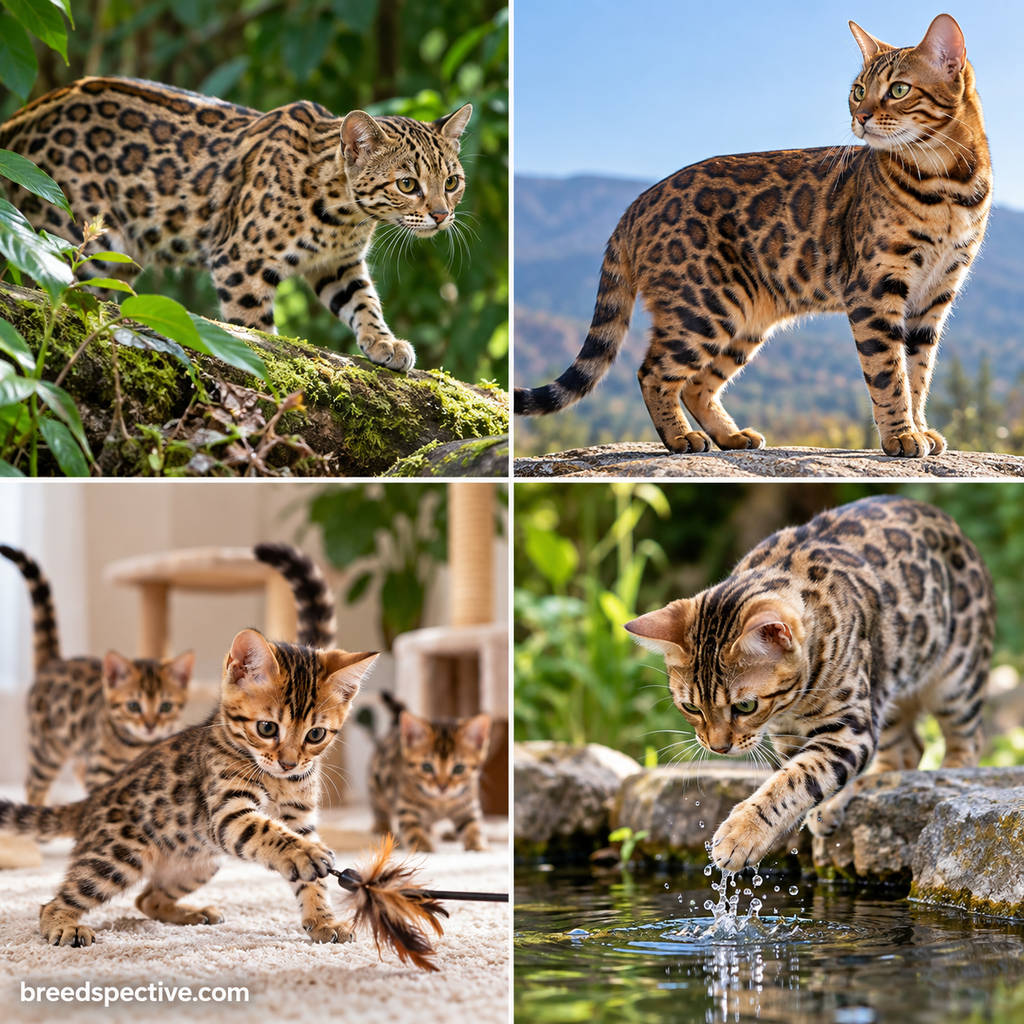
Bengal cats are athletic, curious, intelligent, and highly active companions that benefit from regular play and enrichment.Living with a Bengal means accommodating a cat that is likely to investigate its surroundings rather than simply watch them.
CFA describes Bengals as confident, curious, athletic, intelligent, trainable, and playful. TICA similarly emphasizes their inquisitive and active nature.
That combination affects everyday life in several ways.
They Want to Explore
A Bengal may treat furniture, shelving, cat trees, window perches, and other vertical spaces as part of its territory.
That does not mean every Bengal constantly races through the house, but this is a poor breed choice for someone who strongly prefers cats to remain on the floor and away from furniture.
Vertical territory can be especially valuable. A sturdy cat tree, secure shelves designed for cats, scratching surfaces, and window observation points give the cat acceptable places to climb and investigate.
They Need Interactive Play
Leaving a basket of toys on the floor is not always enough for an active Bengal.
Interactive play allows the cat to stalk, chase, leap, and problem-solve. Wand toys, rolling toys, puzzle feeders, food-search games, and appropriately sized climbing equipment can all contribute to a more interesting indoor environment.
Rotate toys instead of keeping everything available permanently. A familiar toy can become interesting again after being put away for several days.
Mental work matters too. Bengals’ intelligence and trainability mean some individuals can learn behaviors such as retrieving toys, responding to cues, or walking with a properly introduced harness. CFA specifically notes that many Bengals can learn tricks and that some enjoy harness-and-leash walks.
Affection Does Not Always Mean Lap Sitting
Bengals can be affectionate and strongly interested in their people without spending hours sitting still.
Some follow household members from room to room. Others seek play or investigate whatever their people are doing. Some enjoy laps, particularly when settling down, while others prefer staying close without being held.
That distinction matters if your primary goal is a consistently quiet lap cat.
If you like highly people-oriented cats but want to compare different temperaments, our guide to the Siamese cat’s personality and energy level covers another interactive breed with its own social style.
Are Bengal Cats Vocal?
They can be, but vocalness varies substantially between individuals.
CFA specifically cautions against assuming every Bengal is extremely talkative: some frequently vocalize, while others are comparatively quiet.
That makes vocalness harder to predict than the breed’s generally high activity level.
If noise matters to your household, ask a breeder about the temperaments of the kitten’s parents and adult relatives rather than relying solely on a breed stereotype.
Bengals With Children, Cats, and Dogs
A properly socialized Bengal can fit well into a family household. CFA states that Bengals can get along with other pets when appropriately introduced and can be suitable companions for families with children. TICA likewise describes them as social cats that can coexist with other pets following proper introductions.
Children should still be taught to let the cat leave when it wants space and to avoid chasing, grabbing, or restraining it.
Compatibility with another cat depends on both individuals. A playful Bengal may appreciate a similarly active feline companion, but adding a second cat is not a guaranteed solution for boredom.
Dogs should be introduced gradually and should already demonstrate safe behavior around cats.
For comparison with a large, social breed that often has a somewhat different overall presence in the home, see our guide to the Maine Coon’s personality and social traits.
Who a Bengal Suits — and Who Should Avoid One
A Bengal makes the most sense for someone who views interaction with the cat as part of the daily routine.
Good Bengal households generally have time for active play, provide climbing opportunities, enjoy training or enrichment, and accept that an intelligent cat may investigate places its owner would rather it didn’t.
A Bengal may be a poor match if you:
- Want an especially sedentary cat
- Dislike cats climbing furniture or seeking high places
- Have little time for interactive play
- Want a pet that is easily entertained without your involvement
- Are sensitive to potentially frequent vocalization
- Cannot safely provide sufficient indoor enrichment
Apartment living is possible if the environment provides enough usable vertical territory and activity. Square footage alone does not determine whether a home works, but a Bengal with too little stimulation can be challenging.
Readers comparing breeds for smaller homes may find our guide to the best cat breeds for apartment living useful before deciding.
Grooming and Care Needs
Despite their exotic appearance, shorthaired Bengals do not require an exotic grooming routine.
Their short, close coat is relatively straightforward to maintain. Occasional brushing can remove loose hair and gives owners an opportunity to check the skin and coat.
Basic care should also include:
- Regular nail trimming
- Dental care recommended by your veterinarian
- Routine veterinary examinations
- Parasite prevention appropriate to your cat’s circumstances
- Clean food and water dishes
- Consistently maintained litter boxes
- Regular checks of the ears, eyes, skin, coat, and body condition
The greater commitment is often environmental and behavioral care, not brushing.
Plan time each day for interaction and provide scratching posts, climbing structures, safe hiding areas, resting locations, and opportunities for play.
Our daily care routines for cats at every life stage can help turn feeding, grooming, play, litter maintenance, and health observations into a predictable routine.
Litter Box Setup
Bengals need the same fundamentals as other domestic cats: accessible, appropriately sized, regularly cleaned litter boxes in locations where the cat feels safe using them.
A sudden change in litter-box behavior should not automatically be dismissed as stubbornness or a breed quirk. Medical problems, environmental stress, box cleanliness, location, litter preference, or conflict with another animal can all contribute.
Our guide to why cats avoid the litter box and how to address it explains the problem-solving process in more detail.
Bengal Health Issues to Screen For
Responsible breeding matters because some inherited conditions can occur in Bengal lines.
Hypertrophic Cardiomyopathy
Hypertrophic cardiomyopathy (HCM) causes abnormal thickening of the heart muscle and is the most commonly diagnosed form of heart disease in cats.
Cornell University’s College of Veterinary Medicine lists the Bengal among breeds in which HCM is seen more frequently, while also explaining that feline HCM can have complex causes and variable outcomes.
Prospective owners should ask breeders what cardiac screening they perform on breeding cats and discuss appropriate ongoing heart assessment with their veterinarian.
Bengal Progressive Retinal Atrophy
Bengals can inherit a breed-associated form of progressive retinal atrophy (PRA-b), which causes progressive vision loss.
The Veterinary Genetics Laboratory at the University of California, Davis offers a DNA test for the Bengal PRA-b variant. Its guidance distinguishes clear, carrier, and affected genotypes, allowing breeders to use genetic results when planning matings.
Ask a breeder for documentation rather than accepting a general statement that their cats are “health tested.”
A good breeder should also be willing to discuss veterinary care, genetic testing relevant to the line, the health of close relatives, socialization, and what happens if an owner can no longer keep the cat.
Bengal vs Savannah Cat
Bengals and Savannahs are frequently compared because both have striking coats and wild-cat ancestry, but they are separate breeds with different origins.
The Bengal was developed using the Asian leopard cat. The Savannah traces to the serval, a different wild feline species.
Both breeds have reputations for athleticism, curiosity, intelligence, and demanding enrichment needs. Both also have generation terminology that can matter when researching breeders and ownership laws.
| Trait | Bengal | Savannah |
|---|---|---|
| Wild ancestor | Asian leopard cat | Serval |
| General build | Muscular, medium-to-large domestic cat | Often taller and longer-legged |
| Activity | High | High |
| Climbing/jumping needs | High | High |
| Mental stimulation | Significant | Significant |
| Wild-looking coat | Spots, rosettes or marbling | Typically bold spotted appearance |
| Generation matters | Yes, especially early-generation cats | Yes, especially early-generation cats |
| Legal research needed | Yes | Yes |
Neither breed should be chosen primarily because it looks exotic. The practical question is whether your household can meet the behavioral, environmental, financial, and legal requirements of the individual cat.
What Does a Bengal Cat Cost?
Bengal ownership has two separate financial components: getting the cat and maintaining the cat.
Purchase prices vary substantially with breeder, location, pedigree, age, breeding rights, generation, and other factors, so a single national price is not particularly useful. Extremely low prices deserve scrutiny if the seller cannot document the cat’s origin, veterinary care, pedigree, and relevant health screening.
Beyond the purchase price, budget for:
| Expense | What to Plan For |
|---|---|
| Veterinary care | Routine exams, vaccinations as advised, preventive care, illness and emergencies |
| Food | Complete, balanced food appropriate for life stage |
| Litter | Recurring lifetime expense |
| Cat furniture | Sturdy scratching posts, beds and climbing structures |
| Enrichment | Interactive toys, puzzle feeders and replacement toys |
| Carrier and equipment | Secure carrier, bowls, grooming supplies and other basics |
| Dental care | Preventive home care plus veterinary treatment when necessary |
| Emergency expenses | An emergency fund or suitable pet-insurance plan |
A Bengal can also require a larger enrichment budget than a sedentary cat simply because durable climbing equipment, scratching surfaces, interactive toys, and puzzle feeders are genuinely useful in an active household.
The cheapest kitten is not necessarily the least expensive cat to own. Poor breeding, inadequate socialization, or missing health screening can create much larger costs later.
Choosing a Bengal Responsibly
Start with temperament and lifestyle rather than coat color.
Meet the breeder’s adult cats when possible and ask how kittens are raised and socialized. Request pedigree and health-screening documentation, and make sure the breeder can clearly explain the Bengal’s generation.
You should also know:
- What health screening was performed on the parents
- Which genetic test results are available
- What veterinary care the kitten has received
- How the kittens are socialized
- When the kitten can leave for its new home
- What the sales contract requires
- What support or return policy the breeder provides
Then verify that Bengal ownership is legal where you live.
If you are still comparing several breeds rather than committed to a Bengal, our guide on how to choose the right cat breed for your home can help you weigh activity, social needs, grooming, household composition, and long-term care before choosing.
Verdict: Is a Bengal Cat Right for You?
A Bengal is a strong match for an owner who actively wants an intelligent, athletic, inquisitive cat and has enough time and space to provide daily play, climbing opportunities, mental challenges, and social interaction.
It is not a strong match for someone specifically seeking a quiet, highly sedentary, low-engagement pet. The beautiful spotted coat attracts attention, but the Bengal’s activity level and need for involvement are much more important considerations than its appearance.
For the right household, those qualities are exactly what makes the breed appealing: Bengals can be affectionate, trainable, playful companions that participate enthusiastically in household life. For the wrong household, the same intelligence, athleticism, curiosity, and persistence can become difficult to manage.
Choose the Bengal because you want to live with its personality—not simply because you want a cat that looks wild.