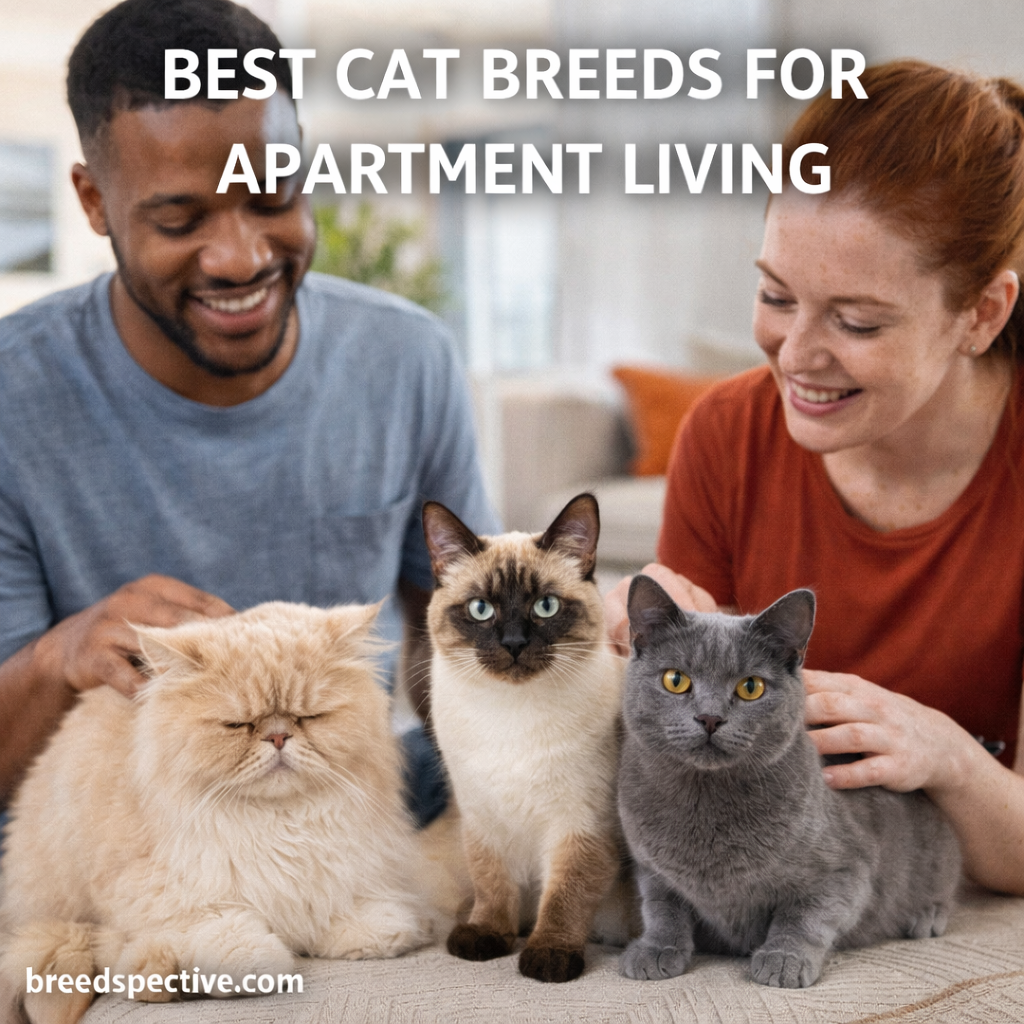
The best cat breeds for apartments are generally calm, adaptable cats that can meet their exercise, social, and enrichment needs indoors. British Shorthairs, Ragdolls, Persians, Russian Blues, Exotic Shorthairs, American Shorthairs, Burmese, and other compatible adult cats can all work well in smaller homes when their environment is set up properly.
Square footage matters less than many people assume. A small apartment with climbing areas, scratching surfaces, hiding places, clean litter boxes, and daily play can provide a better feline environment than a larger home with little enrichment.
What Makes a Cat Good for Apartment Living?
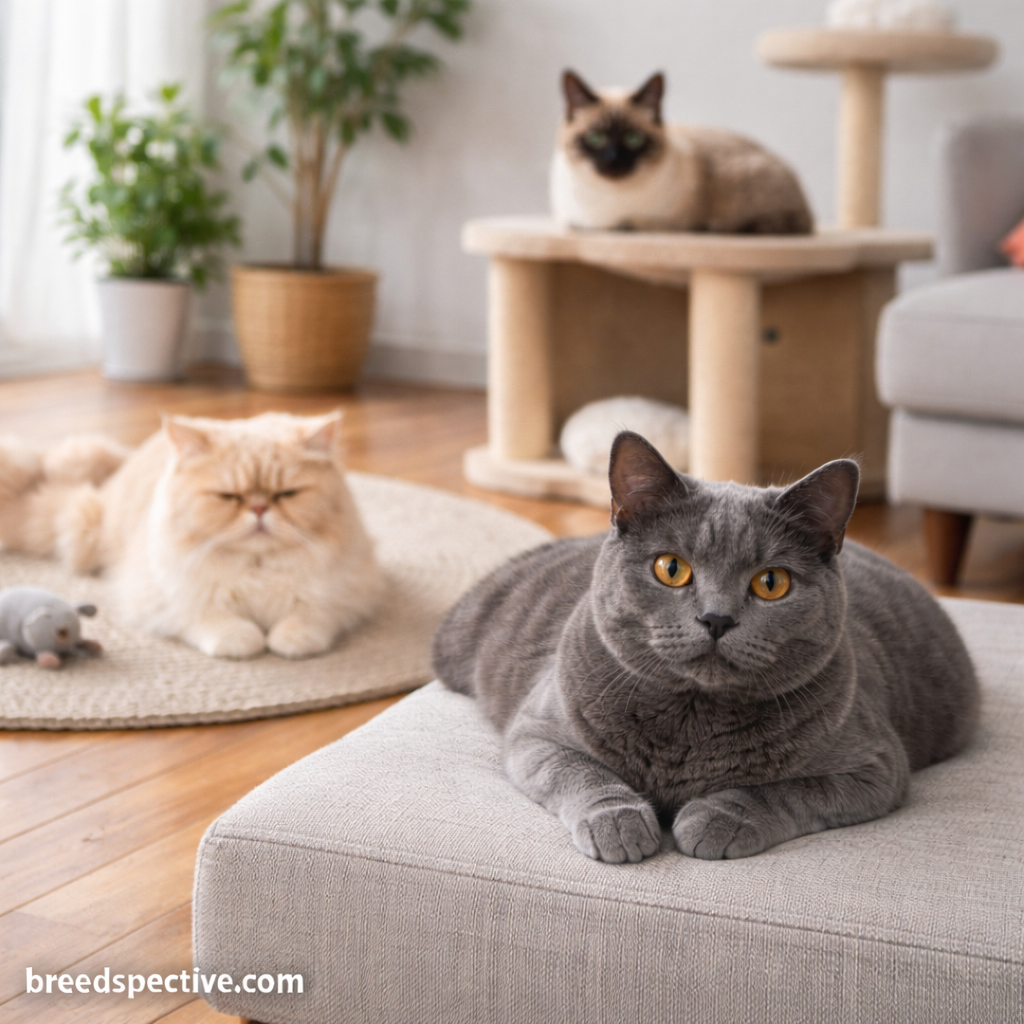
An apartment-friendly cat does not have to be inactive.
Instead, look for a cat whose normal behavior can be comfortably accommodated within your home.
Useful traits include:
- Low to moderate activity
- Ability to settle comfortably indoors
- Manageable vocal behavior
- Adaptability to household routines
- Exercise needs you can meet through indoor play
- Sociability that matches how often you are home
Individual personality matters as much as breed.
An energetic cat can live successfully in an apartment if the owner provides enough activity and vertical territory. Conversely, a supposedly calm breed can be a poor match if its social, grooming, or other needs conflict with the household.
If you are still deciding what characteristics matter most, start with our guide to choosing the right cat breed for your home.
Best Cat Breeds for Apartments at a Glance
| Breed | Activity | Vocalness | Grooming | Best Fit |
|---|---|---|---|---|
| British Shorthair | Low–moderate | Generally quiet | Moderate | Quiet apartments, independent companionship |
| Ragdoll | Low–moderate | Moderate | Regular brushing | Owners wanting an affectionate indoor companion |
| Persian | Low | Generally quiet | High | Calm households prepared for daily coat care |
| Russian Blue | Moderate | Generally quiet | Low–moderate | Predictable, quieter households |
| Exotic Shorthair | Low–moderate | Generally quiet | Moderate | Owners wanting a calmer companion |
| American Shorthair | Moderate | Moderate | Low–moderate | Households wanting an adaptable cat |
| Burmese | Moderate–high | Moderate | Low | People home often enough to provide interaction |
| Adult rescue cat | Depends on individual | Depends on individual | Depends on coat | Owners prioritizing known temperament over pedigree |
These are starting points rather than guarantees. Cats within the same breed can differ considerably in activity, confidence, sociability, and vocal behavior.
1. British Shorthair
The British Shorthair is one of the strongest pedigree choices for someone who wants a relatively calm apartment companion.
British Shorthairs are generally described as easygoing rather than intensely active. They can enjoy play and interaction without necessarily requiring the level of activity associated with more athletic breeds.
Their sturdy build and plush coat also make them substantial cats despite their relaxed reputation.
Why a British Shorthair can work in an apartment
They are generally:
- Calm indoors
- Moderately playful rather than relentlessly active
- Less demanding of constant attention than highly social breeds
- Well suited to predictable household routines
That independence can be useful for someone who works outside the home, although no cat should simply be left without appropriate interaction, enrichment, food, water, and litter facilities.
Their coat is relatively straightforward compared with a Persian’s, but it still benefits from regular grooming.
Read our complete British Shorthair personality, energy, and social traits profile if a quieter, more self-contained companion appeals to you.
2. Ragdoll
Ragdolls can be excellent apartment cats for people who want a more socially involved companion.
They are typically associated with a gentle, relaxed temperament and tend to be less intensely athletic than breeds developed around very high activity.
The trade-off is that a Ragdoll may want more interaction than a more independent cat.
Why a Ragdoll can work in an apartment
A Ragdoll may suit you if you want:
- A generally calm indoor companion
- Regular interaction with your cat
- Moderate rather than extreme activity
- A larger cat but do not have a highly active lifestyle
Their size needs consideration.
A Ragdoll may require a larger litter box, sturdy cat furniture, and appropriately sized resting areas. Their semi-long coat also means regular grooming should be part of the routine.
Explore the Ragdoll’s personality, energy, and social traits before choosing one solely for its laid-back reputation.
3. Persian
A Persian’s calm style can be well suited to a peaceful apartment, but this is not a low-maintenance breed.
Persians are generally less athletic than highly active cats and can be content spending substantial time resting in comfortable locations.
That fits apartment life well.
The coat is the major trade-off.
Why a Persian can work in an apartment
Persians generally suit owners who prefer:
- A quieter home
- A less athletic cat
- Indoor companionship
- A predictable routine
But prospective owners need to be comfortable with regular coat care.
Long-haired cats can develop tangles and mats if grooming is neglected. Persians also have distinctive physical characteristics and breed-related health considerations that should be researched carefully before choosing a breeder.
Our Persian personality, energy, and social traits guide covers the broader ownership picture.
A Persian makes far more sense for someone who actively wants the grooming routine than for someone simply looking for a quiet cat.
4. Russian Blue
Russian Blues can suit apartment dwellers who prefer a quieter cat and a predictable home.
They are generally active enough to enjoy play without having the exceptionally high activity demands associated with breeds such as Bengals.
Russian Blues can also be more reserved than intensely outgoing breeds.
That can suit a quiet adult household particularly well.
What to consider
Provide:
- Daily interactive play
- Elevated observation areas
- Scratching surfaces
- Quiet resting locations
- A stable routine
Reserved does not mean a cat requires no social interaction. Individual Russian Blues can form strong relationships with familiar people while remaining cautious about unfamiliar situations.
For an owner wanting a cat that combines playfulness with a more restrained household presence, the breed deserves consideration.
5. Exotic Shorthair
The Exotic Shorthair can appeal to someone who likes the general type and calmer character associated with the Persian but prefers a shorter coat.
The shorter coat reduces some of the intensive combing associated with long-haired Persians, but it does not make the breed maintenance-free.
Regular grooming, nail care, dental care, and veterinary care still apply.
Apartment advantages
Exotic Shorthairs can suit smaller homes because they are generally:
- Moderate in activity
- Comfortable with indoor routines
- Less athletically demanding than high-energy breeds
- Happy to combine play with substantial downtime
As with the Persian, prospective owners should research health carefully rather than choosing based on the breed’s distinctive facial appearance.
6. American Shorthair
American Shorthairs offer a more balanced option for someone who wants a cat that plays and explores without making high-intensity activity the center of the household.
They still need exercise.
Interactive toys, climbing opportunities, scratching areas, and short play sessions can make an apartment much more interesting without requiring enormous floor space.
Their short coat also makes routine grooming comparatively straightforward.
The breed can suit an owner who does not necessarily want the very calm style of a Persian but also does not want the demands of an exceptionally active breed.
7. Burmese
Burmese cats show why apartment-friendly does not necessarily mean low-energy.
A socially engaged, playful cat can thrive in a small home when its interaction needs are met.
The Burmese is typically people-oriented and active enough to require meaningful daily engagement.
A Burmese may work well if:
- You spend substantial time at home
- You actively want to play with your cat
- You enjoy an involved companion
- You can provide climbing and enrichment opportunities
A Burmese is less appropriate if your goal is a highly independent cat that largely entertains itself.
For apartment owners working long hours away from home, individual temperament and social needs deserve particular attention.
8. An Adult Rescue Cat With a Known Temperament
Breed is not your only route to an apartment-friendly cat.
An adult domestic shorthair or longhair whose personality is already known can be one of the most practical choices for a smaller home.
A shelter or foster caregiver may be able to tell you whether an adult cat is:
- Calm or highly active
- Vocal or quiet
- Comfortable being alone
- Social with people
- Experienced with other cats
- Comfortable around dogs
- Easily stressed by noise
- Interested in climbing and exploring
That information is extremely useful.
A kitten’s adult personality and activity level are still developing. An adult cat gives you a better opportunity to choose according to observed behavior rather than breed tendencies alone.
What About Scottish Folds?
Scottish Folds frequently appear on lists of apartment-friendly breeds because they are often described as calm cats.
That does not make them a Breedspective recommendation.
The folded ears that define the breed result from a genetic cartilage abnormality. International Cat Care has raised significant welfare concerns about breeding cats for this trait because the mutation affects cartilage elsewhere in the body as well, not only the ears.
For someone seeking a calm apartment cat, there are numerous alternatives that do not require selecting for a physical characteristic associated with a skeletal disorder.
High-Energy Cats Can Live in Apartments — With More Work
A Bengal or Abyssinian does not automatically require a detached house.
What these cats need is an environment capable of supporting considerably more activity.
That can be harder in a small apartment.
A highly active cat may need substantial vertical territory, frequent interactive play, opportunities to climb, rotating enrichment, and appropriate outlets for exploration.
This distinction matters because space and energy are different variables.
A calm cat may use a large house primarily for resting. An energetic cat may use every shelf, perch, tunnel, toy, and climbing structure in a studio apartment.
Choose according to the environment you are willing to create.
How to Set Up a Small Apartment for a Cat
The American Association of Feline Practitioners (AAFP) and International Cat Care emphasize that a cat’s environment should support normal behaviors such as climbing, scratching, hiding, resting, playing, and toileting.
In an apartment, good environmental design can compensate for limited floor area.
Use vertical space
Cats do not experience usable territory only at floor level.
A tall cat tree, secure shelves, window perch, or elevated resting platform effectively creates additional usable space without increasing the apartment’s footprint.
For example, a cat might use the floor for play, a mid-height shelf for observation, and the top of a cat tree for sleeping.
Vertical options are particularly useful in multi-cat households because they create additional places for cats to position themselves relative to one another.
Make sure elevated structures are stable and can safely support your cat.
Create Separate Functional Areas
A studio apartment may be one room to you, but you can still create different zones for your cat.
Try to provide distinct locations for:
- Food
- Water
- Toileting
- Scratching
- Resting
- Hiding
- Play
Avoid clustering every feline resource into one corner simply because it is convenient.
Cats benefit from having choice and separation between important resources.
Put the Litter Box Somewhere the Cat Will Actually Use It
Litter-box placement becomes especially important in a small home because owners may be tempted to hide the box wherever it is least noticeable.
That location may not work for the cat.
Choose a place that is accessible and allows the cat to toilet without feeling trapped or repeatedly disturbed.
Keep litter facilities clean. Avoid positioning the cat’s food directly beside its toileting area.
In multi-cat homes, resource distribution becomes even more important because cats may not be comfortable sharing every facility.
If toileting problems develop, do not assume the cat is being spiteful. Medical problems, litter preferences, cleanliness, location, access, stress, and interactions with other animals can all matter. Our guide to why cats avoid the litter box and how to fix it explains how to troubleshoot the problem.
Make Daily Play Part of Apartment Life
Indoor cats still need opportunities to stalk, chase, pounce, climb, scratch, and explore.
Interactive wand toys can encourage chase behavior. Puzzle feeders can add problem-solving to mealtimes. Boxes, tunnels, and safe hiding areas create opportunities to explore.
Rotate some toys rather than leaving every toy available permanently.
The goal is not to fill the apartment with cat products. It is to give the cat several meaningful choices throughout the day.
Short interactive play periods can fit easily into a normal routine and are especially valuable for younger and more active cats.
Protect Resting Time
Cats spend a large portion of the day resting and sleeping. Figures of roughly 12–16 hours of sleep per day are commonly cited for adult cats, although age, health, activity, and the individual cat affect the amount.
That makes resting locations a major part of apartment design.
Provide more than one option when possible: a covered bed, elevated perch, sunny window location, or quiet corner.
A cat should have somewhere to withdraw from visitors, children, other pets, televisions, vacuum cleaners, and normal household activity.
For routines that change as kittens become adults and eventually seniors, see our guide to daily care routines for cats at every life stage.
Indoor Living Can Be Safe and Enriching
Apartment cats are usually indoor cats, which can substantially reduce exposure to dangers associated with unrestricted outdoor access, including vehicles, fights, infectious disease exposure, parasites, toxins, and predators.
Veterinary organizations including the AAFP support approaches that protect cats from outdoor hazards while still meeting their behavioral and environmental needs.
Indoor living should not mean an empty environment.
Windows, secure screened areas, climbing structures, scratching surfaces, toys, scent opportunities, training, and interactive play can give an indoor cat much more to do.
If outdoor access is offered, secure options such as an appropriately designed enclosure can provide additional stimulation without the risks of unrestricted roaming.
Apartment Size Is Not the Only Constraint
Before choosing a cat, consider the building as well as the apartment.
Ask:
- Does the lease allow cats?
- Is there a pet limit?
- Are windows and screens secure?
- Is there a balcony, and can the cat access it?
- Can you fit an appropriate litter setup?
- Are there other animals in the home?
- How noisy is the building?
- How often are you away?
- Can you provide vertical territory?
A 500-square-foot apartment can work extremely well for the right cat.
The wrong match can feel crowded in twice that space.
Common Apartment-Cat Mistakes
Choosing only by breed reputation. A British Shorthair may generally be calmer than a Bengal, but individual personality still matters.
Assuming a calm cat needs no play. Low energy is not zero energy.
Using floor space as the only measurement. Cats can use vertical territory extremely effectively.
Hiding the litter box in an unsuitable location. Human convenience should not make the toilet difficult or stressful for the cat to use.
Expecting one scratching post to solve everything. Cats can have preferences for different scratching orientations, materials, and locations.
Ignoring social needs. A small apartment may physically accommodate a cat while the owner’s schedule provides too little interaction for a highly social individual.
Choosing a long-haired cat without considering grooming. A Persian’s activity level may fit perfectly while its coat-care requirements do not.
Verdict: Which Cats Are Best for Apartments?
A British Shorthair is one of the strongest options for someone who wants a generally calm, relatively independent pedigree cat.
A Ragdoll suits an apartment owner who wants a more socially involved, affectionate companion and has room for a larger cat and its equipment.
A Persian can fit a quiet apartment extremely well when the owner genuinely accepts the grooming and health considerations that come with the breed.
Russian Blues, Exotic Shorthairs, and American Shorthairs can offer a useful middle ground for people wanting manageable indoor activity without choosing an exceptionally sedentary cat.
A Burmese can work in surprisingly little space when the owner actively wants a playful, social cat and provides enough daily interaction.
And for someone who does not care about pedigree, a calm adult rescue cat with an already-observed temperament may be one of the most predictable apartment matches available.
Highly active cats are not automatically unsuitable for apartments, but they are wrong for owners expecting the apartment itself to limit the cat’s need for exercise and stimulation.
Choose the cat whose needs fit both your square footage and the amount of interaction, enrichment, grooming, and environmental setup you are willing to provide every day.