
The Border Collie and Australian Shepherd are both intelligent, high-energy herding breeds that need substantial exercise, training and mental stimulation. The Border Collie generally places more emphasis on sustained work and mental engagement, while the Australian Shepherd is also demanding but tends to bring a somewhat different combination of herding drive, exuberance and family companionship. The American Kennel Club (AKC) describes both breeds as active working dogs that do best when given meaningful things to do. American Kennel Club
Neither should be treated as an ordinary “couple of walks a day” breed. The more useful question is which type of demanding dog better matches your routine.
Border Collie vs Australian Shepherd at a Glance
| Trait | Border Collie | Australian Shepherd |
|---|---|---|
| Height | 18–22 inches | 18–23 inches |
| Weight | 30–55 pounds | 40–65 pounds |
| Energy | Very high | Very high |
| Mental stimulation | Exceptionally important | Very important |
| Trainability | Exceptional; highly responsive | Excellent; intelligent and work-oriented |
| Herding style | Famous for intense “eye” and controlled movement | Generally more upright and loose-eyed |
| Coat | Rough or smooth double coat | Medium-length double coat |
| Grooming | Usually brush 1–2 times weekly; more during shedding | Regular brushing; heavier shedding periods need more attention |
| Family fit | Best with active, engaged households | Best with active, engaged households |
| Best suited to | Training-focused owners, sports and working homes | Active owners, families, sports and working homes |
| Biggest challenge | Constant need for productive physical and mental outlets | High exercise needs, herding behavior and substantial shedding |
AKC places the Border Collie at 18–22 inches and 30–55 pounds. Australian Shepherds are similarly sized but can be heavier, generally standing 18–23 inches and weighing about 40–65 pounds. American Kennel Club
Different Histories Created Different Working Dogs
Both breeds were shaped by livestock work, but their histories aren’t interchangeable.
The Border Collie’s heritage is closely associated with shepherding in the border country between Scotland and England. Generations of selection for livestock work produced a dog capable of responding to a handler while controlling sheep with extraordinary concentration.
One of the breed’s defining characteristics is its “eye” — the intense gaze used while working stock. AKC specifically identifies this herding eye as a hallmark of the Border Collie. American Kennel Club
Australian Shepherd history is surprisingly different.
The Australian Shepherd Isn’t Actually Australian
Despite the name, the Australian Shepherd was developed into the breed we recognize today in the western United States.
AKC describes the Aussie as a quintessentially American breed developed in western states including California, Colorado, Wyoming and Idaho. Its more distant ancestry is complicated, involving European herding dogs and livestock migrations through several countries, but the modern breed was shaped by American ranching. American Kennel Club
Aussies became particularly visible in American western culture after World War II. AKC notes that their popularity grew alongside horse culture, and the dogs appeared at rodeos, horse shows and eventually in movies and television. American Kennel Club
That ranch heritage helps explain the Australian Shepherd’s versatile working style.
Border Collies traditionally control livestock with an intense eye and relatively low, concentrated movement. Australian Shepherds generally work in a more upright, looser-eyed manner and were developed as versatile stock dogs for ranch conditions.
Those differences matter because herding behavior doesn’t disappear when these dogs move into suburban homes.
Energy: Both Need Much More Than Casual Exercise
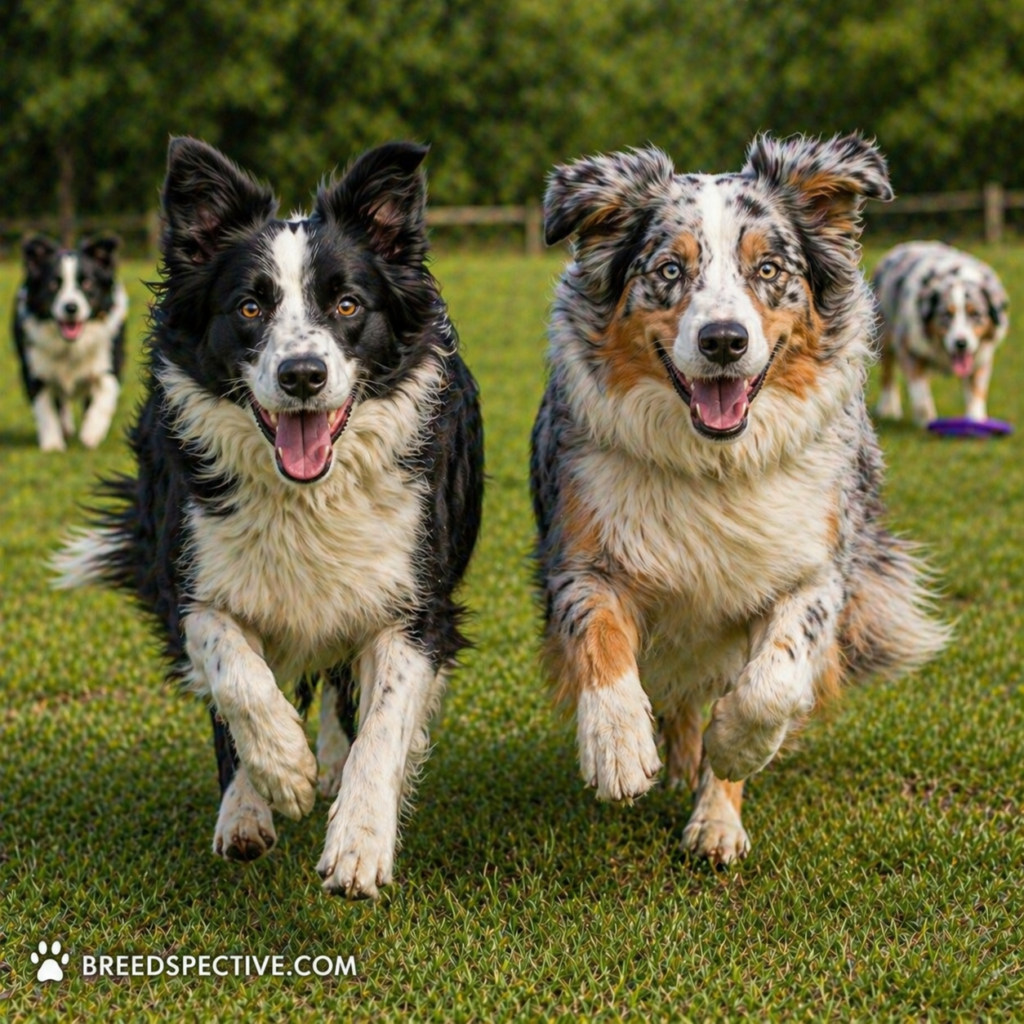
Neither breed belongs in a household looking for a low-key dog.
AKC describes the Border Collie as a very high-energy breed that fares best when given a job. It similarly describes Australian Shepherds as extremely energetic dogs that love working and participating in dog sports. American Kennel Club
Simply having a large yard isn’t enough.
A dog can spend hours in a backyard without receiving meaningful exercise or mental stimulation. These breeds benefit from activities that combine movement with interaction and problem-solving.
Good outlets include:
- Brisk walks and hikes
- Fetch and structured retrieving
- Obedience training
- Agility
- Herding
- Tracking or scent games
- Disc sports
- Puzzle-based feeding
- Training new behaviors
AKC specifically recommends dog sports as an outlet for herding breeds because these activities can redirect working instincts while challenging both the dog’s body and mind. American Kennel Club
Where the Border Collie Becomes Especially Demanding
The Border Collie’s challenge isn’t merely physical stamina.
Mental workload matters just as much.
AKC emphasizes that Border Collies require substantial activity and mental stimulation, recommending ongoing obedience training and other structured activities throughout the dog’s life. American Kennel Club
Trying to exhaust one exclusively through longer walks can therefore miss the point.
A productive day might combine a substantial walk or run with several brief training sessions, retrieving, scent work or another activity requiring concentration.
Our guide to matching a dog’s energy level to your daily routine can help translate terms such as “high energy” into an actual ownership schedule.
Trainability: Extremely Smart Doesn’t Mean Easy
Both breeds are highly trainable.
That doesn’t necessarily make either one easy to own.
Intelligence means a dog can learn desirable behaviors quickly, but an intelligent working dog can also learn unwanted patterns when training is inconsistent.
Training a Border Collie
Border Collies were developed to work closely with handlers while making rapid decisions around livestock.
AKC describes them as highly trainable and capable of excelling in herding, obedience, tracking and agility. It also recommends early socialization, puppy training and continued obedience work throughout the dog’s life. American Kennel Club
The challenge is keeping that intelligence productively occupied.
A Border Collie may be a rewarding match for someone who enjoys training as a hobby. If teaching behaviors feels like an obligation you hope to finish after puppyhood, the breed’s needs may become frustrating.
Our Border Collie temperament, energy and lifestyle guide goes deeper into what everyday ownership looks like.
Training an Australian Shepherd
Australian Shepherds are also highly intelligent and work-oriented.
AKC describes the breed as smart, adaptable and eager to please, but also extremely energetic. American Kennel Club
Aussies need early socialization and consistent boundaries, particularly because normal herding behaviors can become inconvenient in a household. Chasing movement and attempting to control people or other animals require thoughtful management rather than punishment for behaviors humans originally selected the breed to perform.
Both breeds demonstrate why trainable and beginner-friendly aren’t synonyms.
For a broader look at that distinction, see our guide to the easiest dog breeds to train and why.
Grooming: The Australian Shepherd Usually Means More Coat
Neither dog has an especially difficult coat compared with breeds requiring regular clipping, but both shed.
Border Collie Grooming
Border Collies can have rough or smooth coats, and both varieties have weather-resistant double coats.
AKC recommends brushing about once or twice per week, with daily brushing potentially needed during heavier shedding periods. American Kennel Club
Routine care also includes nail trimming, dental care and ear checks.
A rough-coated Border Collie will obviously have more visible feathering than a smooth-coated dog, but choosing the smooth variety doesn’t eliminate shedding or routine coat care.
Australian Shepherd Grooming
Australian Shepherds have a medium-length double coat.
AKC recommends weekly brushing as a general baseline and notes that Aussies shed considerably, requiring more frequent attention when the undercoat is coming out. American Kennel Club
For both breeds, regular brushing helps remove loose undercoat and reduce tangles. AKC’s guidance for medium double-coated dogs specifically includes Border Collies and Australian Shepherds among breeds that benefit from weekly brushing. American Kennel Club
If shedding around the home is a major concern, neither is an ideal choice.
Health: What Responsible Breeders Should Screen For
Breed selection should include health screening, not just temperament and appearance.
Border Collie Health Screening
Prospective Border Collie owners should ask breeders for documented health-testing results rather than accepting statements such as “the parents have never been sick.”
Health screening recommendations can evolve, so buyers should review the current recommendations of the Border Collie Society of America and discuss breed-specific concerns with their veterinarian.
Ask a breeder specifically:
- What tests were performed on both parents?
- Can you see the actual results?
- What health problems have occurred in related dogs?
- Were eyes and joints evaluated?
- Were relevant DNA tests performed?
- At what age were the breeding dogs tested?
Health screening reduces uncertainty; it does not guarantee that a puppy will never become ill.
Australian Shepherd Health Screening
AKC identifies hip dysplasia, epilepsy, cataracts and certain cancers among health concerns breeders monitor in Australian Shepherds. The national breed club’s listed recommended screening includes hip, elbow and ophthalmologist evaluations. American Kennel Club
The United States Australian Shepherd Association (USASA) is the AKC parent club for the breed and is an appropriate place to check current breed-specific health guidance.
The same documentation rule applies: ask to see results.
Merle-to-merle breeding also requires particular genetic consideration because it can increase the risk of serious hearing and vision abnormalities in offspring. A responsible breeder should be able to explain their breeding decisions and health-testing program clearly.
Family Fit: Children, Other Pets and Everyday Life
Both breeds can be affectionate family dogs, but neither should be selected simply because someone wants “a smart family dog.”
Their herding instincts are relevant.
Border Collies With Children
AKC notes that Border Collies may attempt to herd animals and people and suggests that homes with older, well-behaved children can be particularly appropriate. American Kennel Club
Fast-moving children can activate herding behavior.
That doesn’t make the breed inherently unsuitable for families. It means adults need to manage interactions, provide suitable outlets for the dog’s instincts and teach children how to interact appropriately with dogs.
Australian Shepherds With Families
Australian Shepherds can also be devoted family companions, but their ranch-dog heritage remains relevant.
They are active, work-oriented dogs rather than decorative companions. A family that hikes, trains, plays outside and involves its dog in daily activities is much more likely to appreciate the breed than one hoping the dog will entertain itself after a brief morning walk.
Both breeds can also be somewhat reserved with unfamiliar people, making early positive socialization valuable.
What About Other Pets?
Individual temperament and socialization matter more than simple breed labels.
Both breeds may live successfully with other dogs. However, movement can stimulate herding behavior, so introductions and supervision are particularly important around smaller animals.
A household with cats should discuss compatibility with the breeder or rescue organization and evaluate the individual dog’s history rather than assuming every Border Collie or Aussie will behave identically.
Which Breed Handles Downtime Better?
This is one of the most practical differences for companion homes.
Border Collies were selected for extraordinary responsiveness, concentration and sustained livestock work. AKC repeatedly emphasizes their need to stay occupied and describes active, experienced owners as the best fit. American Kennel Club
Australian Shepherds are hardly couch potatoes. AKC likewise characterizes them as high-energy working dogs requiring regular physical and mental activity. American Kennel Club
The distinction is therefore relative.
An Aussie shouldn’t be chosen as the “easy alternative” to a Border Collie. Someone whose routine isn’t compatible with a Border Collie’s needs may discover that an Australian Shepherd is still far more dog than expected.
Instead, ask whether your normal week has room for an intelligent working breed at all.
Space: Do They Need a Huge Yard?
A large property is useful, but it doesn’t solve an activity mismatch.
AKC notes more generally that a dog’s living area does not necessarily need to be large when its exercise requirements are properly met. American Kennel Club
That principle is particularly relevant here.
An engaged Border Collie living with someone who trains, hikes and participates in dog sports may receive considerably more meaningful stimulation than one living on a large property with little human involvement.
The same applies to an Aussie.
Apartment living adds logistical difficulty because every exercise and bathroom break must be intentionally provided, but square footage alone doesn’t determine suitability.
What matters more is your actual routine.
Cost: Which Breed Is More Expensive?
There isn’t a reliable universal purchase price for either breed. Prices vary by location, breeder, pedigree, working or show background, health testing and availability.
The more useful comparison is the lifetime cost structure.
| Expense | Border Collie | Australian Shepherd |
|---|---|---|
| Food | Moderate | Moderate; larger individuals may eat somewhat more |
| Routine vet care | Standard ongoing expense | Standard ongoing expense |
| Health screening | Relevant breed-specific testing | Relevant breed-specific testing |
| Grooming | Mostly home maintenance | Mostly home maintenance, but substantial shedding |
| Training | Potentially significant | Potentially significant |
| Dog sports/equipment | Common optional expense | Common optional expense |
| Enrichment | High priority | High priority |
| Emergency veterinary care | Financial planning needed | Financial planning needed |
The overlooked cost with these breeds is often time.
Training classes, daily exercise, enrichment, transportation to activities and weekend dog sports can become significant parts of an owner’s schedule.
Professional training can also add substantial expense if behavioral problems develop because a dog’s needs weren’t adequately anticipated.
Border Collie vs Australian Shepherd for First-Time Owners
Neither would be our default suggestion for someone whose main priority is an easy first dog.
AKC specifically notes that Border Collies can be challenging for first-time owners because of their intelligence, energy and ongoing need for training and stimulation. It makes a similar point about Australian Shepherds: a committed beginner can succeed, but the breed’s energy and training requirements can be challenging. American Kennel Club
Experience isn’t everything, though.
A dedicated first-time owner who has researched training, arranged appropriate exercise and genuinely wants dog-centered hobbies may be better prepared than an experienced owner whose current lifestyle leaves little time for a working breed.
Before choosing either, look beyond appearance and ask how much of your ordinary week you realistically want to organize around your dog. Our guide to choosing the right dog breed for your lifestyle can help with that assessment.
Verdict: Choose a Border Collie or Australian Shepherd?
Choose a Border Collie if you specifically want an exceptionally work-focused dog and enjoy making training, problem-solving and substantial physical activity part of everyday life. Border Collies are particularly well matched to owners interested in activities such as agility, herding, obedience, tracking or other structured dog sports. Their intelligence is a major asset when it has somewhere productive to go.
Choose an Australian Shepherd if you want an energetic, intelligent ranch breed that can participate heavily in active family life, training and dog sports. Aussies still require considerable exercise and mental engagement, and their shedding and herding instincts should not be underestimated.
Avoid both breeds if your ideal routine consists primarily of short walks, occasional weekend outings and long stretches in which the dog is expected to entertain itself. AKC’s guidance for both breeds consistently emphasizes work, activity, training and mental stimulation rather than passive companionship. American Kennel Club
The biggest difference isn’t that one breed needs activity and the other doesn’t. Both are demanding working dogs; the Border Collie typically places the heavier emphasis on sustained mental work and job-like engagement, while the Australian Shepherd remains a highly active alternative rather than an easy one.