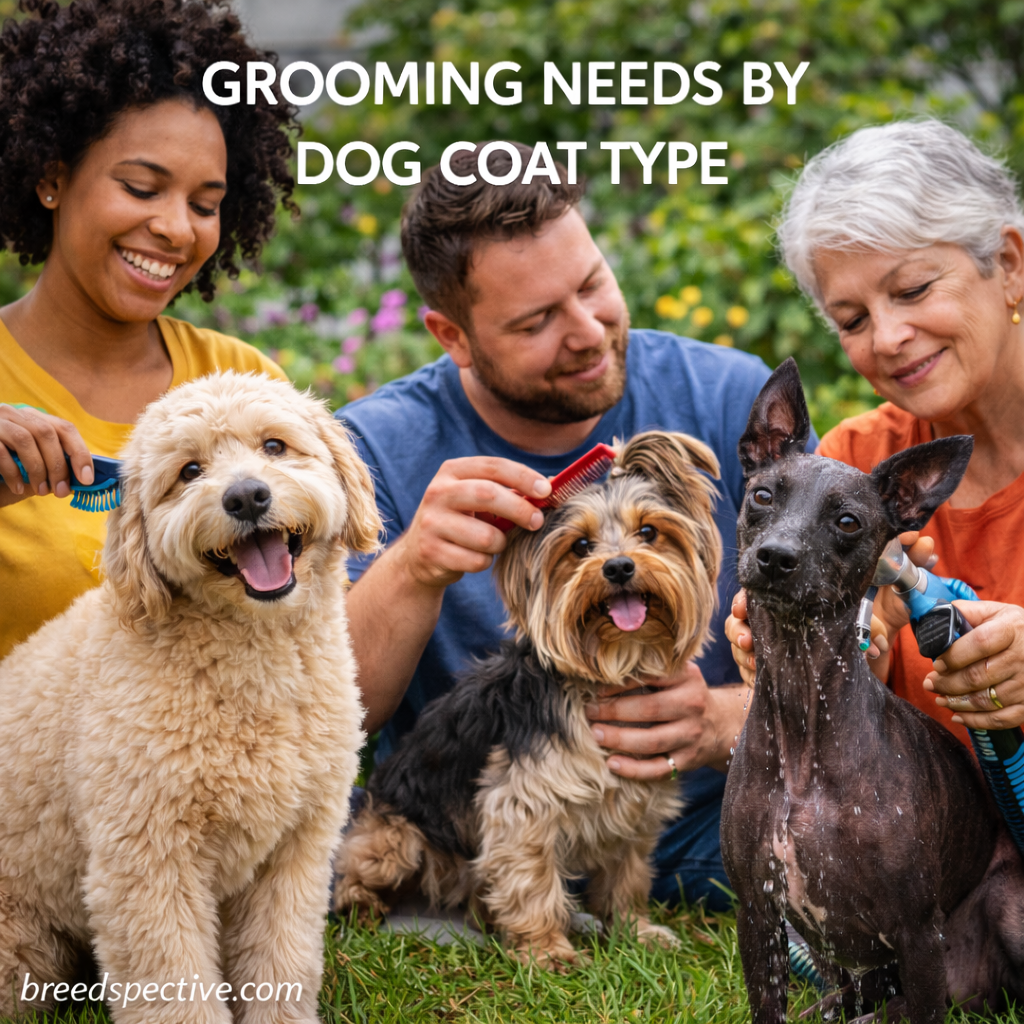
Dog grooming should match the coat: short coats usually need simple brushing, double coats need thorough undercoat removal, long and curly coats need consistent detangling, and wire coats may require specialized hand-stripping. The wrong routine can leave mats behind, irritate the skin or, in the case of many double-coated breeds, unnecessarily alter the protective coat.
Coat type also determines the time and money involved. A short-coated dog may need mostly at-home maintenance, while a Poodle or other continuously growing coat can require brushing between regular professional grooming appointments.
Dog Grooming Needs by Coat Type at a Glance
There is no single grooming schedule that works for every dog. Coat density, length, texture, lifestyle and the individual dog’s skin all influence how frequently grooming is needed.
This table provides a practical starting point:
| Coat type | Typical examples | Main concern | Useful tools | General maintenance level |
|---|---|---|---|---|
| Smooth/short | Boxer, Dalmatian | Loose hair, skin visibility | Rubber curry, soft brush | Low |
| Short double | Labrador Retriever | Undercoat shedding | Rubber curry, undercoat tool | Moderate |
| Long double | Golden Retriever, Siberian Husky | Heavy shedding, tangles | Slicker, comb, undercoat rake | Moderate–high |
| Long/silky | Yorkshire Terrier, Maltese | Tangles and mats | Pin/slicker brush, metal comb | High |
| Curly | Poodle, Bichon Frise | Matting close to skin | Slicker, metal comb | High |
| Wire | Wire Fox Terrier, some terriers | Maintaining harsh texture | Appropriate brush/comb, stripping tools | Moderate–high |
| Corded | Puli, Komondor | Cord separation and drying | Hands, breed-specific tools | Very high |
| Hairless/sparse | Xoloitzcuintli, hairless Chinese Crested | Skin care | Gentle bathing/skin-care supplies | Specialized |
These categories overlap. Some breeds combine characteristics from more than one coat type, and individual dogs within a breed can differ.
Smooth and Short Coats: Simple, Not Maintenance-Free
Smooth-coated dogs such as Boxers and Dalmatians have short hair lying relatively close to the body. Their coats generally do not require the extensive detangling associated with long-haired breeds.
That makes them among the more manageable dogs to groom at home.
A rubber grooming mitt or curry-style brush can loosen dead hair while being relatively gentle on the skin. A soft bristle brush can then pick up loose material and smooth the coat.
Short hair does not mean no shedding. Some smooth-coated breeds shed enough fine hair to make their presence obvious on clothing and furniture.
Because the coat provides less visual coverage, grooming is also a useful opportunity to inspect the skin. Watch for redness, bumps, bald areas, sores or other changes rather than repeatedly brushing an irritated area.
Bathing should be based on need rather than an arbitrary calendar. A dog that has rolled in mud clearly needs different care from a mostly indoor dog whose skin and coat are clean.
Double Coats: Groom the Undercoat Without Shaving It Off
A double coat has two functional layers: an outer coat and a softer, denser undercoat.
Double-coated breeds include dogs as different as Labrador Retrievers, German Shepherd Dogs, Golden Retrievers and Siberian Huskies. The exact length and density differ considerably, but the underlying grooming challenge is similar: loose undercoat needs to be removed without unnecessarily damaging the outer coat.
Tools may include:
- an undercoat rake appropriate for the coat;
- a slicker or pin brush for longer coats;
- a comb for checking feathering and tangle-prone areas; and
- a rubber grooming tool for some shorter double coats.
Technique matters more than aggressively removing as much hair as possible. Brush systematically and avoid repeatedly scraping the same area of skin with a sharp tool.
Should You Shave a Double-Coated Dog?
Generally, not simply to reduce shedding or keep the dog cooler.
Breed clubs and professional grooming organizations commonly advise against routine shaving of double coats because removing the coat can interfere with its normal insulating function and the way it grows back.
The Siberian Husky Club of America specifically cautions against shaving the breed’s coat except for medical reasons, noting the protective role of the double coat. The American Kennel Club similarly advises that shaving a double-coated dog does not stop shedding and can damage the coat. (shca.org)
There are situations in which a veterinarian may need hair clipped for medical treatment or procedures. Severe matting can also create circumstances in which removing coat is necessary for the dog’s welfare.
Those are different from routinely shaving a healthy double-coated dog for convenience.
Anyone considering a northern breed should factor coat maintenance into the broader demands of living with one. Our Siberian Husky temperament, energy level and lifestyle fit guide covers what ownership involves beyond the dramatic coat.
Long Double Coats: Shedding Plus Tangle Control
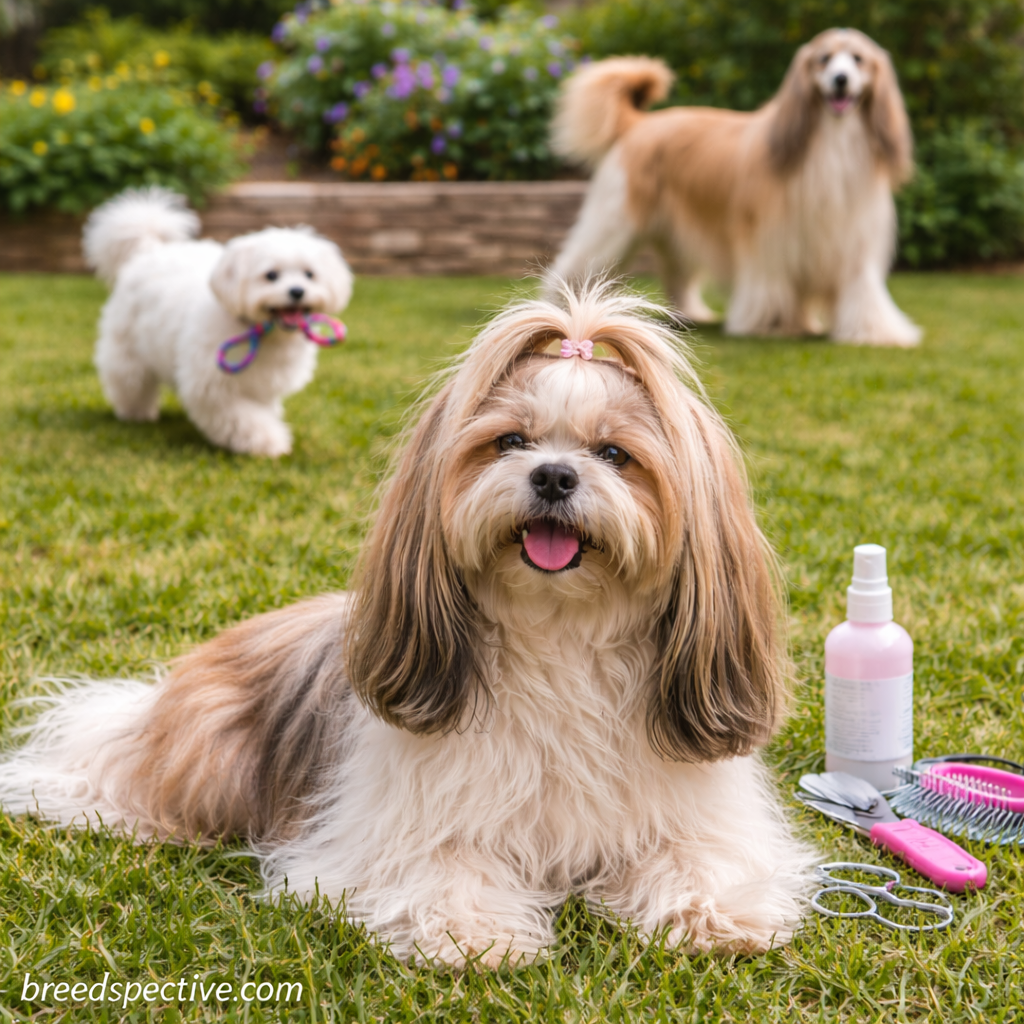
Some double-coated dogs combine a substantial undercoat with longer outer hair and feathering.
Golden Retrievers are a familiar example.
These dogs require attention to both shedding and tangles. Areas behind the ears, around the legs, under the body and in feathering can require more detailed grooming than the broad areas across the back.
A useful tool combination is often:
- an appropriate brush for working through the coat;
- an undercoat tool when loose undercoat is present; and
- a metal comb to check that you have reached through the coat rather than merely smoothing the surface.
That last step matters. A coat can look brushed on top while tangles remain closer to the skin.
The Golden Retriever Club of America recommends regular brushing, attention to the ears, feet and nails, and trimming where appropriate while retaining the breed’s natural coat rather than shaving it down. (grca.org)
Before choosing the breed primarily for its appearance or temperament, factor coat care into the complete Golden Retriever lifestyle and temperament profile.
Heavy Shedders: Managing Fur Without Over-Grooming
Heavy shedding is not automatically evidence of an unhealthy coat.
For breeds that naturally carry substantial undercoat, loose fur is part of normal coat turnover. The owner’s job is to manage it without turning grooming into an aggressive attempt to remove every hair that could possibly come loose.
During heavy shedding periods, more frequent brushing can prevent loose undercoat from accumulating.
A practical routine is to work in sections, especially on thick-coated dogs. Check progress with your fingers or a comb rather than repeatedly dragging a de-shedding tool over the same spot.
Be cautious with tools marketed specifically for extreme de-shedding. Used incorrectly or excessively, tools with blades or sharp edges can remove or damage healthy coat and irritate the skin.
If minimizing fur around the house is a major priority, investigate coat characteristics before adopting rather than assuming grooming can eliminate shedding. Our guide to low-shedding dog breeds and what “low shedding” actually means explains the trade-off: less loose hair often comes with greater brushing and clipping requirements.
Seasonal Shedding and the Double-Coat “Blow”
Many double-coated dogs undergo periods of noticeably heavier shedding as their coats respond to seasonal changes.
Owners often call this blowing the coat.
During these periods, the undercoat may come away in large tufts. Dogs that are manageable with routine brushing during the rest of the year may temporarily require much more frequent grooming.
How dramatic the change is depends on breed, coat, climate, lifestyle and the individual dog.
During a heavy coat blow:
- increase brushing frequency as needed;
- work through the coat in manageable sections;
- pay attention to areas where loose undercoat can compact;
- use tools suited to the dog’s coat rather than scraping aggressively; and
- expect household shedding to increase temporarily.
Bathing followed by thorough drying can help release loose coat, which is one reason some owners use professional grooming during peak shedding periods.
The dog must be dried properly. Dense undercoat can retain moisture close to the skin long after the outer surface appears dry.
Long and Silky Coats: Tangles Can Become Mats Quickly
Long-coated breeds such as Maltese and Yorkshire Terriers require a very different strategy from heavy double-coated dogs.
The priority is preventing tangles from tightening into mats.
A pin brush, slicker brush and metal comb can all have a role depending on the specific coat and style. The comb is particularly useful for checking whether the coat is genuinely tangle-free down toward the skin.
High-friction areas deserve extra attention:
- behind the ears;
- armpits;
- legs;
- around harness contact points;
- underside; and
- areas around the collar.
A long coat kept in full length can require substantial maintenance. Many companion dogs are kept in shorter trims because owners find them easier to maintain, although shorter hair still requires grooming.
Do not repeatedly pull at a tight mat. Matting can be painful, and severe mats close to the skin may be safer for a professional groomer to remove.
Curly and Low-Shedding Coats: Less Fur on the Sofa, More Grooming
Curly-coated dogs illustrate one of the biggest misconceptions about shedding.
A coat can shed relatively little onto the floor while still requiring more grooming, not less.
Poodles are the classic example. Loose hair tends to remain caught within the surrounding coat rather than simply falling away, increasing the risk of tangling and matting if the coat is not brushed and combed thoroughly.
The Poodle Club of America describes grooming as a significant part of caring for the breed, with regular brushing, bathing, clipping and other maintenance required. (poodleclubofamerica.org)
For curly coats, useful tools commonly include:
- a slicker brush appropriate to the dog’s size and coat;
- a sturdy metal comb; and
- professional clippers and other equipment when grooming is performed by someone trained to use them.
Brushing frequency depends heavily on coat length. A longer Poodle coat can require very frequent maintenance, while a shorter professionally maintained trim may be more manageable at home between appointments.
Professional grooming is typically an ongoing part of owning these dogs rather than an occasional luxury.
If you are considering the breed, the grooming commitment should be weighed alongside Poodle temperament, energy level and lifestyle fit.
Wavy and Mixed-Texture Coats Can Be Unpredictable
Dogs with wavy or mixed coat characteristics are sometimes assumed to be easier to groom because the coat is neither tightly curled nor extremely long.
That assumption can backfire.
A soft, wavy coat can mat readily, particularly where different coat textures meet or where collars and harnesses create friction. Mixed-breed dogs can also inherit coat characteristics in combinations that are difficult to predict from appearance alone.
The same principle applies: brush all the way through the coat and verify your work with a comb.
If a comb cannot move comfortably through the coat, the dog is not fully brushed simply because the surface looks fluffy.
Wire Coats: Clipping and Hand-Stripping Are Not the Same
Wire-haired terriers and other rough-coated breeds have a harsh outer coat that traditionally receives specialized maintenance.
Hand-stripping removes dead outer hairs by hand or with suitable stripping tools, allowing new harsh coat to grow in. This is different from simply cutting the hair shorter with electric clippers.
Breed clubs for wire-coated terriers commonly describe hand-stripping as the traditional method for preserving correct coat texture and appearance.
Clipping is often used for companion dogs because it is faster and may be more practical for the owner. The trade-off is that repeated clipping can change the coat’s appearance and texture.
Not every pet needs a show-ring grooming routine. Owners should decide what level of maintenance is realistic while keeping the dog’s comfort and skin health first.
If you want to maintain a traditional wire coat but have never hand-stripped one, learn from an experienced groomer or breed specialist rather than experimenting aggressively with stripping tools.
Corded Coats: A Specialized Commitment
Corded breeds such as the Puli and Komondor are in a category of their own.
Their coats form rope-like cords rather than being brushed out in the conventional way. Developing and maintaining those cords involves separating them appropriately and preventing large sections from matting together.
Bathing creates another challenge: drying.
A dense corded coat can hold a large amount of water, so proper drying is a significant part of the grooming process.
Anyone considering a corded breed should learn the coat-maintenance process before bringing the dog home. This is not a coat for someone who wants grooming to be a quick weekly chore.
Hairless and Sparse-Coated Dogs: Skin Replaces Coat as the Priority
Hairless dogs demonstrate why “no hair” does not mean “no grooming.”
Instead of managing shedding and mats, owners need to pay closer attention to exposed skin.
The Xoloitzcuintli and hairless variety of the Chinese Crested are examples. Their individual grooming requirements differ, but routine skin observation is particularly important because there is little or no coat hiding changes underneath.
Avoid assuming that frequent bathing or applying numerous skin products is automatically beneficial. Excessive washing or unsuitable products can irritate the skin.
For an individual hairless dog, follow breed-specific guidance and ask a veterinarian about persistent dryness, acne-like changes, sores or other skin problems.
Grooming Mistakes That Can Irritate a Dog’s Skin
More grooming is not necessarily better grooming.
Several common habits can turn routine coat care into a source of irritation.
Brushing Too Aggressively
Repeatedly scraping one patch of skin with a slicker, rake or de-shedding tool can cause discomfort and irritation.
Work in sections and let the tool do its intended job. If you need substantial force, stop and determine whether you are dealing with a mat, the wrong tool or improper technique.
Brushing Only the Surface
This is particularly common with long and curly coats.
The dog looks fluffy, but tangles remain underneath. Use an appropriate comb to check your work instead of judging the coat only by its appearance.
Bathing Without Thorough Rinsing
Shampoo residue can irritate skin.
Use products intended for dogs and rinse the coat thoroughly. Dense and long coats require particular care because product can remain trapped beneath the outer layer.
Leaving a Dense Coat Damp
A thick coat can feel dry on top while remaining wet underneath.
Dry thoroughly after bathing, paying attention to dense undercoat and skin folds where applicable.
Cutting Mats With Scissors Close to the Skin
Tight mats can pull skin upward into the mat itself, making it difficult to see where hair ends and skin begins.
Trying to cut a severe mat out with household scissors can therefore cause injury. A professional groomer or veterinarian is the safer option when matting is tight against the skin.
Using Human Grooming Products
Human shampoos and skin products are not automatically appropriate for dogs.
Use products formulated for canine use and seek veterinary advice if your dog has persistent itching, redness, odor, hair loss or recurring skin problems. Grooming should not be used to cover up an unresolved medical problem.
Grooming Is More Than Coat Care
A grooming session is also an opportunity to notice the rest of the dog.
Check:
- nails and paws;
- skin;
- ears;
- eyes;
- lumps or bumps;
- areas the dog suddenly dislikes having touched; and
- changes in coat quality.
Nail care, dental care and appropriate ear maintenance are separate from brushing, but they belong in the broader routine.
Starting gentle handling during puppyhood can make these tasks easier later. Our guide to daily care routines for dogs at every life stage explains how grooming fits alongside exercise, feeding, training and preventive care.
How Often Should You Use a Professional Groomer?
Coat type provides a better answer than breed size.
A smooth-coated dog may rarely need professional coat grooming if the owner can comfortably manage bathing, brushing and nail care.
A long or curly coat kept in a styled trim may need appointments on a regular cycle. Wire coats maintained traditionally may require a groomer experienced with hand-stripping. Corded coats can benefit from someone familiar with their unusual maintenance requirements.
Professional grooming is particularly useful when:
- the coat requires clipping or specialized trimming;
- the owner cannot safely manage the dog’s nails;
- mats are becoming difficult to remove;
- a dense coat needs thorough de-shedding;
- the coat requires hand-stripping; or
- the dog’s size, behavior or physical limitations make home grooming unsafe.
A groomer should not replace veterinary care. Skin infections, unexplained hair loss, wounds, painful ears, persistent itching and other medical concerns belong with a veterinarian.
Choosing a Dog Based on Grooming Commitment
Coat appearance can disguise the amount of work required to maintain it.
A fluffy double coat may mean substantial seasonal shedding. A low-shedding curly coat may mean frequent brushing and lifelong professional clipping. A flowing coat can demand near-daily attention when kept long. A wire coat may need specialized maintenance if you want to preserve its traditional texture.
That makes grooming a lifestyle issue, not merely a cosmetic one.
Before choosing a breed, ask yourself how much brushing you are willing to do, whether professional grooming fits your budget and how much loose hair you are comfortable having in the home.
A beautiful coat is much easier to appreciate when its maintenance requirements fit the household.
Verdict: Which Coat Type Fits Your Grooming Routine?
Smooth and many short coats are generally the best fit for owners who want relatively straightforward at-home coat care, although shedding can still be significant. Double coats suit owners who can tolerate loose fur and increased work during seasonal shedding. Long and curly coats are better suited to households willing to brush consistently and, in many cases, budget for professional grooming.
Wire and corded coats make the most sense for owners prepared to learn specialized maintenance or pay someone who already knows how to do it correctly. Hairless dogs avoid many traditional coat problems but replace them with more direct skin-care considerations.
No dog coat is genuinely maintenance-free. The practical question is which type of maintenance you would rather live with: loose hair, frequent brushing, professional clipping, specialized coat work or exposed-skin care. Choosing that trade-off before choosing the dog makes grooming far easier to sustain for the rest of the dog’s life.