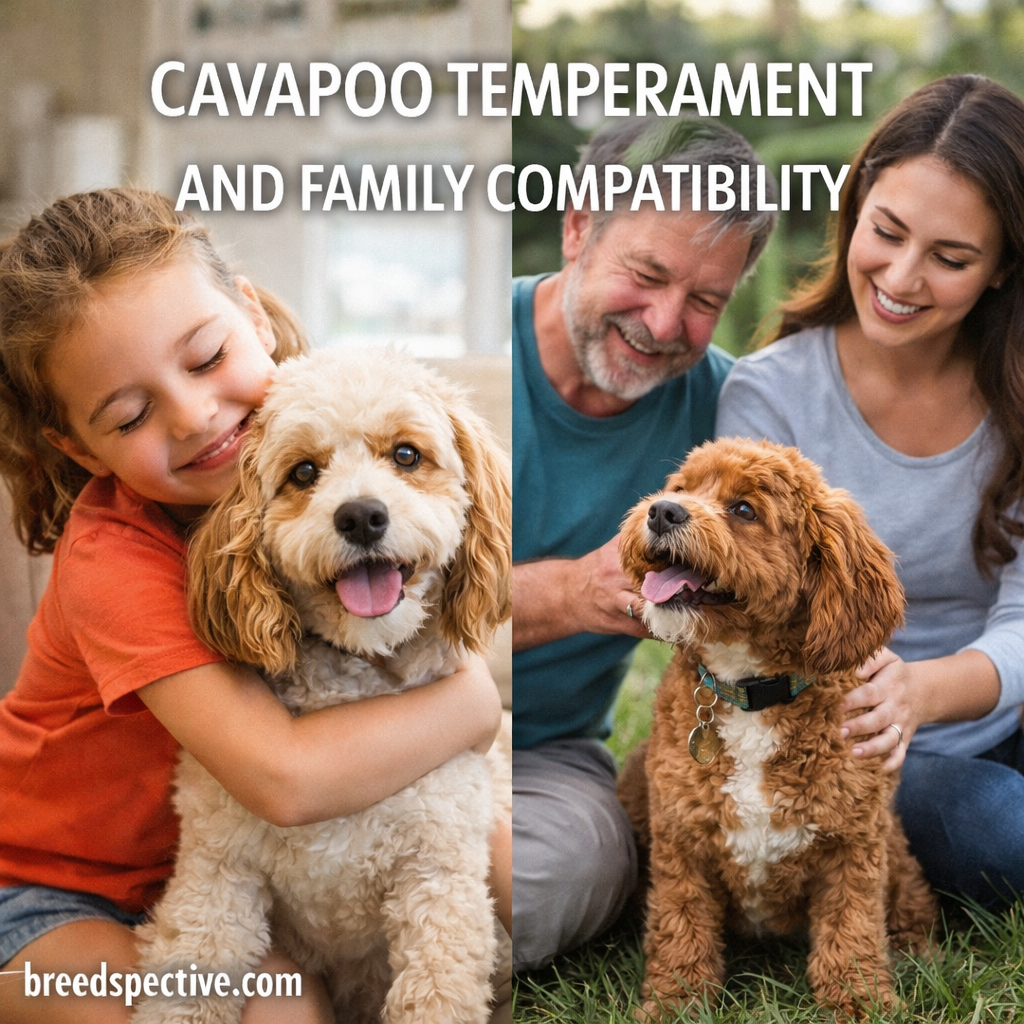
Cavapoo temperament is typically affectionate, social, playful, intelligent, and strongly people-oriented, although no mixed-breed puppy can be guaranteed to inherit a particular personality. Crossing a Cavalier King Charles Spaniel with a Toy or Miniature Poodle often produces a small companion dog that enjoys family life and training, but prospective owners should be prepared for grooming, possible separation difficulties, and inherited health risks from both parent breeds.
Cavapoos are typically among the smaller popular Poodle crosses, making them appealing to families, apartment dwellers and older adults. Their manageable size should not be mistaken for zero-maintenance ownership: coat care can be substantial, and responsible breeding requires considerably more than producing two attractive parent dogs.
Cavapoo at a Glance
| Trait | Typical Cavapoo |
|---|---|
| Parent breeds | Cavalier King Charles Spaniel × Toy or Miniature Poodle |
| Size | Usually small; varies with parents |
| Coat | Wavy, curly or less commonly straighter |
| Shedding | Variable; low shedding is possible but not guaranteed |
| Exercise needs | Moderate |
| Grooming | Moderate-high to high |
| Trainability | Usually good |
| Good with children? | Often, with respectful handling and supervision |
| Good with other dogs? | Often |
| Good with cats? | Often possible with appropriate introductions |
| Alone-time tolerance | Can be challenging for strongly attached individuals |
| Best fit | Household wanting an interactive small companion |
Because the Cavapoo is a cross rather than a standardized breed, size, coat, behavior and appearance can vary more than marketing photos suggest.
The Poodle parent may be Toy or Miniature. That distinction matters. A puppy from a Toy Poodle parent can mature quite differently in size and physical robustness from one whose Poodle parent is a larger Miniature.
Where Did the Cavapoo Come From?

The Cavapoo combines two established companion breeds with very different histories.
The Cavalier King Charles Spaniel was developed as a small companion spaniel and is known for a gentle, people-oriented character. The Poodle began as a working water retriever and remains an athletic, highly intelligent breed despite its modern reputation as a companion and show dog.
Our complete guide to Poodle temperament, energy level and lifestyle fit explains that side of the cross in more detail.
Crossing the two does not create a precise 50/50 blend of every characteristic.
Genes do not divide personality, coat, size and health into perfectly predictable halves. Two puppies from the same litter can differ noticeably in coat texture, confidence, activity level and adult appearance.
That variability is central to evaluating a Cavapoo realistically.
Cavapoo Temperament in Everyday Family Life
The qualities people usually seek in a Cavapoo are companionship and sociability.
A well-adjusted Cavapoo may enjoy sitting beside someone on the couch, following family members around the house, playing short games, learning tricks and accompanying its people on outings.
The Cavalier side can contribute strong companion-dog tendencies, while the Poodle side can contribute considerable intelligence, alertness and enthusiasm for learning.
Affection and Attachment
Many Cavapoos are highly people-focused.
That can be appealing if you want a dog that actively seeks interaction. It can become less convenient when the dog has never learned that being separated from a person is safe.
Start independence training during puppyhood.
A puppy should gradually learn to:
- Rest in a separate bed or pen
- Occupy itself with a safe chew
- Remain calm when someone leaves a room
- Spend short periods alone
- Settle without constant touching
- Sleep or relax while normal household activity continues
Do not wait for separation distress to appear before teaching independence.
Are Cavapoos Good With Children?
Cavapoos can be excellent family companions, but their small size changes the safety equation.
A young child can accidentally injure a small dog by dropping it, falling on it, grabbing it or trying to carry it. Puppies can also become overwhelmed by fast, noisy play.
Adults should supervise interactions and teach children to let the dog leave when it wants space.
The best match is not simply “Cavapoo plus children.” It is a socially stable dog plus children who have been taught appropriate animal handling.
Cavapoos With Other Pets
Many Cavapoos can live successfully with other dogs and cats.
Early socialization and careful introductions help, but compatibility always depends on the individual animals involved.
Do not assume that being a Poodle cross automatically means a dog has no prey or chasing behavior. Poodles have working retriever ancestry, and individual Cavapoos can differ considerably in their interest in movement.
Cavapoo Energy and Exercise Needs
Cavapoos generally occupy a useful middle ground: active enough to enjoy walks and play without normally requiring the workload of a high-drive herding or sporting breed.
For many healthy adults, roughly 30–60 minutes of daily physical activity, divided into walks and play, is a practical starting range rather than a medical prescription.
Individual needs vary according to size, age and which parental characteristics are strongest.
Useful activities include:
- Neighborhood walks
- Fetch
- Short training sessions
- Scent games
- Food puzzles
- Gentle hiking
- Trick training
- Interactive indoor play
The Poodle influence means mental activity should not be ignored.
A Cavapoo may be physically small but still learn quickly enough to become bored by a repetitive routine.
People primarily seeking a very quiet companion should compare the Cavapoo with genuinely lower-energy dogs suitable for apartment living rather than assuming every small dog has minimal exercise needs.
Common Cavapoo Behavior Traits
The most common challenges are usually manageable, but buyers should know about them before choosing the cross.
Separation-Related Behavior
A strongly attached Cavapoo may bark, whine, pace or become distressed when left alone.
Prevention starts with gradual independence rather than keeping a puppy beside someone every minute for its first several months.
Severe separation anxiety is a behavioral disorder, not disobedience. A dog showing panic, persistent destruction around exits, self-injury or extreme distress needs appropriate veterinary or behavioral guidance.
Barking and Alerting
Some Cavapoos are more alert than prospective owners expect.
A Poodle can be highly observant, and either parent may produce a dog that quickly notices hallway noises, visitors or activity outside a window.
Teach a quiet cue and reinforce calm behavior instead of repeatedly shouting over barking.
Jumping and Overexcited Greetings
Friendly dogs can develop poor greeting manners because people unintentionally reward jumping with attention.
Reward four paws on the floor and teach a predictable greeting behavior such as sitting or standing calmly.
House-Training
Small puppies have small bladders and require frequent opportunities outside.
Use a consistent schedule after sleeping, eating, drinking and active play. Reward outdoor elimination immediately rather than punishing accidents indoors.
Clinginess
Following someone from room to room may seem endearing, but a dog should still learn to function independently.
Deliberately build quiet periods into the day when nothing entertaining happens.
Cavapoo Coat Types: F1, F1B and F2
Generation labels tell you about ancestry.
They do not guarantee a coat.
| Generation | Common meaning | Coat expectations |
|---|---|---|
| F1 | Cavalier × Poodle | Can range from loose waves to curls or a straighter coat |
| F1B | Usually F1 Cavapoo × Poodle | May increase the chance of Poodle-like coat traits, but no guarantee |
| F2 | F1 Cavapoo × F1 Cavapoo | Coat characteristics can vary considerably among littermates |
Terms such as F1B should also prompt you to ask exactly what the breeder means. Do not rely on the label without seeing the pedigree.
Is a Cavapoo Hypoallergenic?
No breeder can responsibly guarantee that a Cavapoo will be “hypoallergenic.”
Some Cavapoos shed very little. Others shed noticeably.
Even a curly, low-shedding coat still requires substantial grooming.
Our guide to low-shedding dog breeds explains why low shedding and allergy-friendly are not interchangeable promises.
If allergies are a major concern, spend time around adult dogs with similar coats before committing rather than relying on a puppy’s appearance.
Cavapoo Grooming Expectations
Grooming is one of the most underestimated parts of Cavapoo ownership.
A soft wavy or curly coat can trap loose hair instead of dropping it onto the floor. Without regular combing, that retained hair can contribute to tangles and mats close to the skin.
Expect to:
- Brush and comb thoroughly several times per week
- Pay particular attention behind the ears, legs, chest and friction areas
- Keep nails appropriately trimmed
- Maintain dental care
- Check ears regularly
- Schedule professional grooming if keeping a longer or shaped coat
Many owners use a professional groomer approximately every 6–8 weeks, although coat length, texture and the owner’s home-grooming ability can shorten or extend that interval.
A shorter clip reduces daily coat work but does not eliminate grooming.
Parent-Breed Health Testing Matters
A mixed-breed puppy can inherit disease-associated genes and structural problems from either side of its pedigree.
Crossing two breeds does not make health screening unnecessary.
For Cavapoos, buyers should evaluate the Cavalier parent according to Cavalier recommendations and the Poodle parent according to the recommendations for its Poodle variety.
Cavalier King Charles Spaniel Parent
The Cavalier King Charles Spaniel Club, USA recommends that breeding Cavaliers receive:
- Cardiac clearance by a board-certified veterinary cardiologist
- Eye examination by a board-certified veterinary ophthalmologist
- Patellar evaluation
- Hip evaluation submitted to OFA
The club recommends a minimum cardiology clearance at age 2½ years and subsequent periodic heart, eye and patellar examinations. (ckcsc.org)
Mitral Valve Disease Deserves Special Attention
Cardiac screening is not a box to overlook.
Cornell University College of Veterinary Medicine identifies Cavalier King Charles Spaniels among the small breeds commonly affected by degenerative mitral valve disease and notes a genetic link to myxomatous mitral valve degeneration in Cavaliers. (vet.cornell.edu)
The Cavalier King Charles Spaniel Club likewise treats mitral valve disease as a major inherited health concern and recommends cardiologist screening of breeding dogs. (ckcsc.org)
A breeder saying, “My vet listened to the heart and it sounded fine,” is not equivalent to producing the parent-club-recommended cardiology clearance.
Toy Poodle Parent
The Poodle Club of America currently recommends the following screening for Toy Poodles:
- PRCD progressive retinal atrophy DNA test
- Annual eye examination by a board-certified veterinary ophthalmologist
- Patellar luxation evaluation
Miniature Poodle Parent
For Miniature Poodles, the Poodle Club of America recommends:
- PRCD progressive retinal atrophy DNA test
- Annual ophthalmologist eye examination
- Patellar luxation evaluation
- Hip dysplasia evaluation through OFA or PennHIP
The difference matters because a Cavapoo breeder using a Miniature Poodle should not present a Toy Poodle screening package as sufficient.
Ask for Actual Results
Do not settle for phrases such as:
- “Health tested”
- “DNA tested”
- “Parents are healthy”
- “Vet checked”
- “Genetically cleared”
Ask for registered names or identification information and verify the actual results.
OFA’s CHIC system is designed around breed-specific screening established with parent clubs. A DNA panel alone cannot replace cardiac examinations, specialist eye examinations, patellar evaluations or hip imaging when those tests are appropriate.
How to Avoid Cavapoo Puppy Mills and Poor Breeders
The popularity of Poodle crosses creates a large market for puppies, and polished websites do not tell you how dogs are bred.
The Cavalier King Charles Spaniel Club warns buyers to be particularly cautious about sellers who minimize Cavalier health problems, provide little verifiable health information, sell through pet stores or operate websites centered on readily available puppies rather than responsible breeding. (ckcsc.org)
For a Cavapoo, focus on evidence rather than marketing.
Good Signs
Look for a breeder who:
- Identifies both parents clearly
- Provides verifiable parent-breed health testing
- Discusses mitral valve disease openly
- Uses the correct Poodle screening for Toy or Miniature parents
- Lets you see where puppies and adult dogs are raised
- Discusses temperament as well as appearance
- Does not promise a perfectly predictable adult size or coat
- Does not guarantee that every puppy is non-shedding or hypoallergenic
- Provides veterinary records and a written contract
- Asks questions about your household
- Has a plan for dogs that need to be returned or rehomed
The Poodle Club of America’s ethics guidance likewise emphasizes hereditary health testing, making proof available to puppy buyers, screening prospective homes and taking continuing responsibility for dogs produced. (poodleclubofamerica.org)
Red Flags
Be cautious if the seller:
- Always has multiple litters immediately available
- Breeds many unrelated “designer” crosses
- Charges primarily according to color
- Markets “teacup” Cavapoos
- Cannot show health clearances
- Claims mixed breeding eliminates genetic disease
- Uses only a commercial DNA panel as “complete” health testing
- Will not identify the puppy’s parents
- Guarantees a precise adult weight
- Guarantees zero shedding
- Refuses reasonable questions about health or living conditions
- Pressures you to send a deposit immediately
A high price does not prove responsible breeding.
Health testing does cost money, but expensive puppies can still come from poor breeding programs.
Are Cavapoos Good for First-Time Owners?
They can be.
Their manageable size, social nature and trainability can make them approachable for a prepared novice. Our guide to the best dog breeds for first-time owners explains the broader traits that tend to make ownership easier.
The catch is grooming and attachment.
A first-time owner who expects a virtually maintenance-free teddy-bear dog may find the Cavapoo considerably more demanding than expected.
Are Cavapoos Good for Seniors?
A small companion dog with moderate exercise needs can work well for some older adults.
The Cavapoo’s typical interest in companionship and manageable physical size can be advantages. Our guide to dog breeds for seniors covers other factors worth comparing, including grooming, exercise and physical manageability.
Consider the full care workload rather than size alone.
Regular professional grooming, veterinary care, daily walking and the possibility of a 12-plus-year commitment still need to fit the household.
Who Should Think Twice About a Cavapoo?
A Cavapoo may be a poor match if:
- The dog will routinely spend very long days alone
- Professional grooming is outside your budget
- You want a reliably non-shedding dog
- You do not want to brush a coat several times per week
- You expect crossbreeding to guarantee freedom from inherited disease
- You want a highly independent companion
- You are unwilling to research the breeder beyond its website
The Cavapoo’s small size makes it adaptable, not effortless.
Before choosing one primarily because of appearance or popularity, compare its requirements with your household using our guide to choosing the right dog breed for your lifestyle.
Verdict: Is a Cavapoo Right for Your Family?
A Cavapoo is a strong fit for a household that wants a small, affectionate, interactive companion and is prepared for regular grooming, daily walks, training and plenty of human contact. Families with respectful children, first-time owners willing to learn, active older adults and many multi-pet households may find the cross particularly appealing.
A Cavapoo is not the right choice for someone seeking a guaranteed hypoallergenic coat, a dog that can routinely be left alone all day, or a puppy whose health can be judged from appearance and a basic DNA panel.
The biggest decision may come before the puppy ever enters your home. Because Cavaliers carry significant inherited health concerns—including mitral valve disease—and Toy and Miniature Poodles have their own recommended screening protocols, choosing a breeder who can document appropriate testing for both sides of the cross matters more than coat color, generation label or teddy-bear appearance.