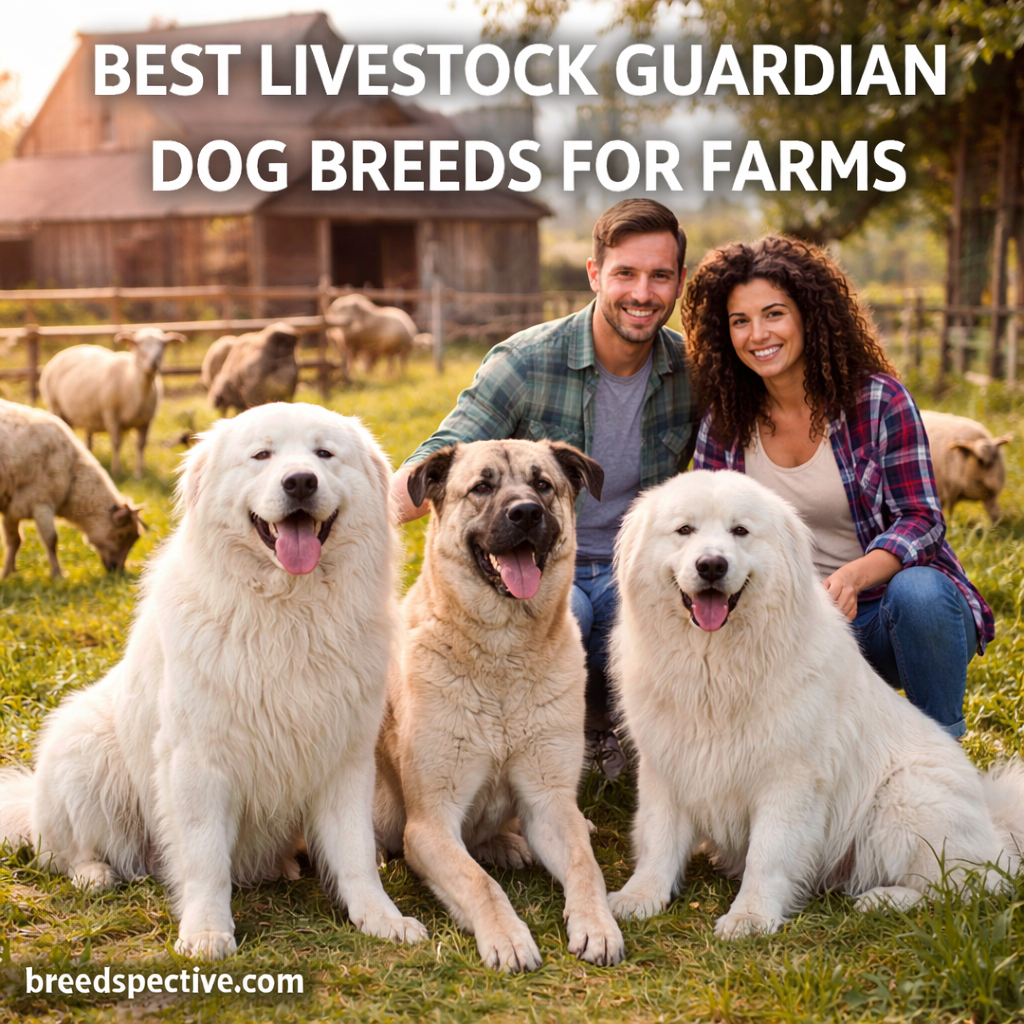
The best livestock guardian dog breeds include the Great Pyrenees, Anatolian Shepherd, Maremma Sheepdog, Akbash, and Kangal. The right choice depends on your livestock, predator pressure, acreage, fencing, climate, and experience because these are independent working dogs bred to live with livestock and deter threats rather than wait for constant commands.
For many North American farms, the Great Pyrenees is a practical starting point. Farms facing heavier predator pressure or working in hotter, more open terrain may consider an Anatolian Shepherd, Kangal, or Akbash, while the Maremma has a long history as a dedicated flock guardian.
Livestock Guardian Breeds at a Glance
| Breed | Working Style | Climate Considerations | Strongest Fit | Major Trade-Off |
|---|---|---|---|---|
| Great Pyrenees | Watchful, vocal, territorial | Excels in cooler conditions | Sheep, goats and varied farms | Barking and roaming |
| Anatolian Shepherd | Independent, athletic, assertive | Handles heat well | Large acreage, serious predator pressure | Requires experienced management |
| Maremma Sheepdog | Flock-focused, watchful | Adaptable with proper management | Sheep and other small livestock | Independent and territorial |
| Akbash | Athletic, alert, independent | Well suited to open terrain | Large properties and mobile flocks | Can roam without excellent fencing |
| Kangal | Powerful, mobile, highly protective | Developed for demanding terrain | Large operations and substantial predators | Size, strength and independence |
These breeds share a basic purpose, but individual dogs vary. A well-raised guardian from proven working lines is generally more useful than choosing solely because a breed has an intimidating appearance.
What Is a Livestock Guardian Dog?
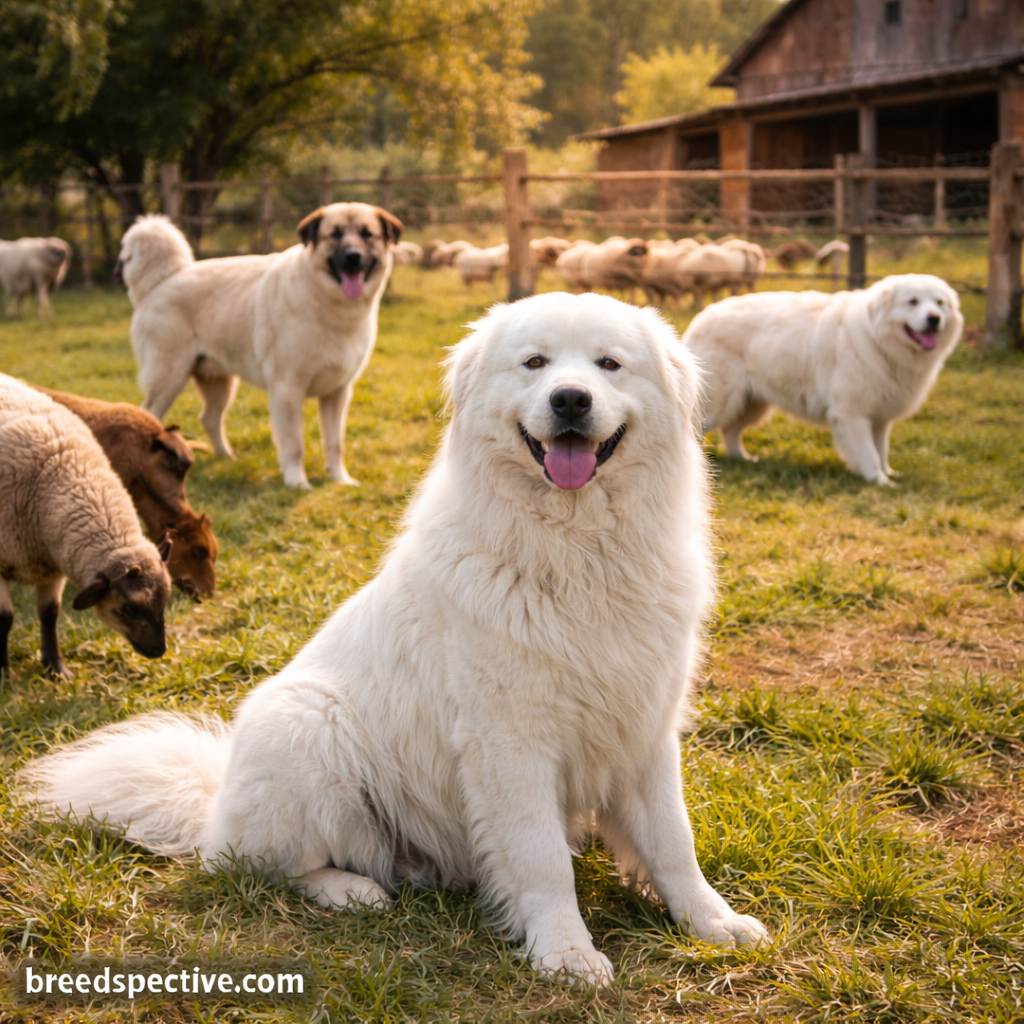
A livestock guardian dog, or LGD, is not the same thing as a herding dog or conventional property-protection dog.
Herding breeds move and control livestock in cooperation with a handler. Livestock guardians are raised to stay with the animals, recognize them as part of their social group, watch for threats, and discourage predators from approaching.
USDA Animal and Plant Health Inspection Service guidance describes LGDs as specially bred and reared dogs that bond with and watch over livestock. Their presence, scent marking, barking, and defensive behavior can all contribute to predator deterrence.
That difference explains why successful LGDs tend to be:
- Independent
- Calm around livestock
- Alert to changes in their environment
- Territorial
- Comfortable spending extensive time outdoors
- Willing to make decisions without waiting for a handler
- Physically capable of traveling with their livestock
They still need handling and training.
Independence should not be confused with a dog requiring no management.
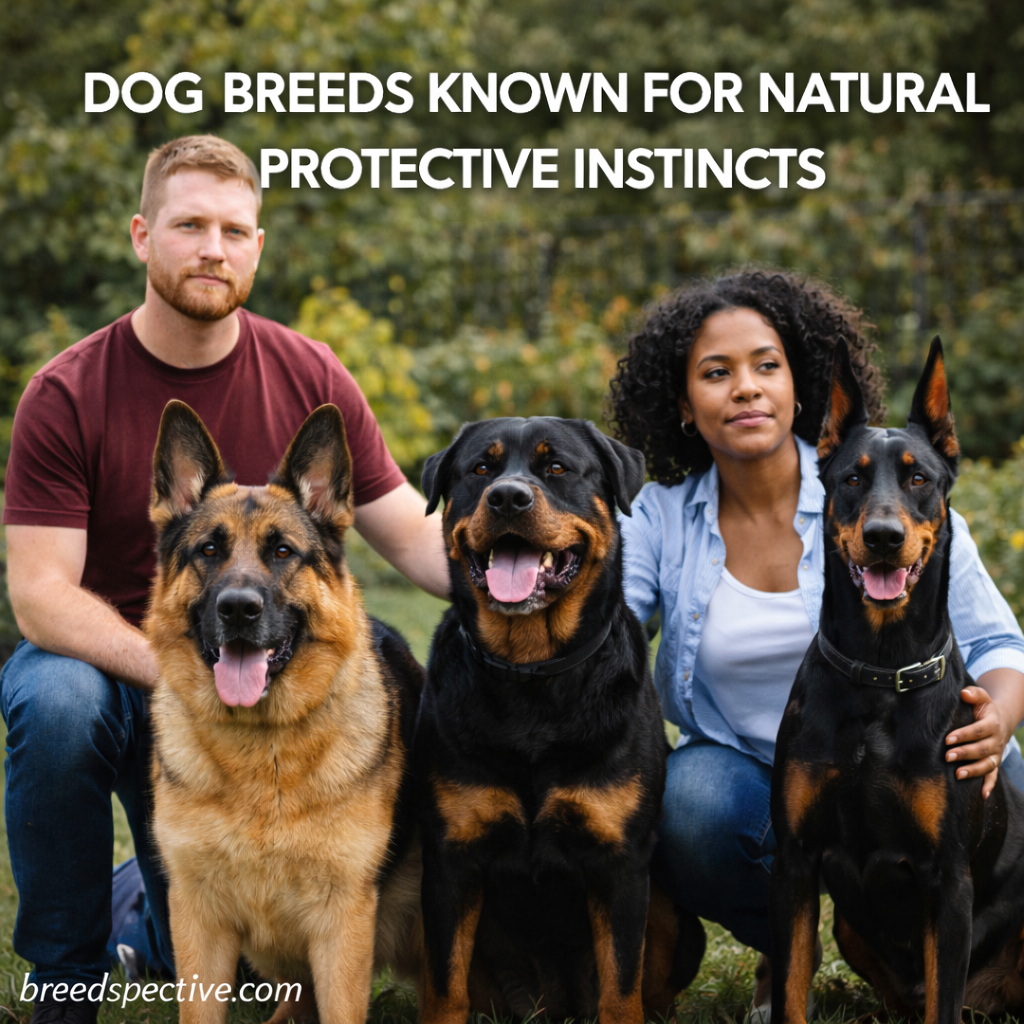
If you are researching protective dogs more broadly rather than specifically for livestock, see our guide to dog breeds known for natural protective instincts.
1. Great Pyrenees
The Great Pyrenees is one of the most recognizable livestock guardian breeds in North America and remains a practical option for sheep and goat operations.
These large, heavily coated dogs were developed for flock protection and tend to combine vigilance with the ability to remain relatively calm around the animals they know.
They can patrol, investigate disturbances, bark at potential threats, and position themselves between livestock and something they consider suspicious.
Why Great Pyrenees work on farms
They offer:
- Strong guardian instincts
- Substantial physical presence
- A long history of flock protection
- Good tolerance of cold weather
- Independence appropriate to guardian work
The breed’s barking needs serious consideration.
Guardian dogs use vocalization as part of deterrence. Great Pyrenees can be particularly vocal at night, when predators may be active and the dog is listening and watching for unusual movement.
On a remote farm, that can be useful.
On five acres surrounded by close neighbors, it can become a conflict.
Secure fencing is equally important because livestock guardians may expand the territory they patrol when boundaries are unclear.
2. Anatolian Shepherd
The Anatolian Shepherd is a serious guardian for farms needing an athletic, independent dog capable of working across substantial territory.
The breed’s guardian style is closely connected to livestock protection in Turkey, where dogs developed for demanding conditions needed to function without constant human direction.
That independence can be an asset on a farm and a challenge everywhere else.
An Anatolian is not a large obedience dog that happens to guard livestock. Its tendency to evaluate situations independently is part of the working package.
A guardian with conservation credentials
The Cheetah Conservation Fund (CCF) provides a particularly useful example of the breed working in modern agriculture.
CCF breeds Anatolian Shepherd and Kangal dogs in Namibia and places them with farmers as puppies. The dogs bond with livestock and use their size, presence, and barking to deter cheetahs and other predators.
The goal extends beyond protecting livestock: reducing losses gives farmers less reason to kill cheetahs in response to predation. CCF has operated its Livestock Guarding Dog Program since 1994 and continues to use Anatolian Shepherds and Kangals as a nonlethal predator-management tool.
Best suited to:
- Larger properties
- Experienced livestock owners
- Hot or demanding environments
- Farms facing meaningful predator pressure
- Operations with secure boundaries
The same independence that makes an Anatolian useful in the field can make it unsuitable for someone expecting immediate obedience or easy suburban-pet behavior.
3. Maremma Sheepdog
The Maremma Sheepdog comes from Italy’s livestock-guardian tradition and is closely associated with protecting sheep.
Like other true LGDs, its job is not to constantly move the flock. The dog stays with or near the livestock and monitors the environment.
Maremmas can be useful for farms wanting a guardian that remains strongly oriented toward its stock.
Strengths include:
- Flock-oriented working behavior
- Independence
- Territorial awareness
- Substantial coat for outdoor work
- Ability to work without constant commands
As with the Great Pyrenees, the heavy coat and guardian instincts need to be considered in the context of climate, fencing, and neighboring properties.
A Maremma is still a large, independent working dog. Good livestock behavior develops through appropriate genetics, early bonding, supervision, and maturity rather than simply putting a puppy in a pasture and expecting instinct to handle everything.
4. Akbash
The Akbash is another Turkish livestock guardian, typically lighter and more athletic in appearance than some of the heavier guardian breeds.
That athleticism can be useful where the dog needs to move across open terrain with livestock.
The Akbash is independent and naturally watchful, characteristics that suit traditional guardian work but require capable management.
Best suited to:
- Larger fenced properties
- Open terrain
- Owners familiar with independent dogs
- Operations requiring a mobile guardian
An Akbash should not be selected because someone wants a quieter alternative to another LGD.
Individual barking behavior varies, and vocalization is a normal tool livestock guardians may use to discourage approaching threats.
The larger issue is whether the dog’s working style, livestock background, and breeder’s lines fit the operation.
5. Kangal
The Kangal is one of the most formidable livestock guardian breeds, combining size, athleticism, independence, and strong protective instincts.
It originated as a livestock guardian in Turkey and is used in environments where dogs may need to deter serious predators.
The Kangal’s physical power attracts considerable attention online, but focusing on bite strength or hypothetical fights misses the purpose of the breed.
A successful Kangal does not need to fight everything that approaches.
An LGD’s presence, scent, posture, barking, patrol behavior, and willingness to defend livestock can discourage a predator before physical contact becomes necessary.
CCF’s program in Namibia illustrates that principle. Its Kangal and Anatolian Shepherd dogs are placed with farmers to protect small livestock from cheetahs and other predators. CCF explains that barking and the dogs’ imposing presence frequently discourage predators from approaching livestock in the first place.
Best suited to:
- Large rural properties
- Serious working homes
- Experienced handlers
- Farms with appropriate livestock
- Operations facing substantial predator pressure
This is not a breed to choose because you want the “strongest” dog.
Its independence and physical power create considerable management responsibilities.
Kangal vs. Other Livestock Guardian Breeds
The Kangal is sometimes portrayed as the ultimate livestock guardian, but farms do not benefit from choosing breeds as if they were competing in a strength contest.
The best guardian is the one that works effectively in the specific agricultural system.
| Trait | Kangal | Great Pyrenees | Anatolian Shepherd | Maremma | Akbash |
|---|---|---|---|---|---|
| Physical size | Very large | Very large | Very large | Large | Large–very large |
| Independence | Very high | High | Very high | High | Very high |
| Heavy coat | Moderate | Very heavy | Shorter/moderate | Heavy | Short–medium |
| Cold-weather suitability | Good with appropriate shelter | Excellent | Good | Very good | Good |
| Hot-climate practicality | Good | More challenging | Very good | Moderate | Very good |
| Vocal deterrence | Significant | Often substantial | Significant | Significant | Variable |
| Beginner friendliness | Low | Moderate for a true LGD | Low | Moderate | Low |
The table describes broad tendencies, not guarantees.
Working lines, upbringing, livestock experience, age, and the individual dog’s temperament can be as important as the breed name.
Kangal vs. Cane Corso: Different Dogs for Different Jobs
Kangals and Cane Corsos are both large, powerful dogs with protective instincts, but they were developed around different working roles.
The Kangal belongs to the livestock guardian tradition. Its job requires spending extended periods around livestock, monitoring large areas, evaluating threats independently, and deterring predators.
The Cane Corso developed in a broader guardian and working context rather than as a specialized flock-living LGD in the same sense as the Kangal.
That distinction matters more than which dog is physically stronger.
Kangal
Best associated with:
- Living and working around livestock
- Independent predator assessment
- Large rural territories
- Flock and herd protection
- Less dependence on constant human instruction
Cane Corso
Better associated with:
- Close human handling
- Property and household guarding
- Structured training
- Working in closer partnership with an owner
For livestock protection, choose a dog from genuine livestock guardian lines rather than selecting a protection breed simply because it is large or intimidating.
The same distinction applies to other popular protection breeds. A Rottweiler’s temperament and working characteristics or a German Shepherd’s temperament and lifestyle requirements may suit other protective or working roles, but neither is a substitute for a purpose-bred LGD raised to bond with livestock.
How Livestock Guardian Dogs Are Raised With Livestock
A guardian puppy’s upbringing is central to the job.
LGDs are generally introduced to the livestock they will protect while young so that strong social bonds can develop. The USDA describes these dogs as both specially bred and reared to bond with livestock.
The Cheetah Conservation Fund uses the same principle. Its puppies are raised around goats and sheep before placement, then sent to farms where they continue living and working with livestock.
Historically, CCF has placed puppies with the type of small stock they are intended to guard while the dogs are still young.
Early bonding
The puppy needs regular, safe contact with appropriate livestock.
That does not mean throwing a young dog into a large pasture and leaving it unsupervised.
Puppies are immature. Chasing, rough play, chewing, and inappropriate interactions can occur and need correction and management.
The objective is for the dog to learn that livestock are part of its normal social environment, not prey or playthings.
Human handling still matters
An LGD should bond with livestock, but it also needs to be manageable by people.
A working dog may need to:
- Accept veterinary examinations
- Be vaccinated
- Take medication
- Walk on a leash
- Enter a vehicle
- Accept basic restraint
- Come when necessary
- Respect gates and fences
Avoiding all human contact does not create a better guardian.
The goal is a dog whose primary working relationship is with its livestock but that can still be handled safely when necessary.
Adolescence requires supervision
A large adolescent LGD may look physically mature before its judgment is mature.
Young dogs can play too roughly with stock, chase animals, wander, or make poor decisions.
Supervision and correction remain necessary as the dog develops.
CCF’s program includes follow-up after dogs are placed with farmers rather than assuming the job is complete when the puppy arrives. That reflects an important principle: developing a dependable guardian is a process.
Match the Dog to the Livestock
“Farm dog” is too broad a job description.
A farm may contain:
- Sheep
- Goats
- Cattle
- Chickens
- Turkeys
- Ducks
- Horses
- Alpacas
- Mixed livestock
A dog experienced with sheep should not automatically be assumed safe with poultry.
Birds can be especially challenging for young dogs because their quick movement may encourage chasing or play.
Ask breeders specifically what livestock their dogs and puppies have worked around.
Working parents with demonstrated livestock behavior provide more useful information than selecting a puppy from companion-only lines because its breed appears on an LGD list.
Predator Pressure Changes the Equation
A small farm dealing mainly with foxes and occasional coyotes has different requirements from open rangeland containing wolves or other large predators.
USDA guidance emphasizes matching the number and breed of LGDs to the operation and predator situation.
Consider:
- Predator species
- Number of predators
- Livestock species
- Herd or flock size
- Acreage
- Terrain
- Vegetation
- Whether livestock remain together or scatter
- Nighttime housing
- Existing fencing
- Human presence
One dog is not automatically enough.
USDA guidance also notes that livestock guardian dogs can be less effective where livestock are highly dispersed. Predator pressure and operation size may influence how many guardians are appropriate.
LGDs work best as part of a broader livestock-management system rather than as a single guaranteed solution.
Fencing Is Part of the Guardian System
A livestock guardian needs boundaries.
Do not assume loyalty to livestock guarantees the dog will remain inside an unfenced property.
Guardians may investigate smells, sounds, wildlife, neighboring dogs, or potential threats outside the area an owner considers the farm boundary.
Secure fencing helps:
- Keep the dog with its livestock
- Prevent roaming onto neighboring properties
- Reduce road risks
- Limit encounters with unfamiliar dogs or people
- Define the territory being protected
A dog repeatedly leaving the farm cannot reliably guard the animals it was meant to protect.
Before choosing any breed, factor property size, fencing, neighbors, and daily management into the broader question of choosing the right dog for your lifestyle and environment.
Barking Is Often Part of the Job
Someone wanting a silent livestock guardian is likely to be disappointed.
Barking serves a purpose.
A guardian can announce its presence to predators without needing physical contact. USDA guidance specifically identifies barking and scent marking as behaviors that can signal occupied territory to wolves.
Great Pyrenees are particularly well known for nighttime vigilance and barking.
That behavior can be an asset on remote acreage and a serious problem near neighbors.
Before getting an LGD, stand outside your house at midnight and consider how far sound carries. Rural does not always mean isolated.
If nearby homes, rental properties, or local noise ordinances make persistent nighttime barking unacceptable, an LGD may be the wrong management tool regardless of breed.
Common Livestock Guardian Dog Mistakes
Expecting herding behavior
LGDs protect livestock; they do not replace Border Collies or other herding dogs used to move stock.
Choosing for intimidation
The biggest or most powerful dog is not automatically the most useful guardian. Livestock compatibility and working judgment matter more.
Insufficient fencing
Roaming can create conflicts with roads, neighbors, wildlife, and other dogs while leaving the livestock unprotected.
Leaving a puppy unsupervised too soon
Guardian instincts do not eliminate puppy behavior.
Young dogs need monitoring while they learn appropriate livestock interactions.
Expecting pet-style obedience
Basic handling and safety cues are valuable, but independent decision-making is part of LGD work.
Assuming every purebred LGD will work
Breed creates tendencies, not guarantees.
USDA material notes that livestock guardian effectiveness depends on appropriate breeding, rearing, bonding, and staying with the animals being protected.
Ignoring ongoing costs
A very large working dog requires food, preventive care, vaccinations, parasite control, veterinary treatment, fencing, shelter, and potentially emergency care.
Those costs continue even during periods when predator pressure is low.
Questions to Ask Before Buying a Guardian Puppy
A breeder supplying actual working farms should be able to discuss more than appearance and registration papers.
Ask:
- Do the parents actively guard livestock?
- What species do they guard?
- What livestock are the puppies being raised around?
- Have the parents shown inappropriate aggression toward stock?
- How are puppies introduced to livestock?
- What predator pressure do the parents work under?
- How are the dogs contained?
- What problems commonly appear during adolescence?
- What health screening is performed?
- What support is available if the puppy develops livestock-related behavior problems?
For a working dog, proven function should carry considerable weight.
Verdict: Which Livestock Guardian Breed Is Best for Your Farm?
The Great Pyrenees is a strong option for many sheep and goat farms, particularly in cooler climates where substantial barking and a heavy coat are manageable.
The Anatolian Shepherd suits larger operations that need an athletic, highly independent guardian and have the experience and fencing to manage one.
The Maremma Sheepdog is well worth considering for dedicated flock protection, while the Akbash can suit operations wanting a mobile Turkish guardian for open terrain.
The Kangal is appropriate for serious livestock operations prepared for an exceptionally powerful, independent working dog. Its value is not that it can win hypothetical fights with other breeds; it is that generations of selection produced a dog capable of living with livestock, evaluating threats, and discouraging predators.
None of these breeds is right for someone who primarily wants a large family pet that occasionally watches farm animals. A livestock guardian is right for a farm prepared to provide livestock bonding from puppyhood, secure boundaries, supervision through adolescence, veterinary care, and a genuine daily job.