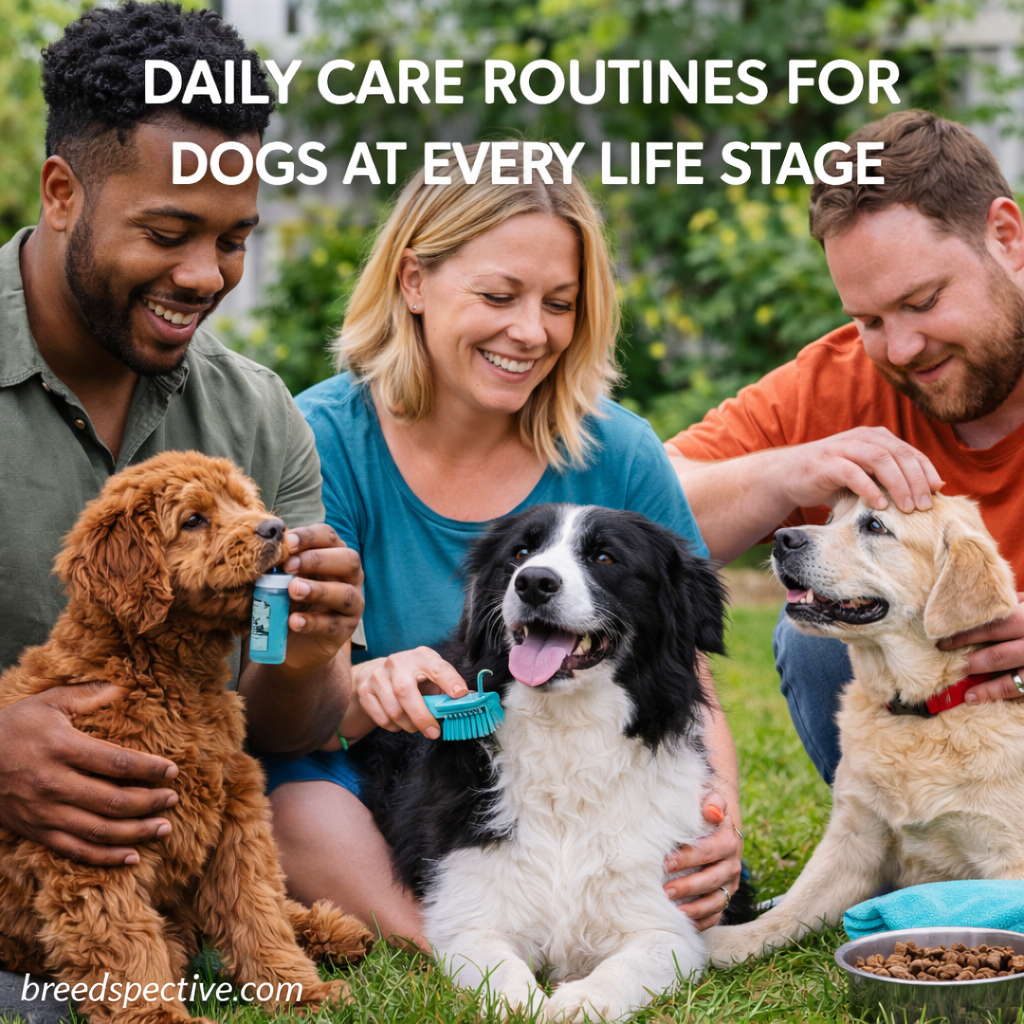
A good daily dog care routine covers feeding, fresh water, bathroom breaks, exercise, mental stimulation, social interaction and basic health monitoring. The routine should change as your dog ages: puppies need frequent supervision and training, adults need consistent exercise and preventive care, and senior dogs often need gentler activity, easier access to resources and closer health monitoring.
Breed, size, coat, health and energy level matter just as much as age. A young Border Collie and a young Bulldog, for example, should not automatically receive identical exercise routines simply because both are adults.
Daily Dog Care by Life Stage at a Glance
The AAHA Canine Life Stage Guidelines divide a dog’s life into puppy, young adult, mature adult and senior stages rather than assigning every dog the same “senior” birthday. AAHA considers the senior stage to be approximately the last 25% of a dog’s estimated lifespan, which means large and giant breeds can reach senior status earlier than many smaller dogs. (aaha.org)
For everyday care, it is useful to think in three broad groups:
| Care area | Puppy | Adult dog | Senior dog |
|---|---|---|---|
| Feeding | Growth-appropriate food; multiple meals depending on age | Measured adult diet based on body condition and activity | Individualized for health, weight and changing needs |
| Bathroom | Very frequent opportunities; active housetraining | Predictable routine | May need more frequent or easier access |
| Exercise | Short, age-appropriate activity and play | Based on breed, health and energy | Regular but often lower-impact |
| Training | Frequent short sessions | Reinforcement and new skills | Continue training at a comfortable pace |
| Mental enrichment | Exploration, toys, socialization | Scent games, toys, training and problem-solving | Gentle enrichment adjusted for mobility and senses |
| Grooming | Handling practice and coat care | Coat-specific routine | Coat, skin, nail and mobility checks become especially useful |
| Health monitoring | Growth, appetite, stool, behavior | Weight, teeth, skin, movement and behavior | Closer monitoring for changes in mobility, appetite and behavior |
This table is a starting point rather than a prescription. Your veterinarian can help adjust nutrition, exercise and preventive care to the individual dog.
Daily Care for Puppies
Puppyhood is the most supervision-intensive life stage.
A puppy is learning where to eliminate, what can be chewed, how to interact with people and animals, how to tolerate handling and what happens during a normal day. At the same time, the puppy is growing rapidly and progressing through an important series of veterinary visits.
A useful puppy routine revolves around four things: sleep, food, bathroom opportunities and short periods of activity or training.
Feeding a Puppy
Puppies need a nutritionally complete diet appropriate for growth. Meal frequency changes as puppies develop, so follow the feeding guidance for the food and your veterinarian’s recommendations rather than relying on one schedule for every age and breed.
Portion control matters.
AAHA’s life-stage guidance emphasizes maintaining an appropriate body condition during growth, particularly because nutritional requirements differ according to the puppy’s expected adult size. (aaha.org)
Large- and giant-breed puppies deserve particular attention to growth and nutrition. Faster growth is not automatically healthier growth.
Fresh water should be readily available, and food and water bowls should be cleaned regularly.
Bathroom Breaks and Housetraining
Puppies need substantially more bathroom opportunities than established adult dogs.
Trips outside are particularly useful after waking, eating, drinking, playing and before settling down for longer rest periods. Consistency makes it easier for the puppy to learn what you expect.
Accidents are part of the learning process, especially with very young puppies. Punishment does not teach a puppy where you wanted it to eliminate.
For a more detailed look at how housetraining develops, see our guide to potty training timelines by dog breed.
Exercise and Play for Puppies
Puppies need activity, but more exercise is not always better.
Play, exploration and short walks appropriate to the puppy’s age can provide physical and mental stimulation without treating a growing dog like an adult endurance athlete.
Training can be part of that enrichment. Brief sessions working on a name response, recall foundations, leash skills, handling and simple cues can be more useful than trying to exhaust a puppy physically.
Rest matters too. Puppies can switch quickly between intense activity and sleep, so the daily routine should provide quiet opportunities to settle.
Vaccinations and Early Veterinary Care
Puppies require a series of veterinary visits rather than one initial appointment.
AAHA’s canine vaccination guidelines recommend core puppy vaccines beginning at approximately 6–8 weeks of age, with subsequent doses generally given at intervals until the puppy is at least 16 weeks old. In higher-risk situations, a veterinarian may recommend extending the series beyond that point. (aaha.org)
Your veterinarian should determine the actual vaccination schedule based on the puppy’s age, history and risk.
This matters when planning socialization too. Do not improvise a vaccination schedule or assume that either complete isolation or unrestricted exposure is automatically appropriate. Ask your veterinarian how to balance developmental socialization with infectious-disease risks in your area.
If the puppy has only recently arrived, our guide to the first 30 days with a new pet covers the adjustment period in more detail.
Daily Care for Adult Dogs
Adulthood is when the routine established during puppyhood needs to become sustainable.
Most adult dogs need a predictable pattern of meals, bathroom breaks, exercise, interaction, rest and enrichment. The amount of each depends heavily on the dog.
A physically healthy working breed with high drive may need considerably more structured activity than a lower-energy companion breed. Two dogs of the same weight can still have very different daily requirements.
Feeding an Adult Dog
Adult feeding should support a healthy body condition rather than simply follow the maximum amount printed on a bag.
AAHA recommends evaluating nutrition and body condition throughout a dog’s life. Activity, reproductive status, health and individual metabolism can all affect energy requirements. (aaha.org)
Measured meals make it easier to know how much the dog is eating and to adjust portions if body condition changes.
Treats count too. Training rewards, chews and food given from the table all contribute to daily intake.
Exercise Should Match the Dog, Not a Generic Number
There is no responsible universal exercise target that fits every adult dog.
Breed tendencies provide useful clues, but the individual dog matters. Health, conditioning, age, weather and temperament can all change how much activity is appropriate.
Daily exercise might include:
- neighborhood walks;
- sniff-focused walks;
- controlled running for suitable, conditioned dogs;
- retrieving;
- tug and interactive games;
- training sessions;
- scent work; or
- other activities appropriate to the dog.
Mental work can be especially useful for dogs that need more than a walk around the block.
If you are trying to determine how much activity realistically fits your schedule, see our guide to matching a dog’s energy level to your daily routine.
Mental Stimulation Is Part of Daily Care
Exercise does not solve every boredom-related problem.
Dogs also benefit from opportunities to sniff, investigate, solve simple problems, learn and interact with people. Food puzzles, scent searches, training practice and rotating appropriate toys can add variety without requiring hours of intense physical activity.
Training should not disappear once the dog learns basic cues. Practicing useful behaviors throughout adulthood keeps communication clear and provides another form of engagement.
Dental Care Deserves a Place in the Routine
Dental health is easy to overlook because problems develop inside the mouth.
AAHA’s dental guidelines describe periodontal disease as one of the most common health problems in dogs and cats and recommend regular professional dental assessment combined with appropriate home care. (aaha.org)
Home dental care should therefore be treated as part of normal dog care rather than something that begins only when breath becomes unpleasant.
Ask your veterinarian how to introduce tooth brushing safely and which home-care products are appropriate for your dog. Human toothpaste should not be substituted for products intended for pets.
Also pay attention to changes such as difficulty eating, dropping food, reluctance to chew or other signs of oral discomfort and discuss them with your veterinarian.
Grooming Needs Depend on Coat Type
Every dog benefits from basic body checks, but grooming workload differs dramatically by coat.
A short-coated dog may require relatively modest brushing. A long, curly, continuously growing or mat-prone coat can require frequent brushing and professional grooming.
Daily or routine checks are useful for noticing:
- mats or tangles;
- unusual shedding;
- skin irritation;
- lumps or swelling;
- paw or nail problems;
- debris around the eyes; and
- changes in the ears.
Nails also need monitoring. Overgrown nails can affect comfort and movement.
Grooming requirements should be researched before choosing a breed, particularly if professional grooming will be needed throughout the dog’s life. Our guide to grooming needs by dog coat type explains how coat characteristics change the workload.
Daily Care for Senior Dogs
There is no single age when every dog becomes senior.
AAHA defines the senior period as the final 25% of estimated lifespan. Because expected lifespan varies with size and breed, a large or giant dog may enter this stage earlier than a small dog. (aaha.org)
Senior care should not mean removing activity from the dog’s life. It means adapting the routine to what the dog can comfortably do.
Keep Senior Dogs Moving
Regular activity can remain valuable as dogs age, but intensity may need to change.
A dog that once tolerated long hikes may do better with shorter walks. Slippery floors, steep stairs or jumping into a vehicle may become more challenging.
Watch the dog rather than the clock.
Changes in willingness to walk, climb stairs, stand up, jump or participate in familiar activities deserve attention. AAHA’s senior-care guidance emphasizes monitoring mobility and identifying pain rather than assuming reduced movement is simply an unavoidable part of aging. (aaha.org)
Make the Home Easier to Navigate
Senior dogs may benefit from practical environmental changes.
Depending on the individual, that can mean better traction on slippery floors, comfortable resting areas, easier access to favorite locations or more frequent opportunities to go outside.
Keep food, water and sleeping areas accessible.
Aging dogs may also require adjustments to grooming. A dog with stiffness may find standing through a long grooming session uncomfortable even if the coat requirements have not changed.
Monitor Changes More Closely
Daily familiarity makes owners particularly well placed to notice small changes.
Pay attention to appetite, water intake, weight, bathroom habits, mobility, sleep and behavior.
AAHA’s senior-care guidelines recommend more frequent veterinary evaluation for senior pets, with the exact schedule based on individual needs. (aaha.org)
Do not automatically label a significant physical or behavioral change as “old age.” Discuss it with your veterinarian.
Seasonal Dog Care: Your Routine Should Change With the Weather
A routine that works perfectly in spring may be inappropriate during a heat wave or freezing weather.
Dogs vary widely in their tolerance of environmental conditions, so breed, coat, body size, age, health and acclimation all matter.
Hot-Weather Care
Heat changes when and how dogs can safely exercise.
The AVMA recommends providing shade and plenty of fresh water and warns against exercising pets during the hottest parts of the day. It also emphasizes that vehicles can become dangerously hot and pets should not be left unattended in them. (avma.org)
During hot weather:
- move longer walks toward cooler parts of the day;
- keep fresh water available;
- provide access to a cool environment;
- adjust exercise intensity;
- consider hot walking surfaces; and
- watch the dog’s condition during activity.
Flat-faced dogs, older dogs and animals with certain medical problems may require additional caution. Ask your veterinarian about risks specific to your dog.
Seasonal care is another reason appearance should not be the only consideration when selecting a breed. Choosing a dog breed that fits your lifestyle includes the everyday demands that continue long after the initial excitement of bringing a dog home.
Cold-Weather and Winter Care
A thick coat does not make every dog immune to cold, and a short coat does not automatically tell you exactly how much cold a dog can tolerate.
The AVMA notes that cold tolerance varies among pets and recommends shortening walks in very cold weather when necessary. It also warns that paws can be affected by ice, snow and chemicals used for deicing. (avma.org)
Winter routines may need to include:
- shorter outdoor sessions in severe cold;
- checking paws after walks;
- removing ice, snow or deicing residue;
- providing a warm, dry resting area; and
- adjusting activity to the individual dog’s tolerance.
Do not assume a dog that loves playing in snow can remain outside indefinitely.
Flea and Tick Season Requires Planning
Parasite prevention is not simply a summer checklist item.
The AVMA notes that fleas and ticks can transmit diseases and recommends discussing parasite prevention with a veterinarian. Geographic location, travel, climate and the dog’s lifestyle all influence exposure.
AAHA likewise treats parasite control as part of preventive healthcare across canine life stages. (aaha.org)
Your veterinarian can recommend a prevention plan appropriate for where you live and where your dog travels.
During periods of higher tick exposure, checking the dog’s body after time outdoors is a useful addition to the routine. Pay particular attention to areas that are easy to overlook while grooming.
A Practical Daily, Weekly and Yearly Dog Care Checklist
Not every responsibility needs to happen every day. Separating tasks by frequency makes a routine easier to maintain.
| Frequency | Care tasks |
|---|---|
| Daily | Food, fresh water, bathroom opportunities, appropriate exercise, enrichment, social interaction and observation for health or behavior changes |
| Several times weekly/as needed | Coat care based on breed, dental home care as recommended, paw and skin checks, training practice |
| Regularly/as needed | Nail care, bathing, ear care and professional grooming depending on the dog |
| At least yearly | Veterinary wellness evaluation and review of nutrition, dental health, vaccination and parasite prevention |
| Senior stage | More frequent veterinary evaluation may be recommended based on age and health |
The most effective checklist is one that can actually be maintained.
An elaborate schedule that collapses after two weeks is less useful than a straightforward routine that reliably covers the dog’s physical, behavioral and medical needs.
How Dog Ownership Changes Your Own Routine
The dog’s schedule does not exist separately from yours.
Morning bathroom breaks happen even when you want to sleep late. Exercise still needs to happen during busy workweeks. Travel requires arrangements. A puppy can interrupt sleep and limit spontaneous plans. A senior dog may eventually need more frequent bathroom trips or medical appointments.
Costs change too. Food and basic supplies are predictable, but grooming, veterinary treatment, training, boarding and other expenses can add up. Our guide to the hidden costs of owning a dog or cat covers those less obvious commitments.
This is why the best daily routine is not necessarily the most intensive one. It is the routine that meets the individual dog’s needs and can realistically be sustained for years.
Verdict: Who Can Keep Up With a Dog’s Daily Care?
Dog ownership is a good fit for someone who can reliably build feeding, bathroom breaks, exercise, training, social interaction and preventive healthcare into everyday life—and adapt that routine as the dog moves from puppyhood through adulthood and into its senior years.
It is a poor fit for someone looking for a pet whose needs can routinely be postponed when work, travel or other commitments become inconvenient. Dogs differ enormously in how demanding their routines are, but none are maintenance-free.
The biggest advantage comes from choosing a dog whose normal needs already fit your life. A manageable routine should not require you to become a completely different person for the next decade. When breed, energy level, coat care, size and age align with the household, consistent daily care becomes much easier to sustain.