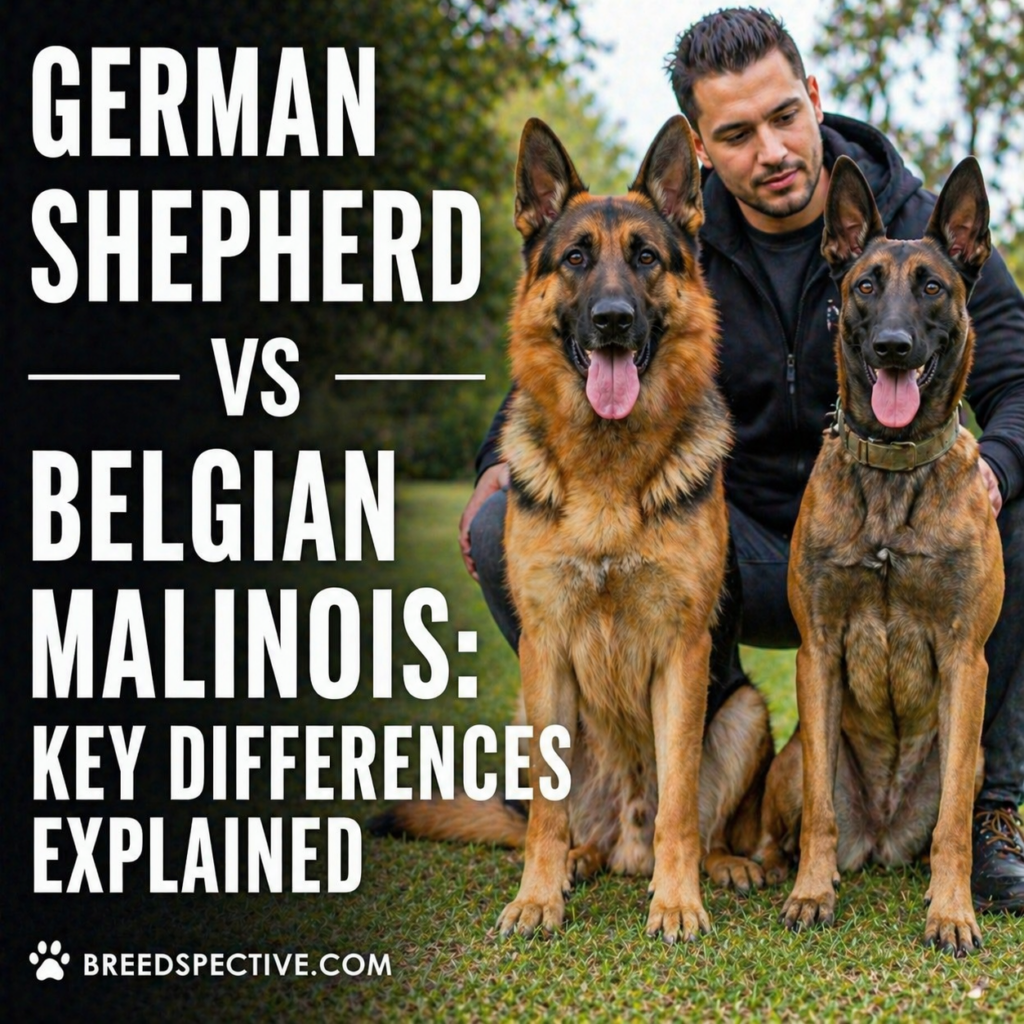
The German Shepherd and Belgian Malinois are intelligent, athletic working breeds, but the Malinois is generally lighter, more intensely work-driven and more demanding of sustained physical and mental activity. German Shepherds are also high-energy dogs that need serious training and exercise, but their larger build and all-purpose working heritage create a somewhat different ownership experience. The American Kennel Club (AKC) emphasizes that both breeds need substantial exercise, training and purposeful activity. American Kennel Club
Neither should be chosen simply because you want a protective-looking dog. These are capable herding breeds whose intelligence and working instincts require daily management.
German Shepherd vs Belgian Malinois at a Glance
| Trait | German Shepherd | Belgian Malinois |
|---|---|---|
| Height | Males 24–26 in.; females 22–24 in. | Males 24–26 in.; females 22–24 in. |
| Weight | Males 65–90 lb.; females 50–70 lb. | Males 60–80 lb.; females 40–60 lb. |
| Build | Larger, heavier, longer-bodied | Lighter, square-bodied and highly agile |
| Energy level | High | Very high |
| Work drive | High | Typically intense |
| Trainability | Excellent | Excellent, but demands consistency |
| Coat | Medium-length double coat | Short, weather-resistant coat |
| Grooming | Regular brushing; heavy seasonal shedding | Easier coat care; heavier seasonal shedding |
| Family fit | Can thrive with active, committed families | Best suited to highly active, experienced homes |
| Typical challenge | Exercise, shedding, training and protective instincts | Intensity, drive and constant need for productive activity |
The breeds are remarkably close in height, but weight reveals an important difference. AKC lists male German Shepherds at up to 90 pounds compared with 80 pounds for male Malinois; females can reach 70 pounds and 60 pounds respectively. AKC notes that most Malinois are lighter than German Shepherds despite their similar height. American Kennel Club
Different Origins, Similar Working Heritage
Both breeds belong to the Herding Group and began as livestock dogs, but they developed independently.
The German Shepherd originated in Germany during the late 1800s. Captain Max von Stephanitz sought to create an exceptional working dog from Germany’s regional sheep-herding dogs, and the dog he acquired in 1899 became the foundation of the modern breed.
The breed’s abilities soon extended well beyond sheep. German Shepherds became prominent military and police dogs and developed a reputation as versatile working animals capable of performing many different jobs. American Kennel Club
The Belgian Malinois developed separately in Belgium.
Why Is It Called a Belgian Malinois?
The Malinois takes its name from Malines, the French name associated with the Belgian city of Mechelen, where this variety of Belgian shepherd was developed during the late 19th century. The American Belgian Malinois Club (ABMC) explains that the four traditional varieties of Belgian Shepherd were named for areas around Brussels associated with their development. Malinois Club
Those four varieties are the Malinois, Tervuren, Groenendael and Laekenois. They share a common foundation but differ notably in coat type, length and color. In the United States, AKC recognizes them as separate breeds; in various other countries, they remain varieties of one Belgian Shepherd breed. American Kennel Club
The Malinois began as a herding and general farm dog. According to ABMC, its combination of an easy-care coat, efficient movement, energy, alertness, intelligence and responsiveness later made the breed useful for police and military work. Malinois Club
From Herding Dogs to Police and Military Work
Today, both breeds are strongly associated with law enforcement and military roles.
AKC notes that German Shepherds moved from their original sheep-herding work into military and police service early in the breed’s development. Malinois followed a similar path as agricultural lifestyles changed and their working abilities found new applications. American Kennel Club
The Malinois has become particularly prominent in demanding operational roles because of its athleticism, trainability and relatively light build. AKC describes the breed as typically lighter and more agile than the German Shepherd and notes its widespread use in police, military, detection and protection work. American Kennel Club
One particularly famous example was Cairo, a Belgian Malinois that participated with U.S. Navy SEALs in the 2011 raid on Osama bin Laden’s compound. AKC specifically identifies Cairo as a member of SEAL Team Six involved in that operation. American Kennel Club
Those working credentials shouldn’t be interpreted to mean that every pet Malinois needs tactical training. They illustrate the intensity and physical capability owners should be prepared to manage.
Energy: The Malinois Raises the Bar
Both dogs need considerably more than bathroom breaks and leisurely walks.
German Shepherds require substantial physical and mental exercise. AKC recommends purposeful activities and notes the breed’s versatility in obedience, tracking, herding, agility and numerous other dog sports. American Kennel Club
The Malinois pushes that requirement further.
AKC describes the breed as extremely active, strongly work-driven and happiest when given plenty of mental and physical activity. ABMC similarly highlights the Malinois’ energy, agility, responsiveness and working ability. Malinois Club
Why Exercise Alone Isn’t Enough
Trying to manage either breed simply by walking farther misses a major part of their needs.
Productive activities can include:
- Structured obedience sessions
- Hiking and running with a physically mature dog
- Tracking or scent work
- Agility
- Herding
- Retrieving
- Dog sports
- Interactive problem-solving
- Short training sessions incorporated throughout the day
AKC specifically says that daily walks followed by time alone in the backyard are not enough for a Belgian Malinois. It recommends active pursuits alongside the dog’s owner. American Kennel Club
That human involvement matters.
Throwing a high-drive dog into a large yard doesn’t give it a job. Physical space can be useful, but it isn’t a substitute for interaction, training and mental work.
Our guide to matching a dog’s energy level to your daily routine can help determine how much activity realistically fits into your week.
Trainability: Both Learn Fast, but That Isn’t the Same as Easy
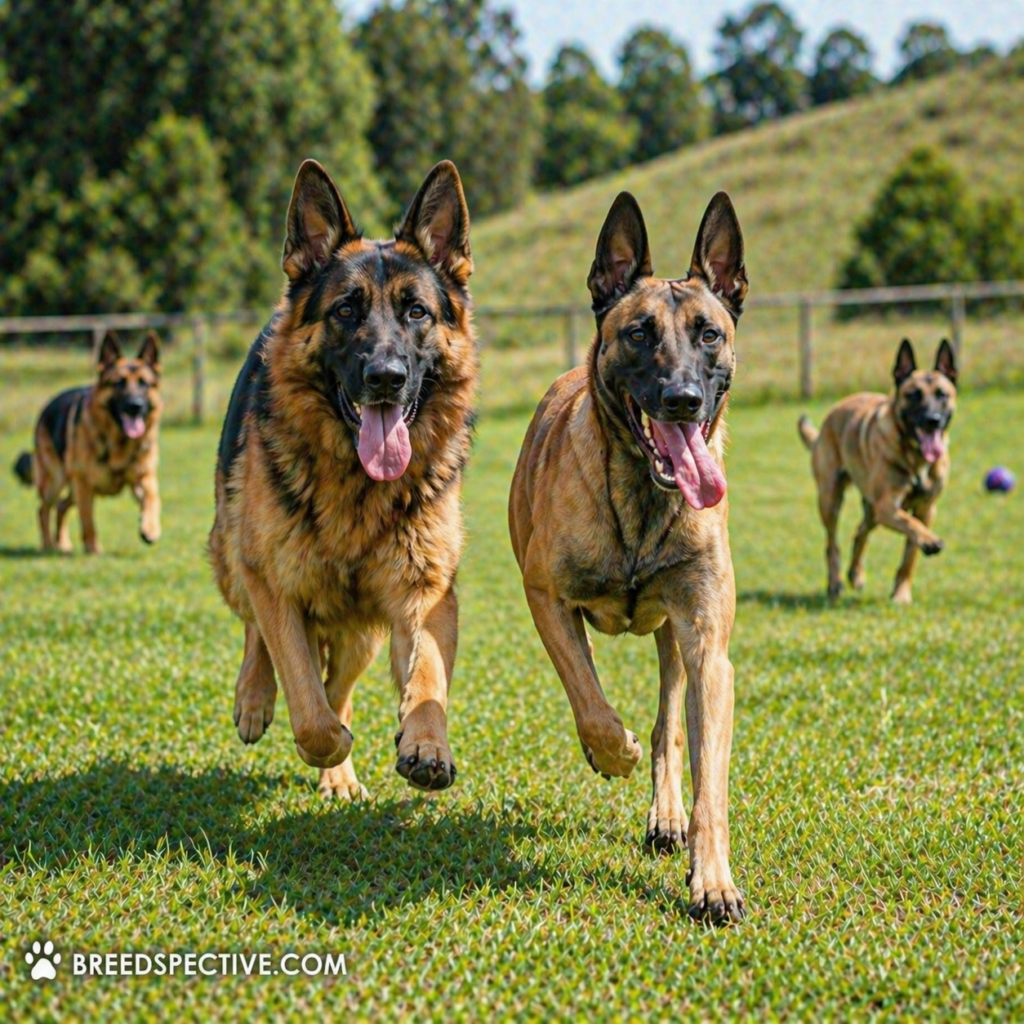
The German Shepherd and Malinois are highly trainable working dogs.
For an inexperienced owner, that can sound reassuring. In practice, intelligence can make a poorly matched working breed more difficult rather than less difficult.
A dog that learns quickly can learn unwanted behaviors just as efficiently as useful ones.
Training a German Shepherd
AKC describes the German Shepherd as highly intelligent, confident, courageous and steady. The breed’s extraordinary versatility is one reason German Shepherds have succeeded in roles ranging from livestock work to police service and competitive dog sports. American Kennel Club
Training should start early and continue through adulthood.
Socialization is equally important. A dog with natural vigilance and protective tendencies needs to learn how to behave appropriately around unfamiliar people, animals and environments.
Our detailed guide to German Shepherd temperament, energy and lifestyle fit looks more closely at what living with the breed involves.
Training a Belgian Malinois
The Malinois presents a different level of intensity.
ABMC describes the breed as keenly intelligent, highly trainable, agile and responsive. AKC calls the Malinois people-oriented and highly work-driven and specifically suggests the breed for experienced owners with significant time to devote to it. Malinois Club
That responsiveness is a tremendous advantage in skilled hands.
It also means consistency matters. A Malinois without productive outlets can be difficult for a casual owner who expected intelligence to make the dog automatically obedient.
Training needs to be an ongoing part of the relationship rather than something completed during puppyhood.
For more context on the difference between intelligence and ease of ownership, see our guide to the easiest dog breeds to train and why.
Temperament and Protective Instincts
Both breeds have histories that required awareness of their surroundings and responsiveness to their handlers.
AKC describes German Shepherds as loyal, confident and courageous. Belgian Malinois are similarly vigilant and strongly bonded to their owners, with ABMC noting that natural alertness and responsiveness originally helped them protect livestock and farms. American Kennel Club
That doesn’t mean every individual dog will behave like a trained protection dog.
Protective behavior is influenced by genetics, socialization, training and environment. Owners shouldn’t deliberately encourage uncontrolled suspicion or aggression.
Instead, the priority should be producing a stable dog that can distinguish normal everyday situations from genuine threats and remain responsive to its handler.
If protection-related temperament is an important factor in your breed search, our guide to dog breeds known for natural protective instincts explains the distinction between natural vigilance and trained protection work.
German Shepherd vs Malinois With Families
Both breeds can form powerful bonds with their households, but family suitability shouldn’t be judged from loyalty alone.
German Shepherd Family Fit
A well-bred, appropriately socialized and trained German Shepherd can thrive as an active family companion.
The breed combines strong working ability with a long history of versatility. German Shepherds can participate in training, hiking, dog sports and other family activities while remaining closely connected to their household.
Their size matters, particularly around small children. An enthusiastic 70- or 80-pound dog can accidentally knock over a child without displaying any aggression.
Herding and protective tendencies also need management.
Belgian Malinois Family Fit
A Malinois can be affectionate with its family, and AKC describes the breed as forming strong bonds with its owners. American Kennel Club
The difficulty is intensity.
A household shouldn’t choose a Malinois because it wants a German Shepherd in a smaller package. The Malinois’ working drive, speed and need for engagement can overwhelm owners who mainly want a conventional family companion.
Children and dogs should always be supervised appropriately, but management becomes especially relevant with a fast, high-drive herding breed that may react strongly to movement.
The best Malinois household is one that actively wants the lifestyle accompanying the dog rather than merely admiring the breed’s capabilities.
Grooming: The Malinois Is Easier
Coat maintenance is one area where the Malinois generally has the advantage.
German Shepherd Grooming
The German Shepherd has a medium-length double coat.
AKC recommends a quick brushing every few days and notes that the breed sheds heavily once or twice per year. During these heavier shedding periods, more frequent brushing helps control loose hair. American Kennel Club
Prospective owners should expect dog hair in the home.
Belgian Malinois Grooming
The Malinois has a shorter, weather-resistant coat.
AKC describes grooming as one of the easier aspects of Malinois ownership. Occasional brushing is generally sufficient during normal periods, although the breed also sheds heavily about twice per year and may benefit from daily brushing while the coat is coming out. American Kennel Club
Both breeds also need routine nail trimming, dental care and general skin and ear checks.
The Malinois is therefore easier to groom, but “short-haired” does not mean “doesn’t shed.”
Health: What to Ask a Breeder
Health screening should be part of choosing either breed.
AKC’s direct comparison recommends that responsible breeders screen both German Shepherds and Belgian Malinois for hip and elbow dysplasia. It also notes an ophthalmologist evaluation for Malinois and temperament testing for German Shepherds. American Kennel Club
ABMC participates in breed health initiatives and promotes breed-appropriate health testing through its health program. Malinois Club
Before buying a puppy, ask:
- What health tests were performed on both parents?
- Can you see the actual results?
- Were hips and elbows evaluated?
- Were the Malinois parents given appropriate eye examinations?
- What health problems have appeared in close relatives?
- What temperament evaluation is used?
- At what ages were the breeding dogs tested?
Don’t settle for “the parents are healthy” or “our vet checked them.”
A routine veterinary examination and a formal breed-recommended health screening are not necessarily the same thing.
A German Shepherd-Specific Concern: Bloat
AKC also identifies bloat as a risk for German Shepherd Dogs. Gastric dilatation-volvulus is an acute, life-threatening condition involving expansion and potentially twisting of the stomach. Owners of at-risk breeds should know the warning signs and seek emergency veterinary treatment immediately when bloat is suspected. American Kennel Club
Health screening cannot eliminate every medical risk, but responsible breeding gives prospective owners considerably more information than choosing a puppy without documented testing.
Cost: Which Breed Costs More?
There is no reliable universal purchase price for either breed.
Puppy prices vary with region, breeder, pedigree, working background, health testing and other factors. A well-bred puppy from health-tested parents may also cost substantially more upfront than one produced without comparable screening.
Purchase price is only the beginning.
| Expense | German Shepherd | Belgian Malinois |
|---|---|---|
| Food | Potentially higher because of larger average size | Moderate to high |
| Routine veterinary care | Ongoing | Ongoing |
| Health screening | Relevant throughout breeding decisions | Relevant throughout breeding decisions |
| Grooming | Mostly home care; substantial shedding | Easier coat care; seasonal shedding |
| Training | Significant priority | Major priority |
| Enrichment | High | Very high |
| Dog sports/equipment | Common optional expense | Common optional expense |
| Emergency care | Financial planning needed | Financial planning needed |
Training is one expense prospective owners frequently underestimate.
A working breed may benefit from puppy classes, advanced obedience, private instruction or structured dog sports. The owner also needs equipment, transportation and, most significantly, time.
With a Malinois in particular, choosing the breed while budgeting only for food and routine veterinary care ignores much of what successful ownership entails.
Which Is Better for a First-Time Owner?
Neither breed is an obvious first-dog recommendation.
A committed beginner who understands German Shepherd behavior, obtains a responsibly bred dog, attends training classes and provides sufficient exercise can potentially succeed with the breed.
A Belgian Malinois presents a steeper challenge.
AKC specifically frames the breed as appropriate for an experienced dog owner with plenty of time for a smart, hard-working dog. It also notes that Malinois require extensive training, regular exercise and consistent mental stimulation. American Kennel Club
Someone attracted to the Malinois because of videos showing spectacular obedience, protection work or athletic feats should remember what those videos demonstrate: extensive genetics, training, handling and work.
The performance is not evidence that the breed is easy.
Which Breed Fits Ordinary Home Life Better?
For most people seriously considering these two breeds, this is the more useful question.
The German Shepherd is still a demanding working dog. It needs exercise, training, socialization and meaningful interaction. Its size, shedding and potential health concerns are substantial commitments.
The Malinois removes very few of those responsibilities and adds exceptional drive and intensity.
AKC’s comparison specifically says Malinois need exercise with their human partners and that ordinary walks plus backyard time aren’t sufficient. ABMC describes the breed’s energy as essentially inexhaustible in its original working context. American Kennel Club
So don’t interpret “smaller and lighter” as “easier.”
The Malinois’ leaner build contributes to speed and agility. It does not make the breed more convenient for an average household.
Before committing to either, work through your actual schedule using our guide on how to choose the right dog breed for your lifestyle.
Verdict: Choose a German Shepherd or Belgian Malinois?
Choose a German Shepherd if you want a large, highly trainable and versatile working breed and can provide substantial daily exercise, lifelong training and careful socialization. For an active household seeking both companionship and serious working-dog characteristics, the German Shepherd can offer a broader balance of those traits.
Choose a Belgian Malinois if you specifically want an exceptionally energetic, agile and work-driven dog and already have the experience, time and interest required to channel those qualities. The breed is particularly suited to handlers who genuinely enjoy structured training, demanding dog sports or other regular working activities.
Avoid both breeds if you primarily want an easy family pet, have limited time for daily training and exercise or expect a backyard to meet the dog’s activity needs. Neither breed should be purchased primarily for appearance, reputation or protective image.
The practical distinction is significant: the German Shepherd is the larger and heavier all-purpose working dog, while the Belgian Malinois is typically lighter, faster and more intensely work-driven. Both demand committed ownership, but a Malinois is particularly unforgiving of a lifestyle that provides too little purposeful activity.