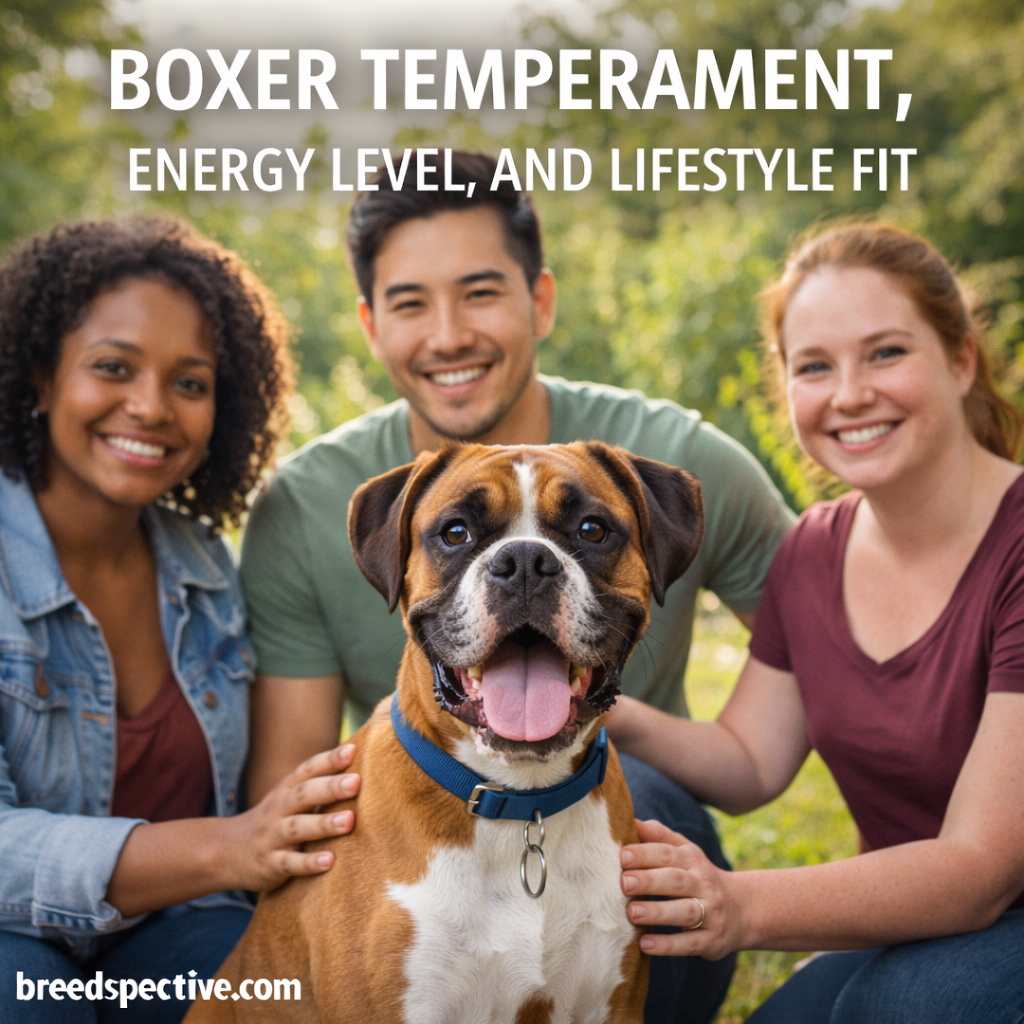
Boxer temperament is typically playful, affectionate, alert, confident, and intensely people-oriented. A well-bred Boxer combines the enthusiasm of an athletic working dog with strong attachment to its family, but that energy can become jumping, rough play, destructiveness, or frustration without enough exercise and training.
The Boxer is not a low-effort companion. This is a powerful dog that needs daily activity, early socialization, consistent boundaries, and plenty of involvement in family life.
Boxer at a Glance
| Trait | Boxer |
|---|---|
| Size | Males: 23–25 inches; females: 21.5–23.5 inches |
| Typical weight | Males commonly 65–80 pounds; females generally smaller |
| Life expectancy | About 10–12 years |
| Exercise needs | High; substantial physical activity and mental stimulation every day |
| Grooming | Low; short, smooth coat |
| Trainability | Intelligent and capable, but can become bored with repetition |
| Good with children? | Often, but exuberance can overwhelm small children |
| Good with other pets? | Variable; early socialization matters, and some Boxers are less tolerant of same-sex dogs |
| Protective tendency | Alert and naturally watchful |
| Best fit | Active household that wants an involved, playful companion |
The American Kennel Club describes Boxers as active, bright, and fun-loving. The official AKC breed standard calls for a dog that is alert, self-assured, playful with family, wary of strangers, and courageous when threatened.
How Much Exercise Does a Boxer Need?
A healthy adult Boxer needs substantial exercise every day. As a practical planning target, many owners should expect to devote at least 60–90 minutes per day to a combination of walks, active play, training, and mentally engaging activities, with some individuals needing more.
That does not mean forcing a Boxer through 90 minutes of continuous high-impact exercise. Two or three sessions spread across the day are usually more practical.
A daily routine might include:
- A 30–45 minute morning walk
- Short training or enrichment sessions
- Fetch, tug, or structured backyard play
- Another walk or active session later in the day
The AKC classifies the Boxer as a high-energy breed and says Boxers need ample daily exercise, either on leash or in securely fenced areas. The American Boxer Club similarly describes them as strong, quick, busy dogs that need plenty of physical activity and enjoy both physical and mental challenges.
Puppies should not simply be given an adult dog’s exercise routine. Growing dogs need age-appropriate activity rather than repetitive forced running or excessive jumping. Senior Boxers and dogs with medical conditions also need individualized exercise plans.
For a broader comparison, see how to match a dog’s energy level to your daily routine.
Exercise Is Only Part of the Equation
A Boxer can take a long walk and still come home looking for something to do.
Training games, food puzzles, scent searches, obedience exercises, and interactive play provide mental work alongside physical activity. The breed’s combination of intelligence, curiosity, and energy makes this especially useful.
An under-stimulated Boxer may invent entertainment that the household does not appreciate.
Boxer Origin and Original Purpose
The modern Boxer was developed in Germany during the late 1800s, particularly around Munich. Its ancestry includes the Bullenbeisser, a now-extinct type of powerful hunting dog used to pursue and hold large game.
According to the American Boxer Club’s history of the breed, the Boxer emerged as a distinct breed around Munich toward the end of the 19th century. AKC historical material likewise traces the modern breed to the smaller Bullenbeisser and places its development in Germany in the late 1800s.
As traditional large-game hunting changed, ancestors of the Boxer found other work. Dogs of this type were used around livestock and by butchers and cattle dealers. The eventual Boxer developed into a versatile guard, working, and companion dog.
The breed’s working ability was taken seriously. The American Boxer Club notes that Boxers were among the first breeds selected in Germany for police training.
The AKC officially recognized the Boxer in 1904.
That history helps explain the modern dog’s mixture of athleticism, vigilance, confidence, trainability, and attachment to people.
Boxer Temperament in Everyday Life

A Boxer generally wants to participate.
This is not usually a dog that is content to spend most of its waking hours quietly separated from the household. Boxers tend to be engaged with what their people are doing and can move rapidly between energetic play and relaxing near family members.
Playful and Exuberant
Playfulness is one of the breed’s defining characteristics.
Adult Boxers can retain a youthful style of play long after they have reached full physical size. Running, bouncing, pawing, wrestling, chasing toys, and enthusiastic greetings are common.
That can be delightful in the right household and exhausting in the wrong one.
Remember that an adult Boxer may weigh considerably more than a small child. A friendly dog does not have to be aggressive to knock someone over.
Teaching four paws on the floor, impulse control, a reliable place cue, and calm greetings should begin early.
Affectionate and Family-Oriented
Boxers are known for strong attachment to their families. The AKC describes them as affectionate and playful, while the breed standard emphasizes loyal affection and suitability as a companion.
That attachment means a Boxer generally fits best in a home where the dog will be included in everyday life.
Regularly leaving one alone for very long days can be difficult, particularly for a young, energetic Boxer. Exercise before and after work helps, but exercise does not completely substitute for social contact and appropriate mental stimulation.
Alert and Protective
Boxers have a genuine working and guarding heritage.
The AKC standard describes the breed as an instinctive guard dog that should be alert and self-assured, deliberate around strangers, responsive to genuine friendliness, and courageous when threatened.
That is different from indiscriminate aggression.
A stable Boxer should not need to treat every unfamiliar person as a threat. Early exposure to different people, environments, sounds, dogs, and ordinary household situations helps the dog learn what is normal.
Anyone specifically comparing protective working breeds may also want to read our guide to Rottweiler temperament, energy level, and lifestyle fit.
Are Boxers Good With Children?
Boxers can be excellent family dogs, but their physical enthusiasm deserves as much consideration as their temperament.
The AKC breed standard describes the Boxer as playful with family and patient with children. The AKC also cautions that a powerful, bouncy young Boxer may overwhelm a small child or physically frail adult even when the dog’s intentions are friendly.
Supervision remains necessary.
Children should be taught not to climb on dogs, interfere with food, corner them, or disturb them while sleeping. Dogs should have somewhere quiet to retreat when they do not want interaction.
Families comparing several options can also see our guide to the best dog breeds for families with young children.
Are Boxers Good With Other Dogs and Pets?
There is more individual variation here than the phrase “good with other pets” suggests.
Early and thoughtful socialization can help Boxers develop appropriate behavior around other dogs. The AKC specifically notes, however, that some Boxers may not tolerate dogs of the same sex as readily as dogs of the opposite sex.
Introductions should therefore be controlled rather than assuming every Boxer will automatically enjoy every dog.
Living with cats is also possible, particularly when the animals are introduced appropriately and the individual dog has suitable behavior around them. Chase behavior should still be taken seriously.
Training a Boxer
Boxers are intelligent enough to learn quickly and clever enough to notice inconsistent rules.
The AKC recommends early socialization and puppy training and notes that Boxers can become bored by excessive repetition.
Training tends to work best when it is:
- Consistent
- Reward-based
- Varied
- Brief enough to maintain engagement
- Practiced in different environments
- Incorporated into daily routines
A Boxer that sits perfectly in the kitchen has not necessarily learned to sit when visitors arrive at the door. Skills need to be practiced around progressively harder distractions.
Impulse-control exercises are particularly valuable. Waiting at doors, settling on a mat, leaving food alone, greeting without jumping, and disengaging from exciting situations can make daily life considerably easier.
Common Boxer Behavior Problems and How to Manage Them
Many Boxer problems are amplified versions of normal breed traits rather than mysterious acts of disobedience.
Jumping on People
Why it happens: Boxers can be highly enthusiastic greeters, and jumping often gets attention.
What helps: reward four paws on the floor, teach an incompatible behavior such as sitting, and prevent visitors from reinforcing jumping with attention.
Consistency matters. Allowing jumping sometimes while correcting it at other times makes the rule difficult for the dog to understand.
Rough or Overexcited Play
Why it happens: the breed is powerful, physical, and playful.
What helps: interrupt play before arousal becomes excessive, teach cues such as “drop,” “leave it,” and “place,” and alternate energetic games with calmer activities.
Exercise helps, but endlessly increasing exercise can simply create a fitter athlete. Boxers also need to learn how to settle.
Pulling on the Leash
Why it happens: a strong, excited dog naturally reaches interesting things faster by pulling if pulling works.
What helps: reward a loose leash, change direction before the dog reaches the end of the leash, reinforce voluntary attention, and practice first in environments with manageable distractions.
Training this behavior while the Boxer is young is much easier than addressing it after the dog has reached adult strength.
Destructive Chewing
Why it happens: boredom, adolescence, inadequate supervision, stress, and normal chewing behavior can all contribute.
What helps: provide appropriate chew items, restrict access to valuable objects, increase productive activity, and supervise young dogs until household habits are established.
Difficulty Settling
Some young Boxers seem to operate at two speeds: asleep and fully active.
Teaching relaxation is a legitimate part of training. Reward calm behavior, provide a predictable resting location, and avoid turning every interaction into high-energy play.
Separation-Related Problems
A Boxer that becomes distressed when alone needs more than additional exercise.
Start with manageable periods of independence rather than suddenly expecting a puppy or newly adopted dog to tolerate an entire workday alone. Food enrichment and a safe resting area may help with ordinary boredom.
Persistent howling, escape attempts, destruction around exits, inappropriate elimination, or severe distress should be discussed with a veterinarian or qualified behavior professional.
Living With a Boxer in an Apartment
A large yard is useful, but it does not exercise a dog automatically.
A Boxer can adapt to an apartment if the owner provides sufficient exercise, training, and enrichment outside it. Conversely, a Boxer can become bored in a large house with a yard if nobody meaningfully interacts with the dog.
The bigger questions are whether you can provide enough activity, manage a powerful dog in shared spaces, and prevent uncontrolled barking or jumping around neighbors.
Climate also matters. The Boxer has a short muzzle and short coat. The AKC advises that the breed does not tolerate extreme heat or cold particularly well.
Grooming and Everyday Care
Boxer grooming is straightforward compared with many breeds.
The short, tight coat needs regular brushing to remove loose hair, but it does not require professional trimming. The AKC recommends brushing once or twice weekly, occasional bathing, regular nail trimming, and frequent dental care.
Owners should budget time for:
- Weekly coat care
- Nail trimming
- Tooth brushing
- Ear checks
- Skin checks
- Routine weight monitoring
Low coat maintenance should not be confused with low overall maintenance. Exercise and training are much bigger commitments with this breed than grooming.
White Boxers: What Owners Should Know
White Boxers occur naturally within the breed.
The American Boxer Club explains that these dogs are genetically fawn or brindle Boxers whose white markings cover most or all of the body. They are not albinos and are neither a separate breed nor a special “rare” variety.
Under the AKC Boxer standard, fawn and brindle are the accepted colors, and white markings may not exceed one-third of the entire coat. Dogs exceeding that amount of white are disqualified from conformation showing.
That does not prevent a white Boxer from being a companion or participating in many performance activities.
There is a health consideration, however. The American Boxer Club reports an association between extensive white coloration and congenital deafness in some Boxers.
A prospective owner considering a white puppy should discuss hearing evaluation with the breeder and veterinarian rather than assuming either that the puppy is deaf or that coat color has no relevance.
Boxer Health Issues and Recommended Screening
Health testing is particularly important when choosing a Boxer breeder because the breed has several inherited conditions that responsible breeding programs monitor.
The American Boxer Club and OFA/CHIC screening recommendations include evaluations for important orthopedic, thyroid, and cardiac conditions. The AKC’s breed-health guidance lists hip and elbow evaluations, thyroid testing, cardiac screening, ARVC DNA testing, annual Holter monitoring for Boxer cardiomyopathy, and degenerative myelopathy testing among recommended assessments.
Prospective puppy buyers should ask to see the actual results rather than accepting “vet checked” or “health tested” as sufficient.
OFA also emphasizes that receiving a CHIC number means the breed-specific tests were completed and publicly disclosed. A CHIC number does not mean every result was normal.
Arrhythmogenic Right Ventricular Cardiomyopathy
Heart health deserves particular attention in Boxers.
Cornell University’s College of Veterinary Medicine identifies arrhythmogenic right ventricular cardiomyopathy, or ARVC, as a condition commonly identified in Boxers. It is consequently often called “Boxer cardiomyopathy.”
ARVC can cause abnormal ventricular rhythms. Cornell notes that serious ventricular arrhythmias can reduce blood flow enough to cause collapse and, in severe cases, can progress to fatal rhythms.
This is one reason Boxer health recommendations go beyond a basic veterinary examination and include cardiac screening and Holter monitoring.
Aortic/Subaortic Stenosis
Cardiac screening also addresses aortic and subaortic stenosis. The American Boxer Club includes AS/SAS screening in its health-testing recommendations, reflecting the significance of heart disease within responsible Boxer breeding programs.
Hip and Elbow Problems
The breed club recommends orthopedic evaluation of breeding dogs, including hip and elbow screening.
Buyers should verify results through OFA or another accepted screening method rather than relying only on statements that the parents “move well” or have never shown symptoms.
Degenerative Myelopathy
Degenerative myelopathy testing is also included among recommended Boxer health screens. It is a progressive neurological disease affecting the spinal cord.
Genetic testing can provide useful breeding information, but a DNA result should be interpreted in the context of the disease and breeding program rather than treated as a complete health guarantee.
How Much Does a Boxer Cost Per Year?
Boxers are medium-to-large dogs, and their recurring costs reflect their size as well as their potential veterinary needs.
For U.S. budgeting, a reasonable planning framework for an adult Boxer is:
| Expense | Practical annual planning range |
|---|---|
| Food and treats | $600–$1,200 |
| Routine veterinary care | $300–$800 |
| Parasite prevention | $200–$500 |
| Toys, chews and enrichment | $150–$500 |
| Grooming and basic supplies | $75–$250 |
| Training | $0–$700+ |
| Pet insurance | $400–$1,200+ |
| Typical planning total | About $1,725–$5,150+ |
These figures are budgeting estimates rather than fixed national prices. Location, food choice, insurance coverage, age, and health can change the total substantially.
They also exclude major veterinary emergencies, chronic disease treatment, boarding, daycare, professional dog walking, and the initial purchase or adoption cost.
Because significant cardiac and other health problems can become expensive, owners should have either appropriate insurance or a realistic emergency-care fund.
Who Is a Boxer Best Suited To?
A Boxer tends to work best for someone who genuinely wants an active dog rather than someone willing to tolerate one.
A good match often includes owners who:
- Can provide substantial daily exercise
- Enjoy training and interactive play
- Want a dog closely involved with family life
- Appreciate an alert, watchful companion
- Can manage a strong 60-plus-pound dog
- Are willing to train calm greetings and impulse control
- Can provide regular companionship
- Understand the breed’s health-screening needs
If you like an outgoing family dog but are comparing different working and sporting personalities, our guide to Labrador Retriever temperament, energy level, and lifestyle fit provides a useful contrast.
Who Should Think Twice About a Boxer?
This breed is less suitable for people who want a quiet, sedentary, physically delicate, or highly independent companion.
Think carefully before choosing a Boxer if:
- Daily exercise already feels difficult to fit into your schedule
- You dislike jumping, boisterous play, or energetic dogs
- Nobody is home for long stretches most days
- You cannot comfortably control a strong dog on leash
- You want minimal training beyond basic house manners
- You have very young children and cannot closely supervise interactions
- Significant breed-specific health screening is not something you want to investigate
The Boxer is also a poor choice if appearance is doing most of the decision-making. A muscular dog with an expressive face can be appealing, but temperament, energy, health, training, and household compatibility will matter far more over the next decade.
Before committing, work through our guide to choosing the right dog breed for your lifestyle.
Verdict: Is a Boxer Right for You?
A Boxer is right for an active household that wants a highly involved, affectionate, playful working dog and has the time to provide daily exercise, training, mental stimulation, and companionship. Owners who enjoy teaching their dogs and do not mind some youthful exuberance can find the breed exceptionally engaging.
A Boxer is not right for someone seeking an easygoing dog that needs little exercise, spends long days alone without difficulty, or requires minimal training. Their strength also makes poor manners more consequential: jumping, pulling, and uncontrolled excitement from a Boxer are very different from the same behaviors in a 15-pound dog.
Choose the breed because you want the complete Boxer temperament—energy, intelligence, vigilance, affection, physicality, and all—not simply because you like the way a Boxer looks.