To choose the right cat breed, match the cat’s activity level, sociability, vocalness, grooming needs, size, and likely care costs to the home and routine you can realistically provide. A Bengal and a British Shorthair may both live happily indoors, for example, but they can ask very different things of their owners in terms of play, interaction, and daily management.
Breed is useful for identifying tendencies, not predicting an individual cat’s personality. Age, early experiences, health, socialization, and the individual cat all matter, which is also why a well-matched non-pedigree rescue cat can be just as suitable as a carefully researched pedigree breed.
Start With Your Lifestyle, Not a Breed Photo
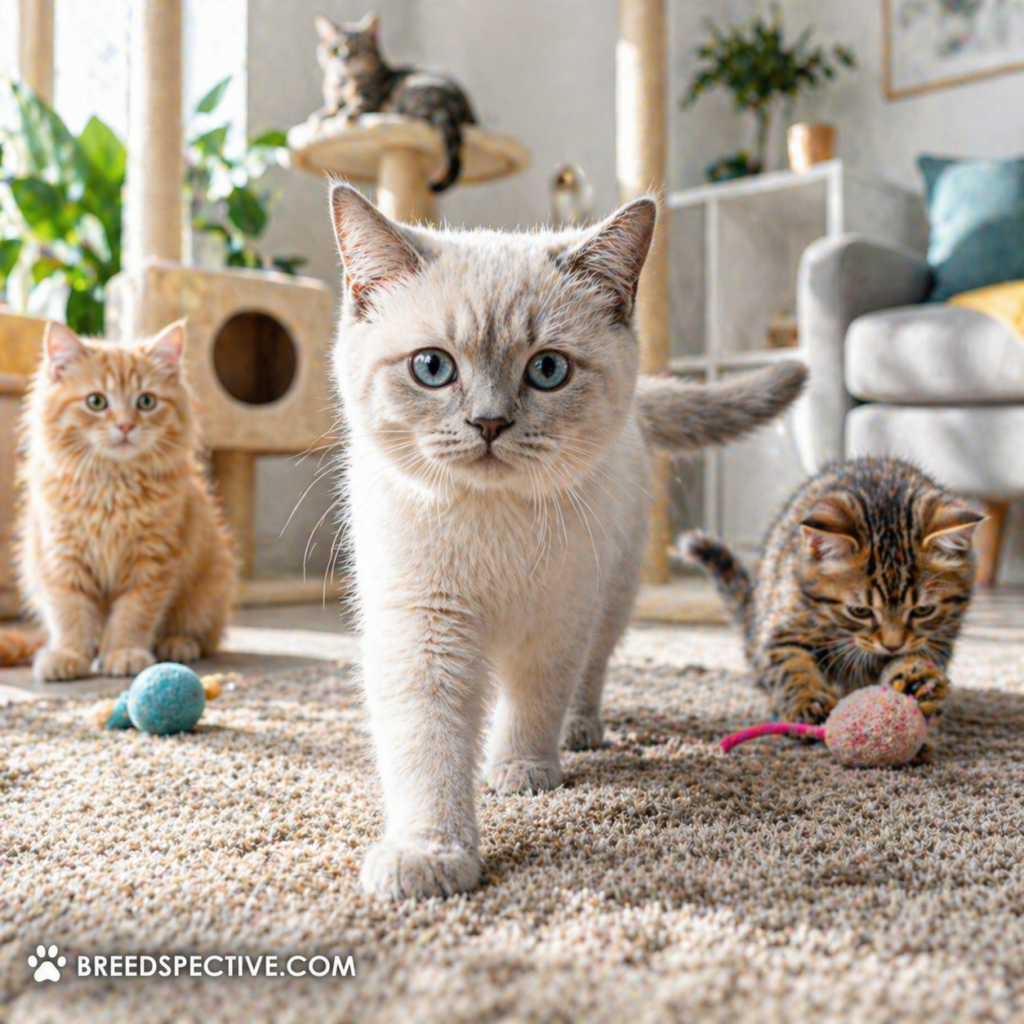
A striking coat or unusual appearance may introduce you to a breed, but it should not make the decision.
Start by describing the home the cat will actually live in.
Ask yourself:
- How much interactive play can I provide every day?
- Do I want a highly involved cat or a more independent companion?
- Would frequent vocalizing bother me?
- How much brushing and coat care am I willing to do?
- Will the cat live with children?
- Are there already cats or dogs in the home?
- Is my home quiet or frequently busy with visitors?
- Can I provide climbing and play opportunities for an active cat?
- Am I prepared for routine and unexpected veterinary costs?
- Would an adult cat suit my routine better than a kitten?
Once those answers are clear, breed research becomes much more useful.
How Much Does Cat Breed Really Matter?
Breed matters, but it is not destiny.
Pedigree breeds have been selectively bred for particular physical characteristics, and some also show recognizable behavioral tendencies. Activity, sociability, vocal behavior, coat type, and body size can differ substantially between breeds.
Breed registries do not even maintain identical breed lists. The Cat Fanciers’ Association (CFA) and The International Cat Association (TICA), for example, recognize different numbers and classifications of breeds because each organization maintains its own registration and recognition criteria.
That means there is no single universal list defining every cat breed.
It is also worth remembering that pedigree cats represent only one part of the pet-cat population. Most companion cats worldwide are non-pedigree cats rather than members of a recognized breed. These cats are commonly described by coat length — such as domestic shorthair or domestic longhair — rather than by pedigree.
For someone primarily interested in finding a compatible companion rather than owning a particular breed, that greatly expands the available choices.
1. Match the Cat’s Activity Level to Your Routine
Activity level should be one of your first filters.
Some cats actively seek climbing, chasing, exploring, interactive play, and involvement in whatever is happening around them. Others tend to have a calmer style.
High-activity breeds
Bengals are among the clearest examples of a breed for which activity requirements deserve serious consideration. TICA describes Bengals as active, curious cats that enjoy climbing and playing.
That can be enormously appealing if you want a cat that interacts frequently with its environment. It can be frustrating if your idea of cat ownership is primarily sharing a sofa with a quiet companion.
Abyssinians are another breed associated with a high level of curiosity and activity.
An active cat benefits from an environment that gives normal feline behaviors somewhere appropriate to go: climbing areas, scratching surfaces, hiding locations, toys, observation points, and opportunities for interactive play.
International Cat Care emphasizes the importance of providing cats with opportunities to express natural behaviors within their environment.
If that energetic style sounds appealing, our Bengal cat personality, energy, and social traits profile explains the commitment in more detail.
Calmer breeds
At the other end of the spectrum, breeds such as the Ragdoll and British Shorthair are typically associated with a calmer style than highly active breeds such as Bengals and Abyssinians.
Calm does not mean inactive.
Every cat needs opportunities to move, play, scratch, explore, and interact with its surroundings. The difference is how intensely and frequently the cat is likely to seek activity.
For a relaxed companion, compare the Ragdoll’s personality, energy, and social traits with the British Shorthair’s personality, energy, and social traits.
2. Decide How Social You Want Your Cat to Be
“Independent” is too broad a description for cats.
Some individuals enjoy spending substantial time near people. Others prefer interaction in shorter periods and may regularly choose to rest alone.
Breed tendencies can help narrow the field.
Ragdolls, for example, are generally associated with a people-oriented companion temperament. Siamese cats are also known for being socially engaged with their households.
A cat that actively seeks interaction may be a poor fit for someone who expects the animal to entertain itself for most of the day. Conversely, someone hoping for a highly interactive companion may be disappointed by a more reserved individual.
The question is not which temperament is better. It is how much interaction you actually want from your cat.
Remember that sociability can vary within a breed. Do not assume every kitten will mature into the personality described in a general breed profile.
When adopting an adult cat, ask the shelter or foster caregiver specific questions:
- Does the cat seek attention from familiar people?
- Does it enjoy being touched, and where?
- How does it respond to visitors?
- Does it prefer sitting beside people or being held?
- How does it react when left alone?
- Does it hide when the environment becomes busy?
Observed behavior from an adult cat can sometimes tell you more about your likely match than a breed label alone.
3. Think About Vocalness Before Bringing the Cat Home
Cat vocalization is easy to overlook during breed research.
It becomes much harder to overlook at 5 a.m.
Some breeds are known for being more communicative than others. The Siamese is particularly associated with frequent vocal interaction and strong engagement with people.
For someone who enjoys a responsive, expressive companion, that can be part of the appeal.
For someone who works from home in a quiet environment, sleeps lightly, shares walls with neighbors, or simply prefers a quiet pet, vocalness deserves more weight in the decision.
Our guide to Siamese cat personality, energy, and social traits provides a closer look at what living with this social breed can involve.
Do not assume a quieter breed guarantees a silent individual. Vocal behavior can be influenced by the individual cat, its environment, learned behavior, age, and health.
A sudden change in how much a cat vocalizes can also warrant veterinary attention rather than being dismissed as personality.
4. Be Realistic About Grooming
Coat length can dramatically change the maintenance involved in cat ownership.
Long-haired cats
A Persian’s coat is part of the breed’s distinctive appearance, but maintaining that appearance requires work.
CFA breed information describes the Persian’s long coat as requiring regular grooming. Someone attracted to the breed needs to be comfortable making coat care part of the normal routine.
Maine Coons and other longer-coated cats also need appropriate coat maintenance, although exact grooming demands vary with coat texture and the individual cat.
Regular handling should be introduced positively rather than waiting until tangles become a problem.
Our Persian cat personality, energy, and social traits profile is a useful starting point if the breed’s appearance appeals to you.
Short-haired cats
Short coats usually reduce brushing demands, but they do not eliminate grooming or shedding.
Cats still benefit from routine observation of the coat, skin, claws, teeth, ears, and general condition.
Short-haired breeds may be more practical if you know that maintaining a long coat every week will become a chore you postpone.
Hairless does not mean maintenance-free
The Sphynx demonstrates why coat length alone is not a reliable measure of maintenance.
Although Sphynx cats lack the conventional coat people associate with brushing and shedding, their skin and general care still require attention. Choosing one because you assume “no fur equals no grooming” can create the wrong expectations.
Read about Sphynx cat personality, energy, and social traits before treating hairlessness as a shortcut to easy care.
5. Consider Your Home Size — but Focus on Enrichment
A large house does not automatically provide a better environment for a cat, and an apartment does not automatically provide a poor one.
Usable territory matters.
Cats make use of vertical as well as horizontal space. A smaller home can offer climbing structures, elevated resting locations, scratching posts, hiding places, window views, play areas, and quiet retreats.
International Cat Care’s environmental guidance emphasizes providing resources that allow cats to perform normal behaviors and feel secure.
For an apartment, consider:
- Activity level
- Vocalness
- Available vertical space
- Location of litter boxes
- Scratching opportunities
- Safe window and balcony arrangements
- Space for the cat to retreat from people or other pets
A calm cat in an enriched apartment may be a far more sensible match than a highly active cat in a larger but unstimulating home.
If floor space is one of your main constraints, start with our guide to the best cat breeds for apartment living.
6. Factor In Adult Size
Most domestic cats occupy a manageable size range, but there are meaningful differences.
Maine Coons are notable for their substantial adult size. Larger cats may need correspondingly sturdy cat furniture, carriers, scratching posts, resting platforms, and litter boxes.
Their size does not tell you everything about personality. Maine Coons are also widely known as social companion cats.
See our complete Maine Coon personality, energy, and social traits guide if you are comfortable accommodating a larger cat.
Ragdolls are another relatively substantial breed, but their typical temperament and care considerations differ.
If those are your two leading choices, our Maine Coon vs. Ragdoll comparison focuses on the differences that matter in a household.
7. Consider Children Before Choosing a Breed
A family cat needs to fit the household rather than merely tolerate it.
Homes with young children can involve sudden movement, noise, visitors, toys, and frequent attempts at interaction. Some cats cope with a busy environment more readily than others.
Breed tendencies can provide clues, but the individual cat’s history and temperament matter enormously.
An adult rescue or foster cat with a known history around respectful children may provide more useful information than selecting a kitten based entirely on breed expectations.
The children’s behavior matters too.
Children should learn not to chase a cat, pull its tail, disturb it while sleeping or eating, corner it, or continue handling when the cat tries to move away.
Every cat should have somewhere it can retreat without being followed.
A breed’s reputation for gentleness is never a substitute for supervising interactions between young children and animals.
8. Think Carefully About Other Cats and Dogs
Do not assume a breed described as “social” automatically wants to live with another cat.
Cats are individuals, and introducing unfamiliar animals requires patience.
International Cat Care advises gradual introductions rather than immediately placing unfamiliar cats together and expecting them to establish the relationship themselves.
Before adding another cat, consider:
- The resident cat’s previous experience with cats
- The new cat’s history
- Age and activity differences
- Available territory
- Separate feeding and resting areas
- Litter-box access
- Opportunities for each cat to avoid the other
Similar caution applies when introducing a cat to a dog.
A calm dog with a history of living safely with cats creates a different situation from a highly excitable dog that intensely pursues moving animals.
The individual animals and the introduction process matter more than a simplistic “cat-friendly” breed label.
9. Budget for More Than Food and Litter
Purchase or adoption cost is only the beginning.
A realistic cat budget includes routine veterinary care, food, litter, scratching equipment, carriers, enrichment, grooming supplies, and replacement household items. Depending on the cat, professional grooming, dental treatment, medications, insurance, boarding, or pet sitting may also become relevant.
Breed can influence some expenses.
A long coat can increase grooming costs. A larger cat may consume more food and need larger equipment. Some breeds have known health concerns that prospective owners should discuss with responsible breeders and veterinarians.
Pedigree kittens can also carry a substantial initial purchase price.
Before committing to any breed, review the hidden costs of owning a dog or cat and build a budget that includes unexpected veterinary care rather than routine expenses alone.
10. Research Health as Seriously as Personality
Temperament is only half of breed selection.
When buying a pedigree kitten, research health concerns associated with that breed and ask the breeder which health screening is performed on breeding cats.
Do not accept vague statements such as “our cats have always been healthy” as a substitute for documented screening where established testing is appropriate.
CFA and TICA both provide breed and breeder resources that prospective owners can use as starting points when researching pedigree cats.
Physical characteristics deserve particular scrutiny when they affect normal anatomy or function. An unusual appearance should never matter more than the cat’s health and welfare.
Your research should answer:
- What health concerns occur in this breed?
- What screening is recommended for breeding cats?
- Can the breeder provide documentation?
- What veterinary care has the kitten received?
- At what age will the kitten leave?
- How have the kittens been socialized?
- Can you see information about the parents?
If a seller discourages questions about health or cannot explain their breeding practices clearly, keep looking.
Pedigree Cat or Non-Pedigree Cat?
You do not need a pedigree cat to get a wonderful companion.
A pedigree gives you more information about ancestry and may make certain physical and behavioral tendencies more predictable. That can be useful when you have specific requirements.
But it is not a guarantee of personality.
A pedigree cat may make sense when:
- You strongly prefer a particular size or coat type.
- You have researched the breed’s temperament and activity requirements.
- You are prepared for breed-specific grooming and health considerations.
- You can find a responsible breeder who prioritizes health and welfare.
A non-pedigree cat may make sense when:
- Individual temperament matters more than appearance.
- You are open to adoption.
- You would prefer an adult whose behavior is already easier to evaluate.
- You do not need the predictability associated with a particular pedigree.
Domestic shorthairs and longhairs encompass enormous variation in appearance and personality.
Rather than viewing “mixed” or “non-pedigree” as a category with one temperament, evaluate the individual animal.
Kitten or Adult Cat?
Breed selection often receives more attention than age, but age can change the ownership experience dramatically.
Kittens require supervision, play, social development, litter training reinforcement, appropriate scratching outlets, and patient teaching. Their adult personality is also still developing.
An adult cat gives you more information.
A shelter or foster caregiver may already know whether the cat is highly active, reserved, affectionate, vocal, comfortable with handling, or experienced around other animals.
That can make an adult particularly appealing to someone who wants fewer unknowns.
Senior cats deserve consideration as well. Their veterinary needs may be greater, but their established temperament and typically calmer lifestyle can suit the right home.
Whichever age you choose, our guide to daily cat care routines at every life stage can help you anticipate how needs change over time.
Adoption or Breeder?
Both routes require careful evaluation.
When adopting, ask the shelter or rescue what is actually known about the cat rather than assuming its behavior from a breed label or appearance.
Foster-based rescues may have particularly useful information about how an adult cat behaves in a home environment.
Ask about:
- Activity
- Handling
- Litter-box habits
- Interaction with unfamiliar people
- Experience with children
- Experience with dogs
- Experience with other cats
- Play style
- Medical history
When buying from a breeder, research the breeder as carefully as the breed.
Look for transparent health practices, appropriate veterinary care, good living conditions, thoughtful socialization, and a willingness to answer detailed questions.
Registration alone should not be treated as proof that every aspect of breeding practice is responsible.
Your Cat’s Environment Still Matters After You Choose
Choosing a compatible cat is only the beginning.
Even a breed well suited to indoor life needs an environment that supports normal feline behavior.
Provide appropriate:
- Scratching surfaces
- Resting areas
- Hiding places
- Elevated locations
- Interactive play
- Food and water resources
- Clean toileting areas
Litter-box setup deserves particular attention. Avoid assuming that inappropriate elimination is spite or disobedience.
Changes in toileting can have environmental, behavioral, or medical causes. Our guide to why cats avoid the litter box and how to address it covers the issue in more detail.
The adjustment period also takes time. A newly arrived cat may initially hide or behave differently while becoming familiar with the environment. Our guide to what to expect during your first 30 days with a new pet explains how to approach that transition.
Cat Breed Finder: Start With Your Situation
If you have narrowed down what you need but not the breed, use this as a starting point rather than a guarantee of compatibility.
| Your Situation | Breeds to Research | Main Trade-Off |
|---|---|---|
| Apartment or smaller home | British Shorthair, Ragdoll | Still need enrichment and play |
| Want a calm companion | Ragdoll, British Shorthair, Persian | Grooming or social needs vary |
| Want an active cat | Bengal | Requires substantial stimulation |
| Want a highly social cat | Siamese, Ragdoll, Maine Coon | May seek frequent interaction |
| Want a talkative cat | Siamese | Vocal behavior may be too much for quiet homes |
| Want a large cat | Maine Coon, Ragdoll | Larger equipment and space considerations |
| Prefer less coat brushing | Siamese, British Shorthair | Short hair still sheds and needs routine care |
| Love long coats | Persian, Maine Coon | Greater grooming commitment |
| Interested in hairless cats | Sphynx | Hairless does not mean maintenance-free |
| Busy family household | Maine Coon, Ragdoll | Individual temperament still matters |
| First-time cat owner | British Shorthair, Ragdoll or a well-matched adult rescue | Avoid choosing on breed reputation alone |
| Want maximum predictability | Research a pedigree breed from a responsible breeder | Breed cannot guarantee personality |
| Open to the widest choice | Adult domestic shorthair or longhair | Evaluate each cat individually |
This table should narrow your research rather than make the decision for you.
A calm Ragdoll may suit one apartment beautifully while a particular adult domestic shorthair from a rescue may suit it even better. A Bengal may be perfect for someone actively seeking an energetic, interactive cat and completely unsuitable for someone wanting a low-key companion.
A Simple Cat-Breed Checklist
Before contacting a breeder or applying to adopt, write down your non-negotiables.
For example:
- Activity: low, moderate, or high?
- Sociability: independent, balanced, or highly people-oriented?
- Vocalness: does frequent vocalization bother you?
- Grooming: how often will you realistically brush?
- Size: are you comfortable accommodating a particularly large cat?
- Children: does the cat need to cope with a busy family environment?
- Other animals: what pets already live in the home?
- Budget: can you cover routine and unexpected veterinary costs?
- Age: kitten, adult, senior, or no preference?
- Source: responsible breeder, rescue, shelter, or open to any responsible route?
Then eliminate cats that conflict with your strongest requirements.
If you dislike frequent brushing, a Persian should not remain near the top because you love its appearance. If you want a quiet household, do not ignore vocal tendencies because you like the look of a Siamese. If daily interactive play already sounds burdensome, a Bengal is unlikely to become easier simply because you admire the breed.
Compatibility requires being candid about the life you will actually provide.
Verdict: Who Should Choose a Specific Cat Breed?
Choosing a specific breed makes sense for someone who has clear preferences about activity, sociability, size, coat, vocalness, or other predictable tendencies and is prepared to research the breed’s health and care requirements as carefully as its appearance.
It is less useful for someone whose main goal is simply to find a friendly companion. In that situation, an adult non-pedigree cat with a known temperament may provide a better match — and more useful behavioral information — than choosing a kitten primarily because of its breed.
For active households wanting an involved cat, breeds such as the Bengal deserve consideration. For someone seeking a generally calmer companion, the Ragdoll or British Shorthair may make more sense. Siamese cats suit people who appreciate social, vocal interaction, while Maine Coons appeal to owners prepared for a larger, longer-coated companion. Persians and Sphynx cats demonstrate why appearance must always be considered alongside maintenance.
The right cat is not necessarily the rarest breed, the calmest breed, or the breed with the appearance you like most. It is the individual cat whose activity, social needs, grooming, health considerations, and temperament you can comfortably support throughout its life.