
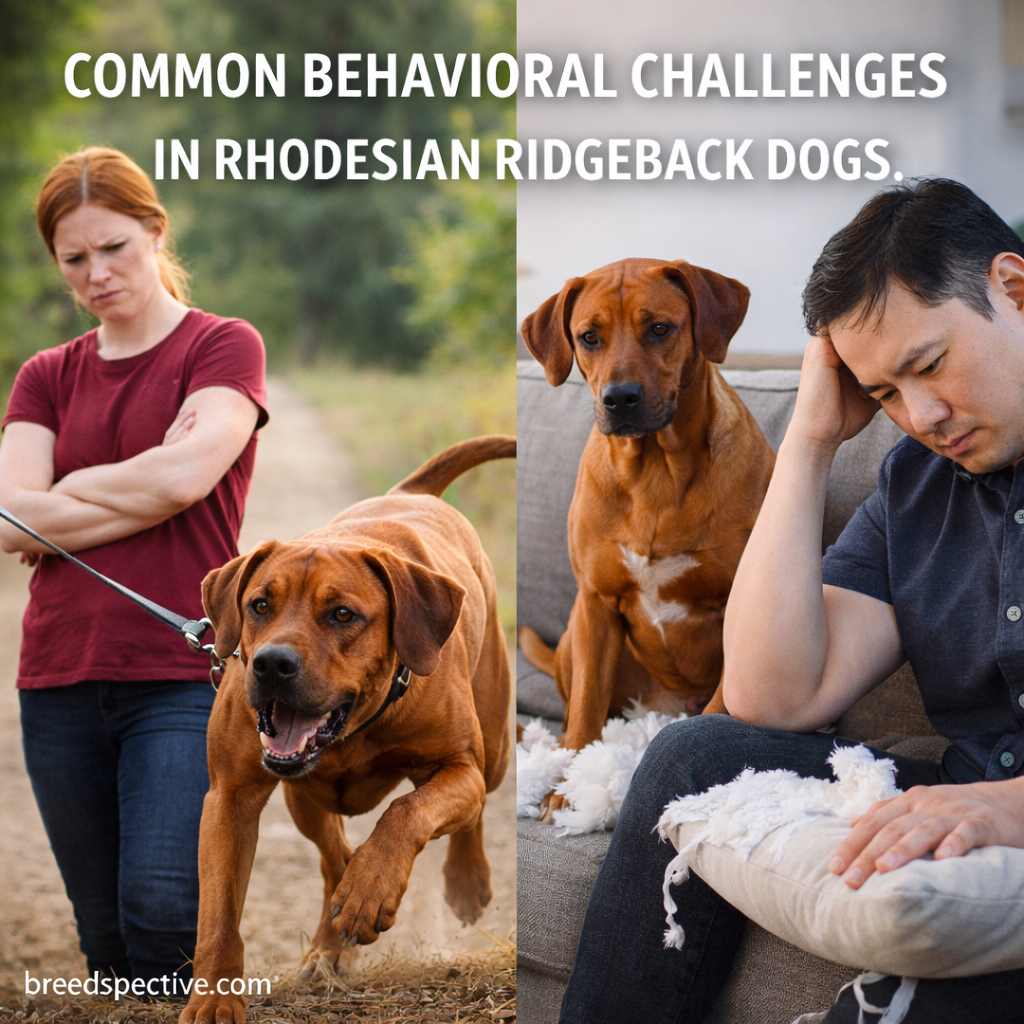
Rhodesian Ridgeback behavior problems most often involve strong prey drive, leash pulling, selective obedience, territorial watchfulness, destructive behavior when bored, and an independent streak that can make inconsistent training ineffective. These tendencies make more sense when you understand the breed’s original work: Ridgebacks were powerful hunting dogs expected to pursue game, make decisions independently, and help hold dangerous animals such as lions at bay rather than wait for constant direction from a handler.
A well-bred, well-trained Ridgeback should not be indiscriminately aggressive. The bigger challenge is managing a large, fast, physically powerful hound that may see wildlife, question repetitive commands, and reserve its enthusiasm for people it knows.
Rhodesian Ridgeback at a Glance
| Trait | Rhodesian Ridgeback |
|---|---|
| Height | Males: 25–27 inches; females: 24–26 inches |
| Weight | About 85 lb males; 70 lb females under the AKC standard |
| Life expectancy | About 10–12 years |
| Exercise needs | Moderate-high |
| Grooming | Low |
| Trainability | Intelligent but independent |
| Good with children? | Can be, with training and supervision |
| Good with other dogs? | Often possible with appropriate socialization |
| Small-pet compatibility | Variable; prey drive requires caution |
| Stranger behavior | Commonly reserved |
| Best fit | Experienced owner wanting a large, athletic, independent companion |
The AKC describes the Rhodesian Ridgeback as dignified, affectionate and even-tempered while also emphasizing its independence, strength and strong prey drive. Adults are substantial athletes rather than oversized couch dogs.
Common Rhodesian Ridgeback Behavior Problems
Most Ridgeback problems are easier to address before a 70- to 85-pound adult has spent months rehearsing them.
Training should start when the dog is physically manageable, not after pulling, chasing, guarding or ignoring cues has become established.
1. Selective Obedience and “Stubbornness”
A Ridgeback can understand a cue perfectly and still appear to ask, “Why?”
That is different from being unintelligent.
Hounds were developed to work with more independence than breeds selected to remain continuously responsive to a handler. Ridgebacks in particular needed enough judgment to approach dangerous game while avoiding unnecessary contact. AKC’s history of the breed describes lion hunting as requiring courage, agility and the intelligence to know when to advance and when to retreat.
Modern owners may see that independence as:
- Slow responses to familiar cues
- Losing interest in repetitive drills
- Ignoring recall when something more interesting appears
- Testing whether household rules are consistently enforced
- Performing enthusiastically when rewards matter and disengaging when they do not
The answer is not a contest of wills.
Use short training sessions, meaningful rewards and consistent consequences. Make the correct behavior worthwhile and avoid repeating a cue six times until the dog learns that the first five are optional.
Training five focused minutes twice a day can be more productive than a long session of repetitive obedience.
2. Prey Drive and Chasing
This is one of the breed’s most important management issues.
The AKC specifically identifies strong prey drive as something Ridgeback owners must be prepared to manage. The breed’s hunting heritage included tracking, pursuing and holding large quarry at bay.
Modern triggers can include:
- Rabbits
- Squirrels
- Cats
- Deer
- Birds
- Other wildlife
- Fast-moving animals
Do not assume excellent obedience in the living room equals a wildlife-proof recall.
Use a leash or long line in unsecured areas, build recall around progressively stronger distractions, and provide access to safely fenced exercise.
Lure coursing and scent-based activities can provide controlled outlets for hound instincts without allowing uncontrolled pursuit.
A Ridgeback that lives successfully with the household cat may still chase an unfamiliar cat outdoors. Familiarity and prey drive can coexist.
3. Leash Pulling
A Ridgeback that learns to pull as a puppy can become physically difficult to control as an adult.
Start loose-leash training immediately.
Reward the dog for remaining near you, change direction before it reaches the end of the leash, and prevent pulling from consistently earning access to interesting smells or destinations.
Equipment can assist management, but equipment is not a substitute for teaching leash behavior.
The goal is a dog that understands how to move with its handler rather than one that can only be physically restrained.
4. Guarding and Territorial Watchfulness
Ridgebacks can be reserved around unfamiliar people and protective of their families.
AKC describes the breed as faithful and protective of loved ones. Historically, Ridgebacks also served broader duties beyond hunting, including protecting homesteads and livestock areas.
Watchfulness becomes problematic when the dog believes every visitor requires intervention.
Do not encourage a young Ridgeback to act suspicious or threatening because it seems impressive.
Instead, teach:
- A place or bed cue
- Calm door behavior
- Reliable recall away from entrances
- Neutrality around visitors
- Acceptance of invited guests
- Quiet after an appropriate alert
Our guide to dog breeds with natural protective instincts explains why natural watchfulness should be managed rather than deliberately amplified.
If you want a more overtly guarding working breed, compare these traits with Rottweiler temperament and lifestyle needs.
5. Destructive Behavior
A mature Ridgeback can appear impressively calm indoors—after its needs have been met.
An under-exercised adolescent is another matter.
Chewing furniture, digging, stealing household objects and restless pacing can emerge when a young dog has too little physical activity, mental engagement or structure.
Provide appropriate chewing outlets and combine exercise with short training tasks, sniffing opportunities and food enrichment.
Management matters too. A puppy should not have unsupervised access to an entire house simply because you eventually want a trustworthy adult.
6. Digging
Digging can be rewarding in its own right, particularly when smells, soil, wildlife or boredom make the activity interesting.
Protect areas where digging would be dangerous, supervise yard access, increase meaningful activity and consider providing an acceptable digging area if the behavior is persistent.
A large yard does not automatically solve boredom.
A Ridgeback left alone in a yard for hours still has to invent something to do.
7. Jumping and Overexcited Greetings
A large athletic hound jumping onto someone is not a minor manners issue.
Teach an incompatible behavior such as standing with four paws down or sitting before receiving attention.
Everyone in the household needs to follow the same rule.
Allowing jumping when wearing old clothes but objecting when dressed for work is a distinction the dog is unlikely to find useful.
8. Separation-Related Problems
Ridgebacks can be independent thinkers while still becoming strongly attached to their families.
Those qualities are not contradictory.
Teach independence gradually during puppyhood through calm periods behind a gate, resting in a separate room, safe enrichment, and short absences that increase as the dog succeeds.
If a dog panics when alone—especially if it attempts to escape, injures itself, destroys doors or windows, or cannot eat—treat that as a behavioral health problem rather than disobedience.
Rhodesian Ridgeback History and Original Purpose
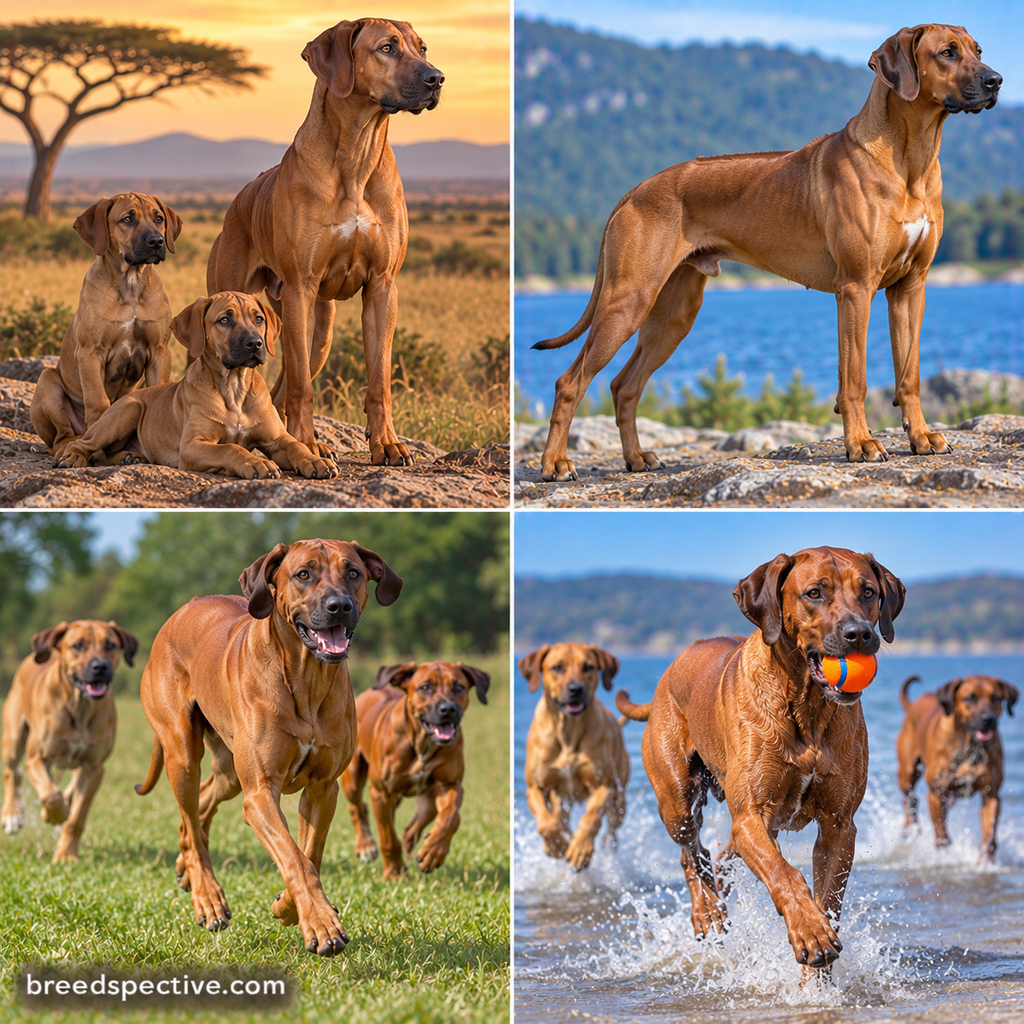
Modern Ridgeback behavior makes considerably more sense against the breed’s history.
The Rhodesian Ridgeback was developed in southern Africa from dogs that included native ridged Khoikhoi dogs and European dogs brought by settlers.
The native dogs contributed the breed’s defining physical characteristic: a ridge along the back.
That ridge is a strip of hair growing in the opposite direction from the surrounding coat. Under the breed standard it should be clearly defined, symmetrical and tapering, with two matching crowns.
Why Were Rhodesian Ridgebacks Called African Lion Hounds?
The breed became famous as the African Lion Hound because Ridgebacks were used in big-game hunting.
That name is sometimes misunderstood.
They were not developed to kill lions.
AKC historical material describes the dogs as tracking and harrying lions, keeping them occupied and holding them at bay so the hunter could approach. Doing this required speed, endurance, agility, courage and independent judgment.
The dogs also performed other jobs. Historical accounts describe Ridgebacks pursuing antelope, confronting baboons and helping protect livestock enclosures.
Those were demanding jobs for a versatile hunting dog.
It helps explain why today’s Ridgeback combines athleticism, prey drive, confidence, independence and watchfulness.
The 1922 Bulawayo Standard
By the early 20th century, the dogs varied considerably in appearance.
In 1922, Ridgeback enthusiasts met in Bulawayo, in modern Zimbabwe, to establish a more consistent breed type. AKC’s historical account describes how the assembled dogs ranged dramatically in size and appearance, prompting early fanciers to select desirable characteristics from different individuals while drawing heavily on the Dalmatian standard when developing the first Ridgeback standard.
The breed eventually became known as the Rhodesian Ridgeback rather than African Lion Dog.
The AKC recognized the breed in 1955.
Rhodesian Ridgeback Temperament in Everyday Life
The ideal Ridgeback is more nuanced than either “gentle family dog” or “fearless lion hunter” suggests.
Many adults are relatively composed in the house, affectionate with family and reserved rather than exuberant around strangers.
They can also be formidable athletes.
Affectionate Without Being Constantly Obedient
Ridgebacks can form very close family bonds without displaying the continuous handler focus seen in some working breeds.
That independence is part of the package.
An owner who wants a dog constantly waiting for its next instruction may find the Ridgeback frustrating.
An owner who appreciates a dog with more self-possession may find the temperament appealing.
Reserved Is Not the Same as Aggressive
A Ridgeback does not need to greet every stranger enthusiastically.
Neutrality is perfectly acceptable.
A stable adult should be able to exist around unfamiliar people without needing to threaten, challenge or control them.
Do not force interaction to make a reserved puppy “social.” Good socialization means creating positive, controlled experiences and teaching the dog that unfamiliar people, environments and situations are normal.
Adolescence Can Be Demanding
A young Ridgeback may have nearly adult strength before it has adult judgment.
That combination can expose weaknesses in training.
Leash manners, recall, visitor routines, food manners and impulse control should already be established before adolescence rather than introduced only when the dog becomes difficult to manage.
How Much Exercise Does a Rhodesian Ridgeback Need?
Plan on roughly 60–90 minutes of purposeful daily activity for many healthy adults, adjusting for age, health and the individual dog.
Useful activities include:
- Brisk walks
- Hiking
- Running with a properly conditioned adult
- Lure coursing
- Scent work
- Tracking games
- Structured play
- Training sessions
Young puppies should not be pushed through repetitive high-impact exercise simply to tire them out.
Mental work also matters.
Hide food for scent searches, practice recall on a long line, teach directional cues, or combine a walk with short obedience exercises.
Before choosing the breed, compare those requirements against your real schedule using our guide to matching a dog’s energy level to your daily routine.
If you like athletic family dogs but want a temperament with a different working background, our Boxer temperament and lifestyle guide provides a useful comparison.
Are Rhodesian Ridgebacks Good With Children?
They can be excellent family companions in the right household.
Their size changes the equation.
An enthusiastic young Ridgeback can knock over a small child without aggression, while children who climb on, corner or disturb a resting dog can create unnecessary conflict.
Supervise interactions and teach children not to:
- Ride or climb on the dog
- Disturb it while sleeping
- Take food or toys
- Corner it
- Pull ears or tail
- Encourage rough chasing games indoors
The same household rules should apply to adults and children: respect the dog’s space while expecting appropriate behavior from the dog.
Rhodesian Ridgebacks and Other Pets
Compatibility with other dogs varies by individual and socialization.
Small animals require additional caution because of the breed’s prey drive.
Do not choose a Ridgeback assuming it will automatically coexist safely with rabbits, rodents, poultry or unfamiliar cats.
Some individuals can live successfully with smaller household pets, particularly when raised with them, but management remains important.
Rhodesian Ridgeback Health Testing
Responsible breeders should be able to document health screening rather than simply saying their dogs are healthy.
The Rhodesian Ridgeback Club of the United States requires or strongly recommends multiple screenings through its breeding ethics and CHIC framework.
RRCUS identifies hip and elbow evaluation as core screening and also highlights thyroid and eye testing, with cardiac screening among additional recommended evaluations.
Ask for the parents’ registered names and verify results.
A CHIC number means the required tests were completed and made available according to the program’s requirements. It does not mean every result was normal. RRCUS explicitly makes this distinction in its CHIC guidance.
Dermoid Sinus in Rhodesian Ridgebacks
Dermoid sinus deserves special attention because of its association with the breed.
It is a congenital abnormality, meaning it is present at birth. The condition involves a tubular skin indentation or tract that can extend into deeper tissues. Veterinary research from the University of Veterinary Medicine Hannover describes dermoid sinus as a complex genetic condition particularly associated with Rhodesian Ridgebacks.
The sinus commonly occurs along the dorsal midline and may extend to varying depths.
The University of Tokyo Veterinary Medical Center has documented a Ridgeback case in which MRI was used to evaluate a cervical dermoid sinus before surgical removal, illustrating why the depth and course of the tract can matter clinically.
RRCUS explains that affected tracts can contain skin debris and hair and may become infected or form painful abscesses.
Responsible Ridgeback breeders should know how to check newborn puppies for dermoid sinus and should be transparent about any affected puppy.
Do not confuse dermoid sinus with the normal ridge.
The ridge is the breed’s characteristic strip of backward-growing hair. A dermoid sinus is a congenital medical abnormality.
Other Health Screening to Ask About
When evaluating a breeder, ask specifically about:
Hips and Elbows
RRCUS breeding ethics call for final hip and elbow screening of breeding dogs over 24 months through OFA or an accepted comparable registry.
For a large athletic dog, orthopedic screening is particularly relevant.
Thyroid
RRCUS’s CHIC framework includes thyroid screening using an OFA-approved laboratory or appropriate veterinary specialist.
Eyes
Eye examination is also part of the RRCUS CHIC screening framework.
Cardiac Screening
RRCUS lists cardiac certification among its strongly recommended additional health screenings.
No health-testing program can guarantee a disease-free puppy, but documented screening gives buyers substantially more useful information than statements such as “our dogs have never had problems.”
Rhodesian Ridgeback Grooming
Coat maintenance is one of the easier parts of ownership.
The Ridgeback has a short, dense, sleek coat that does not require elaborate professional grooming.
Routine care generally involves:
- Regular brushing
- Nail trimming
- Ear checks
- Dental care
- Bathing as needed
They do shed, but there is no long coat to detangle or clip.
The characteristic ridge requires no special grooming.
How Much Does a Rhodesian Ridgeback Cost Per Year?
A large dog creates large-dog expenses.
A realistic U.S. planning budget might look like this:
| Expense | Practical annual planning range |
|---|---|
| Food and treats | $600–$1,200 |
| Routine veterinary care | $350–$1,000 |
| Parasite prevention | $150–$450 |
| Toys and enrichment | $150–$400 |
| Grooming/basic supplies | $75–$250 |
| Training | $150–$800+ |
| Pet insurance | $500–$1,500+ |
| Typical planning total | About $1,975–$5,600+ |
These are budgeting estimates rather than fixed national prices.
Emergency treatment, orthopedic problems, surgery, professional behavioral help, boarding and chronic medication can push costs considerably higher.
Large dogs can also make medications, anesthesia and boarding more expensive simply because of body size.
Who Is a Rhodesian Ridgeback Best Suited To?
The strongest match is an owner who likes large athletic dogs but does not expect robotic obedience.
Good candidates often include:
- Experienced dog owners
- Active individuals and families
- Hikers and runners
- Owners with secure fencing
- People comfortable managing prey drive
- Households willing to train consistently
- Owners who appreciate an independent temperament
The breed can live in a home without acreage if exercise and management are adequate.
A giant backyard is less useful than an owner who actually trains, walks and engages the dog.
Who Should Think Twice About a Rhodesian Ridgeback?
This breed can be a difficult match if:
- You want effortless off-leash reliability
- Small pets roam freely in your household
- You dislike independent dogs
- You cannot physically manage a powerful adult
- You expect a yard to replace exercise
- You want a dog that loves every stranger
- You are unwilling to train leash manners early
- You want an extremely eager-to-please temperament
- You plan to encourage guarding behavior
- You cannot provide secure containment
A Ridgeback’s calm adult appearance can make the breed look easier than it is.
The challenge is not constant frantic energy. It is managing strength, speed, prey drive and independent decision-making in a dog capable of becoming extremely determined when something captures its attention.
Before committing, compare the complete package against your household with our guide to choosing the right dog breed for your lifestyle.
Verdict: Is a Rhodesian Ridgeback Right for You?
A Rhodesian Ridgeback is right for an owner who wants a large, athletic, affectionate but independent hound and is prepared to manage prey drive, teach leash control, maintain secure boundaries and train consistently from puppyhood.
It is not the right breed for someone seeking automatic obedience, casual off-leash freedom, effortless compatibility with small animals or a naturally protective dog that can be encouraged to make its own decisions about strangers.
The behaviors that create the most difficulty—chasing, selective listening, pulling, watchfulness and independent decision-making—are closely connected to the qualities that once allowed Ridgebacks to work in demanding southern African conditions. Good ownership does not try to erase those traits. It gives them safe outlets while teaching the dog exactly which behaviors are acceptable in modern family life.