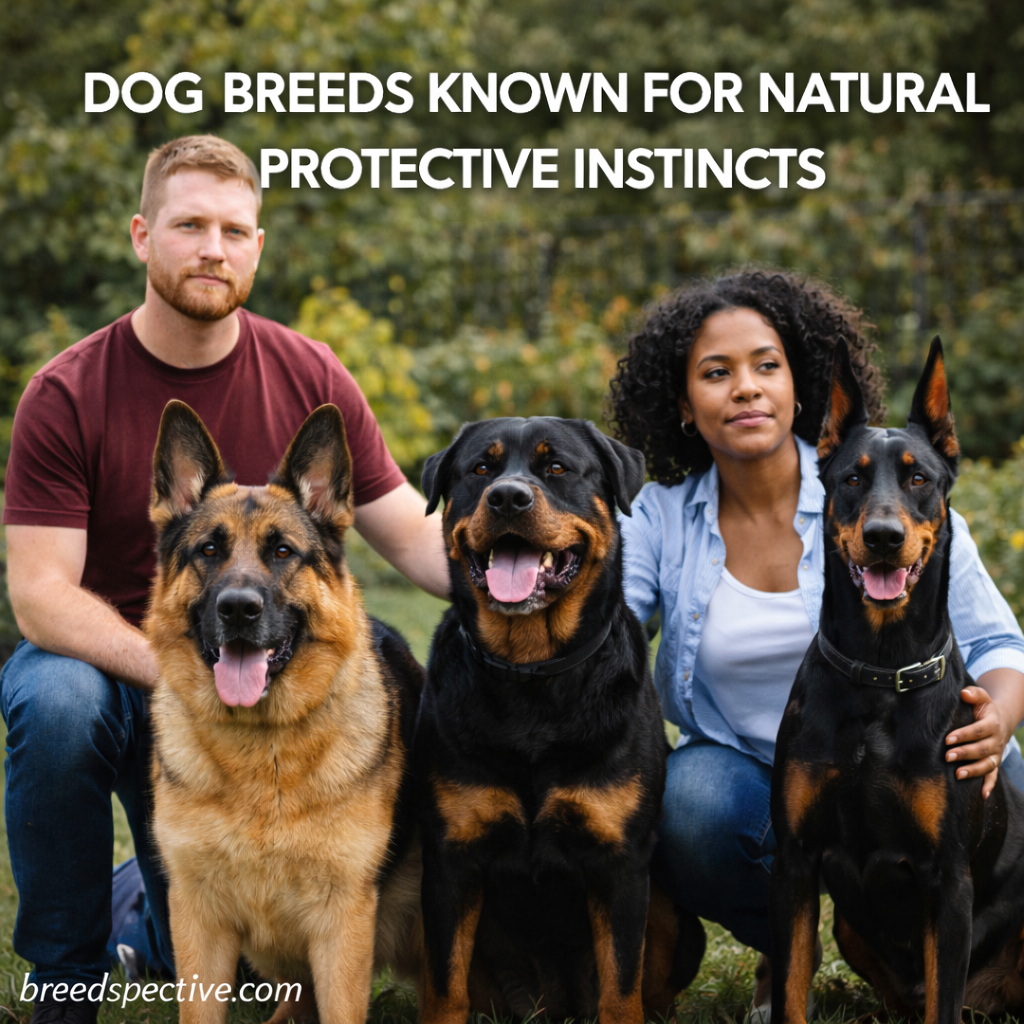
Dog breeds known for natural protective instincts include the German Shepherd, Rottweiler, Doberman Pinscher, Cane Corso, Bullmastiff, Belgian Malinois, Akita, Great Pyrenees, and Rhodesian Ridgeback. These breeds tend to combine qualities such as alertness, confidence, territorial awareness, loyalty, and willingness to monitor unfamiliar situations, but a naturally protective dog is not the same thing as a professionally trained protection dog.
For most households, the goal should be a stable companion that can recognize normal people and situations without treating everything unfamiliar as a threat. Early socialization, reward-based training, secure management, and realistic expectations are especially important when the dog is large, powerful, or naturally reserved with strangers.
Protective Dog Breeds at a Glance
| Breed | Protective Style | Trainability | Activity | Best Fit |
|---|---|---|---|---|
| German Shepherd | Alert, handler-oriented | Very high | High | Experienced active households |
| Rottweiler | Calm, territorial, watchful | High | Moderate–high | Confident experienced owners |
| Doberman Pinscher | Vigilant, people-focused | Very high | High | Active owners wanting close companionship |
| Cane Corso | Territorial, imposing | High | Moderate–high | Experienced guardian-breed owners |
| Bullmastiff | Watchful, physically imposing | Moderate | Moderate | Owners comfortable with a very large dog |
| Belgian Malinois | Intense, fast, handler-focused | Very high | Very high | Serious working-dog homes |
| Akita | Reserved, independent | Moderate | Moderate | Experienced owners comfortable with independence |
| Great Pyrenees | Independent territorial guardian | Moderate | Moderate | Rural properties and livestock settings |
| Rhodesian Ridgeback | Reserved, independent, watchful | Moderate | High | Active experienced households |
Breed tendencies are useful, but they do not guarantee how an individual dog will respond to a stranger or stressful situation.
The American Kennel Club (AKC) describes guardian breeds broadly as loyal, strong, watchful dogs with natural protective tendencies, while also emphasizing the need for proper training and socialization because many are large and powerful.
What Does a Natural Protective Instinct Look Like?
Protection should not be treated as a synonym for aggression.
A naturally protective dog may pay close attention to unfamiliar people, investigate unusual sounds, alert when someone approaches the property, remain reserved with strangers, or position itself near family members when something unusual happens.
That is very different from a dog that indiscriminately lunges, bites, or cannot tolerate ordinary visitors.
Useful protective qualities include:
- Confidence rather than fear
- Awareness of the environment
- Strong attachment to the household
- Trainability
- Ability to disengage when directed
- Appropriate recovery after something surprising
- Predictable behavior around normal visitors
- Territorial awareness without constant escalation
A dog that reacts intensely to every person, noise, bicycle, or delivery is not necessarily a better guardian.
Fear, anxiety, frustration, poor socialization, and aggression can all produce behavior that inexperienced owners mistake for “protectiveness.”
Protective Dog vs. Guard Dog vs. Trained Protection Dog
These categories overlap in everyday language, but they should not be treated as interchangeable.
Naturally protective dog
This is a dog whose inherited tendencies make it alert, territorial, reserved, or inclined to monitor its household.
The dog may bark when someone approaches without having any formal protection training.
Property or livestock guardian
Some breeds were developed specifically to guard territory, livestock, or other resources.
Great Pyrenees are an obvious example. Their independent guardian style differs substantially from the handler-focused work associated with breeds such as German Shepherds.
Our guide to the best livestock guardian dog breeds for farms explains that specialized role.
Professionally trained protection dog
A trained protection dog is different again.
Formal protection work requires carefully selected dogs, skilled handling, controlled training, and professional expertise. Owners should not attempt to turn an ordinary pet into an attack or protection dog through intimidation, encouragement of aggression, or improvised bite training.
The distinction matters because natural protectiveness does not mean a dog knows when physical intervention is appropriate.
For a family pet, reliable obedience, social stability, appropriate management, and the ability to remain calm around ordinary people are much more useful than uncontrolled defensive behavior.
1. German Shepherd
The German Shepherd is one of the breeds most closely associated with protection and working roles.
Its combination of intelligence, athleticism, trainability, alertness, and handler engagement has allowed the breed to work in numerous roles requiring close cooperation with people.
That versatility is also why the German Shepherd should not be reduced to the label “guard dog.”
A well-bred German Shepherd needs meaningful physical exercise, mental activity, training, and social interaction.
Best for:
- Experienced or highly committed owners
- Active households
- People who enjoy training
- Owners wanting a responsive working breed
- Homes prepared for substantial daily engagement
Poorly managed German Shepherds can become difficult because intelligence and sensitivity do not compensate for inadequate socialization or training.
For a complete ownership picture, see our German Shepherd temperament, energy level, and lifestyle guide.
2. Rottweiler
Rottweilers combine substantial physical strength with natural watchfulness.
The AKC describes the Rottweiler as a strong, intelligent, alert Working Group breed with protective tendencies. It also emphasizes early training and socialization because territorial behavior needs appropriate direction.
A mature Rottweiler’s physical presence alone can be considerable. That makes reliable manners particularly important.
An owner should be able to comfortably manage:
- Visitors entering the home
- Veterinary appointments
- Walks around unfamiliar people and dogs
- Deliveries
- Contractors and maintenance workers
- Travel and boarding
- Unexpected encounters
A Rottweiler that cannot safely participate in ordinary life becomes a liability rather than an asset.
Our Rottweiler temperament and lifestyle profile covers the breed’s broader requirements.
3. Doberman Pinscher
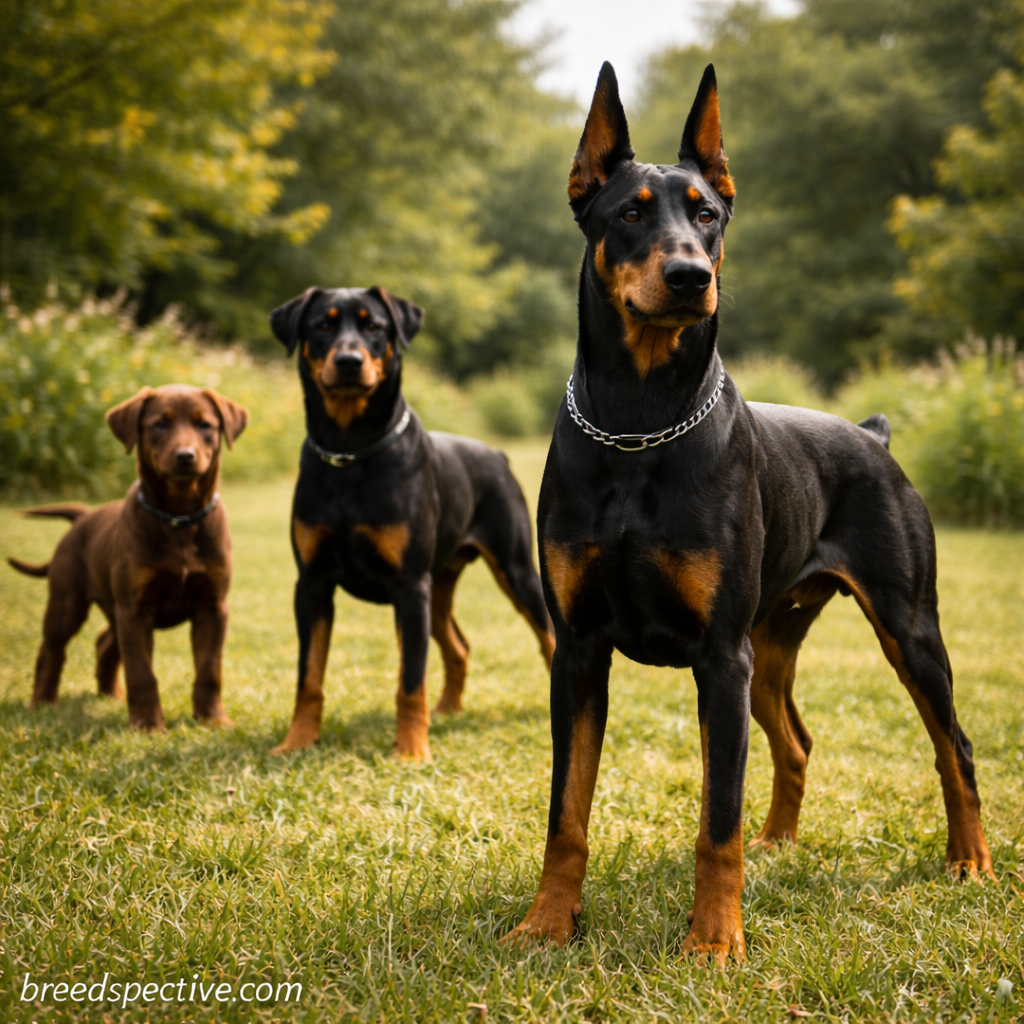
The Doberman Pinscher was deliberately developed as a protective companion and remains one of the clearest examples of a people-oriented guardian breed.
The AKC describes Dobermans as intelligent, vigilant, athletic dogs that bond closely with their families. Early socialization and obedience training are considered essential because of their strength and protective nature.
Dobermans also need substantial exercise.
This is not a dog that simply stands beside the front door looking intimidating.
Best for:
- Active owners
- People who enjoy structured training
- Households wanting a closely bonded dog
- Experienced owners comfortable managing a large athletic breed
If you are deciding between two classic guardian breeds, our Rottweiler vs. Doberman comparison looks more closely at their differences in protection style, temperament, and daily life.
4. Cane Corso
The Cane Corso is a large Italian guardian breed with strong territorial tendencies and considerable physical power.
The AKC describes the Corso as confident, intelligent, protective, and highly trainable, while stressing that early training and socialization are crucial.
That last point deserves more attention than the breed’s imposing appearance.
A Cane Corso may exceed 100 pounds. An adult dog that becomes overprotective, poorly controlled, or highly reactive can create a serious management problem.
Socialization should help the dog learn that visitors, veterinarians, pedestrians, children playing, delivery workers, and unfamiliar environments are ordinary parts of life.
It should not attempt to make the dog indiscriminately friendly.
The goal is neutrality and control.
5. Bullmastiff
Bullmastiffs were developed as large guardians, and their physical presence remains one of their defining characteristics.
Compared with some highly driven working breeds, a Bullmastiff may present a quieter style of watchfulness. But lower activity does not eliminate the responsibility that comes with a very large, strong dog.
Training needs to begin before the dog reaches adult size.
Loose-leash walking, calm greetings, waiting at doors, handling, recall, and settling around visitors all become substantially harder to teach when an owner is already struggling to physically control the dog.
A Bullmastiff can suit someone wanting a substantial guardian breed without the extreme activity of a Belgian Malinois, but it is still not a low-responsibility choice.
6. Belgian Malinois
The Belgian Malinois is often seen performing police, military, sport, and other demanding working roles.
That visibility has also made the breed attractive to people who underestimate how much dog they are bringing home.
Malinois tend to be intensely active, highly trainable, quick, and strongly motivated to work. Those qualities can be exceptional in the right environment and exhausting in the wrong one.
A typical pet household should not choose a Malinois merely because it wants a dog that “will protect the family.”
The daily training and activity commitment is much more relevant.
For prospective owners comparing two highly capable working breeds, our German Shepherd vs. Belgian Malinois guide explains why the Malinois is often the more demanding household companion.
7. Akita
The Akita represents a different protective style from highly handler-focused dogs such as the German Shepherd or Doberman.
Akitas tend to be independent and can be reserved with unfamiliar people. That independence requires owners who are comfortable with a dog that may not approach training with the same eagerness for constant direction as some working breeds.
Socialization remains essential.
A naturally reserved dog should learn to navigate unfamiliar people and environments without automatically escalating.
The combination of strength, independence, and guardian tendencies means the Akita is generally better suited to owners who understand large, self-directed breeds.
8. Great Pyrenees
The Great Pyrenees was developed around livestock protection rather than personal protection.
That heritage produces a substantially different kind of guardian.
Instead of constantly waiting for instructions from a handler, livestock guardians were selected to monitor territory and make independent decisions around their animals.
That can translate into:
- Territorial awareness
- Independent decision-making
- Nighttime vigilance
- Substantial barking
- A willingness to patrol
- Less interest in repetitive obedience work
A Great Pyrenees can be deeply devoted to its household, but prospective owners should not choose one expecting the working style of a German Shepherd.
Fencing and barking are particularly important considerations.
9. Rhodesian Ridgeback
The Rhodesian Ridgeback is a powerful, athletic hound with an independent temperament and a history that included hunting and property protection in southern Africa.
Ridgebacks may be reserved with unfamiliar people, but their hound background produces a different temperament from classic European protection breeds.
They can also have substantial prey drive and independent decision-making.
That means an owner wanting instant obedience and constant handler focus may find the breed frustrating.
Before interpreting independence or reserve as a desirable protection trait, consider the common behavioral challenges of Rhodesian Ridgebacks.
Where IGP Fits Into Protection-Dog History
Discussions of German Shepherds and other working breeds frequently lead to IGP.
IGP is the modern international utility-dog sport historically associated with Schutzhund. Schutzhund developed in Germany in the early 20th century as a way of evaluating German Shepherd working ability and suitability.
Modern FCI IGP competition is governed by detailed international regulations and tests dogs in structured working exercises. The Fédération Cynologique Internationale (FCI) currently categorizes IGP under its utility and tracking dog programs.
This is very different from encouraging a pet dog to threaten strangers.
Structured working-dog sports involve rules, trained handlers, controlled environments, and dogs selected and prepared for the work.
The existence of protection-related dog sports does not mean the average owner of a German Shepherd, Rottweiler, or Doberman needs to pursue bite work.
Bite Force PSI: Why the Numbers Need Context
Search for almost any powerful breed and you will encounter claims such as:
- “This breed has a 700 PSI bite.”
- “That breed has the strongest bite.”
- “Breed A bites twice as hard as Breed B.”
Treat precise breed-by-breed PSI rankings cautiously.
PSI means pounds per square inch, a measurement of pressure. Turning that concept into a dependable league table of dog breeds is much more difficult than repeating a number online.
A dog’s actual bite can be influenced by multiple variables, including:
- The individual dog’s anatomy
- Head and jaw structure
- Body size
- Where and how the bite is measured
- What the dog is biting
- Motivation and effort
- Measurement equipment and methodology
Breedspective does not recommend selecting a protection breed based on an online bite-force ranking.
The organizations used for this article — AKC, FCI, and the American Veterinary Society of Animal Behavior (AVSAB) — do not provide a standardized consumer ranking assigning definitive PSI scores to the guardian breeds above.
That absence matters.
Without a consistent, validated testing method applied comparably across breeds, a precise number repeated across websites should not be treated as established evidence.
More importantly, bite pressure tells you very little about whether a dog is an appropriate guardian for your home.
Temperament, stability, trainability, control, socialization, and responsible management matter far more than a theoretical maximum bite measurement.
Natural Protection Is Not Professional Protection Training
Owning a Rottweiler does not automatically give you a protection dog.
Neither does owning a German Shepherd, Doberman, Cane Corso, or Belgian Malinois.
A naturally protective companion may bark at an unexpected visitor, monitor unfamiliar situations, or remain close to its owner.
A trained protection dog is expected to perform specialized behaviors under controlled circumstances.
That work requires professional expertise.
Improvised protection training can be dangerous because owners may accidentally reinforce fear, uncontrolled aggression, inappropriate targeting, or behavior they cannot reliably stop.
For the typical household wanting greater security, practical measures such as secure doors, lighting, alarms, cameras, fencing, and a stable dog that alerts appropriately are far more straightforward than attempting to create an attack dog.
Socialization Matters More With Guarding Breeds
Early socialization does not “ruin” a dog’s protective instincts.
It helps the dog develop a broader understanding of what normal life looks like.
AVSAB identifies the first three months of a puppy’s life as the primary socialization period and recommends safe exposure to people, animals, environments, stimuli, and experiences during puppyhood.
For a guardian breed, that learning is especially valuable.
The puppy should gradually encounter ordinary things such as:
- People of different ages and appearances
- Visitors entering the home appropriately
- Veterinary handling
- Cars and traffic
- Delivery activity
- Other dogs where appropriate
- Household noises
- New surfaces
- Grooming and handling
- Public environments
The objective is not to make every Rottweiler or Akita love every stranger.
It is to prevent unfamiliarity itself from becoming a reason for inappropriate defensive behavior.
AKC guidance for Rottweilers, Dobermans, and Cane Corsos similarly emphasizes early and continuing socialization because natural territorial or protective tendencies can otherwise become harder to manage.
Training Should Build Control, Not Fear
Protective breeds need reliable everyday skills.
Prioritize:
- Recall
- Loose-leash walking
- Waiting at doors and gates
- Leaving objects when asked
- Settling calmly
- Polite greetings
- Comfortable handling
- Moving away from a situation when directed
- Remaining responsive around distractions
AVSAB recommends reward-based methods for dog training, including behavior modification, and advises against aversive training methods.
That is particularly relevant with powerful dogs.
Training based on intimidation or deliberately provoking defensive behavior can create exactly the instability a responsible guardian-dog owner should be trying to avoid.
Confidence and control are more useful than fear.
Protective Dogs and Children
A breed’s loyalty to its family should never be treated as a safety guarantee around children.
Children can run, shout, wrestle with friends, bring unfamiliar classmates into the home, and behave unpredictably from a dog’s perspective.
A strongly protective dog needs to learn that normal childhood activity is not an emergency requiring intervention.
Adults should manage interactions rather than expecting the dog to decide when children’s play has become dangerous.
This is especially relevant when visiting children are present. A dog familiar with its own household may respond differently to unfamiliar children.
Physical separation using doors, gates, crates, or another secure area can be the appropriate choice when supervision cannot be maintained.
Responsible Ownership Starts Before You Get the Dog
Protective breeds amplify weak management.
Before choosing one, ask:
- Can I physically control this dog at adult size?
- Do I have time for daily training?
- Can I provide enough exercise and mental activity?
- Can I securely contain the dog?
- How frequently do unfamiliar people enter my home?
- Do I have children or frequent child visitors?
- Can I manage the dog around contractors and delivery workers?
- What will happen when I travel?
- Am I comfortable with a dog that may be naturally reserved?
- Do I have access to qualified professional training if problems develop?
If you primarily want a relaxed companion that welcomes everyone and requires little training, a strongly protective breed may be an unnecessary complication.
Liability, Housing, and Insurance Matter
Large guardian breeds can carry practical responsibilities beyond training.
Before bringing one home, check:
- Homeowner or renter insurance requirements
- Landlord and lease restrictions
- HOA rules
- Local animal-control laws
- Fencing requirements
- Boarding and daycare policies
- Availability of suitable housing if you move
Rules can vary by jurisdiction, insurer, landlord, and individual property.
Do this research before acquiring the dog.
A breed that fits your personality but jeopardizes your housing or cannot be covered under your insurance creates a problem for both owner and dog.
Owners are also responsible for preventing foreseeable incidents.
Secure gates, functional fencing, controlled visitor introductions, proper leash handling, veterinary care, training, and appropriate separation are ordinary parts of responsible ownership when managing a large protective dog.
Protective Does Not Mean Aggressive
One of the most persistent myths about guardian breeds is that aggression proves the dog’s protective ability.
It does not.
A dog that cannot safely encounter ordinary people, recover from surprises, or respond to its handler may be difficult to manage regardless of breed.
Nor should every bark or growl be interpreted as evidence of admirable protection.
Behavior has context.
Fear, pain, resource guarding, frustration, territorial behavior, and anxiety can all produce defensive responses. Sudden or concerning behavior changes deserve professional assessment rather than encouragement.
The useful household guardian is not the dog looking for a confrontation.
It is the stable dog that can live safely in ordinary society while remaining naturally attentive to its environment.
Verdict: Who Should Choose a Protective Breed?
A German Shepherd or Doberman Pinscher can suit an active, training-oriented owner who wants a closely engaged working breed and is prepared for substantial daily exercise and socialization.
A Rottweiler may suit an experienced household wanting a powerful, watchful companion with a more measured guardian style, while the Cane Corso is better reserved for owners prepared to manage an exceptionally strong, territorial dog.
The Belgian Malinois belongs with people who genuinely want the workload of an intense working dog, not someone simply looking for extra home security. Akitas and Rhodesian Ridgebacks suit owners comfortable managing greater independence, while Great Pyrenees make more sense when their territorial, livestock-guardian heritage fits the property and environment.
None of these breeds is right for someone who wants aggression, an intimidating status symbol, or a dog that will somehow distinguish threats from harmless people without extensive socialization and management.
The right protective dog is stable, controllable, appropriately socialized, and compatible with its owner’s actual lifestyle. Natural guarding instinct can be useful; responsible ownership is what keeps that instinct manageable.