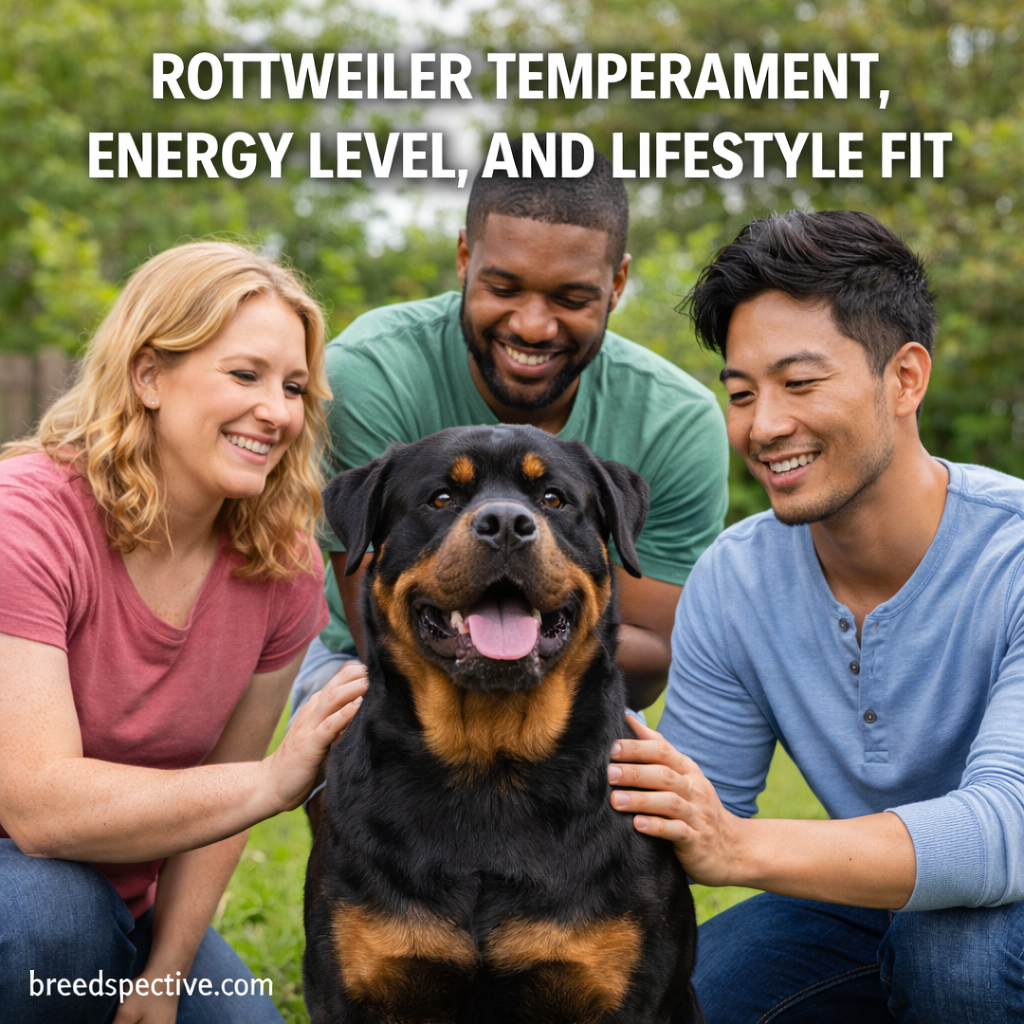
Rottweiler temperament should be confident, calm, alert, devoted, and naturally watchful rather than indiscriminately aggressive. A well-bred Rottweiler can be affectionate and playful with family while remaining reserved with strangers, but its size, strength, territorial instincts, and guarding heritage make early socialization and consistent training essential.
The American Kennel Club describes a properly raised Rottweiler as calm, confident, courageous, and not unduly aggressive. The breed’s self-assured reserve toward strangers is part of its character, not something owners should try to turn into indiscriminate friendliness—or deliberately intensify into suspicion.
Rottweiler at a Glance
| Trait | Rottweiler |
|---|---|
| Height | Males: 24–27 inches; females: 22–25 inches |
| Weight | Males: 95–135 pounds; females: 80–100 pounds |
| Life expectancy | About 9–10 years |
| Exercise needs | Moderate-high |
| Grooming | Low-moderate; regular shedding with heavier seasonal periods |
| Trainability | High, but consistency matters |
| Good with children? | Can be, with training and close supervision |
| Good with other pets? | Variable; socialization and individual temperament matter |
| Protective tendency | High |
| Best fit | Experienced or well-prepared owner committed to training and socialization |
The Rottweiler is a substantial working dog. AKC describes the breed as powerful, intelligent, trainable, and naturally protective, with males reaching as much as 135 pounds.
That physical power changes the consequences of poor training. A behavior that is merely irritating in a 15-pound dog—lunging toward another dog, jumping on visitors, dragging on the leash—can become a serious management problem in a full-grown Rottweiler.
Rottweiler History and Original Purpose
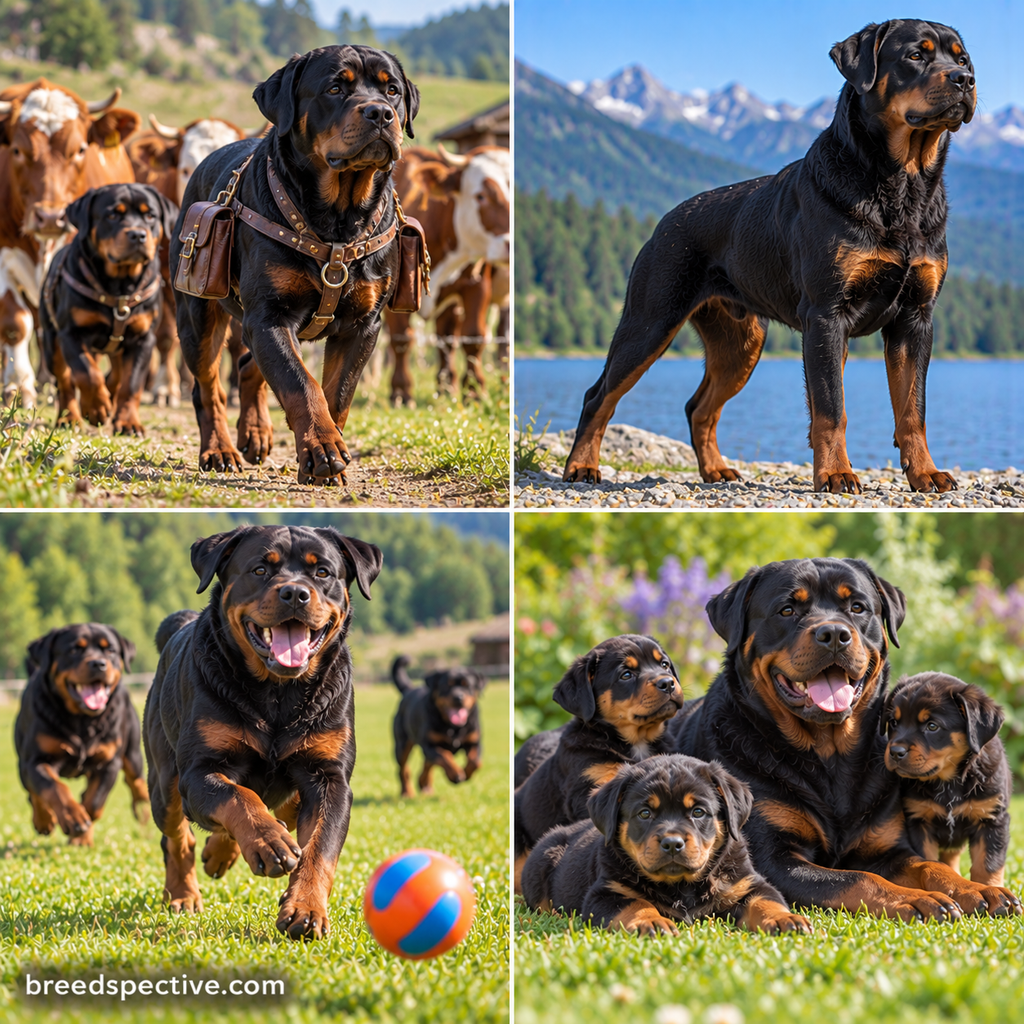
The Rottweiler’s history helps explain its modern temperament.
The breed descends from mastiff-type drover dogs associated with Roman legions. These dogs accompanied livestock as Roman forces moved through Europe, helping drive and protect the herds.
The German town of Rottweil later became an important livestock-trading center, and working dogs in the region continued driving cattle, protecting property, and hauling carts. The breed ultimately took its name from the town.
The Rottweiler Metzgerhund
Rottweilers became closely associated with butchers and cattle dealers, earning the name Rottweiler Metzgerhund, or Butcher’s Dog of Rottweil.
Historical accounts describe the dogs driving cattle to market and pulling carts containing meat.
They were also said to protect the proceeds from cattle sales. Money was placed in a purse tied around the dog’s neck, making a large, powerful working dog the unlikely guardian of the day’s earnings. AKC and American Rottweiler Club historical material both preserve this traditional account.
Industrialization eventually reduced demand for cattle-driving and carting dogs.
The Rottweiler found another role.
In the early 1900s, German police organizations began using Rottweilers alongside breeds including German Shepherd Dogs, Doberman Pinschers, and Airedale Terriers. AKC records that the breed found renewed favor as a police dog during this period.
The modern Rottweiler therefore carries a heritage built around driving livestock, guarding, hauling, and working closely with people.
Rottweiler Temperament in Everyday Life
The ideal Rottweiler is not constantly looking for conflict.
A stable adult tends to watch first.
AKC describes the breed’s demeanor toward the outside world as self-assured and aloof. That “wait and see” tendency is useful in understanding how a Rottweiler differs from a dog expected to enthusiastically greet everyone it meets.
Affectionate With Family
The imposing exterior can hide a surprisingly playful household companion.
Many Rottweilers enjoy physical affection, games, training, and simply staying near their people. They generally do best when they live as part of the household rather than being isolated in a yard as a “guard dog.”
Their attachment to family is one reason prospective owners sometimes compare them with German Shepherd temperament and lifestyle needs.
The breeds share working backgrounds and high trainability, but they should still be evaluated individually rather than treated as interchangeable protection dogs.
Reserved With Strangers
A Rottweiler does not need to greet every stranger like an old friend.
Neutrality is a perfectly acceptable goal.
The dog should be capable of seeing unfamiliar people without panicking, lunging, threatening, or deciding independently that normal human behavior is dangerous.
That distinction becomes central to socialization.
Socialization Is Non-Negotiable
For a naturally watchful, territorial breed, socialization is not about making the dog love everyone.
It is about teaching the dog that the world contains many ordinary things that do not require a defensive response.
A Rottweiler puppy should gradually encounter:
- People of different appearances
- Calm, appropriate dogs
- Veterinary handling
- Grooming and nail care
- Traffic and bicycles
- Visitors entering the home
- Delivery activity
- Children at safe distances
- Different surfaces and environments
- Car travel
- Household noises
- People using mobility equipment
- Calm behavior around fences and property boundaries
Exposure needs to be controlled and positive.
Dragging a frightened puppy into a crowded environment or allowing strangers to overwhelm it is not productive socialization.
AKC specifically emphasizes early training and socialization because of the Rottweiler’s territorial and protective tendencies.
Owners interested in guarding breeds should also distinguish controlled temperament from simply encouraging suspicion. Our guide to dog breeds known for natural protective instincts explores that distinction further.
How Much Exercise Does a Rottweiler Need?
A healthy adult Rottweiler generally fits best with roughly 60–90 minutes of purposeful daily activity, adjusted for age, health, weather, and the individual dog.
That does not need to mean 90 minutes of running.
Useful activities include:
- Brisk walks
- Hiking
- Swimming
- Structured retrieving
- Obedience practice
- Tracking and scent work
- Appropriate tug games
- Carting or drafting activities
- Dog sports
- Short training sessions throughout the day
AKC describes Rottweilers as active dogs that can excel in activities such as herding, tracking, obedience, carting, agility, and other working roles.
Young Rottweilers require special consideration because their joints are still developing. Exercise should build coordination and fitness without turning a growing puppy’s routine into repetitive high-impact conditioning.
Rottweiler Training
Training should begin while the Rottweiler is small enough that mistakes are easy to manage.
Useful priorities include:
- Reliable recall
- Loose-leash walking
- Leave it
- Drop it
- Settle or place
- Waiting at doors
- Calm visitor routines
- Cooperative veterinary handling
- Food manners
- Neutral behavior around dogs
- Emergency interruption cues
Reward-based training works well with a breed capable of learning quickly.
“Firm” training does not mean physical intimidation.
A powerful dog needs predictable rules, clear reinforcement, and consistent follow-through. Harsh confrontation can create unnecessary conflict and does not replace teaching the dog what behavior is expected.
Owners comparing two popular protection breeds may find our Rottweiler vs. Doberman comparison useful for understanding differences in lifestyle and temperament.
Common Rottweiler Behavior Problems and How to Address Them
Behavior problems become harder to ignore when the dog weighs 100 pounds.
Leash Pulling
Do not wait until adulthood.
Reward the puppy for remaining near the handler, change direction before the leash becomes continuously tight, and gradually add distractions.
Equipment can help with management, but equipment does not teach leash manners by itself.
Territorial Barking
Acknowledging an unfamiliar sound is different from allowing prolonged fence running or window barking.
Limit access to triggers when necessary and teach an alternative behavior such as going to a mat after an alert.
Over-Guarding Visitors
Create a predictable visitor routine.
The dog may initially remain behind a gate, on leash, or in another safe area while guests enter. Reward calm behavior rather than forcing interaction.
A Rottweiler does not need to physically investigate everyone entering the home.
Reactivity Toward Other Dogs
Increase distance before the dog becomes overwhelmed and reinforce attention to the handler.
Repeatedly allowing lunging and barking to be practiced can make the pattern more established.
Persistent reactivity warrants help from a qualified professional who uses humane, evidence-based methods.
Resource Guarding
Do not routinely take food or prized objects away merely to prove that you can.
Teach trades, approach with something valuable, and create positive associations with people near resources.
Growling is information. Punishing the warning without changing the underlying discomfort can remove an important signal while leaving the emotional problem intact.
Some management principles overlap with challenges found in other large, independent dogs, including those discussed in our guide to common behavioral challenges in Rhodesian Ridgebacks.
Are Rottweilers Good With Children?
A well-socialized Rottweiler can live successfully in a family with children, but “good with kids” should never be interpreted as supervision being unnecessary.
Size is the most obvious concern.
An enthusiastic 100-pound dog can knock over a small child without intending harm. Children should also never climb on the dog, interfere with meals, take toys, disturb sleep, or corner a dog trying to leave.
AKC notes that properly trained Rottweilers can be patient with children while also warning that their size and play style may be too much for some families with small children.
Adults should actively supervise dog-child interactions.
Rottweilers and Other Pets
Compatibility varies.
Some Rottweilers live peacefully with other dogs and household pets, particularly when carefully socialized and introduced. Individual temperament, sex, history, training, and the behavior of the other animal all influence the result.
Do not assume that puppy socialization guarantees universal adult dog-friendliness.
The more practical goal is a dog that can remain under control around other animals, even if it does not want to socialize with every dog it encounters.
Grooming and Shedding
The Rottweiler is relatively straightforward to groom.
Its coat is short, straight, dense, and coarse. Weekly brushing is generally sufficient for routine coat care, although seasonal shedding can increase the amount of loose hair. AKC notes heavier shedding periods in spring and fall.
Routine care should include:
- Weekly brushing
- Nail trimming
- Dental care
- Ear checks
- Occasional bathing
- Skin and coat monitoring
Low grooming requirements should not be confused with low overall maintenance. Training, exercise, socialization, and managing a large dog require far more time than brushing the coat.
Rottweiler Health Screening
Health testing should be verified before buying a puppy.
The American Rottweiler Club (ARC) currently requires breeding dogs in its mandatory health program to complete hip, elbow, eye, cardiac, and Juvenile Laryngeal Paralysis & Polyneuropathy (JLPP) testing, along with obtaining a CHIC number.
ARC specifies:
- Hips: OFA radiographic evaluation after 24 months
- Elbows: OFA radiographic evaluation after 24 months
- Eyes: examination by a board-certified veterinary ophthalmologist, with periodic recertification
- Heart: cardiac evaluation after 24 months, preferably by a board-certified cardiologist and preferably using echocardiography
- JLPP: DNA testing with breeding requirements designed to prevent affected puppies
- CHIC: completion and public release of the parent-club-required results
A CHIC number shows that required screenings were completed and disclosed. Buyers should still inspect the actual individual results rather than treating “CHIC” as shorthand for perfect health.
Hip and Elbow Dysplasia
Orthopedic screening is particularly important in a heavy working breed.
Cornell University College of Veterinary Medicine identifies Rottweilers among medium and large breeds in which hip dysplasia is common. Hip dysplasia involves abnormal development and laxity of the hip joint, which can lead to arthritis and pain.
Cornell also identifies Rottweilers among breeds with a high prevalence of elbow dysplasia.
Healthy body condition matters throughout life.
Cornell notes that excessive nutrition and rapid growth can worsen expression of hip dysplasia in predisposed puppies and recommends appropriate large-breed growth diets rather than overfeeding or indiscriminate calcium supplementation.
Osteosarcoma
Prospective Rottweiler owners should also know about osteosarcoma.
Cornell University College of Veterinary Medicine identifies Rottweilers among the large and giant breeds predisposed to this aggressive bone cancer. Common signs include persistent lameness, reluctance to walk, localized swelling, and loss of muscle mass around an affected limb.
Persistent unexplained lameness deserves veterinary evaluation rather than assuming an older Rottweiler has simply strained a muscle.
Screening parents cannot eliminate every future health risk. Responsible breeding reduces avoidable risk where validated screening tools exist, while owners still need realistic expectations about diseases for which no simple prebreeding clearance can guarantee protection.
Breed-Specific Legislation, Housing, and Insurance Restrictions
Rottweiler ownership has a practical complication unrelated to temperament: some housing providers, insurers, municipalities, or other authorities may impose breed-based restrictions.
Rules vary substantially by location and can change.
Before obtaining a Rottweiler, verify:
- Local animal-control ordinances
- Homeowners or renters insurance coverage
- Landlord or property-management rules
- HOA restrictions
- Boarding and daycare policies
- Requirements that may apply if you relocate
Do this before bringing the dog home.
Do not assume that a friendly individual dog automatically exempts an owner from a policy written around breed identification.
These restrictions are also a reason to think beyond your current home. A Rottweiler may live 9–10 years, during which employment, housing, insurance, or location can change.
How Much Does a Rottweiler Cost Per Year?
Large dogs eat more, require larger equipment, and can generate substantial veterinary expenses.
A practical annual U.S. planning budget is:
| Expense | Practical annual planning range |
|---|---|
| Food and treats | $700–$1,400 |
| Routine veterinary care | $350–$900 |
| Parasite prevention | $200–$500 |
| Toys and enrichment | $150–$500 |
| Grooming/basic supplies | $100–$300 |
| Training/classes | $100–$800+ |
| Pet insurance | $600–$1,800+ |
| Typical planning total | About $2,200–$6,200+ |
These are budgeting estimates, not fixed national prices.
Emergency surgery, orthopedic treatment, cancer treatment, professional behavior help, boarding, daycare, or insurance limitations can raise costs dramatically.
Owners should also budget for sturdy crates, gates, beds, collars, harnesses, and other equipment appropriately sized for a powerful adult dog.
Who Is a Rottweiler Best Suited To?
The strongest match is an owner who appreciates the breed’s confidence without trying to turn it into unnecessary aggression.
A Rottweiler may suit someone who:
- Wants an involved working companion
- Can provide daily exercise
- Enjoys structured training
- Will socialize throughout puppyhood and adolescence
- Can physically manage a large, powerful dog
- Values calm neutrality around strangers
- Can enforce consistent household rules
- Will verify health testing
- Has confirmed housing and insurance eligibility
- Understands that guarding instincts require management
Prior large-dog experience helps, but preparation and willingness to seek competent professional guidance matter too.
Who Should Think Twice About a Rottweiler?
This breed deserves more consideration than “I want a dog that will protect me.”
Think carefully if:
- You want an indiscriminately social dog
- You have little interest in training
- You plan to keep the dog isolated outdoors
- You want to deliberately encourage suspicion or aggression
- You cannot safely control a dog weighing 80–135 pounds
- Your housing situation is unstable
- Your landlord or insurer restricts the breed
- You are unwilling to manage introductions to visitors
- You expect puppy socialization alone to solve every future behavior issue
- Daily exercise and mental engagement are difficult to provide
A yard does not replace training, and physical strength does not automatically create a reliable guardian.
Before committing, compare the breed’s actual requirements with your household using our guide to choosing the right dog breed for your lifestyle.
Verdict: Is a Rottweiler Right for You?
A Rottweiler is right for an owner who wants a confident, powerful, highly trainable working dog and is prepared to take socialization, obedience, exercise, health screening, and responsible management seriously. In the right household, the breed can combine calm affection at home with the alert, self-assured temperament expected of a historic drover and guardian.
A Rottweiler is not right for someone seeking an intimidating dog with minimal training, or for an owner who wants to encourage uncontrolled protective behavior. The breed’s strength means poor leash manners, inadequate socialization, territorial behavior, and inconsistent rules carry greater consequences than they do with many smaller dogs.
Choose a Rottweiler because you value a steady working temperament and are prepared to manage it responsibly for the dog’s entire life—not simply because the breed looks powerful.