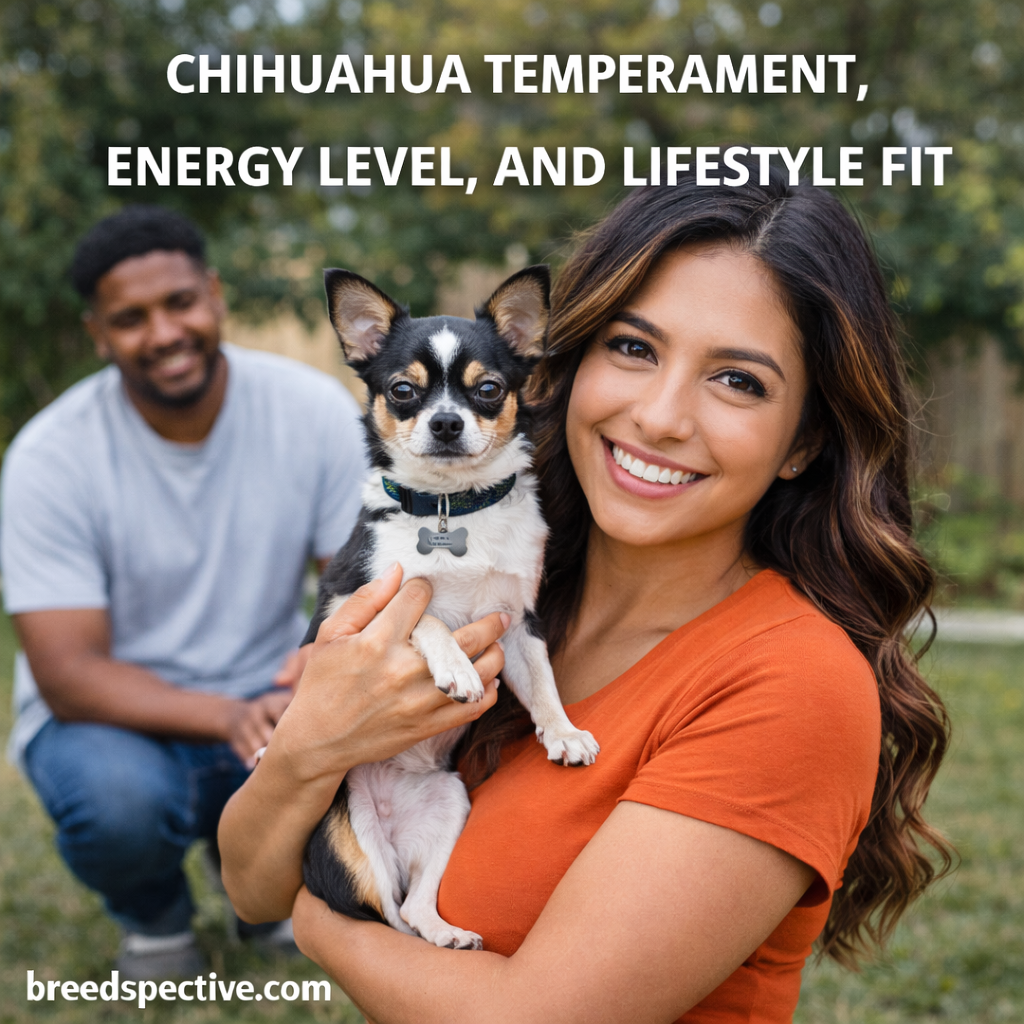
Chihuahua temperament is typically alert, confident, affectionate, lively, and strongly attached to familiar people. Despite weighing no more than 6 pounds under the AKC breed standard, a Chihuahua should not be treated as a fragile accessory: this is an intelligent, expressive little dog that needs training, socialization, exercise, and the same behavioral boundaries given to much larger breeds.
Chihuahuas can be excellent apartment companions and devoted household dogs, but their small size creates its own challenges. Barking, stranger reactivity, resource guarding, difficult house-training, and confrontational behavior toward larger dogs can become serious problems when owners excuse behavior they would never accept from a 70-pound dog.
Chihuahua at a Glance
| Trait | Chihuahua |
|---|---|
| Height | About 5–8 inches |
| Weight | No more than 6 pounds under the AKC standard |
| Life expectancy | About 14–16 years |
| Exercise needs | Low-moderate |
| Grooming | Low-moderate; varies by coat |
| Trainability | Intelligent and trainable, but can be strong-minded |
| Good with children? | Better with calm, respectful children; vulnerable to rough handling |
| Good with other dogs? | Can be, with appropriate socialization and supervision |
| Good with cats? | Often possible with careful introductions |
| Barking tendency | High |
| Best fit | Owners wanting a small, interactive companion |
The Chihuahua Club of America and AKC standard describe a graceful, alert, swift-moving little dog with a “saucy” expression and terrier-like qualities of temperament. The breed comes in two coat varieties—Smooth Coat and Long Coat—but both share the same basic breed standard apart from coat.
Chihuahua History and Original Purpose
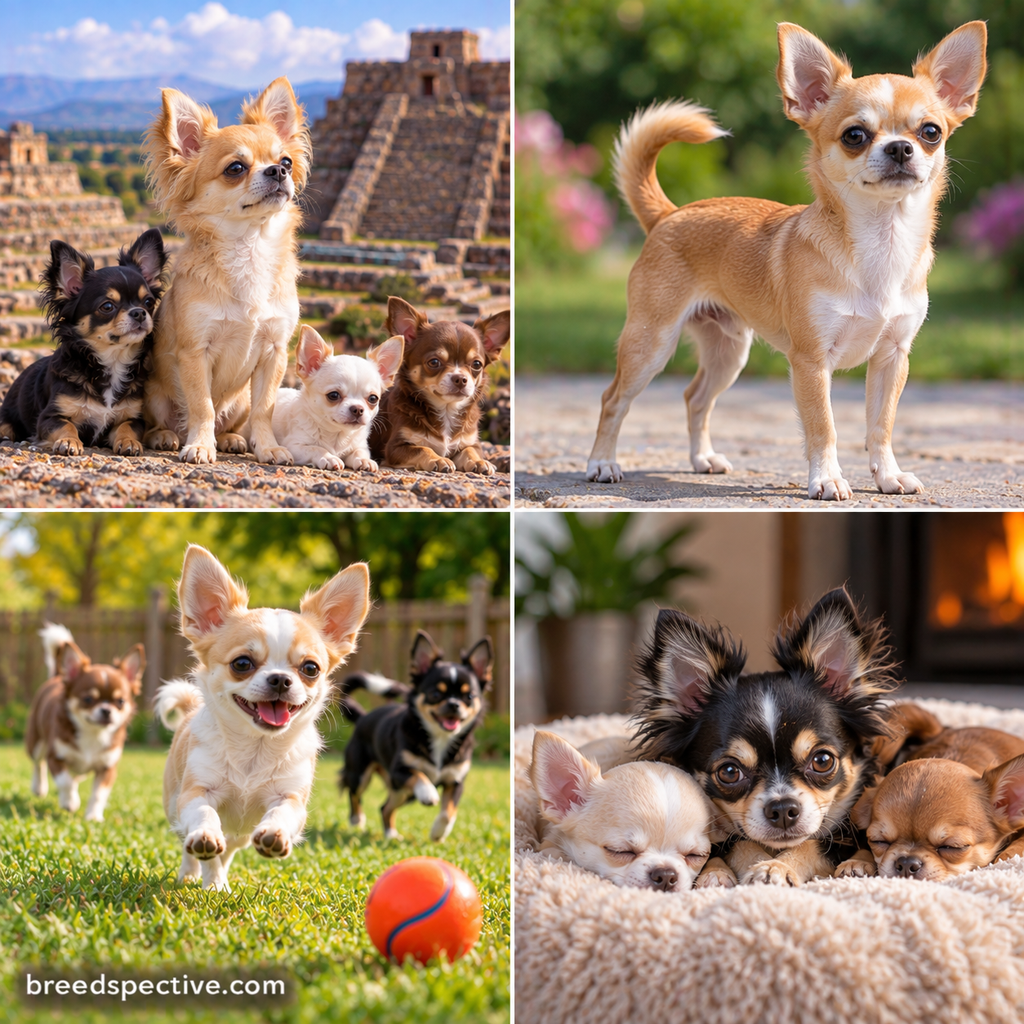
The Chihuahua is named after the Mexican state of Chihuahua, where early examples associated with the modern breed were found. It is one of the oldest dog breeds associated with the Americas and is closely tied to Mexico’s pre-Columbian history.
Its precise ancestry is not completely settled.
The most widely accepted historical connection is to the Techichi, a small companion dog kept by the Toltec civilization. AKC historical material reports that the Toltecs possessed Techichi dogs roughly 1,000 years ago and that the later Aztec civilization also kept these small dogs.
Unlike breeds developed to herd livestock, retrieve birds, or pull sleds, the Chihuahua’s history centers largely on companionship and cultural significance.
That helps explain the modern breed.
Chihuahuas often want to be physically close to their people and pay close attention to what happens around the home. They may be tiny, but generations of companion-dog history did not produce an emotionally detached lap ornament.
The AKC officially recognized the Chihuahua in 1904.
Chihuahua Temperament in Everyday Life
A typical Chihuahua packs considerable personality into a very small body.
Many are affectionate at home, intensely interested in their owners, alert to unfamiliar activity, playful, and willing to make their opinions known.
Strong Attachment to Their People
Chihuahuas frequently become closely bonded to one or several household members.
They may follow someone from room to room, seek a lap whenever one becomes available, sleep close to their people, and carefully monitor activity around the home.
That attachment is part of the breed’s appeal.
It can also become unhealthy if the dog is never expected to function independently.
Teach a puppy to rest in its own bed, occupy itself with a safe chew, remain calmly behind a gate, and tolerate gradually increasing periods without direct human interaction.
Affection and independence are not opposites. A companion dog can enjoy enormous amounts of human contact while still learning that temporary separation is normal.
Alert and Often Vocal
Chihuahuas make surprisingly effective alarm systems.
AKC describes them as a vocal breed and notes their tendency to bark at strangers and unexpected noises.
That does not mean nonstop barking should simply be accepted.
Window watching, hallway sounds, visitors, delivery drivers, doorbells, other dogs, and people approaching the owner can all become barking triggers.
Training should focus on teaching what happens after the alert.
A useful sequence is:
- Allow a brief alert.
- Call the dog away from the trigger.
- Reward disengagement.
- Send the dog to a bed or resting place.
- Reinforce quiet behavior.
Repeatedly picking up a barking Chihuahua while it continues reacting can unintentionally maintain the pattern.
“Small Dog Syndrome” Is a Human Problem
“Small dog syndrome” is not a veterinary diagnosis and should not be treated as an inherent Chihuahua personality trait.
The phrase usually describes a collection of behaviors that people tolerate in small dogs but would immediately address in larger ones.
Examples include:
- Barking and lunging at other dogs
- Guarding an owner’s lap
- Snapping when moved
- Demanding to be carried
- Charging visitors
- Ignoring recall
- Growling over toys or food
- Pulling frantically toward triggers
Imagine the same behavior in a German Shepherd.
Few people would laugh while a 75-pound dog lunged at every passerby from someone’s arms. Yet a Chihuahua doing the same thing is sometimes treated as funny, protective, or simply “being a Chihuahua.”
That double standard does the dog no favors.
Chihuahuas need leash skills, recall, polite greetings, impulse control, handling practice, house rules, and socialization just like larger dogs.
At the same time, owners should not swing to the opposite extreme and force a frightened 5-pound dog into situations it cannot handle. Good training combines boundaries with an awareness that the dog is genuinely tiny and physically vulnerable.
Chihuahua Energy Level and Exercise Needs
Chihuahuas require much less physical exercise than high-drive working breeds, but they are not sedentary ornaments.
For many healthy adults, roughly 30–45 minutes of total daily activity, divided into manageable walks and play sessions, is a reasonable practical starting point rather than a medical prescription.
That might include:
- Two short walks
- Indoor fetch
- Tug
- Trick training
- Food puzzles
- Scent games
- Exploring a secure yard
- Short training sessions
AKC notes that Chihuahuas can participate successfully in activities including obedience and agility despite their size.
They generally need less exercise than breeds developed for sustained physical work. If a quiet small companion is your priority, compare the Chihuahua with other low-energy dog breeds for apartment living.
Are Chihuahuas Easy to Train?
They can be very trainable.
AKC describes the Chihuahua as intelligent and responsive to positive training methods. The mistake is assuming a dog this small does not need formal training.
Keep sessions short and rewarding.
Useful priorities include:
- Name response
- Recall
- Loose-leash walking
- Sit and down
- Leave it
- Drop it
- Settle on a bed
- Cooperative handling
- Quiet after an alert
- Calm behavior around visitors
Tiny treats are sufficient. A training reward does not need to be large just because the dog values it highly.
Avoid intimidating physical corrections. With a dog weighing only a few pounds, forceful handling is unnecessary and can create fear.
House-Training a Chihuahua
House-training can require patience.
Tiny dogs have tiny bladders, and owners sometimes make the problem worse by providing inconsistent outdoor opportunities or allowing indoor accidents because they are small.
Take puppies outside frequently, especially after:
- Waking
- Eating
- Drinking
- Active play
- Training
- Excitement
Reward successful outdoor elimination immediately.
A consistent schedule matters more than punishment after an accident. Our guide to potty-training timelines by dog breed provides a broader framework for setting realistic expectations.
Cold or wet weather can also complicate the routine because some Chihuahuas strongly prefer warmth.
Chihuahuas and Cold Weather
This breed deserves protection from cold conditions.
AKC specifically cautions that Chihuahuas require special care in cold weather. Their tiny body size—and especially a Smooth Coat Chihuahua’s minimal coat protection—makes cold-weather management more important than it is for many larger breeds.
Depending on conditions, a Chihuahua may benefit from:
- A properly fitted sweater or coat
- Shorter winter walks
- Indoor exercise
- A warm sleeping area
- Protection from rain and wind
A Chihuahua is an indoor companion, not a dog suited to living outside.
Are Chihuahuas Good With Children?
This requires a more cautious answer than “Chihuahuas love families.”
The dog’s physical vulnerability matters.
AKC specifically warns that Chihuahuas are too small for roughhousing with children.
A well-behaved child can still accidentally drop a Chihuahua, step on it, fall on it, or squeeze it too hard.
Older children who understand dog body language and gentle handling are generally easier matches.
Supervision should prevent:
- Picking the dog up without permission
- Carrying it around like a toy
- Chasing it
- Disturbing it while sleeping
- Cornering it
- Reaching into its food
- Rough play
A growl should be treated as communication, not insolence. Determine why the dog is uncomfortable while teaching both dog and child safer behavior.
Chihuahuas and Other Pets
Chihuahuas can live successfully with other dogs and cats.
The larger concern is often physical compatibility rather than simple sociability.
A playful 70-pound dog can injure a 5-pound Chihuahua without intending to. Choose canine companions carefully and supervise mismatched play.
Some Chihuahuas also behave as though their own size is irrelevant, confronting dogs vastly larger than themselves.
Do not allow this because it appears brave or amusing.
Owners comparing other small but strong-minded companions may also find our Dachshund temperament and lifestyle guide useful.
Common Chihuahua Behavior Problems and How to Address Them
Many stereotypical Chihuahua behaviors improve when the dog receives appropriate training rather than special exemptions because of its size.
Barking at Everything
Reduce opportunities to rehearse the behavior, particularly at windows and doors.
Teach the dog to disengage from a trigger and settle elsewhere. Reward quiet periods rather than giving attention only when barking starts.
Stranger Reactivity
Do not force strangers to reach toward or pick up the dog.
Allow the Chihuahua to observe at a comfortable distance and pair calm exposure with rewards.
Socialization means building confidence, not requiring physical interaction with everyone.
Guarding a Person
A Chihuahua that growls whenever someone approaches its favorite person should not simply be labeled “protective.”
Avoid rewarding possessive behavior by continuously holding the dog during confrontations. Teach it to move to a bed, respond to cues away from the owner, and receive good things when other people approach.
Snapping During Handling
Because Chihuahuas are frequently picked up, cooperative handling matters enormously.
Practice touching paws, examining ears, checking teeth, fastening a harness, and lifting the dog calmly while pairing these experiences with rewards.
Also respect genuine discomfort. Sudden handling aggression can indicate pain and deserves veterinary attention.
Confronting Bigger Dogs
Create distance and reward calm attention.
Do not let a Chihuahua repeatedly practice barking and lunging from your arms or the end of a leash. Being physically incapable of winning the confrontation does not prevent the dog from starting one.
Smooth Coat vs. Long Coat Chihuahua Grooming
Both coat varieties are relatively manageable.
The AKC standard describes the Smooth Coat as soft, close and glossy. The Long Coat should be soft and can be flat or slightly wavy, with feathering around areas such as the ears, feet, legs and tail.
Routine care includes:
- Brushing
- Nail trimming
- Dental care
- Ear checks
- Bathing as needed
Long Coats generally need more brushing to prevent tangles, while Smooth Coats require less coat maintenance.
Both shed.
What Is a Chihuahua Molera?
Many people first encounter this term after bringing home a puppy.
A molera is a soft spot or opening in the Chihuahua’s skull, comparable to the fontanelle present in human infants.
The Chihuahua Club of America states that Chihuahuas can be born either with or without a molera and that its presence alone does not mean the dog has hydrocephalus. The AKC standard also explicitly permits an apple-dome skull “with or without molera.”
If a puppy has a molera, discuss appropriate handling with your veterinarian.
More broadly, the Chihuahua’s tiny skull and body are reasons to prevent falls, rough handling, and unsupervised interaction with much larger animals.
Chihuahua Health Testing
Responsible breeding requires more than saying that the parents appear healthy.
The Chihuahua Club of America identifies cardiac, patella, and eye testing among its recommended hereditary-health screening practices.
Prospective puppy buyers should ask breeders for the parents’ actual results and verify available records rather than accepting statements such as “vet checked.”
Patellar Luxation
Patellar luxation occurs when the kneecap moves out of its normal position.
Cornell University College of Veterinary Medicine identifies Chihuahuas among the small breeds in which patellar luxation is more common and notes that genetics play an important role. A characteristic sign can be intermittent skipping on a hind leg. Severe cases may require surgery.
This is why a proper patellar evaluation in breeding dogs matters.
Cardiac Screening
Cardiac screening is another component prospective Chihuahua buyers should verify.
The Chihuahua Club of America’s breeding ethics specifically identifies cardiac testing alongside patella and eye testing in accordance with CHIC-related recommendations.
Ask what examination was performed, at what age, and where the result is recorded.
Eye Screening
Eye evaluation is also part of the parent club’s recommended screening framework.
As with other breeds, a normal-looking eye is not a substitute for the appropriate examination.
The OFA/CHIC system exists to make breed-specific screening results publicly accessible. Buyers should look at the underlying results rather than treating the words “CHIC” or “health tested” as a blanket guarantee.
How Much Does a Chihuahua Cost Per Year?
Chihuahuas eat relatively little, but their veterinary needs do not shrink in proportion to their body weight.
A practical annual U.S. planning budget might look like this:
| Expense | Practical annual planning range |
|---|---|
| Food and treats | $200–$500 |
| Routine veterinary care | $300–$900 |
| Parasite prevention | $100–$300 |
| Toys and enrichment | $75–$250 |
| Grooming/basic supplies | $75–$250 |
| Training | $100–$500+ |
| Pet insurance | $300–$1,200+ |
| Typical planning total | About $1,150–$3,900+ |
These figures are budgeting estimates, not fixed national prices.
Emergency care, dental procedures, boarding, professional training, chronic medication, specialist care, and surgery can increase expenses considerably.
The Chihuahua’s small food bill should never be interpreted as protection from significant veterinary costs.
Are Chihuahuas Good Apartment Dogs?
Usually, yes—with one major caveat.
Their tiny size and modest exercise requirements make them physically well suited to smaller homes. Barking can create the bigger problem.
A Chihuahua that reacts to every hallway sound can be more disruptive in an apartment than a quiet dog five times its size.
Teach calm responses to environmental noise from the beginning.
For people comparing compact companion breeds, our French Bulldog temperament and lifestyle guide highlights how two popular apartment-sized dogs can have very different health, exercise, grooming, and temperature-management considerations.
Are Chihuahuas Good for Seniors?
They can be an excellent match for some older adults.
Chihuahuas are portable, require relatively modest physical exercise, and often enjoy close companionship. Their long potential lifespan, barking tendencies, house-training requirements, and veterinary needs still deserve consideration.
Our guide to the best dog breeds for seniors covers additional factors such as manageability, exercise, grooming, and daily care.
Who Is a Chihuahua Best Suited To?
The Chihuahua often suits someone who wants an interactive little companion rather than an independent dog.
Strong matches can include:
- Apartment and condo residents
- Singles and couples
- Older adults
- Households with respectful older children
- People who enjoy close canine companionship
- Owners willing to train a toy breed seriously
- People wanting a dog with modest exercise requirements
Their combination of small size and adaptability can make them exceptionally convenient companions.
Who Should Think Twice About a Chihuahua?
This breed is less suitable if:
- Very young children will handle the dog roughly
- Large, boisterous dogs dominate the household
- Frequent barking is unacceptable
- You want an emotionally independent dog
- You expect to carry the dog instead of training it
- You dislike house-training small dogs
- You cannot protect the dog from extreme cold
- You intend to excuse aggressive or reactive behavior because the dog is tiny
A Chihuahua should be allowed to be a dog.
That means walking, sniffing, learning, playing, making choices, developing confidence, and following reasonable household rules—not spending life permanently tucked under someone’s arm.
Before choosing one based primarily on its convenient size, compare the full package with our guide to choosing the right dog breed for your lifestyle.
Verdict: Is a Chihuahua Right for You?
A Chihuahua is right for an owner who wants a tiny, affectionate, alert companion and is prepared to take its training as seriously as its companionship. The breed can work particularly well in apartments and smaller homes, with older adults, and with people who enjoy having a dog closely involved in daily life.
A Chihuahua is not right for a household where its physical vulnerability will be ignored, where frequent barking cannot be tolerated, or where poor behavior will be excused because “it’s only a little dog.”
The best Chihuahua ownership avoids both extremes. These dogs should not be treated as helpless accessories, but neither should their tiny size be forgotten. Give a Chihuahua appropriate boundaries, positive training, safe socialization, daily activity, protection from rough handling, and the dignity of being treated like a real dog, and its famous big personality becomes much easier to appreciate.